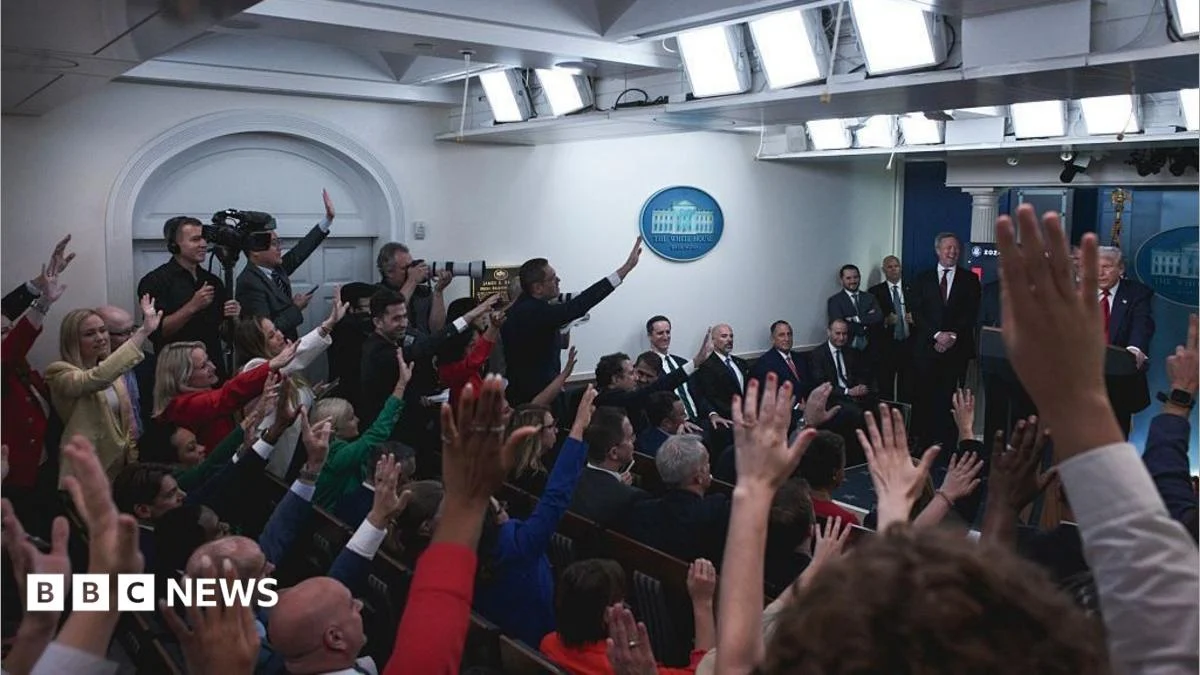
A significant challenge to press freedom unfolded as the White House revoked the press credentials of reporters from MS NOW, CNN, and Politico, denying them access to official events and prompting immediate and forceful condemnation from the affected outlets and journalism advocacy groups. The move, described by critics as an unprecedented assault on the First Amendment, saw veteran journalists barred from entry, with Secret Service agents citing "disabled" or "deactivated" badges, often without clear explanation. This action reignited long-standing tensions between the administration and segments of the media, raising profound questions about government transparency and the essential role of an independent press in a democratic society.
Details of the Incident: Denied Entry and Disabled Badges
The incident began to unfold on a Saturday morning when reporters attempted to access the White House grounds. Akayla Gardner, a reporter for MS NOW, recounted her experience: "The officer asked me to hand over my badge. He said that it was disabled." Gardner pressed for an explanation, asking why she was unable to gain entry, only to be told by the officer that the decision was "above him." This lack of transparency surrounding the revocation process immediately raised red flags for the journalistic community. Gardner further noted a perplexing inconsistency: while her badge and that of a colleague were disabled, an MS NOW producer accompanying them was still able to scan her badge and gain access, for which no explanation was provided. This selective denial of access, without a consistent rationale, underscored the arbitrary nature of the decision in the eyes of the affected journalists.
Concurrently, CNN reporter Betsy Klein faced a similar predicament. She reported that a Secret Service agent informed her directly that her badge had been deactivated, effectively barring her from performing her duties. Later that same morning, Politico confirmed that its reporter, Cheyenne Haslett, was also denied entry, with the Secret Service explicitly revoking her press pass. These coordinated actions against three prominent news organizations, occurring within a short timeframe, suggested a deliberate policy rather than isolated technical glitches. The immediate consequence was that these reporters, critical components of their respective newsgathering operations, were physically prevented from covering the Executive Branch, a cornerstone of their constitutional mandate.
The Administration’s Stance: "Cumulative Stories" and "Fake News" Accusations
In the wake of the widespread reports of denied access, the administration’s rationale began to emerge, albeit vaguely. In his initial announcement, the President did not specify any particular stories or pieces of reporting from MS NOW, CNN, or Politico that had triggered the drastic measure. This absence of specific grievances made it difficult for the outlets to understand or address the underlying issues, further fueling accusations of arbitrary decision-making.
However, the President later elaborated, stating that the decision was based on "cumulative stories over the last few years." This broad justification implied a pattern of dissatisfaction with the overall coverage from these outlets rather than a reaction to a single, egregious report. He further added a veiled threat, indicating that there "may be others to join them," implying a potential expansion of the ban to additional news organizations. When pressed by a reporter to clarify which "others" might be included in future bans, the President explicitly named two more major news organizations, stating, "Others to come in terms of fake news? Well, you know, the New York Times is fake news, the Washington Post is fake news."
This rhetoric, categorizing critical reporting as "fake news," has been a consistent theme throughout the administration’s tenure. It serves not only to discredit specific reports but also to undermine the credibility of entire news organizations, creating an environment where objective journalism is frequently challenged. The use of "fake news" as a justification for denying access to the White House represents a significant escalation, shifting from rhetorical attacks to direct operational interference with the press’s ability to cover the government.
Outlets Respond: A Unanimous Defense of First Amendment Rights
The response from MS NOW, CNN, and Politico was swift, unified, and unequivocal, framing the administration’s actions as a direct assault on constitutional rights. All three outlets issued strong statements, accusing the President of violating their First Amendment rights to free speech and freedom of the press.
An MS NOW spokesperson released a statement emphasizing the public ownership of the White House: "The White House belongs to the American people and the decisions made inside are funded by our tax dollars." This statement underscored the principle that government facilities, particularly those central to national governance, should be accessible to the public through its representatives, the press. MS NOW further declared its firm resolve, stating it "intends to take any and all steps necessary to defend our First Amendment rights and the essential role of independent journalism in our democracy." This signaled a willingness to pursue legal avenues or other forms of advocacy to challenge the ban.
Politico Editor-in-Chief Jonathan Greenberger echoed these sentiments in an internal email, later shared in the outlet’s Playbook newsletter. Greenberger affirmed the company’s full support for its reporters and pledged to "vigorously defend" their First Amendment rights. This internal message, made public, reinforced the gravity with which the news organization viewed the situation and its commitment to standing by its journalists.
CNN, a frequent target of the administration’s criticism, issued a particularly strong condemnation: "We have a right under the US Constitution to do our reporting without hindrance or interference from the government and this ban is an illegal assault on this fundamental right." CNN’s statement directly labeled the ban as "illegal," setting the stage for potential legal challenges and asserting the unconstitutionality of government interference in journalistic operations. The collective outcry from these major media organizations highlighted a perceived systemic threat to the mechanisms of democratic accountability.
The White House Correspondents’ Association (WHCA) Condemns the Action
Beyond the directly affected outlets, the White House Correspondents’ Association (WHCA) — the independent, non-profit group representing journalists who cover the US presidency — played a crucial role in amplifying the industry’s concerns. The WHCA swiftly called on the administration "to immediately restore" access to the journalists, echoing the accusation that the move violated the First Amendment.
Jacqui Heinrich, then President of the WHCA and a reporter for Fox News, a network often viewed as more favorable to the administration, delivered a powerful statement that transcended partisan lines. Heinrich underscored the broader implications of the ban, warning, "The implications extend beyond these organizations: a standard used to exclude one news outlet because of its coverage could be applied to any outlet in the future." This "slippery slope" argument highlighted the danger of setting a precedent that could be weaponized against any media organization deemed critical by those in power.
Heinrich further articulated the fundamental principle of press freedom, stating that Americans, through a free and independent press, must be able to scrutinize those elected in their coverage "regardless of whether government officials view it favorably." This assertion is central to the concept of checks and balances in a democracy, where the press acts as a watchdog, holding power accountable. She concluded by referencing established legal precedent: "That’s why courts have repeatedly held that once the White House provides access to journalists, it cannot deny that access arbitrarily or based on the content of their reporting." This legal interpretation, backed by judicial rulings, formed the bedrock of the WHCA’s argument against the administration’s actions.
Legal and Constitutional Framework: The First Amendment’s Protections
The First Amendment to the U.S. Constitution guarantees freedom of speech and of the press, foundational principles for a functioning democracy. While this right does not grant journalists unlimited access to all government spaces at all times, established legal precedent, particularly concerning the White House, dictates that once access is granted to some journalists, it cannot be arbitrarily or discriminatorily denied to others based on the content of their reporting or perceived bias. This principle is designed to prevent administrations from creating a "press pool" composed solely of favorable outlets, thereby controlling the narrative and limiting public information.
Several groups dedicated to the freedom of the press swiftly condemned the White House ban as illegal and unconstitutional. A major voice in this area, the Reporters Committee for Freedom of the Press (RCFP), which provides legal services to the media, expressed strong confidence that such a ban would be struck down by the courts. Bruce Brown, president of the RCFP, stated unequivocally that the ban was "flatly unconstitutional." He reiterated the core legal argument: "The First Amendment is clear that once the White House invites in some journalists, it can’t ban others because it doesn’t like their reporting." This position reflects decades of legal interpretation and case law designed to protect the press from government retaliation or censorship.
Historical context reveals that while tensions between the presidency and the press are not new, outright bans on specific, established news organizations from the White House briefing room or events are exceptionally rare and have almost always been met with fierce legal and public resistance. The Supreme Court has consistently upheld the vital role of the press in informing the public and has been wary of government actions that could be seen as an attempt to control or manipulate news dissemination.
A Pattern of Hostility: Broader Implications for Media Relations
This incident was not an isolated event but rather the latest in a series of moves by the administration to target media outlets perceived as critical. Throughout its term, the administration frequently employed the term "fake news" to describe reports it disagreed with, often labeling entire organizations as "enemies of the people." This rhetoric created an environment of heightened antagonism, challenging the legitimacy of mainstream journalism.
Beyond rhetorical attacks, the administration had previously initiated legal actions against various U.S. and international outlets, including The New York Times, The Wall Street Journal, and the BBC. Some of these lawsuits, though often challenged vigorously by the media organizations, had resulted in multimillion-dollar settlements, creating a chilling effect and placing financial burdens on newsrooms. The lawsuit against the BBC, for instance, remained ongoing at the time of the White House credential revocation. These legal maneuvers, coupled with the denial of access, signaled a multi-pronged strategy to pressure and delegitimize critical reporting.
The broader implication of such actions is a potential erosion of public trust in independent journalism and a dangerous precedent for future administrations. If a government can arbitrarily deny access based on content, it threatens the ability of the press to act as a crucial check on power, leaving the public less informed and more susceptible to unchecked government narratives. It also raises concerns about whether such tactics could be replicated at state or local levels, further fragmenting the media landscape and hindering accountability across all levels of government.
Conclusion: Defending the Essential Role of a Free Press
The revocation of press credentials for MS NOW, CNN, and Politico marked a critical juncture in the relationship between the White House and the news media. It underscored the fragile yet fundamental nature of press freedom in a democratic society. The unified condemnation from news organizations and press freedom advocates highlighted the gravity of the situation, framing it as a direct challenge to the First Amendment. As the White House Correspondents’ Association and legal experts reiterated, the right of the press to report without arbitrary hindrance or content-based discrimination is not merely a privilege for journalists but a constitutional imperative for the American people. The ability of an independent press to scrutinize government actions, regardless of official favor, remains indispensable for informed public discourse and the health of democratic institutions. The ongoing battle over access and the definition of "fake news" continues to shape the future of journalism and its role in holding power accountable.