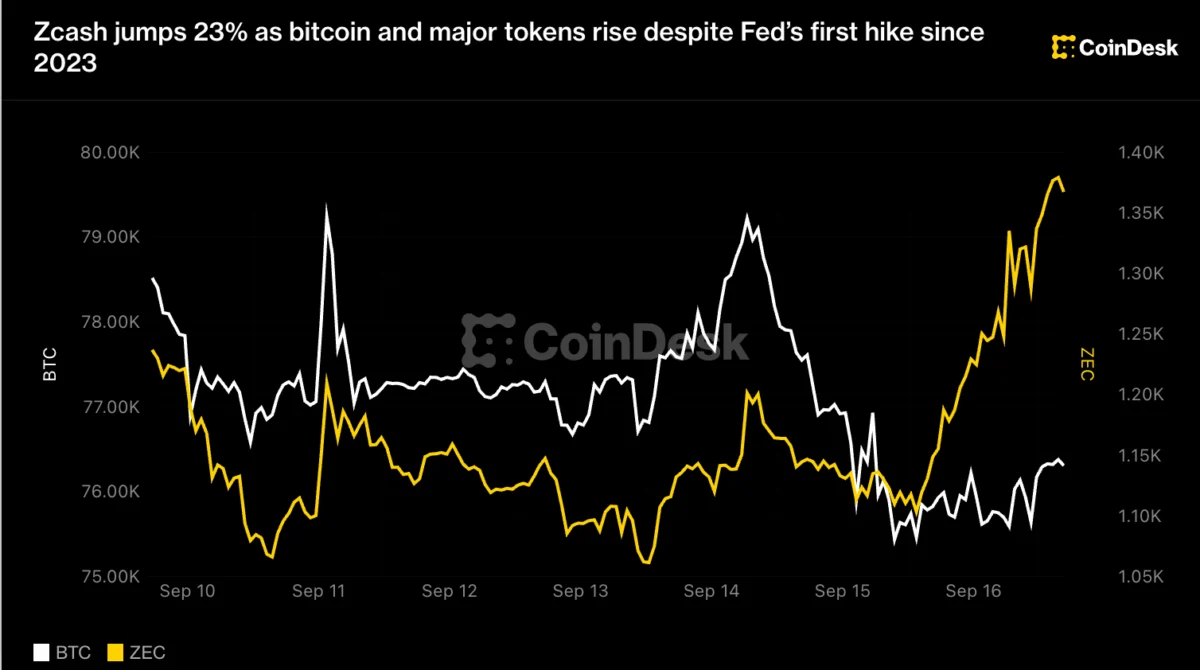
The global cryptocurrency market experienced a significant wave of volatility and subsequent recovery over the last 24 hours, characterized by Bitcoin maintaining its position above the $76,000 threshold and a remarkable 23% surge in the value of the privacy-centric token Zcash (ZEC). This market movement occurred against the backdrop of the United States Federal Reserve’s latest monetary policy decision, where officials implemented the first interest-rate hike since 2023. Despite the increase in borrowing costs, investor sentiment remained buoyed by the central bank’s projections, which suggested that the current tightening cycle might be nearing its conclusion.
In the Asian trading session on Thursday, Bitcoin (BTC) was seen trading at approximately $76,258, reflecting a modest gain of less than 1% following a period of intense price discovery. While the flagship cryptocurrency’s movement was relatively stable, the broader altcoin market showed more pronounced activity. Solana (SOL) climbed nearly 3% to reach just under $100, while Binance Coin (BNB) and HYPE, the native token of the Hyperliquid trading platform, both posted gains exceeding 2%. Other major assets, including Ether (ETH), XRP, and Dogecoin (DOGE), saw appreciation ranging between 1% and 2%.
The standout performer of the day, however, was Zcash. The privacy token’s value jumped to roughly $1,369, a move catalyzed by high-profile endorsements and positive sentiment regarding upcoming technical improvements to its network. The rally highlighted a renewed interest in privacy-preserving technologies within the blockchain ecosystem, particularly as regulatory scrutiny on transparent ledgers continues to intensify globally.
The Federal Reserve’s Monetary Policy Pivot
The Federal Open Market Committee (FOMC) concluded its latest meeting by raising the benchmark federal funds rate by 25 basis points, bringing the target range to 3.75% to 4%. This move marked a return to tightening after a prolonged pause that began in late 2023. Historically, rising interest rates present a headwind for "risk-on" assets like cryptocurrencies and tech stocks, as they increase the "risk-free" yield available on government bonds and cash equivalents, making non-yielding assets like Bitcoin less attractive by comparison.
However, the market’s reaction to this specific hike was notably optimistic. The primary driver of this positivity was the Fed’s "dot plot"—a chart of individual officials’ projections for future rates. The median projection indicated that the policy rate would likely settle at 4.1% by the end of 2026 and remain there through 2027. This suggests that the Fed anticipates only one more quarter-point increase for the remainder of the year before entering a period of stabilization.
Federal Reserve officials signaled that while inflation remains a concern, the labor market’s current state allows for a more measured approach to tightening. By projecting a "terminal rate" that is not significantly higher than current levels, the Fed effectively reduced the "uncertainty premium" that had been weighing on markets. Investors interpreted the move not as the start of an aggressive new hiking cycle, but as a "fine-tuning" of the economy to ensure a soft landing.
Analyst Perspectives on Macroeconomic Impact
Financial analysts noted that the market had largely anticipated the 25-basis-point hike, allowing the news to be "priced in" well before the official announcement. Jeff Ko, the chief analyst at ViaBTC, provided an assessment of the situation, stating that the Fed is currently signaling a desire to avoid an overly aggressive tightening path. According to Ko, the markets appear reassured by the central bank’s efforts to contain inflation without stifling economic growth.
This sentiment was mirrored in traditional financial markets. S&P 500 futures rose by 0.6%, and Nasdaq 100 futures—which often trade in high correlation with the crypto market—gained 0.7%. In the fixed-income market, the two-year Treasury yield, which is highly sensitive to shifts in Fed policy, eased by two basis points to 4.71%. This slight decline in yields provided additional breathing room for Bitcoin and other digital assets to maintain their upward trajectory.
The Zcash Surge and Paradigm’s Strategic Endorsement
The 23% rally in Zcash was directly linked to public comments made by Matt Huang, the co-founder of Paradigm, one of the most influential venture capital firms in the cryptocurrency industry. In a post on the social media platform X, Huang described Zcash as a "private complement to Bitcoin," sparking a wave of buying pressure. Huang also disclosed that Paradigm holds a position in ZEC, further validating the token’s value proposition to institutional investors.
Zcash, which launched in 2016, is built on the same fundamental principles as Bitcoin, including a capped supply of 21 million coins and a four-year halving cycle. However, it distinguishes itself through the use of Zero-Knowledge Succinct Non-Interactive Arguments of Knowledge (zk-SNARKs). This cryptographic technology allows users to transact without revealing the sender, receiver, or the amount involved, offering a level of financial privacy that is not natively available on the Bitcoin blockchain.
Huang’s endorsement emphasized the idea that as Bitcoin becomes more integrated into the traditional financial system (TradFi), the demand for a secondary, privacy-focused layer will grow. He argued that Zcash provides the necessary "shielded" environment for users who require confidentiality for legitimate business or personal reasons. Furthermore, Huang expressed support for the continued funding of Zcash developers, suggesting that a robust ecosystem of innovators is essential for the protocol’s long-term survival.
Technical Milestones and Governance Shifts in Zcash
Beyond the influence of Paradigm, Zcash’s price action was supported by recent governance decisions within its community. Holders of the token recently voted overwhelmingly in favor of several proposals designed to modernize the network. One of the primary focuses of these upgrades is increasing transaction speed. While Zcash’s privacy features are robust, the computational overhead required for shielded transactions has historically made the network slower than some of its competitors.
The community also reaffirmed its commitment to "Bitcoin-style" halvings. Every four years, the reward given to Zcash miners is cut in half, a mechanism designed to combat inflation and ensure the token’s scarcity over time. By maintaining this schedule, Zcash aligns itself with the "hard money" narrative that has been a cornerstone of Bitcoin’s success.
A significant point of discussion within the Zcash ecosystem involves the transition toward a more decentralized governance model. Huang and other stakeholders have argued that while coin-holder votes are important, they should be integrated with other decision-making frameworks to ensure that the network remains resilient against central points of failure. This shift toward a more sophisticated governance structure is seen as a necessary step for Zcash to attract further institutional capital.
The Broader Crypto Market Context
While Zcash and Bitcoin dominated the headlines, the performance of other assets provided a clearer picture of the current market cycle. Solana’s climb toward the $100 mark is particularly noteworthy, as the network continues to recover its reputation as a high-throughput alternative to Ethereum. The rise of HYPE, the token for Hyperliquid, also points to a growing interest in decentralized perpetual exchanges, where traders can access high leverage without relying on centralized intermediaries.
The general upward trend suggests that liquidity is beginning to rotate from Bitcoin into high-conviction altcoins. This "altseason" behavior typically occurs when Bitcoin enters a period of consolidation after a major run. With Bitcoin holding steady above $76,000, traders appear more willing to take on risk in smaller-cap assets that offer higher potential returns.
Chronology of Market Events
To understand the current market state, it is helpful to look at the timeline of the past 48 hours:
- Pre-FOMC Anticipation: Bitcoin trades between $74,000 and $75,000 as investors brace for the Federal Reserve’s interest rate decision. Volatility remains low as the market waits for a clear signal.
- The Fed Announcement: At 2:00 PM ET, the Federal Reserve announces a 0.25% rate hike. Initial market reaction is a brief dip as "sell the news" algorithms trigger.
- The Press Conference and Dot Plot: Fed Chair Jerome Powell’s subsequent comments and the release of the median projections suggest a "one and done" approach for the near future. Markets begin to rally as the fear of an aggressive tightening cycle dissipates.
- Matt Huang’s X Post: Shortly after the Fed news, Paradigm’s Matt Huang posts his thesis on Zcash. ZEC begins its vertical ascent, decoupling from the rest of the market.
- Asian Market Opening: As Asian traders enter the market, the momentum continues. Bitcoin stabilizes above $76,000, and Zcash hits its 24-hour high of $1,369.
- Yield Stabilization: Treasury yields ease, providing a supportive macro environment for the close of the trading day.
Implications for Privacy and Regulation
The resurgence of Zcash brings the ongoing debate over crypto privacy back to the forefront. Regulatory bodies in the United States and Europe have expressed concerns that privacy tokens could be used to facilitate money laundering or evade sanctions. This has led some centralized exchanges to delist privacy coins to remain compliant with evolving "Know Your Customer" (KYC) and "Anti-Money Laundering" (AML) standards.
However, the endorsement from a firm like Paradigm suggests that institutional players view privacy as a feature, not a bug. From a corporate perspective, the ability to conduct transactions without exposing sensitive financial data to competitors is a fundamental requirement for the adoption of blockchain technology in global commerce. The market’s reaction to Huang’s comments may indicate that investors are betting on a future where privacy-preserving technologies are integrated into regulated frameworks rather than being pushed to the fringes.
Future Outlook
Looking ahead, the trajectory of the cryptocurrency market will likely be determined by the interplay between inflation data and the Fed’s actual policy moves in the coming months. If inflation continues to cool, the Fed may stick to its projection of limited tightening, which would create a favorable environment for Bitcoin to test new all-time highs.
For Zcash, the focus will remain on execution. The successful implementation of faster transaction protocols and the continued evolution of its governance model will be critical in maintaining the momentum generated by this week’s rally. As the distinction between "transparent" and "private" assets becomes more defined, Zcash’s role as a complement to Bitcoin’s transparency could solidify its position as a top-tier digital asset.
In summary, the market’s ability to absorb a Federal Reserve rate hike while pushing Bitcoin to new heights and revitalizing interest in privacy tech reflects a maturing ecosystem. Investors are increasingly looking past short-term macro fluctuations to focus on the underlying technological value and long-term scarcity of digital assets.