



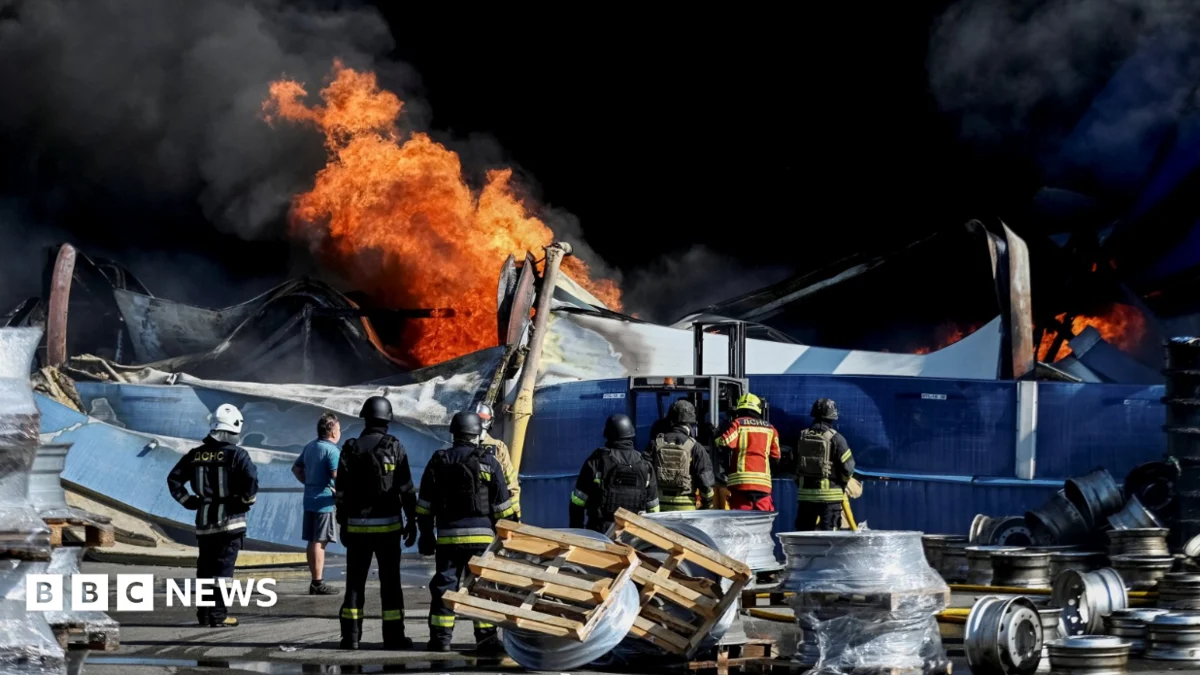
A devastating Russian drone strike late on Friday triggered massive explosions at a warehouse in the Kyiv region, resulting in the deaths of thirty-seven people and the evacuation of nearly 400 individuals from the immediate vicinity. The assault, which President Volodymyr Zelensky confirmed also damaged residential buildings and a care home in the surrounding area, has led Ukrainian prosecutors to initiate a sweeping investigation into the "legality of the placement and storage of explosive objects" at the targeted facility. The incident underscores a significant escalation in the ongoing conflict, characterized by intensified cross-border attacks and a growing toll on civilian populations on both sides.
The Myla Catastrophe: A Detailed Aftermath
The tragic event unfolded in the village of Myla, situated within the Bucha district, a region that bore witness to some of the war’s earliest and most horrific atrocities. Emergency services descended upon the scene on Saturday, commencing a perilous rescue operation amidst the smoldering ruins. Regional head Tymur Tkachenko reported that four children were among the 42 people injured, highlighting the indiscriminate nature of the blast’s impact. More than 300 emergency service personnel, supported by specialized equipment, were deployed to manage the extensive damage and search for survivors or victims trapped under debris. The scale of destruction was profound, encompassing not only the warehouse complex but also a "care home for elderly people and people with disabilities," which suffered significant damage, compounding the humanitarian crisis. The proximity of such a vulnerable institution to a site containing explosive materials has become a central point of the ongoing official inquiry. Witnesses described a terrifying sequence of events, beginning with the distinctive buzz of incoming drones, followed by initial impacts, and then a series of thunderous secondary explosions that reverberated for miles, shattering windows and causing structural collapses in nearby residential areas. The sheer force of the blasts created a crater of considerable size, indicative of a large quantity of ordnance detonating. Medical teams, working tirelessly, established field triage points, attending to the injured who presented with a range of trauma, from blast wounds and burns to injuries sustained from flying debris and collapsing structures. The psychological toll on the survivors, particularly the elderly residents of the care home and the children caught in the crossfire, is immeasurable, adding another layer to the long-term consequences of the conflict.
Official Scrutiny and Calls for Accountability
In the immediate aftermath, President Volodymyr Zelensky took to X (formerly Twitter) to express his profound concern and to signal a robust domestic response. "Ammunition must not be stored near houses or other residential buildings. Appropriate conclusions will certainly be drawn," Zelensky wrote, unequivocally pointing towards potential failings in wartime safety protocols. This statement was not merely a condemnation of the strike itself but a clear directive for internal accountability. The office of Ukraine’s prosecutor general swiftly opened criminal proceedings, specifically on charges of "official negligence." The investigation’s mandate is dual: first, to review the "legality of the placement and storage of explosive objects and materials" in such close proximity to residential areas; and second, to scrutinize the "actions of officials who made the relevant decisions" regarding the establishment or maintenance of the warehouse’s contents. This internal probe is critical for maintaining public trust and demonstrating that even amidst active warfare, the Ukrainian state is committed to upholding standards of care and preventing preventable tragedies. Should negligence be proven, the officials responsible could face severe legal repercussions, ranging from dismissal to criminal charges, reflecting the gravity of risking civilian lives.
Conversely, Russia’s Ministry of Defence offered its own narrative, asserting in a statement that its forces had precisely targeted "an ammunition depot" in Myla. Moscow claimed the facility stored "components and launch boosters for FP-1/FP-2 long-range unmanned aerial vehicles," implying a legitimate military target. The FP-1/FP-2 designation, while not widely recognized in open-source intelligence, likely refers to specific models of long-range drones, potentially analogous to the Iranian-supplied Shahed-136 "Geran-2" drones that Russia has extensively used to strike Ukrainian infrastructure and cities. These drones are known for their ability to carry significant explosive payloads over long distances, making any facility involved in their production, assembly, or storage a high-value target in Russia’s strategic calculations. However, Russia’s justification does not mitigate the profound civilian casualties and infrastructural damage, particularly the destruction of non-military facilities like the care home. The international community often scrutinizes such claims, especially when significant civilian harm is reported, emphasizing the principles of proportionality and distinction under international humanitarian law. The Ukrainian investigation will undoubtedly consider Russia’s claim against the evidence gathered at the site, especially concerning the nature of the materials stored and the justification for their location.
A Broader Canvas of Conflict: Strikes Across Ukraine
The Myla incident, while catastrophic, was but one tragic component of a broader pattern of intensified Russian aggression across Ukraine. Concurrently, other regions reported significant casualties and damage from ongoing aerial assaults. In a separate attack, a 14-year-old was killed in the Boryspil district, further adding to the grim tally of child victims. Kyiv Mayor Vitaliy Klitschko confirmed the death of a two-year-old in the Obolonskyi district of the capital, after a Russian drone crashed following an interception attempt. These individual tragedies underscore the constant threat civilian populations face, even in areas considered relatively secure. Klitschko also reported that five people, including an 18-year-old girl, were injured in fresh strikes on Kyiv itself on Saturday morning, a testament to the persistent bombardment tactics employed by Moscow. Local officials across the country confirmed that five people had been killed over the past day, a figure that tragically illustrates the daily human cost of the conflict.
President Zelensky further detailed overnight strikes in the southern port city of Odesa, the industrial heartland of Dnipropetrovsk, the northeastern region of Sumy, and the southeastern oblast of Zaporizhzhia. These reports indicate a widespread and coordinated wave of attacks targeting various strategic and civilian infrastructures across Ukraine. The Ukrainian army’s response was robust, with military officials reporting the interception and shooting down of an astonishing 233 Russian drones over the past day. This figure, while demonstrating the formidable capabilities of Ukraine’s air defense systems, also highlights the sheer volume and persistence of Russian aerial attacks. The deployment of such a large number of drones in a single 24-hour period indicates a strategy of overwhelming Ukrainian air defenses and striking multiple targets simultaneously, stretching resources and increasing the likelihood of successful penetrations. The constant threat of drone attacks, ranging from the slow-moving Shahed-type drones to more advanced reconnaissance and attack UAVs, has become a defining feature of the conflict, forcing Ukrainian cities into a perpetual state of alert and significantly impacting daily life.
Escalation Beyond Borders: Attacks on Russian Territory and Economic Targets
The intensification of hostilities is not unidirectional. Ukraine has also significantly ramped up its long-range drone strikes into Russian territory and against targets in Russian-occupied Ukrainian regions. In the past 24 hours preceding the Myla incident, Russian local officials reported two people killed and 25 injured in strikes across the Belgorod and Rostov regions, both bordering Ukraine. These regions have increasingly become frontline territories, subjected to regular shelling and drone attacks, reflecting Kyiv’s strategy to disrupt Russian logistical chains, military staging areas, and to exert pressure on the Russian populace.
A notable shift in Ukraine’s targeting strategy has been its focus on Russian economic infrastructure, particularly online retail and logistics centers. The Moscow-appointed governor of the occupied Ukrainian region of Zaporizhzhia stated that four people were injured after a Ukrainian strike hit a shopping center, indicating a broader targeting scope that includes commercial facilities, often justified by Kyiv as indirectly supporting the Russian war effort.
Crucially, Russian online retailer Ozon, one of Russia’s largest e-commerce platforms, reported that one of its logistics centers had been hit in an overnight Ukrainian drone strike. The company further announced the suspension of operations at a second logistics center and the evacuation of staff "due to the danger in the area." This marks a significant development in Ukraine’s campaign against Russian economic targets. For weeks, Ukraine has openly targeted facilities belonging to Wildberries, Russia’s largest online retailer, describing the firm as a legitimate target due to its alleged supply of components and logistical support to the Russian military – a claim Moscow vehemently denies. The targeting of Ozon suggests an expansion of this strategy, aiming to disrupt Russia’s domestic economy, sow discontent, and impact the logistical capabilities that could indirectly aid the war effort. This is not an isolated incident; Ozon’s facilities in Krasnodar, Dagestan, Stavropol, and Adygea were reportedly targeted in strikes earlier in the week, resulting in several injuries and widespread damage. The economic implications for Russia are substantial, as these attacks disrupt supply chains, cause financial losses, and force businesses to invest heavily in security measures or relocate. The psychological impact on the Russian populace, witnessing such strikes increasingly deep within their territory, is also a key objective of Kyiv’s strategy.
The Evolving Landscape of Drone Warfare
The recent wave of attacks underscores the profound evolution of modern warfare, with unmanned aerial vehicles (UAVs) now playing a central and often decisive role. Both Russia and Ukraine have heavily invested in and relied upon drone technology, transforming the battlefield and extending the reach of conflict far beyond traditional front lines. Russia primarily utilizes its own Lancet loitering munitions, Orlan-10 reconnaissance drones, and a vast arsenal of Iranian-supplied Shahed-136 (Geran-2) attack drones, often deployed in large "swarm" attacks to overwhelm defenses. Ukraine, in turn, has developed an impressive indigenous drone industry, producing various types of attack and reconnaissance UAVs, including long-range models capable of reaching deep into Russian territory. The sheer number of drones intercepted by Ukrainian air defenses – 233 in a single day – is indicative of the scale of this aerial confrontation. This reliance on drones enables precision strikes, surveillance, and attritional warfare at a relatively lower cost in human resources compared to manned aircraft. However, it also significantly blurs the lines between combatants and civilians, as these weapons can be difficult to track and intercept, leading to unintended consequences and collateral damage. The Myla warehouse incident tragically exemplifies this, where a presumed military target resulted in catastrophic civilian casualties due to its proximity to populated areas.
Humanitarian Crisis and Legal Echoes
Beyond the immediate death tolls and destruction, the ongoing intensification of attacks exacerbates an already dire humanitarian crisis. Millions of Ukrainians remain displaced, either internally or as refugees abroad, and the constant threat of aerial bombardment adds immense psychological strain to daily life. Essential services, including power, water, and heating, are frequently targeted or disrupted, particularly during the harsh winter months, further endangering vulnerable populations. The legal implications of these attacks are also significant. International humanitarian law (the laws of war) mandates that parties to a conflict must distinguish between civilian and military objects and ensure that attacks are proportionate, minimizing civilian harm. While Russia claims its Myla strike targeted an ammunition depot, the high civilian death toll and damage to a care home raise serious questions about adherence to these principles. Similarly, Ukraine’s targeting of commercial entities in Russia, while framed as legitimate economic warfare, could also be subject to scrutiny regarding proportionality and the direct contribution of such facilities to the military effort. These incidents feed into ongoing investigations by international bodies and national prosecutors regarding potential war crimes committed by both sides since the full-scale invasion began in February 2022.
Outlook and Implications for the Conflict
The latest surge in cross-border drone and missile strikes suggests a deepening and intensifying phase of the conflict. With neither side showing signs of yielding, the strategy appears to be one of attrition, aiming to degrade the adversary’s military capabilities, economic resilience, and public morale. For Ukraine, targeting Russian economic infrastructure serves multiple purposes: to disrupt the war economy, to demonstrate Kyiv’s capacity to strike deep within Russia, and to exert domestic pressure on the Kremlin. For Russia, sustained aerial bombardments aim to exhaust Ukrainian air defenses, destroy military logistics, and undermine civilian resolve. The tragic outcome in Myla, leading to an internal Ukrainian investigation, highlights the complex and often devastating challenges faced by nations at war, where military necessity must be balanced against the imperative to protect civilian lives. As winter approaches, the frequency and intensity of these strikes are likely to increase, further compounding the suffering and uncertainty for millions caught in the crossfire, making the prospect of a swift de-escalation increasingly remote. The human cost continues to mount, with each drone strike and explosion adding to the long and painful ledger of this brutal conflict.