



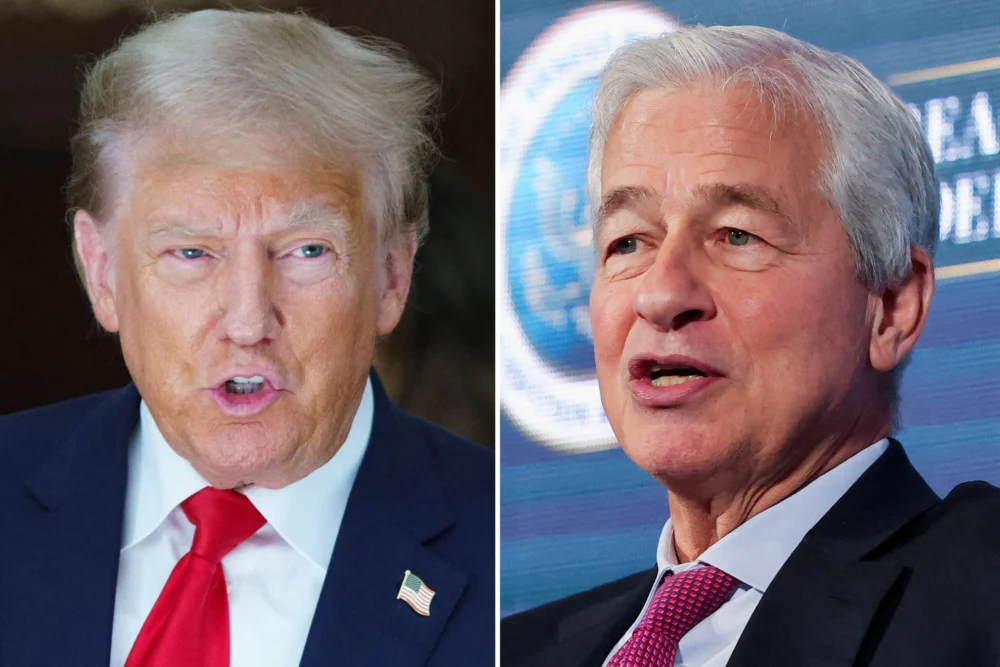
JPMorgan Chase CEO Jamie Dimon has weighed in on former President Donald Trump’s substantial $5 billion lawsuit against the financial giant, expressing sympathy for Trump’s frustration over the closure of his accounts while firmly dismissing the legal merits of the case. The high-stakes legal battle, which accuses JPMorgan and other institutions of politically motivated "debanking," thrusts one of finance’s most prominent figures into an uncomfortable spotlight, balancing corporate defense with the delicate politics of a polarizing public figure.
Speaking on the sidelines of a JPMorgan conference in Miami, Dimon told CNBC’s Leslie Picker that while the lawsuit itself "has no merit," he could understand the sentiment behind it. "I agree with them," Dimon stated, referring to Trump and his supporters. "They have the right to be angry. I’d be angry, too. Like, why is a bank allowed to do that?" This nuanced position highlights the complex pressures faced by financial institutions, caught between stringent regulatory obligations and accusations of political bias.
The Heart of the Dispute: Debanking and Regulatory Pressures
The core of Trump’s accusation, echoed by many conservative voices, is that banks are closing accounts for political reasons, effectively discriminating against individuals and entities deemed undesirable. Dimon, however, offered a starkly different explanation rooted in the realities of modern banking regulation. He asserted that banks are often "forced" to debank individuals or entities due to the immense legal and regulatory risks associated with maintaining certain client relationships.
"We debank people because it causes legal, regulatory risk for us," Dimon elaborated. "It’s been much easier for a bank to say, ‘I’m not taking the risk, let them go bank elsewhere.’" This explanation points to an intricate web of anti-money laundering (AML), know-your-customer (KYC), and counter-terrorism financing (CTF) regulations, along with the overarching concept of "reputational risk." While no single law explicitly mandates the closure of accounts solely based on reputational risk, the collective framework of regulatory guidance, enforcement actions, and the threat of severe penalties for non-compliance creates an environment where banks err on the side of caution.
Regulators, including the Financial Crimes Enforcement Network (FinCEN), the Office of the Comptroller of the Currency (OCC), and the Federal Reserve, impose strict requirements on financial institutions to identify and monitor suspicious activities. Failure to comply can result in massive fines, executive accountability, and even the revocation of banking licenses. This regulatory hammer often forces banks to adopt a highly risk-averse posture, leading to the phenomenon of "debanking" where customers, even those not directly accused of illegal activity, are deemed too risky to service. The subjective nature of "reputational risk" — how a client’s public profile or controversies could harm a bank’s image or attract unwanted regulatory scrutiny — adds another layer of complexity.
A Chronology of Events: From Capitol Attack to Legal Offensive
The roots of Trump’s current legal offensive against JPMorgan Chase trace back to the tumultuous period following the January 6, 2021, attack on the U.S. Capitol. In the immediate aftermath of the insurrection, a significant number of corporations, including financial institutions, undertook reviews of their relationships with individuals and organizations perceived to have played a role in the events or to pose a heightened risk.
January 2021: In the weeks following the Capitol attack, JPMorgan Chase confirmed in recent court filings that it closed dozens of accounts associated with Donald Trump. While the bank has not explicitly stated the precise reasons for each closure, the timing strongly suggests a connection to the heightened political and reputational risks perceived by financial institutions at that juncture. Public sentiment and corporate governance concerns were heavily skewed against those associated with the events of January 6th, prompting many businesses to distance themselves from perceived controversial figures.
Late 2025: Donald Trump, after regaining office, initiated a broader legal campaign against various entities he accused of targeting him for political reasons. This comprehensive strategy sought to challenge what he and his conservative allies characterized as systemic discrimination.
Early 2026: As part of this wider campaign, Trump formally sued Jamie Dimon and JPMorgan Chase, seeking $5 billion in damages. The lawsuit alleges that the bank’s decision to shutter his accounts was politically motivated and discriminatory. This legal action placed JPMorgan, the world’s largest bank by market capitalization, directly in the crosshairs of a former president known for his aggressive litigation tactics.
This lawsuit against JPMorgan is not an isolated incident. Trump’s broader legal strategy includes similar debanking claims against other financial institutions, such as Capital One. Beyond banking, he has also pursued legal action against media outlets for alleged defamation and even the Internal Revenue Service (IRS) over the leak of his tax information, illustrating a pattern of challenging perceived adversaries across various sectors.
Jamie Dimon’s Deliberate Stance: A Tightrope Walk
Jamie Dimon’s public comments reveal the delicate position he occupies. As the CEO of a global financial behemoth, he must defend his bank’s actions and its adherence to regulatory standards while simultaneously avoiding further antagonizing a powerful political figure. Trump’s capacity to influence public opinion and move markets with a single social media post is a well-documented phenomenon, making any engagement with him a calculated risk for corporate leaders.
Dimon’s acknowledgment of Trump’s "right to be angry" can be interpreted as an attempt to de-escalate the personal animosity while firmly defending the institutional decision. He is effectively separating the emotional validity of Trump’s grievance from the legal and operational realities that guided JPMorgan’s actions. This approach allows him to appear empathetic without conceding the legal basis of the lawsuit.
The relationship between the financial industry and political administrations is often transactional. Banks, including JPMorgan, frequently engage in lobbying efforts to shape regulations that impact their profitability and operational flexibility. During Trump’s previous term, his administration pursued a deregulatory agenda, particularly easing some of the capital requirements and compliance burdens that had been implemented post-2008 financial crisis. This deregulatory push was generally favorable to the banking sector, potentially allowing institutions to become more profitable and hold less capital against potential losses.
This history adds another layer of complexity to Dimon’s current predicament. While defending his bank’s compliance-driven debanking practices, he must also be mindful of potentially alienating a political faction that has historically championed policies beneficial to the industry. The outcome of this lawsuit, and the broader debate around debanking, could influence future regulatory landscapes and the degree of political intervention in banking decisions.
The Broader Landscape: Politics, Regulation, and Financial Access
The debate ignited by Trump’s lawsuit extends far beyond the specific case of JPMorgan Chase. It touches upon fundamental questions about financial access, the role of banks as gatekeepers, and the balance between national security interests (preventing illicit finance) and individual rights (freedom from discrimination).
Critics of "debanking" practices argue that they can lead to a two-tiered financial system where certain individuals or groups are effectively excluded from mainstream banking services, regardless of their legal standing. This can disproportionately affect politically unpopular groups, nascent industries (like certain cryptocurrency ventures), or even non-profit organizations operating in high-risk regions, raising concerns about financial exclusion and censorship by proxy. The absence of a clear, explicit law defining when "reputational risk" warrants account closure leaves banks with significant discretion, which can be perceived as arbitrary or politically influenced.
From the banking industry’s perspective, the current regulatory environment leaves little room for error. The penalties for non-compliance with AML/KYC regulations are so severe that the cost of potentially servicing a "risky" client often far outweighs the revenue generated. Banks are effectively incentivized to de-risk their client portfolios, even if it means sacrificing relationships that might otherwise be legitimate. This creates a difficult situation where banks are criticized for debanking, yet simultaneously face harsh penalties from regulators if they don’t.
Implications for the Banking Sector and Public Policy
The resolution of Trump’s lawsuit against JPMorgan Chase will have significant implications for both the banking sector and public policy. Should Trump prevail, it could set a precedent for challenging banks on grounds of political discrimination, potentially forcing a re-evaluation of how "reputational risk" is defined and applied. Conversely, if JPMorgan successfully defends its actions, it would reinforce the existing regulatory framework and the banks’ discretion in managing their risk profiles.
The public discourse surrounding this case may also catalyze legislative efforts. Dimon himself expressed hope for future change: "There are a lot of misunderstandings here," he said. "Hopefully the law will change, and hopefully it’ll get sorted out." This sentiment suggests a desire for clearer guidelines from lawmakers that could alleviate the pressure on banks while also addressing concerns about arbitrary debanking. Possible legislative avenues could include:
- Defining "Reputational Risk": Establishing clearer, objective criteria for what constitutes a legitimate reputational risk that warrants account closure, distinguishing it from subjective or politically motivated decisions.
- Due Process for Debanking: Implementing requirements for banks to provide more transparency and a clearer appeals process for customers whose accounts are closed.
- Government-Backed "Bank of Last Resort": Exploring mechanisms, perhaps through public banking options or expanded credit union roles, to ensure financial access for individuals or entities deemed too risky by commercial banks but who are not engaged in illegal activity.
Ultimately, the lawsuit underscores a growing tension at the intersection of finance, regulation, and politics. As digital transactions become more ubiquitous and financial institutions increasingly serve as critical infrastructure, the power to grant or deny access to banking services carries immense weight. The outcome of this high-profile legal battle will undoubtedly shape the future dialogue around who gets to bank, under what conditions, and who holds the ultimate authority in defining acceptable risk in the financial system.