



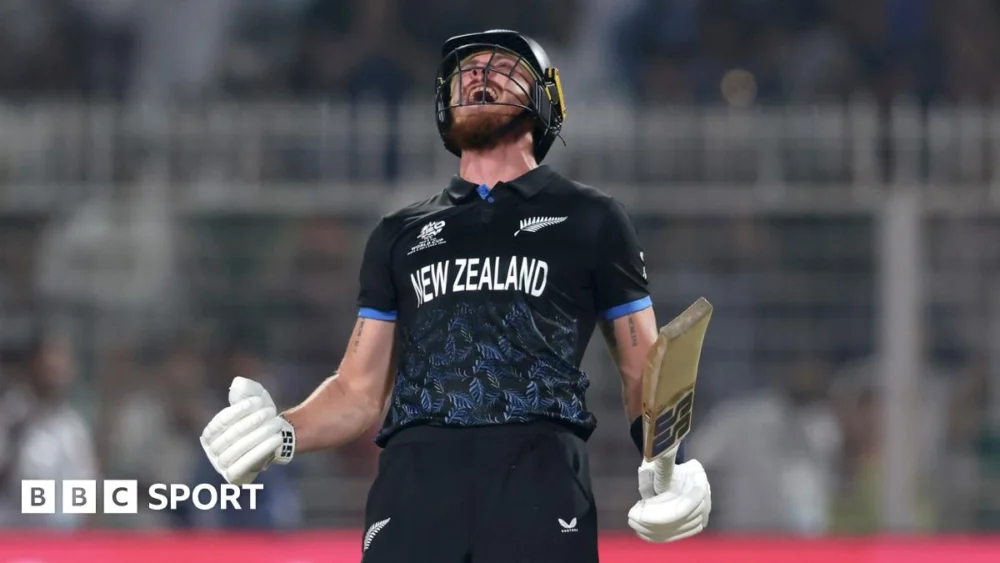
In a performance that will be etched in T20 World Cup folklore, Finn Allen unleashed a century of breathtaking power and precision to guide New Zealand to a resounding nine-wicket victory over the previously unbeaten South Africa, securing the Black Caps’ berth in the tournament’s grand finale. Allen’s astonishing 100 not out, achieved off a mere 33 deliveries, shattered the record for the fastest century in T20 World Cup history, leaving South Africa, the 2024 runners-up, in its wake with 43 balls to spare.
The electrifying knock from Allen, who finished with an unbeaten 100 including 10 fours and eight sixes, overshadowed Marco Jansen’s crucial 27-ball half-century that had provided a glimmer of hope for the Proteas. Chasing a target of 170, New Zealand’s formidable opening partnership of Allen and Tim Seifert laid an unassailable foundation, a testament to their aggressive intent from the outset. Seifert himself contributed a rapid 58 off 33 balls, as the pair amassed 117 runs in just 55 deliveries for the first wicket.
Allen’s personal acceleration was particularly spectacular. After Seifert’s departure, he swiftly dominated a 56-run partnership with Rachin Ravindra, contributing 42 runs off just 11 balls. The crescendo of his innings arrived in the final overs of the powerplay, where he famously dispatched Jansen for five consecutive boundaries, sealing an emphatic triumph and a place in Sunday’s final.
"I am sure my parents were up watching the whole game. Hopefully, they are proud," a jubilant Allen commented after the match, reflecting on the significance of the moment. He lauded the bowlers for setting the platform, stating, "It was an extremely impressive start from our bowlers. They set the game up for sure." Allen described his approach as playing a supportive role to Seifert initially, capitalizing on opportunities when they arose. "I just looked to play a support role to Tim and if it was in my area, I tried to hit it for four or six." He added, "He has shown the world what he can do and that made it easy for me to sit back and have the best seat in the house. It was good fun batting together."
South Africa’s Unbeaten Run Ends Abruptly
South Africa, who had enjoyed a flawless campaign leading into the semi-final, including a seven-wicket victory over New Zealand in the group stage, found themselves on the back foot after losing the toss and being asked to bat. Their top order faltered significantly, a stark contrast to their previous performances. Quinton de Kock (10) and Ryan Rickelton (0) were dismissed in consecutive deliveries in the second over, plunging the team to 12 for 2. Key batsmen Aiden Markram (18 off 20) and David Miller (6) were unable to convert their second lives after being dropped early in their innings.
The situation worsened when Dewald Brevis (34 off 27) chipped a catch to Mitchell Santner in the covers in the 11th over, leaving South Africa precariously placed at 77 for 5. However, Marco Jansen found a crucial ally in Tristan Stubbs (29 off 24). Together, they forged a vital 73-run partnership for the sixth wicket, with Jansen accelerating in the final five overs to propel the Proteas from 108 for 5 to a competitive total of 169 for 8. Jansen’s unbeaten 55 came off just 30 balls, punctuated by five sixes.
Despite Jansen’s valiant effort with the bat, the total proved to be insufficient against a New Zealand side that attacked from the first ball. The Black Caps’ destructive opening partnership established immediate dominance, scoring a blistering 84 runs in the powerplay. This powerplay score is the second-highest in the tournament, surpassed only by India’s effort against Namibia.
Allen’s Explosive Knock: A Record-Breaking Performance
Finn Allen, known for his aggressive batting, has now registered his sixth T20 century and third while representing New Zealand. While he had a relatively quiet tournament leading up to the semi-final, with his highest score being 31 after an impressive 84 against Nepal in the opener, his performance against South Africa was a statement of intent. Despite registering strike rates above 170 in three of his next four innings, his contributions had been brief.
This innings, however, was different. The 26-year-old Allen played a chanceless knock, fearlessly taking the attack to the South African bowlers from the outset. He was initially starved of the strike, with Seifert facing 21 of the opening 30 deliveries. But when the opportunity arose, Allen seized it with both hands, playing on the front foot and finding boundaries with remarkable ease. He struck two sixes within his first nine deliveries.
The pivotal moment of his innings, and arguably the match, came in the final over of the powerplay. Facing Corbin Bosch, Allen unleashed a six over backward point, followed by four consecutive boundaries – a pulled shot, a drive down the ground, and two sweeps over third man. This onslaught propelled him to 43 runs off just 15 balls, leaving New Zealand requiring only 86 runs from the remaining 14 overs.
The Weight of Expectations and Past Knockouts
South Africa entered this semi-final as favourites, not only to defeat New Zealand but also to finally claim their maiden T20 World Cup title. The Proteas had topped the highly competitive Group D and had a dominant Super 8s campaign, securing their semi-final spot with a match to spare. Head coach Shukri Conrad had expressed confidence in the team’s ability to handle the pressure. However, the match proved to be a stark reminder of South Africa’s historical struggles in knockout stages of major tournaments.
Their top order, including Aiden Markram, the third-highest run-scorer in the competition, faltered for the second consecutive match. This collapse against spin bowling echoed their previous struggles. In the group stage, Zimbabwe’s Sikandar Raza had been instrumental in their downfall. Against New Zealand, the Black Caps’ spinners, Cole McConchie and Rachin Ravindra, played crucial roles in dismantling the Proteas’ top order. McConchie took two wickets in as many deliveries in the second over, while Ravindra accounted for Markram and Miller, reducing South Africa to 77 for 4.
With the ball, tasked with defending a total that now appeared below par, South Africa’s bowlers were ruthlessly exposed. Corbin Bosch, in particular, struggled, conceding 29 runs in his two powerplay overs. Of the 12.5 overs New Zealand required to complete their chase, only three cost fewer than 10 runs, highlighting the extent of their bowling unit’s struggles.
"To get to 170 was a great effort, and we felt we had a sniff. But as it goes in T20 cricket, the powerplay got off to a flyer, and it was hard to pull back," acknowledged Aiden Markram after the match. He credited the New Zealand openers for their exceptional start, stating, "You give credit to their openers to kill the game like they did. A bad night for us tonight." Markram added, "We have to get back on the horse and prepare for the future. It feels like a slap in the face, and we need to be better as a team."
A Pattern of Knockout Stage Heartbreak
This loss marks South Africa’s third defeat in four men’s T20 World Cup semi-finals and their fifth loss in five knockout matches in the tournament’s history. Their record in the 50-over World Cup is similarly bleak, with all five of their semi-final appearances ending in defeat. While they have achieved success in other formats, including winning the World Test Championship final, their reputation for faltering under pressure in limited-overs World Cups continues to loom large. The ghosts of past semi-final exits – Sydney in 1992, Kolkata in 1999, Melbourne in 2015, and Barbados in 2024 – seemed to haunt the Proteas once again.
Looking Ahead: New Zealand’s Championship Aspirations
New Zealand’s dominant performance propels them into the T20 World Cup final, where they will face either India or Afghanistan. Their clinical display against South Africa, characterized by exceptional batting and strategic bowling, signals their serious championship aspirations. The Black Caps have consistently been a strong contender in ICC tournaments, known for their resilience and ability to peak at the right time. Finn Allen’s record-breaking century serves as a powerful statement of their attacking prowess and their readiness to compete for the coveted title. The nation will be eagerly anticipating Sunday’s final, hoping to witness a historic triumph.