

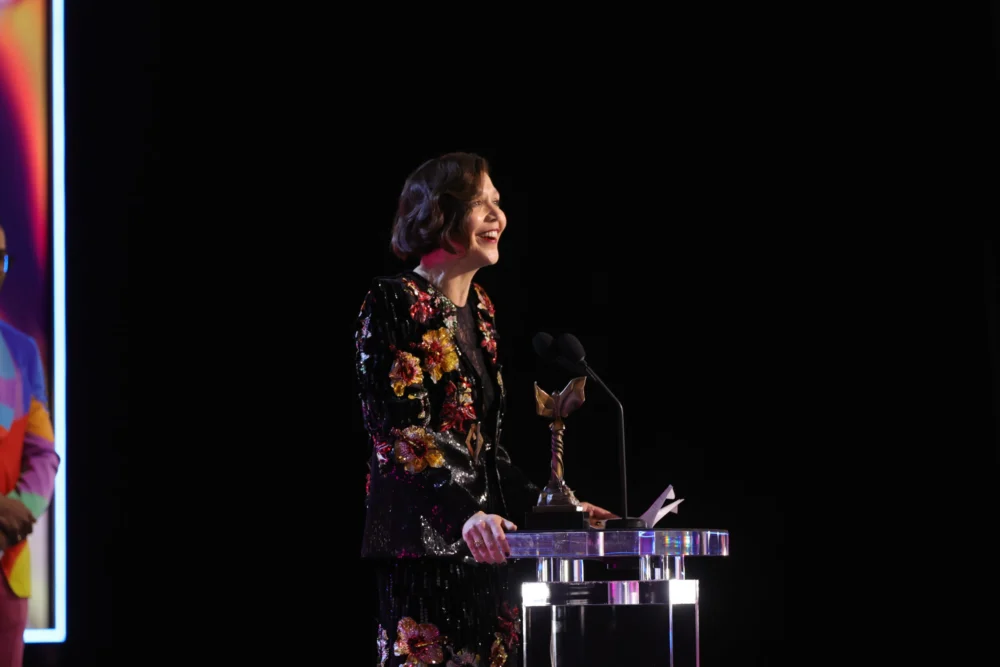
Maggie Gyllenhaal’s audacious reimagining of the Frankenstein mythos, "The Bride!", has arrived in theaters, sparking immediate and often fervent reactions. The film, a punk-infused, sensuous, and decadently designed exploration of Mary Shelley’s seminal work and its iconic 1935 cinematic adaptation, has been described by many as "wild" and "new." Gyllenhaal, however, views this label with a nuanced perspective, asserting that while the external reception highlights its unconventional nature, for her, the creative process felt deeply personal and familiar. "To me, who made it, it feels like home," she explained in a recent interview, admitting a slight disconnect between her internal experience and the outward perception of the film. "It’s hard for me to sometimes process that, because I’ve been living inside of it for so long."
The film’s imminent release marks a significant moment for Gyllenhaal, transitioning from a celebrated actress to a director with a distinct and bold vision. Her previous directorial debut, "The Lost Daughter," garnered critical acclaim, earning her an Oscar nomination for best adapted screenplay and multiple awards. That film also solidified a powerful creative partnership with actress Jessie Buckley, who returns in "The Bride!" to portray both the titular character and Mary Shelley herself, embodying a potent blend of energy, rage, desire, and intellectual prowess. Gyllenhaal’s journey with "The Bride!" has been characterized by openness regarding her creative process, including navigating the technical demands of large-scale filmmaking, such as working with IMAX, and engaging in extensive dialogue with Warner Bros. executives Michael De Luca and Pamela Abdy. This collaboration aimed to balance the studio’s desire for broader audience appeal with Gyllenhaal’s unwavering artistic integrity, all for an ambitious $80 million budget.
A Bold Departure from Cinematic Conventions
From its opening moments, "The Bride!" deliberately eschews traditional narrative pacing, plunging audiences directly into its distinctive world. Gyllenhaal champions this immersive approach, likening it to being "pushed off a cliff into the movie as opposed to the slow ‘get used to it.’" This intentional disorientation, she believes, reflects a modern sensibility, particularly from a female perspective. "There’s a real comfort in using rhythms and grammar that we know and that we love," Gyllenhaal stated, "but I think a lot of that grammar was made so long ago by people with a very different experience of the world than me. Sometimes when the person at the helm has a different experience to the world – being a woman – I think that the language will shift and change."
This daring approach was even noted by lead actor Christian Bale, who admitted that upon receiving the script, he initially believed it was a mistake due to its unconventional feel, assuming it was intended for a smaller, independent production. Gyllenhaal, however, embraced the scale and ambition of the project, underscoring Warner Bros.’ commitment to fostering unique cinematic voices. "This is what this movie cost," she affirmed. "Different movies cost different things with different actors and IP and scale – and this is what this movie costs. Warner Bros. has been really brave in supporting people with unusual and singular visions, cinematically and not repeating the same work over and over again."
Deconstructing Shelley’s Legacy Through a Contemporary Lens
"The Bride!" delves into Mary Shelley’s personal life and creative process, presenting her not merely as the author of "Frankenstein" but as a character grappling with unspoken thoughts and societal constraints. Gyllenhaal’s interpretation of Shelley is rooted in the notion that the author, a "radical person at the time," may have harbored ideas and desires that were not publishable or even permissible in 1819. This exploration of suppressed thoughts and unleashed potential directly informs the film’s thematic core.
"I read it and I loved it," Gyllenhaal said of Shelley’s novel, "but I also literally closed the last page and had a secret fantasy or wish – or I don’t know, a question. Is this all that Mary Shelley had to say, or was this all that was publishable in 1819? Were there other things that might’ve been on her mind as a woman, as a really radical person at the time that she wasn’t able to write down, or as we say in the movie, wasn’t even able to allow herself to think?"
The film intricately weaves contemporary anxieties into this historical reimagining. Gyllenhaal drew parallels between the concept of repressed ideas bursting forth and current societal discourse, referencing the recent unsealing of the Epstein files as an example of suppressed truths coming to light. "It is kind of wild that those Epstein files were opened last week," she observed. "It’s all on the tips of all of our tongues and all of our minds, and it’s very much at least a piece of what this movie is about."

The theme of possession, central to "The Bride of Frankenstein," is explored through the lens of unconscious desires and uncontrollable impulses. Gyllenhaal likens Shelley’s spectral presence within the Bride to the unconscious mind – "the things that we can’t control that burst into our minds anyway, and that really need some paying attention to." This resonates with her personal experiences, as she also reflected on having a close family member with Tourette’s syndrome, a condition characterized by involuntary vocalizations and movements. This personal connection informed her portrayal of the Bride’s internal struggle with an uncontrollable force. "There’s an aspect of the Bride that has something uncontrollable inside her that is bursting out," Gyllenhaal explained. "If I’m imagining that Mary Shelley had a whole lot more to say, then sometimes there are five words where there could be one, because again, the levee is bursting with all of Mary’s excitement and intellectual energy, and it’s all really a laser beam."
Evolution of a Filmmaker: From "The Lost Daughter" to "The Bride!"
The transition from the intimate, contained narrative of "The Lost Daughter" to the expansive canvas of "The Bride!" presented Gyllenhaal with a steep learning curve, marked by both terror and profound growth. "I speak a language that I didn’t speak when I started, and I love it," she confessed. "It was terrifying. The scope of responsibility came with a kind of terror that is very hard to bear and wear. But I don’t think the movie could have been made without it, and I wouldn’t wish it away, but I was definitely learning every day."
This learning process extended to her interactions with the studio system. Unlike "The Lost Daughter," which was shot and edited during the COVID-19 pandemic with minimal studio oversight, "The Bride!" demanded a more collaborative approach. "I was completely left alone on ‘The Lost Daughter’ – nobody," Gyllenhaal recalled. "It was COVID when we shot and when I cut, we would send it off, and they’d give us some notes. We’d be like, ‘Yeah, no.’ And nobody cared because it was a very small investment."
With "The Bride!", Gyllenhaal sought to replicate the raw honesty that resonated with audiences in her debut, but on a larger scale. "When I made ‘The Lost Daughter,’ I noticed as it came out that we hit a little vein because it was a little movie," she observed. "I think we hit a vein by being very honest about something that nobody was talking about. What was on my mind after that was, ‘Well, if I’m very honest about something else that nobody’s talking about – say, the monstrousness inside of us – but I do it in a much bigger way with scope, if I build a rollercoaster ride that’s fundamentally based on something honest, will it hit a bigger vein? Could there be blood all over the room?’"
This pursuit of honesty, even within the corporate structure of a major studio, fostered a sense of trust and partnership with Warner Bros. executives Pam Abdy and Michael De Luca. Gyllenhaal described their engagement as a challenging yet ultimately rewarding dialogue. "Pam and Mike were totally on board with the entire time," she said. "They’re saying, ‘We’re challenging you to make this clear, this clearer and this clearer.’ Sometimes my original response was, ‘It’s clear.’ I love the feeling of having to tolerate not understanding something briefly, but maybe that’s not always totally a hundred percent the grammar of a much bigger movie. I felt seen and heard by that studio."
Navigating Test Screenings and the Creative Process
Gyllenhaal has been candid about her experience with test screenings, viewing them as an integral, albeit challenging, part of refining her artistic vision. Far from being a source of conflict, she embraced the feedback as a necessary step in the filmmaking process, dispelling any notion of a hostile studio environment. "With this movie, you walk into a mall, you have no idea where you’re going to see, and then you see this," she remarked, acknowledging the film’s unconventional nature. "We know it’s unusual. It’s wild. It’s different. It’s new. But at the time, they were like, ‘…Frankenstein?’"
The collaborative nature of test screenings, Gyllenhaal explained, is often misunderstood. "When there’s consensus, it’s extremely helpful," she stated. "I don’t know how often all that stuff is usually in the press. I guess I don’t really care, but that the fantasy is that it should be born perfect. The idea that you’re working on something, asking for feedback, going back and working on it, thinking it through. To ask, ‘What is that?’ – to me, that just seems like, ‘Have you ever made anything?’ The fantasy of it being some horrible thing is inaccurate. Me and Pam, we love each other. We’re partners here, and so try and make it whatever you want, but you can talk to us and we’ll tell you what it’s like."
A specific example of this feedback loop involved the introduction of Mary Shelley’s character. "In the beginning, in an early screening in New Jersey, I hadn’t framed Mary Shelley at all," Gyllenhaal recalled. "Many people were like, ‘We don’t know who that is.’ You don’t have to know much about Mary Shelley in order to watch the movie – all you need to know is that she wrote Frankenstein – so I was like, ‘Cool, let’s make it super clear. Let’s just tell them.’ So I loved [the test screenings], honestly. They were super vulnerable – so vulnerable, so scary, so living on the fucking edge. But I was like, ‘OK, let’s go.’"

Mentorship and the Future of Filmmaking
Gyllenhaal also sought guidance from established filmmakers throughout the production of "The Bride!". Adam McKay, an early supporter, provided invaluable encouragement. Greta Gerwig and Denis Villeneuve also offered crucial advice and insights. "You know who was so amazing? Adam McKay," Gyllenhaal shared. "He was one of my very first supporters. He saw an early cut, and he really saw it and saw me, and it felt great." She added that Gerwig was "super helpful and great," and Villeneuve, a "real lover of the movie," responded with enthusiasm, "OK. I saw the beast!"
The film’s blend of genres, from horror to dark comedy, reflects Gyllenhaal’s interest in pushing the boundaries of cinematic language. She described the film’s "punk" sensibility not as a musical genre but as a celebration of individuality and the refusal to be confined. "If you’re going to get into the monstrousness, you have to also make space for the joy, for the celebration," she explained. "The talk about this movie as punk, I think, is really about not so much the kind of music, even though half of Sonic Youth plays on the score – but also it’s a celebration of not being able to fit in your box."
Gyllenhaal views contemporary cinema as increasingly "post-genre," a space where filmmakers can draw from diverse influences to tell their stories effectively. She cited "One Battle After Another" as an admired example of this trend.
Navigating Studio Shifts and the Call for Original Cinema
The release of "The Bride!" coincides with significant shifts in the corporate landscape of Warner Bros., including recent acquisition news. Gyllenhaal expressed concern for the future of original, point-of-view-driven films in theaters. "I am not an expert in this," she stated. "I’m reading tweets like everyone else, but I will say this: I’ve heard our community, the film community, saying, ‘What is this going to mean for real movies in theaters that have a point of view?’ If you’re rooting for movies like that, go see mine this weekend – for real! Just go to the fucking theater and let’s get behind real cinematic conversations and movies that have something to say in a big way. Let’s go. That’s my point."
A Director’s Path Forward
While Gyllenhaal remains an accomplished actress, her current focus is firmly on directing. She recently directed a short film featuring the venerable Ellen Burstyn, a project that reignited her passion for acting. "It’s so fun acting – and acting with a great," she enthused. However, her primary ambition lies in exploring the creative tools available to filmmakers, particularly for women who have historically had limited access to them.
"My mind is on these incredible tools that I have had the opportunity to work with," Gyllenhaal elaborated. "So few women have had access to these tools, and when we do, we really do use them in a different way. I just started using them. I’m really interested in this concept of worldbuilding." She distinguishes her approach to worldbuilding from mere visual spectacle, emphasizing its role in constructing immersive narratives. "For a lot of people it means, ‘Pan the camera over and show off your incredible VFX,’ which is just not my thing. But I’m so interested in these tools that I’ve had the opportunity to start to learn about and use, and I want to keep using them. I feel like I’m just getting started."
"The Bride!" is now playing in theaters.