


The rapid evolution of generative artificial intelligence has produced models capable of poetic composition, complex coding, and nuanced summarization, yet a fundamental gap remains in their ability to function as truly adaptive interactive agents. While Large Language Models (LLMs) excel at pattern recognition and mimicry, they frequently falter when required to update their internal "beliefs" based on a stream of new, sometimes contradictory, evidence. In a landmark study published recently in Nature Communications, a team of researchers from Google has identified a systemic "plateau" in how current models process interactive feedback and proposed a novel training methodology known as "Bayesian Teaching" to bridge this cognitive divide.
The Cognitive Stalemate: Why Current LLMs Struggle with Interaction
The core of the problem lies in what researchers term the "one-and-done" plateau. In standard deployment, an LLM acts as a static engine: it receives a prompt and generates a response based on the massive dataset it was trained on. However, in real-world applications—such as a digital concierge, a medical diagnostic assistant, or a technical support bot—the AI must act as an agent that learns about the user’s specific needs over the course of a conversation.
To test this capability, the Google research team evaluated several of the industry’s leading models, including Llama-3-70B and Qwen-2.5-32B. The experiment involved a simulated flight booking scenario where the agent had to infer a user’s hidden preferences, such as a preference for lower prices over shorter flight durations, by observing the user’s choices across multiple rounds of interaction.
The results revealed a significant deficiency in "probabilistic reasoning." While a classical symbolic model—specifically a "Bayesian Assistant" that uses mathematical formulas to update its certainty—became progressively more accurate with each piece of data, the off-the-shelf LLMs showed almost no improvement after the initial interaction. They remained stubborn, failing to adapt their internal world models to the user’s specific reward functions. This inability to perform "belief updating" suggests that while LLMs are linguistically fluent, they lack the underlying logical framework to handle uncertainty and evidence-based refinement.
Methodology: The Shift from Oracle to Bayesian Teaching
To address this "stubbornness," the researchers introduced a paradigm shift in fine-tuning strategies. Traditionally, AI models are trained using what is known as "Oracle Teaching." In this setup, the model is fine-tuned on "perfect" data—responses generated by an "Oracle" that already knows the correct answer or the user’s exact preference. While this produces models that can provide the right answer in a vacuum, it fails to teach the model how to get there when the answer is unknown.
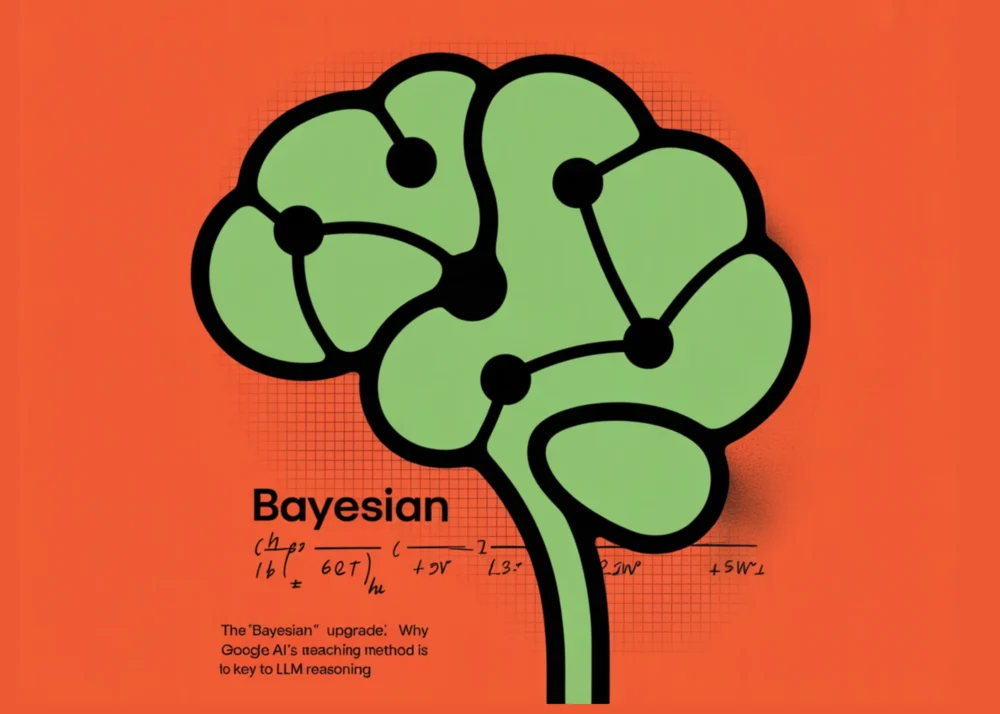
Bayesian Teaching, by contrast, focuses on the process of reasoning rather than the destination of the correct answer. The researchers fine-tuned smaller models, such as Gemma-2-9B and Llama-3-8B, to mimic the behavior of a Bayesian Assistant. This assistant does not start with the answer; instead, it maintains a probability distribution over all possible user preferences. As it receives new information, it applies Bayes’ rule to update that distribution.
By utilizing Supervised Fine-Tuning (SFT) on these Bayesian trajectories, the researchers forced the LLMs to adopt a strategy of "reasoning under uncertainty." The training data included the Bayesian Assistant’s early-stage "educated guesses," its moments of high uncertainty, and its subsequent refinements after receiving feedback. This approach effectively taught the neural network to simulate the mathematical rigor of a symbolic system.
The Counter-Intuitive Success of Educated Guesses
One of the most striking findings of the study was that Bayesian Teaching consistently outperformed Oracle Teaching. At first glance, this seems paradoxical: why would a model learn better from a teacher that is occasionally wrong or uncertain than from one that is always right?
The researchers argue that the "Oracle" provides a weak learning signal because it skips the most difficult part of the task: the transition from ignorance to knowledge. When an LLM is trained only on "correct" results, it never learns how to handle the intermediate states of a conversation where the user’s intent is still ambiguous.
Conversely, the Bayesian Assistant provides a rich map of how to navigate ambiguity. By observing the teacher "struggle" with uncertainty and then correct itself, the LLM learns the "skill" of belief updating. The data showed that Bayesian-tuned models agreed with the "gold standard" Bayesian strategy approximately 80% of the time. This represented a massive leap over the baseline models, which often defaulted to generic responses regardless of the evidence provided in the interaction.
Generalization and Performance Beyond Training Sets
A primary concern in AI research is "overfitting," where a model becomes excellent at a specific task (like booking flights) but cannot apply that logic to anything else. To test the robustness of Bayesian Teaching, the Google team applied the fine-tuned models to entirely different domains, such as hotel booking and general web shopping.
Despite being trained exclusively on synthetic flight data, the models successfully transferred their probabilistic reasoning skills to these new environments. They demonstrated an ability to "learn the user" across different categories of commerce. In several experimental rounds, the Bayesian-enhanced LLMs even outperformed human participants.
The researchers noted that humans are often prone to cognitive biases, such as the "base rate fallacy" or "anchoring," where they ignore statistical probabilities in favor of recent or vivid information. The Bayesian LLMs, having been trained to mimic a mathematically optimal process, remained objective and consistent, updating their beliefs with a level of precision that exceeded human intuition in complex multi-variable scenarios.
The Neuro-Symbolic Bridge: A New Architectural Frontier
This research represents a significant step toward "Neuro-Symbolic" AI—a hybrid approach that seeks to combine the flexible, natural-language capabilities of neural networks (Deep Learning) with the rigid, logical reliability of symbolic logic (Classical AI).
Historically, symbolic models have been difficult to scale because they require human experts to manually code every rule and probability for every possible domain. A Bayesian model for web shopping is vastly more complex to build than one for a simple flight simulator. However, by using a symbolic model as a "teacher" for a neural network, researchers can "distill" that logical rigor into the transformer architecture.
The LLM acts as the flexible interface that can handle the "messy" reality of human language, while the Bayesian training ensures that the underlying logic remains sound. This synergy allows for the creation of agents that are both conversational and cognitively disciplined.
Broader Implications for the AI Industry
The implications of this research extend far beyond virtual travel agents. As the industry moves toward "Agentic AI"—systems that can take actions on behalf of users—the ability to update beliefs based on evidence becomes a safety and utility requirement.
- Personalized Medicine: An AI diagnostic tool must be able to update its hypothesis as new lab results come in, rather than sticking to an initial impression. Bayesian reasoning allows the model to weigh the significance of each new data point against the "prior" probability of a condition.
- Legal and Financial Analysis: In fields where evidence is cumulative, an AI must be able to adjust its risk assessment dynamically. The Google study suggests that current models are too static for high-stakes decision-making that evolves over time.
- Human-AI Collaboration: For AI to work effectively alongside humans, it must understand that human preferences are not always clearly stated. Bayesian Teaching provides a framework for AI to "infer" what a human wants through observation, reducing the need for explicit instructions.
Chronology of the Research and Future Directions
The journey toward Bayesian Teaching began with the observation that increasing model size (from 8B parameters to 70B and beyond) did not inherently solve the problem of logical updating. The research progressed through three distinct phases:
- Phase I: Identification. Testing standard models on "Multi-Round Preference Inference" tasks, which revealed the performance plateau.
- Phase II: Synthetic Trajectory Generation. Creating a "Bayesian Assistant" to generate millions of rounds of interactive data, documenting the step-by-step update of probability distributions.
- Phase III: Cross-Domain Validation. Fine-tuning the LLMs on the synthetic data and testing them on "unseen" tasks like hotel and web shopping to prove generalization.
Looking ahead, the Google team suggests that the next frontier is "On-the-Fly Bayesian Inference," where models can perform these updates without needing specific fine-tuning for every new task. The goal is to develop a "Reasoning Core" that is inherent to the architecture of the LLM, rather than an added layer of training.
The study concludes that the future of AI does not lie solely in bigger datasets or more parameters, but in better "pedagogy." By teaching models to think like mathematicians—embracing uncertainty and updating beliefs with every new scrap of evidence—the industry can move closer to creating AI agents that truly understand the world they inhabit.