


The cinematic retelling of what has been described as "one of Scotland’s most spontaneous and successful acts of civil resistance in recent memory" has arrived, carrying a title that resonates with the urgency of its subject matter. Everybody to Kenmure Street, a documentary helmed by filmmaker Felipe Bustos Sierra, made its debut as the opening film for the 22nd edition of the Glasgow Film Festival. This compelling narrative, which previously premiered at the Sundance Film Festival, is now set to captivate audiences further with its screening at CPH:DOX, the Copenhagen International Documentary Film Festival, on Wednesday, followed by a theatrical release across the U.K. and Ireland via Conic on Friday, March 13th. The film also boasts the significant backing of two-time Oscar winner Emma Thompson as an executive producer, who also takes on a surprising role within the documentary itself.
The Spark of Resistance: A Dawn Raid Ignites a Community
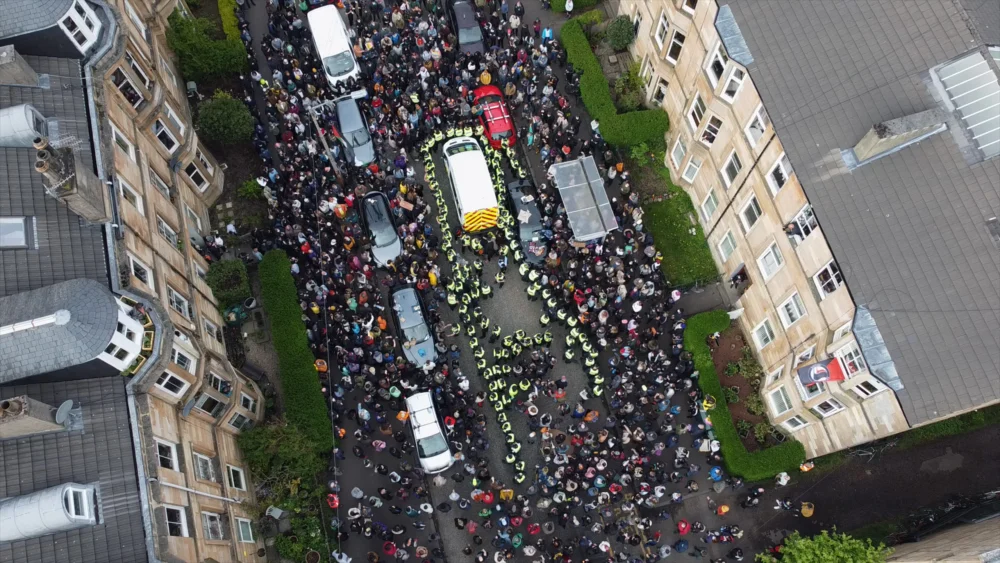
Everybody to Kenmure Street unfolds as a modern David and Goliath tale, detailing an event that galvanized a Glasgow community into extraordinary action. In May 2021, a pre-dawn raid by the U.K. Home Office in the Pollokshields district of Glasgow, a neighborhood renowned for its rich diversity, triggered an immediate and powerful response from local residents. The raid, which aimed to deport two neighbors, prompted an outpouring of solidarity as word spread rapidly through the community, particularly poignant as it coincided with Eid celebrations for many.
What began with a handful of concerned individuals quickly swelled into hundreds of people. They converged on Kenmure Street, creating a human barrier that rendered the thoroughfare impassable to the immigration enforcement van. The synopsis highlights the dramatic eight-hour standoff that ensued, drawing international attention and showcasing an "extraordinary act of peaceful solidarity" orchestrated by the community. The two men targeted for deportation were of Indian origin, and their potential removal ignited a profound sense of injustice and collective responsibility.
Crafting the Narrative: A Mosaic of Voices and Perspectives
Documentary maker Felipe Bustos Sierra, a Chilean-Belgian filmmaker based in Scotland, has meticulously pieced together this remarkable story. His approach to Everybody to Kenmure Street involves a multifaceted narrative construction. The film skillfully integrates crowd-sourced footage captured by residents on the day of the protest, alongside archival film and "set-designed scenes." These latter elements, artfully captured by cinematographer Kirstin McMahon, feature actors who "relay verbatim the testimonies of contributors who wished to remain anonymous." This technique allows for the preservation of the anonymity of individuals while still giving voice to their experiences and emotions.
Bustos Sierra’s previous work, the 2018 documentary Nae Pasaran, garnered significant acclaim, including the best film honor at the BAFTA Scotland Awards. That film chronicled the vital role of Scottish Rolls Royce factory workers in boycotting aircraft parts, a move that played a crucial role in undermining General Augusto Pinochet’s regime in 1970s Chile. This background underscores Bustos Sierra’s established commitment to exploring powerful narratives of solidarity and resistance.
The production of Everybody to Kenmure Street was spearheaded by Ciara Barry of the Glasgow-based production company barry crerar, in collaboration with Bustos Sierra’s Debasers Films. Adding to the film’s prestige, Mark Thomas of Screen Scotland also served as an executive producer, alongside Emma Thompson. The film’s sonic landscape is further enriched by an original score composed by Barry Burns of the acclaimed band Mogwai.
A Call for Decency: Emma Thompson’s Endorsement
Emma Thompson, in her commentary within the film’s press notes, eloquently describes Everybody to Kenmure Street as an "urgent film." She states, "This film beautifully and powerfully demonstrates the innate and deep decency of our people whilst also highlighting the institutional mannerisms and structures that are the opposite of this." Her endorsement underscores the film’s dual focus: celebrating the inherent goodness of individuals and critically examining the systems that can lead to their marginalization.
The Genesis of the Film: Personal Connection and a Shared Vision
Bustos Sierra shared his motivations for undertaking this project in a conversation with The Hollywood Reporter. His personal connection to the events was immediate, living just a short distance from Kenmure Street. The initial message he received, a photograph of an immigration van surrounded by a few people, evoked a sense of foreboding given his awareness of the often-violent nature of police responses to protests and crime.

"I grew up with solidarity movements," Bustos Sierra explained, reflecting on his upbringing and influences. The viral footage of the van doors opening, witnessed by millions, struck him profoundly. "There was something in my brain. I couldn’t believe that this happened, that this was reality, that it was so joyful, and that I had missed that when it was so close to me." This sense of missing a pivotal moment, coupled with a deep-seated belief in the power of collective action, fueled his desire to document and explore the event.
Reconstructing the Day: The Power of the People’s Footage
The acquisition of footage for the documentary was a testament to the power of collective contribution. Bustos Sierra detailed how social media served as the initial and primary source for identifying and gathering visual material. "So, obviously, social media became our first source to find footage and build the spine of the film, visually," he stated.
The day following the protest, amidst strict COVID-19 lockdown protocols in Glasgow, direct filming of interviews proved challenging. Bustos Sierra resorted to extensive walks in local parks, engaging in conversations with residents over several months. These extended discussions allowed for a deeper exploration of not only the chronological unfolding of the day’s events but also the profound questions of individual sacrifice and community responsibility. "Who has time for this type of thing in our lives? You know, we’re all trying to keep a roof above our heads, work in a place that doesn’t demean us, have a voice somehow and keep our family together. But in this case, you got this idea of people dropping everything for two people they know nothing about, just because they’ve been caught, and they find that abhorrent." The enforced period of reflection, Bustos Sierra believes, was instrumental in shaping the film into its final, impactful form.
Crowd-Sourcing a Movement: The Digital Archive of Resistance
The process of collecting the visual narrative was an extensive and collaborative effort. Bustos Sierra and his editor, Colin Monie, spent months meticulously reviewing footage, frame by frame, seeking out individuals who had filmed the events. "There’s that person who is filming! How do we get to that person? Or asking who has an angle of that same moment that is maybe better," he described. This painstaking work was facilitated by a successful Kickstarter campaign, which allowed for the crowd-sourcing of most of the footage.
The filmmakers were particularly fortunate to connect with individuals who, recognizing the significance of the unfolding events, returned to the scene with professional cameras. "We’re very lucky that a couple of cameramen who lived in the area went to film with their smartphones and then realized there was something bigger happening. And they just went back and came back with [professional] cameras. So we have about 20 minutes of broadcast-quality footage," Bustos Sierra revealed. This blend of amateur and professional footage creates an immersive and authentic viewing experience.
The Unsung Heroes and a Surprise Revelation: Emma Thompson’s Role
The documentary also delves into the captivating personas of key figures who emerged from the protest, including the individual dubbed "Van Man," who famously lay under the immigration enforcement vehicle to prevent its movement. This figure, described by Bustos Sierra as a "mystical figure around Glasgow," ultimately chose to remain anonymous. He explained his reasoning: "I was useful for 15 minutes, right? My power was basically being at the right place at the right moment when the two guys were being detained in their flats. It was a split-second decision. I’m just going to go under there and hold up the van and give time for more people to come."
The anonymity was a deliberate choice to prevent his individual story from overshadowing the collective effort and to avoid being placed on a pedestal. "I don’t want to be on a pedestal. I think anybody could have done this. It could have been a nice old lady. It could have been a 12-year-old boy. It could have been anyone. I don’t want my identity to be known and for it to become bigger than it was," he stated.
Similarly, an off-duty nurse who provided aid to "Van Man" also requested anonymity. Her rationale was rooted in her professional standing: "I’m a nurse, sort of a public figure, and I want to be able to do this type of thing again. And I think if people know my face, it might make that more difficult."
It was in this context that Emma Thompson was brought into the project, not just as an executive producer but also to portray "Van Man." Bustos Sierra elaborated on his existing relationship with Thompson, stemming from her appreciation of his earlier film Nae Pasaran. He sought to inject a sense of humor and surprise into the film, mirroring Glasgow’s historical penchant for "colorful people just finding solutions to their problems." Thompson’s involvement, he believes, provides that crucial "WTF element" and adds a layer of lighthearted defiance.

The film also features acclaimed Scottish actresses Kate Dickie and Keira Lucchesi. Dickie, who lives in Glasgow and was familiar with the events as they unfolded, and Lucchesi, also a Glasgow-based actress, bring a deep understanding of the local context to their roles. Bustos Sierra highlighted the moments of intimacy captured between Thompson and Dickie, suggesting that these scenes convey "the only thing that matters in that moment," emphasizing the profound human connections forged in the heat of the protest.
Themes of Solidarity in a Divided World
The film’s resonance extends beyond its immediate setting, touching upon universal themes of immigration and social justice. Bustos Sierra acknowledged the four-and-a-half-year production timeline and the concern that the film’s relevance might wane over time. However, he noted with a sense of somber reflection, "sadly, we’re very aware that the topic of immigration is going to keep being brought back."
He drew a comparison between the events in Glasgow and the broader context of policing and immigration enforcement. While acknowledging that the situation in the U.K. has at times been perceived as heavy-handed, he contrasted it with the more severe realities faced by individuals in countries like the United States, where "ICE and the prevalence of guns" are significant concerns.
A key takeaway from the film, Bustos Sierra emphasized, is the inherent human capacity for action, even in the face of uncertainty. "Everybody assumes that the film has a sad ending. But the people in Glasgow did not know that it was going to be a happy ending, and they turned up anyway." This sentiment underscores the courage and conviction of the community.
Community Reception and Future Endeavors
The film has been met with heartfelt responses from Glaswegians. One individual who participated in the protest shared his experience: "I was at the protest, and I love the film. I realize that there’s so much of the day that I missed, even though I was at one end of the street. And I recognized so many people." This reaction suggests that the film serves as both a historical record and a personal reflection for those who were present.
Looking ahead, Bustos Sierra is exploring potential new projects. He is currently examining another act of protest in Scotland, with the intention of fictionalizing its narrative. This indicates a continued interest in the power of human agency and collective action as subjects for his filmmaking.
The release of Everybody to Kenmure Street marks a significant moment in documentary filmmaking, offering a powerful testament to the strength of community, the courage of ordinary citizens, and the enduring spirit of resistance in the face of adversity. It serves as a vital reminder that when people unite for a common cause, even the most daunting challenges can be met with spontaneous and successful acts of civil defiance.