

The Bathurst 12 Hour, held at the iconic Mount Panorama Circuit in New South Wales, Australia, has long been regarded as one of the most grueling endurance races in the international GT3 calendar. However, the 2024 iteration of the event highlighted a persistent and violent hazard that transcends mechanical failure or driver error: the unpredictable intersection of high-speed racing and local wildlife. During the opening stages of the race, German professional driver Christopher Mies, piloting the Ford Mustang GT3, experienced a high-velocity collision with a kangaroo that not only decimated the front end of his vehicle but also served as a stark reminder of the physical and psychological risks inherent in circuit racing within semi-rural environments.
The Chronology of the Incident at Mount Panorama
The incident occurred during the early morning hours, a period characterized by low-angle light and high wildlife activity. Christopher Mies was on his third lap, navigating the circuit at speeds approaching 245 km/h (approximately 152 mph). Mount Panorama is unique for its public road status outside of race weekends, winding through a landscape that serves as a natural habitat for various marsupial species, most notably the Eastern Grey and Red kangaroos.
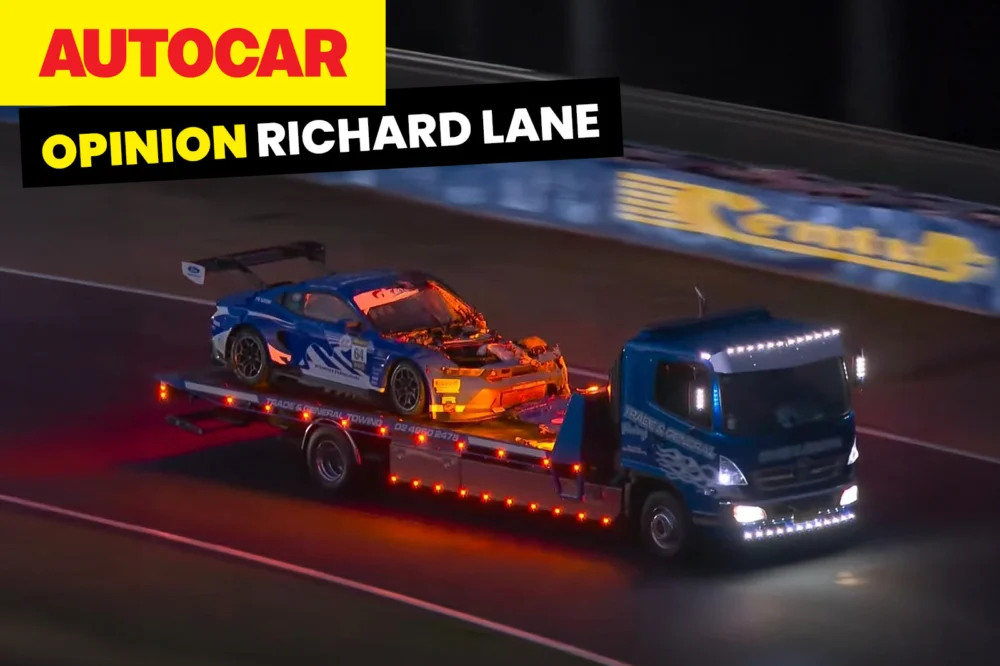
As Mies crested a high-speed section of the track, a kangaroo entered the racing line. Given the velocity of the GT3-specification Mustang, the window for evasive maneuvers was non-existent. The impact was catastrophic for the animal and caused significant structural damage to the Mustang’s carbon-fiber bodywork and cooling systems. Despite the severity of the strike, the car’s front-engine configuration provided a crucial buffer between the point of impact and the cockpit.
Mies managed to return the vehicle to the pits, though the scene that greeted the mechanics was described as visceral. The front fascia of the Mustang was destroyed, and the driver’s overalls and helmet were contaminated with biological debris. Mies was visibly shaken, reporting to team personnel and later to the media that he had vomited trackside due to the intensity of the event. Even after multiple attempts to clean his equipment, the driver noted that the olfactory remnants of the collision persisted, highlighting the lingering sensory trauma associated with such incidents.
Technical Analysis: Vehicle Architecture and Impact Mitigation
The physics of the collision provide a compelling case study in race car engineering. The Ford Mustang GT3 features a traditional front-engine layout, with a 5.4-liter V8 engine situated ahead of the driver. In the context of the Bathurst incident, this "bluff-nosed" design was instrumental in preserving the driver’s safety. The engine block, radiator supports, and the expansive hood acted as a crumple zone, absorbing a significant portion of the kinetic energy generated by the 152-mph impact.
In contrast, mid-engined or rear-engined competitors, such as the Porsche 911 GT3 R or the Ferrari 296 GT3, present a different risk profile for animal strikes. In these vehicles, the driver is positioned closer to the front axle with less mechanical mass between the windscreen and the point of impact. Had Mies been driving a vehicle with a lower, more aerodynamic nose and a rear-mounted engine, the animal could have potentially cleared the hood and struck the windscreen directly.
Data from previous high-speed animal strikes in Australia suggests that larger "Big Red" kangaroos, which can weigh upwards of 85 kg (187 lbs), pose a lethal threat to drivers. When such a mass strikes a windscreen at racing speeds, the glass often fails, allowing the animal to enter the cockpit. In such scenarios, the thrashing of a wounded animal within the confined space of a roll cage can result in severe secondary injuries to the driver.
Historical Context: Wildlife Incursions in Professional Racing
The incident involving Christopher Mies is not an isolated occurrence in the history of motorsport. While modern circuits employ extensive fencing and marshaling, the "porous" nature of large-scale tracks makes total exclusion difficult.
- Cristiano da Matta (2002): One of the most severe examples occurred at Road America during a CART test session. Da Matta struck a deer that had wandered onto the track. The impact resulted in a ruptured temporal artery and a subdural hematoma, placing the driver in a medically induced coma for nearly a month. This incident led to significant changes in how American circuits manage perimeter security.
- Stefan Johansson (1987): During practice for the Austrian Grand Prix at the Österreichring, Johansson’s McLaren hit a deer at high speed. The impact destroyed the left side of the car and broke the deer in two. While Johansson survived, the incident highlighted the vulnerability of Formula 1 cars to large mammal strikes even on European circuits.
- Alan Stacey (1960): A tragic precedent was set at the Belgian Grand Prix when Stacey was killed after a bird flew into his face while he was traveling at high speed. In the era of open-face helmets and minimal windscreen protection, the impact rendered him unconscious, leading to a fatal crash.
- Andrea Iannone (2015): During the MotoGP race at Phillip Island, Iannone struck a seagull with his helmet and fairing. While Iannone was able to maintain control and finish on the podium, the incident demonstrated that even smaller animals can pose a significant risk to riders who lack the protection of a chassis.
Statistical Overview: The Broader Impact on Public Road Safety
While the Bathurst incident captured the attention of the motorsport world, the reality of animal-vehicle collisions (AVCs) is a significant concern for public road safety and insurance sectors globally. The transition from the race track to the public highway reveals a growing trend in wildlife-related accidents.
In the United Kingdom, data indicates approximately 70,000 deer-related collisions occur annually. This figure has seen a steady increase over the last decade. Environmental analysts attribute this rise to several factors:
- Climatic Shifts: Milder winters have led to higher survival rates among fawns, resulting in record-high deer populations.
- Urbanization: As suburban sprawl encroaches on traditional woodland habitats, deer are increasingly forced into urban and peri-urban environments.
- Afforestation: Increased tree planting initiatives provide more cover for wildlife near major arterial roads.
Most UK collisions involve Roe deer, which typically weigh around 25 kg. While significantly lighter than an adult kangaroo, a 25-kg mass striking a vehicle at 60 mph (96 km/h) generates enough force to deploy airbags and cause total vehicle loss. The financial impact of these collisions in the UK is estimated to exceed £50 million annually in property damage and medical costs.
In Australia, the statistics are even more pronounced. Kangaroos and wallabies account for nearly 90% of all animal-related vehicle insurance claims. Unlike deer, which tend to bolt, kangaroos have a high center of gravity and powerful hind legs, often causing them to roll over the hood and into the windscreen of passenger cars, mirroring the dangers identified by racing drivers at Mount Panorama.
Official Responses and Mitigation Strategies
The organizers of the Bathurst 12 Hour and the operators of the Mount Panorama Circuit have faced ongoing pressure to improve wildlife mitigation. Current strategies include:
- Extensive Fencing: Millions of dollars have been invested in "kangaroo-proof" fencing around the perimeter of the 6.2-kilometer circuit.
- Dusk and Dawn Protocols: Timing of practice sessions is often adjusted to minimize running during peak wildlife movement hours.
- Spotters and Infrared Technology: Marshals equipped with binoculars and, in some cases, thermal imaging are used to monitor the surrounding bushland for encroaching animals.
Despite these efforts, the sheer scale of the terrain and the athletic capability of kangaroos—capable of clearing fences over two meters high—means that a "zero-risk" environment is virtually impossible to achieve.
From a driver safety perspective, the FIA (Fédération Internationale de l’Automobile) continues to evolve cockpit protection standards. The introduction of the "Halo" in open-wheel racing and the strengthening of GT3 windscreens with polycarbonate laminates are direct responses to the threat of external debris and animal strikes.
Fact-Based Analysis of Future Implications
The collision at the Bathurst 12 Hour serves as a catalyst for a broader discussion on the intersection of infrastructure and ecology. As racing speeds continue to increase due to advancements in aerodynamics and hybrid power units, the margin for error in wildlife incursions narrows.
For the automotive industry, the incident reinforces the importance of Active Safety Systems. Features such as Night Vision with animal detection and Autonomous Emergency Braking (AEB) are becoming standard in high-end road vehicles. However, these systems are currently optimized for highway speeds and may not yet be capable of processing the data required to intervene at the 200+ km/h speeds seen in professional motorsport.
Furthermore, the psychological impact on drivers like Christopher Mies cannot be overlooked. Professional motorsport is a discipline of calculated risk, but the unpredictable nature of a wildlife strike introduces a variable that many drivers find more distressing than mechanical failure. The industry may see an increased focus on driver mental health support following "traumatic impact" events, acknowledging that the aftermath of such collisions extends beyond the physical damage to the car.
In conclusion, the Bathurst incident was a confluence of high-speed engineering and raw nature. While the structural integrity of the Ford Mustang GT3 and the skill of Christopher Mies prevented a more tragic outcome, the event underscores the necessity for continued innovation in track security and vehicle safety. Whether on the slopes of Mount Panorama or the motorways of the United Kingdom, the challenge of coexisting with wildlife remains a high-stakes component of modern transportation.