

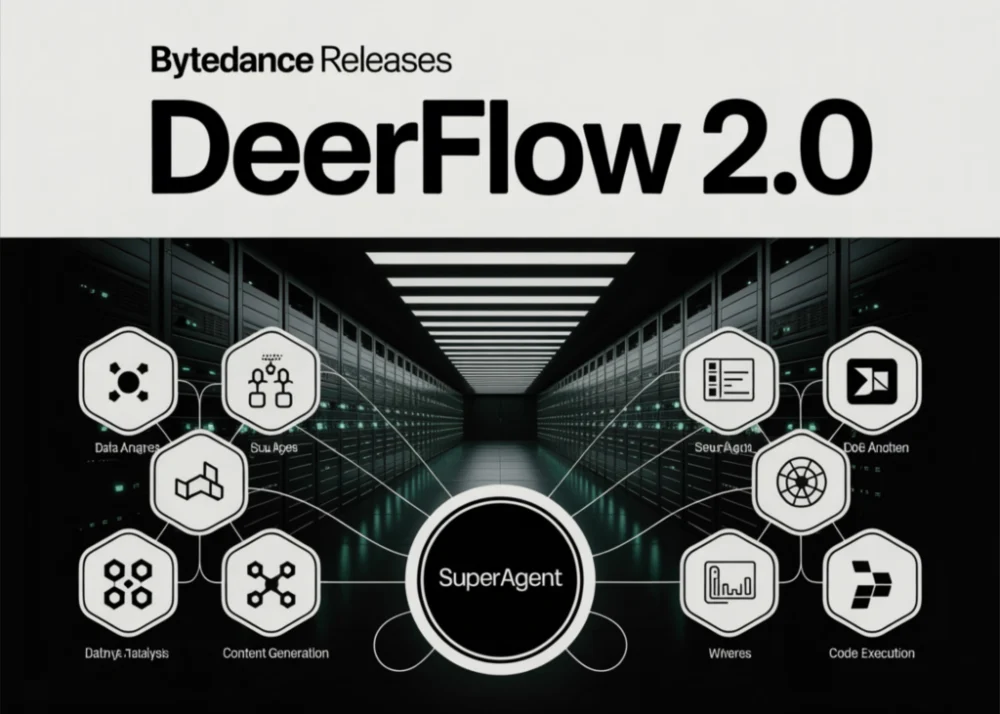
The release comes at a time when the global technology sector is shifting its focus from Large Language Models (LLMs) that merely "think" to agentic frameworks that can "act." By open-sourcing the DeerFlow 2.0 framework, ByteDance—the parent company of TikTok and a global leader in algorithmic content delivery—is positioning itself at the forefront of the agentic AI movement. The framework is engineered to bridge the gap between AI-generated plans and real-world implementation, providing the agent with the tools and environment necessary to see a project through from conception to final deployment.
The Architectural Shift: The Isolated Sandbox Environment
The primary innovation of DeerFlow 2.0 lies in its operational environment. Unlike conventional AI agents that operate within the restricted confines of a chat interface, DeerFlow 2.0 functions within a real, isolated Docker container. This technical choice solves one of the most persistent issues in AI reliability: the "hallucination-to-execution" gap. In a standard setup, an AI might provide a script that contains errors or relies on non-existent libraries. The user is then responsible for setting up the environment, installing dependencies, and debugging the output.
DeerFlow 2.0 eliminates this friction by providing the AI with its own virtual "computer." This Docker-based sandbox includes a full filesystem, a functional bash terminal, and the ability to read, write, and execute files in real-time. When tasked with a data analysis project, the agent does not simply suggest Python code; it creates a script, installs the necessary libraries (such as Pandas or Matplotlib), executes the code within its container, inspects the output for errors, and iterates until the final visualization or dataset is ready for the user.
This stateful execution model allows the agent to maintain a persistent memory of its environment. If a developer asks DeerFlow to modify a specific module in a complex software project, the agent can navigate the directory structure, understand the dependencies between files, and perform edits that are contextually aware of the entire codebase. This level of environmental interaction represents a fundamental shift in how humans interact with machine intelligence, moving the AI from the role of a consultant to that of a digital employee.
Chronology and Development: From Internal Tool to Open Source
The development of DeerFlow 2.0 was not a linear process aimed at general-purpose automation. Originally, the project began within ByteDance as a specialized tool for internal research teams. The initial version, DeerFlow 1.0, was designed to assist analysts in synthesizing large volumes of information and generating reports. However, as the tool gained internal traction, ByteDance engineers observed a trend: users were attempting to use the research agent to perform technical tasks, such as writing automated testing scripts or building data scrapers.
Recognizing that the community required more than just a search-and-summarize tool, the ByteDance development team initiated a complete overhaul of the framework. Throughout late 2023 and early 2024, the focus shifted toward "agentic orchestration." The goal was to create a system where a high-level "SuperAgent" could manage a fleet of specialized sub-agents.
The transition to version 2.0 involved rewriting the core logic to support multi-agent collaboration and integrating the Docker-based execution engine. By the time of its open-source release, DeerFlow had evolved into a full-stack automation engine. The decision to open-source the project is seen by industry analysts as a strategic move to foster a developer ecosystem around ByteDance’s AI tools, challenging the dominance of Western-led frameworks like OpenAI’s "Operator" or various LangChain-based agents.
Multi-Agent Orchestration and Task Decomposition
At the heart of DeerFlow 2.0 is a sophisticated orchestration layer that employs a "Divide, Conquer, and Converge" strategy. When a user provides a complex, high-level prompt—such as "Build a functional e-commerce landing page with a product dashboard"—the SuperAgent does not attempt to write the entire codebase in a single pass. Instead, it acts as a project manager, decomposing the request into distinct, manageable sub-tasks.
The orchestration process typically follows a three-step workflow:
- Decomposition: The SuperAgent analyzes the prompt and identifies the necessary components (e.g., UI design, backend logic, data schema).
- Parallel Processing: The system spins up multiple specialized agents to work on these components simultaneously. One agent may focus on writing CSS for the frontend, while another configures the database logic in the Docker environment.
- Synthesis and Verification: Once the sub-tasks are complete, the SuperAgent converges the outputs, ensuring that the code modules are compatible. It then runs the application within its sandbox to verify that it functions as intended before presenting the final result to the user.
This parallel processing significantly reduces the time-to-delivery for complex tasks. In internal testing benchmarks, tasks that would typically require several hours of human-led research and development were completed by DeerFlow 2.0 in a fraction of the time, often with higher levels of structural consistency.
Broader Capabilities: Beyond Coding and Research
While software development is a primary use case, the capabilities of DeerFlow 2.0 extend into various professional domains. The framework is designed to handle:
- Deep Research and Strategy: The agent can navigate the live web, synthesize data from multiple sources, and produce comprehensive white papers or market analysis reports complete with citations and data visualizations.
- Content and Multimedia Creation: Beyond text, the framework can generate slide decks for corporate presentations and even automate the production of video content by coordinating between script-writing agents and video-editing tools.
- Automated Data Pipelines: By leveraging its bash terminal and filesystem access, DeerFlow can build and maintain real-time data dashboards, pulling information from APIs and transforming it for business intelligence purposes.
Supporting Data and Technical Specifications
The technical community has noted that DeerFlow 2.0’s reliance on stateful memory is a critical differentiator. Most LLMs are "stateless," meaning they do not remember the specific configuration of a previous session unless the entire history is fed back into the prompt. DeerFlow 2.0’s persistent filesystem allows it to "remember" project-specific styles, previous debugging attempts, and user preferences across different sessions.
Data from initial open-source deployments suggests that DeerFlow’s execution-based approach reduces the rate of "unrecoverable errors" in AI-generated code by up to 40% compared to non-agentic models. Because the agent can test its own code and read the resulting error logs, it can self-correct before the user ever sees the output. This "self-healing" capability is viewed as essential for the future of autonomous DevOps and site reliability engineering.
Industry Implications and Market Reaction
The release of DeerFlow 2.0 has sparked a wide range of reactions from the global tech community. For software engineers, the tool represents both a productivity boon and a shift in the required skillset. The role of the developer is increasingly moving toward "architectural oversight" rather than manual syntax writing.
Market analysts suggest that ByteDance’s move to open-source this framework could accelerate the commoditization of AI agents. If powerful, autonomous agents are freely available, the competitive advantage for companies will shift from "who has the best AI" to "who has the best data and environmental integration."
From a security perspective, the use of Docker containers provides a necessary layer of isolation. However, experts warn that granting AI agents the ability to execute bash commands and write files requires rigorous "guardrailing" to prevent the accidental or malicious execution of harmful code. ByteDance has addressed this by emphasizing the "isolated" nature of the DeerFlow sandbox, though they acknowledge that enterprise deployments will require customized security protocols.
Future Outlook: The Rise of the Agentic Economy
DeerFlow 2.0 is a precursor to what many are calling the "Agentic Economy," where AI agents serve as the primary interface for digital work. As these frameworks become more robust, the distinction between "software" and "labor" begins to blur. A framework like DeerFlow 2.0 does not just provide a tool for a human to do work; it provides the capability to perform the work itself.
In the coming months, ByteDance is expected to continue updating the DeerFlow repository, with a focus on improving the "reasoning" capabilities of the SuperAgent and expanding the library of pre-configured Docker environments. As the global community contributes to the open-source project, the versatility of the framework is likely to grow, potentially setting a new standard for how autonomous AI systems are built and deployed across the globe.
The era of the simple AI assistant is closing, and the era of the autonomous SuperAgent, led by developments like DeerFlow 2.0, has officially begun. This transition promises to redefine productivity, software architecture, and the very nature of digital problem-solving in the years to come.