


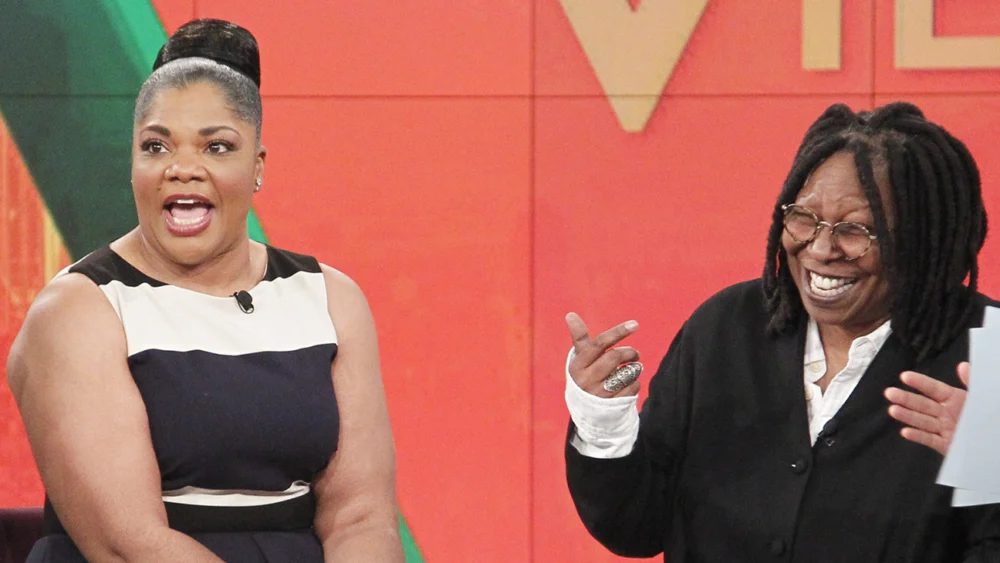
Eight years after a contentious on-air exchange on The View, Academy Award-winning actress Mo’Nique has publicly called out co-host Whoopi Goldberg, accusing her of "schooling" her over her refusal to participate in overseas promotion for the critically acclaimed 2009 film Precious. The resurfaced dispute, reignited by Mo’Nique via an open letter on Instagram, centers on a deeply divisive issue within the film industry: the extent of an actor’s promotional obligations beyond their contractual duties and the perceived repercussions for those who push back against industry norms.
Mo’Nique’s latest salvo comes after viewing a clip of the original View segment, which occurred approximately eight years prior to her Instagram post. In it, Goldberg, then a co-host of the popular talk show, questioned Mo’Nique’s decision not to engage in further promotional activities for her Oscar-winning role as Mary Lee Johnston in Lee Daniels’ harrowing drama. Despite her monumental win for Best Supporting Actress, Mo’Nique asserts that the ensuing industry backlash significantly hampered her career, a consequence she attributes, in part, to the public stance taken by Goldberg and other industry figures like Tyler Perry and Oprah Winfrey, who were involved in the film’s production and distribution.
A Deep Dive into the Precious Promotion Controversy
The core of the disagreement lies in Mo’Nique’s interpretation of her contractual obligations versus the perceived expectations of the film’s stakeholders. Mo’Nique maintains that her contract, which stipulated a $50,000 salary, only bound her to specific promotional duties that she fulfilled. However, when approached by director Lee Daniels, producers Tyler Perry and Oprah Winfrey, and distributor Lionsgate for additional, unpaid international promotion, Mo’Nique declined. Her reasoning, as articulated in subsequent interviews and her recent Instagram post, was that her contractual obligations were met, and she was unwilling to undertake further work without additional compensation or a revised agreement.
This refusal, Mo’Nique contends, was met with significant resistance and led to her being labeled as "difficult to work with." She views this as a form of industry ostracism designed to punish actors who deviate from the established protocol of extensive, often unpaid, promotional tours, particularly for international markets. The implication, she suggests, is that failing to comply with these extra demands can lead to a severe dent in one’s career prospects and earning potential, a situation she describes as akin to "an act of slavery against my will."
The View Confrontation: A Flashpoint
The original exchange on The View serves as a critical juncture in this ongoing narrative. Mo’Nique, present to discuss her role and accolades, found herself in a direct confrontation with Goldberg. Goldberg, adopting a firm stance, argued that promoting a film is an inherent part of an actor’s responsibility once a movie is made, regardless of the specific clauses in their contract. She famously stated, "I’m going to stop you. Contractually, when you make a movie, regardless of who you signed with, your job is to promote said movie." Goldberg further added that she could have "schooled" Mo’Nique on industry expectations, implying a lack of understanding on Mo’Nique’s part regarding the unwritten rules of Hollywood.
Mo’Nique’s response, delivered with a mix of frustration and conviction, highlighted her understanding of her contractual limitations. She explained that if her actions had breached her contract, legal repercussions would have followed. The absence of any lawsuit, she argued, proved her adherence to the terms she agreed upon. She recounted how producers and studio executives, after her refusal, allegedly threatened her livelihood, a claim that has persisted for years and now forms the basis of her renewed public appeal.
Mo’Nique’s Instagram Appeal: A Call for Accountability
In her extensive Instagram post, Mo’Nique directly addressed "Sister Whoopi," framing her message as a consequence of viewing the resurfaced clip. She noted a perceived shift in public sentiment, with many now seemingly aligning with her perspective on refusing to work for entities to whom she feels no obligation. This led her to question Goldberg’s evolving stance on the matter.
Crucially, Mo’Nique brought to light a previously lesser-known detail from Goldberg’s own career: a lawsuit filed against her in 1993 over an alleged verbal commitment to the film Theodore Rex. Goldberg’s defense at the time was that she had never actually committed. Mo’Nique expressed her "confusion" at this revelation, drawing a parallel to her own situation. She pointed out the apparent hypocrisy in Goldberg’s position: advocating for industry norms that compelled Mo’Nique to promote Precious beyond her contractual duties, while simultaneously defending her own right to uphold a lack of verbal commitment in a prior instance.
"You can imagine how confused I was when I discovered this, especially since when I explained that my only contractual obligation was to Lee Daniels, it didn’t sway your opinion enough to stop you from saying you could have ‘schooled’ me on doing what they expected from me," Mo’Nique wrote, directly challenging Goldberg to reconsider her past judgment. "I’ll await your reply about whether you still feel you schooled me correctly."
The actress also reiterated her earlier statements regarding Tyler Perry. While acknowledging that Perry had "privately admitted on audio that he was wrong for saying I was difficult to work with," she lamented his failure to publicly retract the statement. This, for Mo’Nique, symbolizes a broader issue of powerful figures evading accountability. She drew a parallel between the industry’s treatment of her and broader societal issues like the Epstein Island scandal, where powerful individuals allegedly avoided consequences for their actions.
"People like Tyler Perry refused to take responsibility, while I had to take responsibility for refusing to sign up for an act of slavery against my will," Mo’Nique declared. Her critique extended to the broader implications of Goldberg’s actions, questioning whether her stance was genuinely about upholding justice or about aligning with "the ‘right people’." She concluded her message with a pointed question: "So, are you willing to do what’s right for the little girls coming behind us, or is your position still ‘F*** the little girl coming behind us’? I look forward to finding out."
The Broader Implications for Hollywood
Mo’Nique’s persistent advocacy raises critical questions about power dynamics, labor practices, and accountability within the entertainment industry. The Precious incident, and her subsequent career trajectory, highlight the potential consequences for actors who challenge established norms, particularly concerning promotional labor.
Supporting Data and Industry Context:
The film industry’s reliance on extensive promotional tours is a well-documented phenomenon. For major releases, particularly those with awards potential, studios and production companies often expect lead actors to dedicate significant time and energy to global press junkets, premieres, and talk show appearances. While these activities are crucial for a film’s box office success and awards trajectory, the compensation and contractual stipulations surrounding them can vary significantly.
Historically, there has been a growing awareness and discussion surrounding the unpaid labor demanded of actors, especially concerning promotional efforts. Many actors, particularly those who are not A-list superstars, find themselves in a precarious position, needing to balance their contractual obligations with the expectation of extensive, often demanding, promotional work that can detract from their personal lives and other professional opportunities. The case of Precious serves as a stark example of how these tensions can manifest and the potential repercussions for those who push back.
The film Precious itself was a critical and commercial success, grossing over $62 million worldwide against a production budget of $10 million. Mo’Nique’s performance was widely lauded, culminating in her Oscar win in 2010. The film’s success underscored the importance of her role and the potential impact of her promotional efforts, yet it also amplified the conflict surrounding her decision.
Timeline of Events:
- 2009: Precious is released, garnering critical acclaim and numerous awards. Mo’Nique delivers a standout performance, earning her an Academy Award for Best Supporting Actress.
- Post-Oscar Win (approx. 2010-2011): Mo’Nique declines requests for additional international promotion of Precious beyond her contractual obligations. This leads to friction with producers and the studio.
- Circa 2010-2011: Mo’Nique appears on The View, where she discusses her decision and is publicly critiqued by co-host Whoopi Goldberg.
- 1993: Mo’Nique references an alleged lawsuit against Whoopi Goldberg concerning her commitment to the film Theodore Rex.
- Present: Mo’Nique reignites the dispute, posting an open letter on Instagram detailing her grievances and calling for accountability from Goldberg and other figures involved in the Precious production.
Inferred Reactions and Broader Impact:
While representatives for Whoopi Goldberg, The View, and Tyler Perry have not immediately responded to requests for comment, their silence in the face of Mo’Nique’s renewed accusations speaks volumes within the industry. The controversy touches upon sensitive issues of power, artist rights, and the often-unseen labor involved in promoting films.
Mo’Nique’s public stance serves as a catalyst for conversations about fair labor practices in Hollywood, particularly for actors whose careers may not be as established as those of seasoned veterans. Her argument that industry figures should be held accountable for potentially damaging careers through ostracization and public criticism is a powerful one. The reference to "little girls coming behind us" underscores her desire to pave a more equitable path for future generations of performers, ensuring they are not subjected to similar pressures or repercussions for asserting their professional boundaries.
The implications of this ongoing feud extend beyond personal grievances. It highlights the need for greater transparency in contractual agreements and a more nuanced understanding of the promotional demands placed upon actors. Mo’Nique’s continued advocacy forces a re-examination of whether the industry’s current practices are truly fair and sustainable, or if they perpetuate a system where artists, especially women of color, are expected to sacrifice personal well-being and career autonomy for the success of a project. The industry will be watching to see if this renewed public pressure prompts any tangible shifts in how promotional labor is perceived and managed.