


Researchers at the University of Cambridge have pioneered a groundbreaking technique that harnesses light to precisely modify complex drug molecules, eschewing the need for toxic chemicals and harsh reaction conditions. This innovative method, detailed in the March 12th edition of Nature Synthesis, promises to significantly accelerate drug discovery and enhance the efficiency of medicinal chemistry. The discovery, which the team has dubbed an "anti-Friedel-Crafts" reaction, marks a pivotal shift from traditional chemical synthesis, offering a cleaner, faster, and more versatile approach to crafting life-saving medicines.
A Paradigm Shift in Chemical Synthesis
The traditional Friedel-Crafts reaction, a cornerstone of organic chemistry for over a century, is instrumental in forming carbon-carbon bonds, a fundamental building block for countless molecules, including pharmaceuticals. However, its reliance on potent chemical reagents, often including corrosive acids and heavy metal catalysts, necessitates stringent laboratory conditions and typically occurs early in the manufacturing process. This often leads to lengthy, multi-step synthetic pathways, requiring extensive purification and potentially generating significant chemical waste. Each subsequent step adds time and cost, and the need to introduce modifications early in the synthesis can limit flexibility if later-stage adjustments are required.
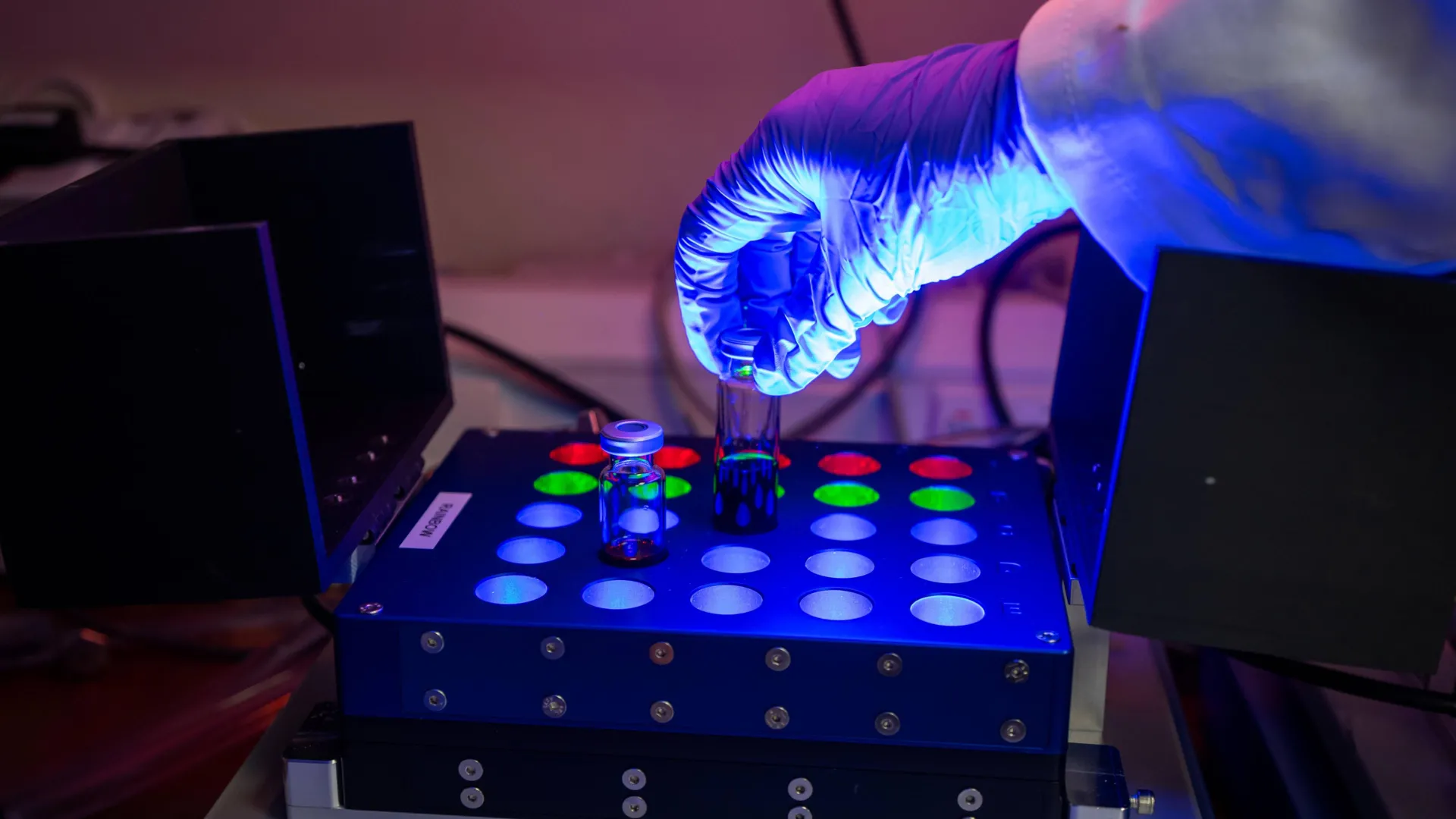
The Cambridge team’s "anti-Friedel-Crafts" reaction ingeniously reverses this paradigm. Instead of requiring potent reagents and elevated temperatures, their novel approach is initiated by simple LED light at ambient temperature. This triggers a self-sustaining chain reaction that efficiently forms crucial carbon-carbon bonds under remarkably mild conditions. This breakthrough allows chemists to make precise alterations to drug molecules much later in the development cycle, a capability that has previously been exceptionally challenging and time-consuming.
LED-Activated Precision: The Core of the Innovation
At the heart of this discovery lies the remarkable ability of light to activate a cascade of chemical events. Unlike conventional methods that often demand high temperatures or corrosive substances to forge carbon-carbon bonds, the Cambridge technique employs a photocatalyst activated by visible light from an LED lamp. This activation initiates a chain reaction that selectively targets and forms these vital bonds without the need for hazardous chemicals or expensive metal catalysts.
This has profound practical implications for drug development. Currently, if a medicinal chemist identifies a potential improvement to a drug candidate – perhaps to enhance efficacy, reduce side effects, or improve bioavailability – making that small change might necessitate a complete redesign of the synthesis. This can involve painstakingly dismantling large portions of the molecule and rebuilding them, a process that can consume weeks or even months of dedicated research. The new Cambridge method bypasses this laborious dismantling and rebuilding, enabling chemists to directly modify complex molecular structures with unprecedented ease and precision, even at the late stages of development.
"We’ve discovered a new method to make highly specific modifications to intricate drug molecules, particularly those that have proven exceptionally difficult to alter using existing techniques," stated David Vahey, the lead author of the study and a PhD researcher at St John’s College, Cambridge. "Previously, scientists might spend months rebuilding substantial parts of a molecule simply to test a minor structural alteration. Now, instead of undertaking a multi-step synthesis for hundreds of molecules, researchers can begin with a promising ‘hit’ compound and introduce small, targeted modifications much later in the process."
Vahey elaborated on the transformative potential: "This reaction empowers scientists to implement precise adjustments much later in the development pipeline, under gentle conditions and without recourse to toxic or costly reagents. This effectively unlocks previously inaccessible chemical space, providing medicinal chemists with a cleaner, more efficient toolkit for exploring novel drug variants."
Accelerating Discovery, Minimizing Environmental Impact
The implications of this light-driven chemistry extend beyond mere speed and efficiency. By reducing the number of synthetic steps required, the technique inherently leads to a lower consumption of chemicals, decreased energy usage, and a significantly smaller environmental footprint for drug development. This aligns with the growing global imperative for sustainable practices within the chemical and pharmaceutical industries.
Furthermore, the reaction’s exceptional selectivity is a critical advantage. It allows chemists to modify one specific part of a molecule without inadvertently affecting other sensitive functional groups. This precision is paramount in drug design, as even minute structural changes can profoundly influence a drug’s interaction with biological targets, its metabolic fate within the body, and the potential for adverse side effects.
At its fundamental level, the breakthrough addresses one of chemistry’s most enduring challenges: the efficient and selective formation of carbon-carbon bonds. These bonds form the structural backbone of an astonishing array of substances, from the fuels that power our world and the plastics that shape our daily lives to the intricate molecules that sustain biological processes.
The technique also exhibits what chemists refer to as "high functional-group tolerance." This means it can selectively modify one region of a molecule while leaving other reactive parts of the molecule intact. This characteristic makes the reaction particularly valuable for late-stage optimization, a critical phase in drug discovery where scientists fine-tune lead compounds to enhance their therapeutic performance.
The avoidance of heavy metals, harsh reaction conditions, and lengthy synthesis pathways not only streamlines the process but also holds the promise of reducing toxic waste generation and energy consumption in large-scale pharmaceutical manufacturing. These environmental benefits are increasingly vital as the chemical industry strives to mitigate its ecological impact.
Roots in Sustainable Chemistry Research
The work by Vahey and his colleagues is situated within the broader research agenda of Professor Erwin Reisner’s group at Cambridge. Professor Reisner’s team is renowned for its pioneering efforts in developing chemical systems inspired by natural processes, particularly photosynthesis. Their research endeavors to harness solar energy to convert waste materials, water, and atmospheric carbon dioxide into valuable chemicals and fuels, embodying a commitment to circular economy principles.
Professor Reisner, who holds the Yusuf Hamied Professorship of Energy and Sustainability in the Department of Chemistry and is the lead author of the study, emphasized the significance of their findings. "This represents a novel approach to forging a fundamental carbon-carbon bond, which underscores its immense potential impact. It also allows chemists to circumvent an undesirable and inefficient process for drug modification."
The researchers rigorously tested their new reaction on a diverse range of drug-like molecules. Crucially, they demonstrated its adaptability to continuous flow systems, a common and highly efficient methodology employed in industrial chemical production. Their collaboration with pharmaceutical giant AstraZeneca provided valuable insights into whether the technique could meet the stringent practical and environmental requirements demanded by large-scale pharmaceutical manufacturing.
"Transitioning the chemical industry towards sustainability is arguably one of the most formidable aspects of the entire global energy transition," Professor Reisner remarked.
Serendipity and the Spark of Discovery
The genesis of this significant breakthrough, like many seminal scientific discoveries throughout history, can be traced back to an unexpected laboratory outcome. This phenomenon of accidental discovery is a recurring theme in scientific annals, with notable examples including X-rays, penicillin, Viagra, and modern weight-loss medications.
"It was a process of failure after failure, and then, amidst the perceived chaos, we stumbled upon something entirely unexpected – a true diamond in the rough," Vahey recounted. "This discovery was entirely thanks to a failed control experiment."
Vahey had been conducting experiments involving a photocatalyst. During a control experiment designed to isolate variables, he removed the photocatalyst. To his surprise, the reaction proceeded just as effectively, and in some instances, even more so, without it. Initially, the unusual product that formed appeared to be an anomaly, an experimental error. However, rather than dismissing it, the researchers recognized the potential significance of this unexpected result and pursued further investigation.
According to Professor Reisner, the ability to identify and explore the value inherent in unexpected findings is a critical hallmark of successful scientific inquiry. "Recognizing the worth in the unexpected is probably one of the key characteristics of a successful scientist," he stated.
The Role of AI in Modern Scientific Exploration
Following the initial uncovering of the novel chemistry, the team integrated machine learning models, developed in collaboration with researchers at Trinity College Dublin, to predict the reaction’s behavior on entirely new molecular structures that had not yet been experimentally tested. These artificial intelligence systems learn patterns from extensive datasets of known chemical reactions, enabling them to simulate potential outcomes before costly and time-consuming laboratory experiments are conducted. This predictive capability allows researchers to identify promising molecular candidates more rapidly and with significantly reduced trial-and-error.
"We generate enormous amounts of data, and increasingly we leverage artificial intelligence to help analyze it," explained Professor Reisner. "We have an algorithm that can predict reactivity. AI is beneficial because it eliminates the need for chemists to engage in endless trial and error; however, an algorithm can only operate within the parameters it has been given. It still requires a human being to observe something that appears anomalous and question whether it might, in fact, represent something entirely new."
In this instance, it was David Vahey’s keen observation and willingness to question the unexpected that propelled the research forward. "David could have easily dismissed it as a failed control experiment," Reisner observed. "Instead, he paused and reflected on what he was witnessing. That moment, the decision to investigate rather than ignore it, is precisely where discovery happens."
For Vahey, this discovery represents a significant enhancement of the capabilities available to scientists engaged in drug discovery and development. "What the industry and other researchers do with this technology next – that is where the future impact will lie," he stated. "For us, the lab is typically characterized by average to challenging days. The good days, however, are exceptionally rewarding."
Professor Reisner added a concluding thought on the nature of scientific progress: "As a chemist, you only need one or two truly exceptional days a year – and those can often stem from a failed experiment."
A Legacy of Accidental Discoveries
The serendipitous nature of this Cambridge breakthrough echoes a long and distinguished history of accidental scientific discoveries that have profoundly shaped our world. These often-unplanned findings, born from unexpected observations during experiments, have led to innovations ranging from life-saving medical treatments to revolutionary technological advancements.
Among the most famous of these accidental discoveries are:
- X-rays (1895): Wilhelm Conrad Röntgen’s investigation into electrical currents in vacuum tubes led him to observe a mysterious radiation that caused a nearby screen to glow, revealing the potential to visualize the internal structures of the human body.
- Radioactivity (1898): Marie Curie’s meticulous study of uranium minerals revealed an unexpectedly high level of radiation, prompting further investigation that ultimately led to the discovery of polonium and radium.
- Vulcanized Rubber (1839): Charles Goodyear’s accidental dropping of a mixture of rubber and sulfur onto a hot surface resulted in a material that was both strong and elastic, transforming rubber into a practical industrial commodity.
- Penicillin (1928): Alexander Fleming’s observation of mold that had accidentally contaminated a petri dish and inhibited bacterial growth led to the development of the first widely used antibiotic, revolutionizing medicine.
- Teflon (1938): Roy Plunkett’s work with refrigerant gases unexpectedly produced a highly slippery and heat-resistant material, which later found widespread use in nonstick cookware and industrial applications.
- Super Glue (1942): Harry Coover’s attempt to create transparent plastics resulted in the accidental development of a substance that bonded instantly to virtually any surface, becoming the ubiquitous super glue.
- LSD (1943): Albert Hofmann’s accidental absorption of a small amount of a synthesized compound led to the discovery of its powerful psychoactive effects, sparking significant research in neuroscience and broader cultural impact.
- Pulsars (1967): Jocelyn Bell Burnell’s analysis of radio telescope data revealed repeating signals that were initially dismissed as interference but were later identified as evidence of rapidly spinning neutron stars.
- Viagra (1990s): Researchers at Pfizer were investigating a drug for angina when patients reported an unexpected side effect, leading to the development of the drug now widely known for treating erectile dysfunction.
- Weight Loss Injections (2021): Scientists developing treatments for Type 2 diabetes discovered that drugs mimicking the hormone GLP-1 also induced significant weight loss, leading to the development of medications like Ozempic and Mounjaro for obesity management.
The discovery by the Cambridge team, born from a "failed control experiment," firmly places it within this esteemed lineage of scientific breakthroughs driven by curiosity, keen observation, and the courage to explore the unexpected. This light-powered chemical transformation offers a powerful new avenue for innovation in pharmaceutical research, promising to accelerate the delivery of safer, more effective medicines to patients worldwide while simultaneously promoting a more sustainable future for chemical manufacturing.