


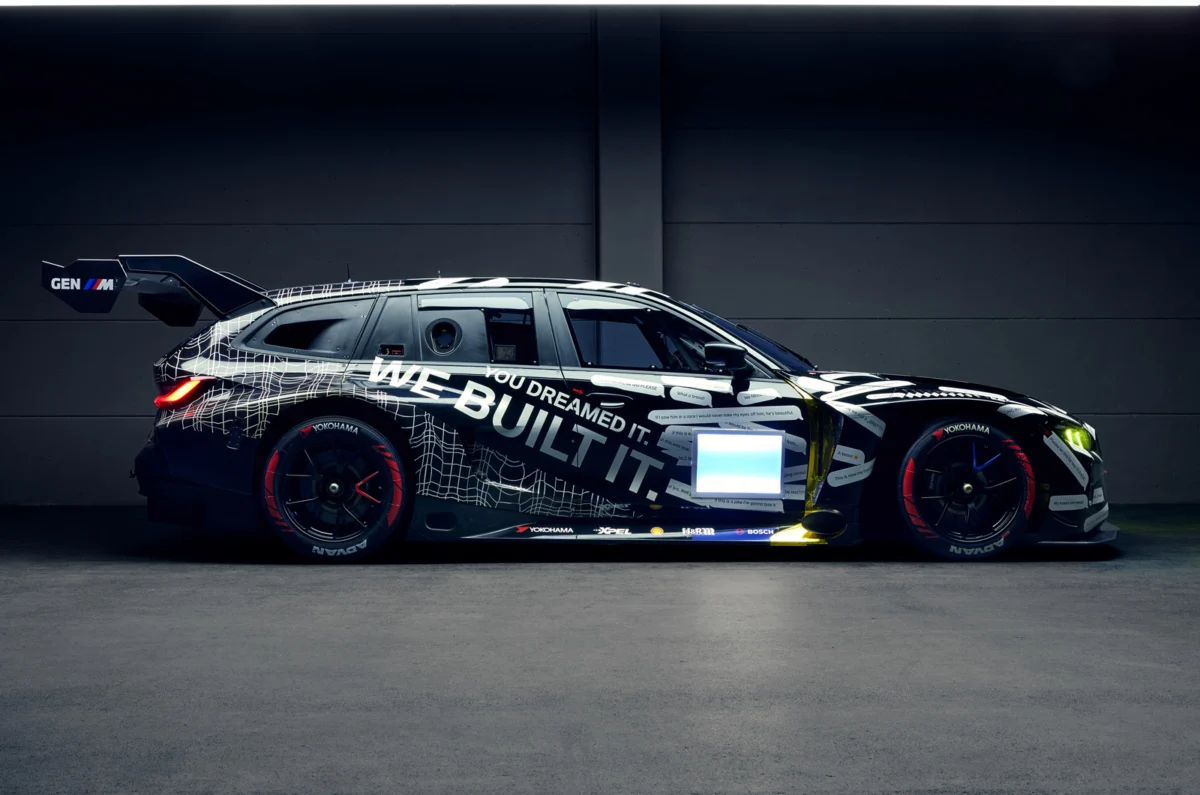
BMW M Motorsport has officially bridged the gap between digital satire and automotive engineering by unveiling the M3 Touring 24H, a high-performance racing iteration of the G81-generation estate. The vehicle, which originated as an April Fools’ Day prank in 2023, is scheduled to make its competitive debut next weekend at the Nürburgring Langstrecken-Serie (NLS) on the legendary Nordschleife. This transition from a social media concept to a physical, race-ready machine represents a significant shift in how manufacturers respond to enthusiast engagement and digital trends, marking one of the most rapid development cycles in the history of BMW’s racing division.
From Digital Concept to Competitive Reality
The genesis of the BMW M3 Touring 24H can be traced back to April 1, 2023, when BMW’s social media channels shared a set of realistic renderings depicting a GT3-specification version of the long-awaited M3 Touring. At the time, the post was intended as a lighthearted nod to the "fast wagon" enthusiast community, which had spent years lobbying for a production M3 estate. However, the public reaction exceeded all internal projections. The "overwhelming" response from fans, coupled with persistent inquiries from potential customer racing teams, prompted BMW M leadership to evaluate the feasibility of a physical build.
The project was officially greenlit following an internal review that assessed the compatibility of the M3 Touring’s chassis with existing GT3 components. The result is an intensive eight-month engineering program aimed at producing a vehicle capable of enduring the rigors of endurance racing at the "Green Hell." While BMW has a storied history of racing coupes and sedans, a factory-backed racing estate represents a departure from traditional GT racing silhouettes, placing the M3 Touring 24H in a unique niche within the motorsport ecosystem.
Technical Architecture and Performance Specifications
Underneath its elongated roofline, the M3 Touring 24H is a technological sibling to the highly successful BMW M4 GT3. By utilizing the M4 GT3’s proven drivetrain and suspension architecture, BMW engineers were able to compress the development timeline significantly. The heart of the machine is the P58 3.0-liter twin-turbocharged straight-six engine. This power unit is a heavily modified version of the S58 engine found in the road-going M3 and M4 models but optimized for the extreme thermal and mechanical stresses of 24-hour endurance cycles.
In its racing trim, the engine delivers 586bhp, representing an 86bhp increase over the standard M3 Touring Competition. More importantly, the racing version benefits from a drastic reduction in curb weight. While the road car weighs approximately 1,865kg due to its xDrive system and luxury interior, the 24H variant has been stripped to its bare essentials. Extensive use of carbon-fiber-reinforced plastic (CFRP) for the body panels, the removal of all sound deadening and rear seating, and the installation of a lightweight FIA-specification roll cage have likely shed several hundred kilograms. Although BMW has not released official performance figures, the power-to-weight ratio suggests a vehicle that will be significantly faster than its road-legal counterpart, particularly in high-speed cornering and braking zones.
The drivetrain has also been overhauled for competition. While the road car utilizes a torque-converter automatic and all-wheel drive, the M3 Touring 24H follows GT3 conventions by sending power exclusively to the rear wheels via a six-speed Xtrac sequential racing gearbox. This setup not only saves weight but also aligns the car with the handling characteristics required for professional GT racing.
The Nürburgring Debut and Competitive Category
The M3 Touring 24H will make its first appearance on the track during the upcoming Nürburgring Langstrecken-Serie (NLS) weekend. The car will be operated by Schubert Motorsport, a long-time partner of BMW M with a proven track record in both the DTM and the Nürburgring 24 Hours. Due to its unique body style and the fact that it does not strictly adhere to the global FIA GT3 homologation standards, the car will compete in the SPX category.
The SPX class is reserved for "special" or unhomologated vehicles, often serving as a testing ground for manufacturers to trial new technologies or showcase experimental projects. By entering the SPX class, the M3 Touring 24H will not compete directly for the overall win against the top-tier SP9 (GT3) field, which includes BMW’s own M4 GT3s. Instead, it will serve as a high-profile "fan car," designed to demonstrate the versatility of the M3 platform while providing a spectacle for the thousands of spectators who frequent the Nordschleife.
For its initial outings, the car will wear a "tribute livery" that incorporates actual comments and reactions from the original April Fools’ social media post. This design choice reinforces the car’s identity as a project born from community engagement. However, for its formal race debut next weekend, BMW has confirmed that a new, dedicated racing livery will be unveiled.
Strategic Implications for BMW M Motorsport
The decision to build the M3 Touring 24H is more than just a marketing exercise; it reflects a broader strategy within BMW M to leverage its "M Motorsport" heritage to bolster the brand’s road car sales. The M3 Touring has been a commercial success for BMW, with demand far outstripping initial production estimates in European and Asian markets. By placing a racing version of the estate on the world’s most demanding circuit, BMW reinforces the "track-bred" credentials of the entire M3 lineup.
Andreas Roos, Head of BMW M Motorsport, emphasized the emotional weight of the project during the unveiling. “A project like the BMW M3 Touring 24H has never existed at BMW M Motorsport before,” Roos stated. He noted that the project was a labor of love for the engineering team and a direct gift to the fans who have remained loyal to the "M" brand’s racing roots. Roos’s comments suggest that BMW is increasingly willing to explore "passion projects" that may not have a traditional business case but provide immense brand value and fan loyalty.
Furthermore, the existence of the M3 Touring 24H raises questions about the future of BMW’s customer racing program. Currently, the M4 GT3 is the flagship offering for privateer teams, retailing for approximately £500,000. While BMW has not yet announced plans to sell the M3 Touring 24H to customers, the development of a race-ready estate could open a new niche in the market for collectors or teams looking for a distinctive entry in non-homologated series or "Track Day" specials.
Analysis: The Power of Community-Driven Development
The M3 Touring 24H serves as a case study in the power of modern digital feedback loops. In previous decades, the gap between a manufacturer’s "joke" and a production reality would have been insurmountable due to the rigid nature of automotive product planning. However, the rise of digital rendering and social media has allowed manufacturers to "prototype" ideas in the public eye before committing a single Euro to physical development.
By monitoring the "overwhelming" reaction to the 2023 prank, BMW was able to quantify the market interest in a racing wagon. This data-driven approach allowed the board to approve an eight-month development cycle—a timeframe that is remarkably short by industry standards. It also highlights a growing trend where the line between "content" and "product" is blurring. The M3 Touring 24H is as much a piece of high-performance machinery as it is a physical manifestation of a viral moment.
However, the "M2 Dakar"—another April Fools’ concept involving an off-road-ready M2—remains in the digital realm. This suggests that while BMW is open to fan-driven projects, they must still align with the brand’s core racing competencies. A GT3-based wagon is a logical extension of existing engineering; a Dakar-style coupe would require a ground-up platform development that likely lacks the same immediate technical synergy.
Future Outlook and the Road Ahead
As the M3 Touring 24H prepares for its first laps of the Nürburgring, the automotive world will be watching closely to see how the estate’s unique aerodynamics and weight distribution handle the Nordschleife’s 154 turns. The "long-roof" design presents unique challenges, particularly regarding rear-axle downforce and high-speed stability compared to the more traditional M4 GT3 coupe.
While the current plan focuses on the NLS and the celebratory nature of the car’s debut, the successful integration of GT3 hardware into the Touring body could pave the way for more "special edition" racing projects. Whether this leads to a limited production run of "CS" or "CSL" wagons for the road, or a new category of customer racing vehicles, remains to be seen. For now, the M3 Touring 24H stands as a testament to the fact that in the modern automotive era, the fans occasionally have a seat at the drafting table.
The competitive debut next weekend will be a litmus test for the vehicle’s durability and pace. If the M3 Touring 24H performs as well as its M4 sibling, it will solidify the G81 M3 Touring’s legacy not just as a practical performance car, but as a legitimate contender in the world of professional motorsport. For the fans at the Nürburgring, the sight of a 586bhp racing estate thundering through the Foxhole or ascending toward Hohe Acht will be the ultimate realization of a digital dream.