


The integration of Manthey Racing’s performance engineering into the official Porsche production ecosystem has reached a definitive milestone with the release of the Manthey Kit for the 992-generation 911 GT3 RS. Priced at £99,999, the kit represents a significant financial investment, equivalent to the base price of a contemporary 911 Carrera. However, the primary shift in the consumer experience lies in accessibility; for the first time, the Manthey Kit is available as a factory-sanctioned optional extra through the Porsche configurator. This transition marks the culmination of a decade-long integration process following Porsche’s acquisition of a 51% majority stake in Manthey Racing in 2013. The resulting package is a fully homologated, warranty-compliant upgrade that elevates the GT3 RS from a high-performance road car to a machine capable of rivaling dedicated racing prototypes in aerodynamic efficiency.
Technical Evaluation and Comparative Performance Data
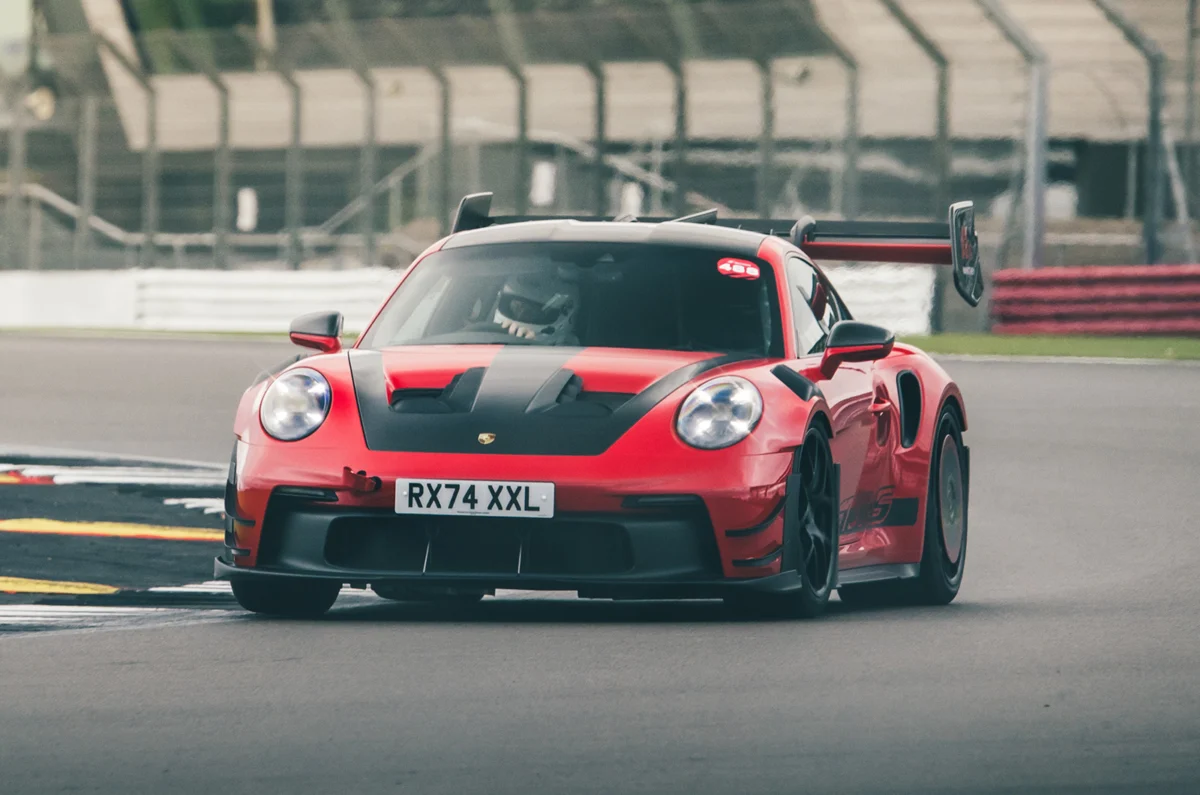
To quantify the efficacy of the Manthey Kit, technical evaluators conducted a year-on-year comparison at the Silverstone Grand Prix circuit. The baseline was established in November 2024 using a standard 992 GT3 RS. Under specific ambient conditions—12 degrees Celsius with a damp morning track transitioning to dry by mid-afternoon—the standard vehicle recorded a benchmark lap time of 2:13.10. During this session, the standard GT3 RS demonstrated the capabilities of its Porsche Active Suspension Management (PASM) system, recording lateral acceleration peaks of nearly 1.8g.
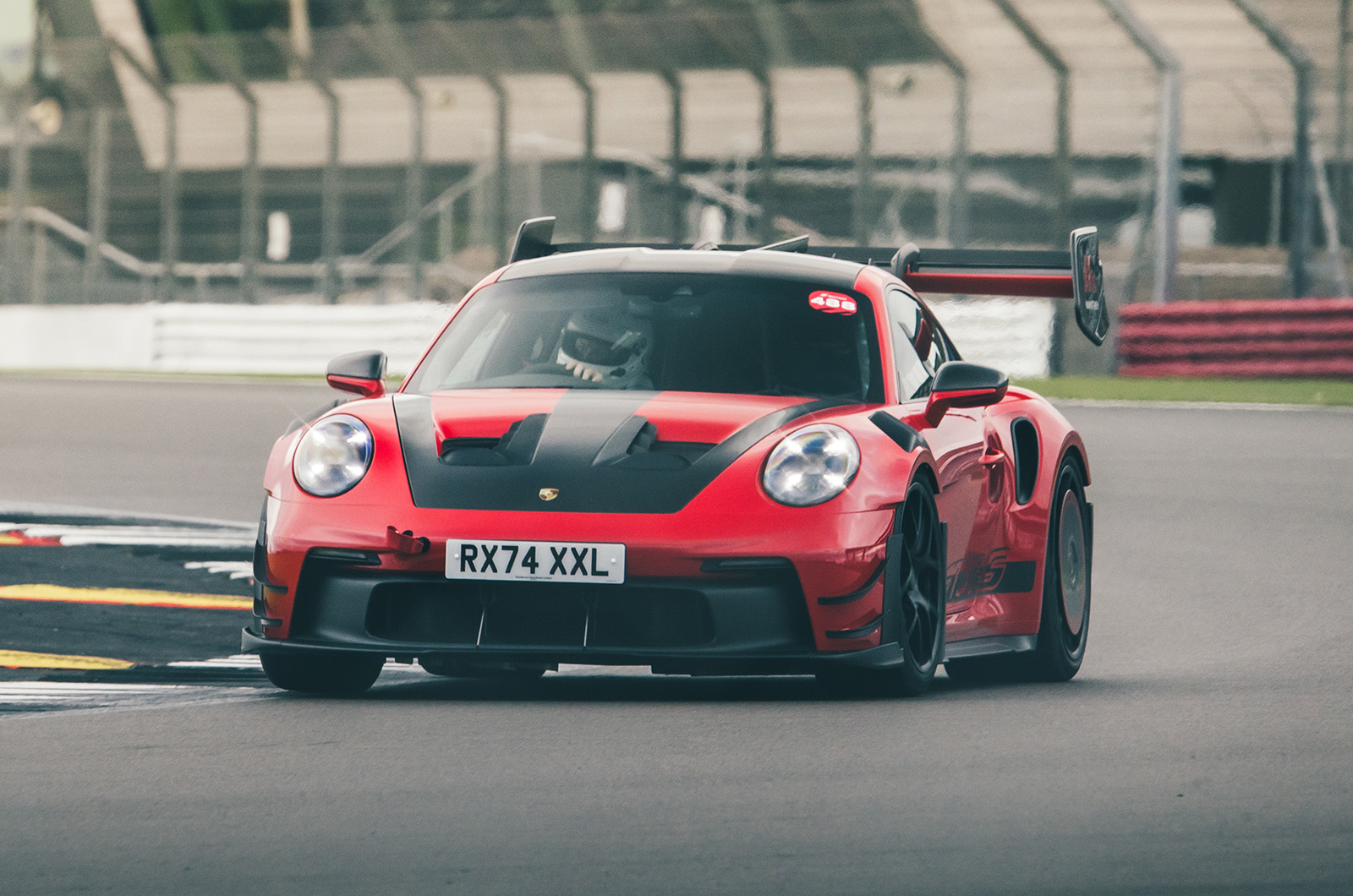
Exactly one year later, in November 2025, the Manthey-equipped GT3 RS was tested under identical meteorological conditions and on the same tire specification: the Michelin Pilot Sport Cup 2. The Manthey Kit recorded a lap time of 2:11.15, representing a 1.95-second improvement over the standard model. Telemetry data indicates that the Manthey Kit’s primary advantage is not found in outright braking distances, which remained largely consistent with the base model, but in mid-corner speed and stability. The vehicle demonstrated the ability to carry higher velocity through high-speed transitions, such as the Maggotts-Becketts-Chapel sequence, and maintained higher exit speeds on the kerbs of the Farm curve.
Mechanical and Aerodynamic Engineering Enhancements
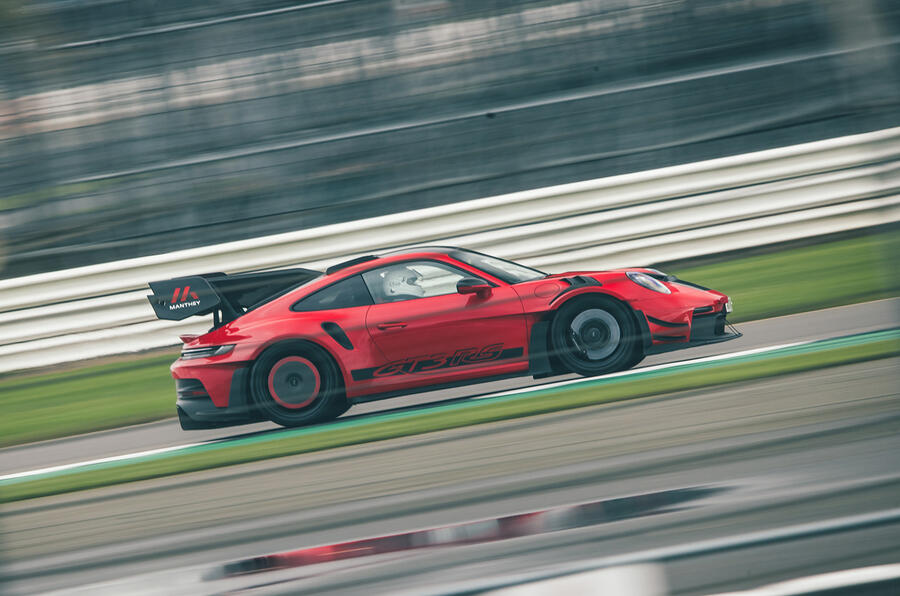
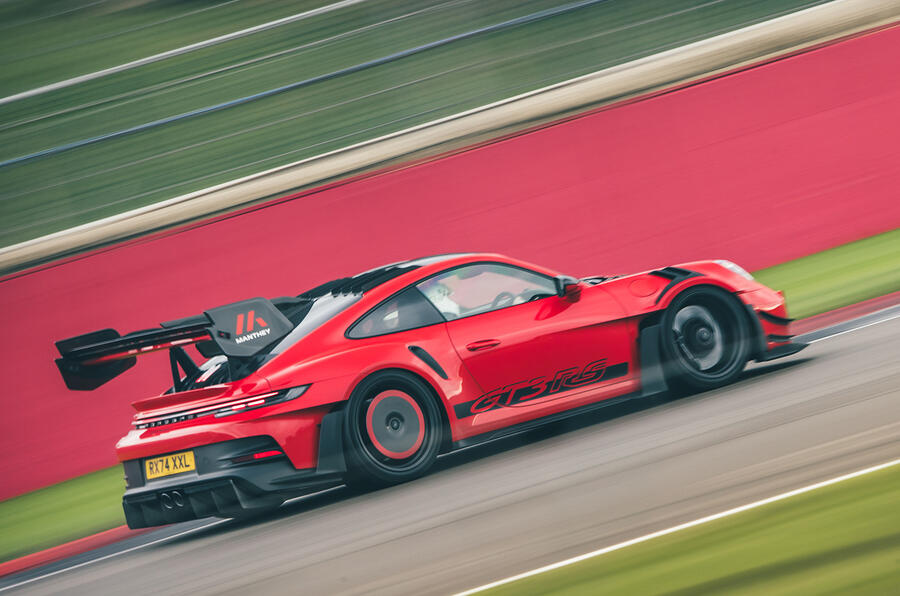
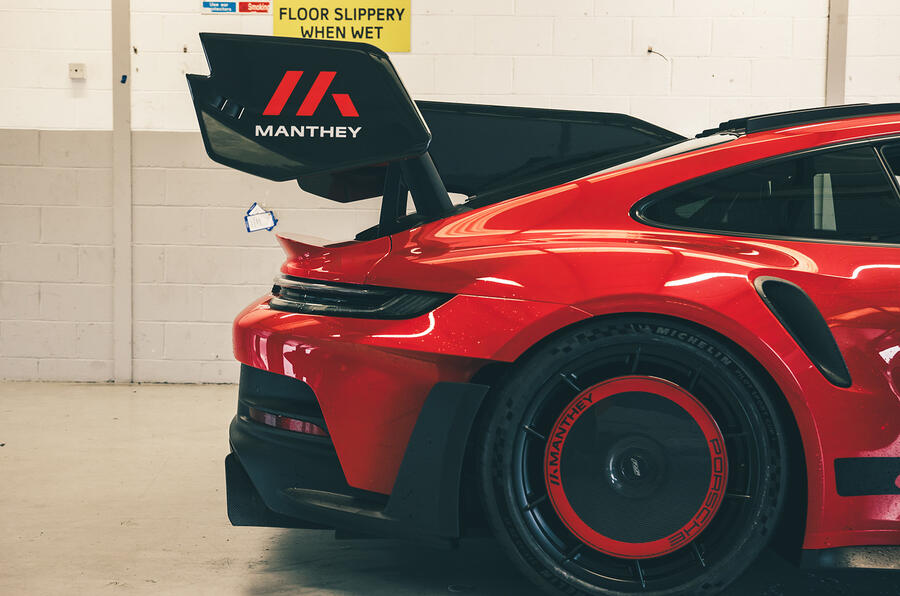
The Manthey Kit for the 992 GT3 RS is defined by a comprehensive suite of aerodynamic and chassis modifications designed to maximize mechanical grip and downforce. The most striking visual and functional change is the addition of a longitudinal "shark fin" on the roof and engine cover, which improves directional stability at high speeds. The rear of the vehicle features a redesigned wing with larger endplates and a revised angle of attack, contributing to a total downforce figure exceeding 1,000 kilograms at speed.
Beyond aerodynamics, the kit introduces significant hardware changes to the chassis:
- Suspension: The standard setup is replaced with a coilover system featuring inverted dampers. These units utilize rose-jointed connections, replacing traditional rubber bushings to provide more granular feedback and eliminate compliance under high lateral loads.
- Braking: While the calipers and discs remain largely unchanged, the kit includes braided steel brake lines. These lines reduce pedal sponginess under extreme heat, providing a more consistent "bite" point during heavy deceleration from triple-digit speeds.
- Aero Discs: The rear wheels are fitted with carbon-fiber aerodynamic discs. These components reduce turbulence within the wheel arches, smoothing the airflow along the flanks of the car toward the rear diffuser.
The subjective result of these changes is a vehicle that feels significantly more "granular" in its communication with the driver. Technical reports note an increase in mechanical noise—specifically the clinking of the rose joints and the resonance of the stripped-back interior—which reinforces the car’s identity as a track-focused instrument rather than a grand tourer.
Chronology of the Porsche-Manthey Partnership
The development of the 992 GT3 RS Manthey Kit is the latest chapter in a strategic partnership that began in the late 1990s. Manthey Racing, founded by Olaf Manthey in 1996, quickly established itself as the preeminent Porsche racing team, particularly at the Nürburgring Nordschleife.
- 1996: Manthey Racing is established in Meuspath, Germany.
- 1999–2006: The team secures multiple class wins at Le Mans and total dominance at the 24 Hours of Nürburgring.
- 2013: Porsche AG acquires a 51% stake in Manthey Racing GmbH. This move was intended to consolidate Porsche’s GT racing efforts and bring Manthey’s specialized "Performance Kits" under official factory oversight.
- 2018: The 911 GT2 RS MR (Manthey Racing) sets a road-legal lap record at the Nürburgring, proving the commercial viability of the kits.
- 2021–2023: Porsche begins integrating Manthey engineering earlier in the vehicle development cycle, leading to the 992-generation projects.
- 2024/2025: The Manthey Kit becomes a standard option on the Porsche configurator, eliminating the need for owners to send their vehicles to Meuspath for aftermarket installation.
The One-Tonne Club: Market Positioning and Comparisons
Achieving 1,000kg (one tonne) of downforce is a milestone typically reserved for seven-figure hypercars or non-road-legal track toys. By reaching this threshold, the Manthey GT3 RS joins an elite group of vehicles that utilize extreme aerodynamics to manipulate airflow for performance.
For context, the Caparo T1, a pioneer in this field in 2007, produced 875kg of downforce but suffered from reliability and usability issues. Modern members of the "one-tonne club" include the Mercedes-AMG One, which utilizes Formula 1-derived active aerodynamics, and the Aston Martin Valkyrie, which relies on massive underbody Venturi tunnels. The Czinger 21C, an AI-designed hypercar, also occupies this space.
In comparison to these multi-million-pound vehicles, the Manthey-equipped GT3 RS—while expensive at nearly £300,000 total (including the donor car)—is viewed by industry analysts as a high-value proposition for track-day enthusiasts. It offers comparable aerodynamic performance to the "Holy Trinity" of hypercars but with the reliability and serviceability of a mass-produced Porsche.
Implications for the Amateur and Professional Driver
The 1.95-second improvement at Silverstone raises questions regarding the "diminishing returns" of automotive performance. At a cost of approximately £51,280 per second saved, the Manthey Kit is a premium product aimed at a specific demographic: the "track-day warrior."
For the amateur driver, the kit’s value lies in confidence. The increased downforce and the precision of the rose-jointed suspension allow the driver to approach the limit of adhesion with greater predictability. The car "sticks" in high-speed sweepers where a standard GT3 RS might exhibit slight yaw or instability.
For professional drivers, the advantage is even more pronounced. A professional can exploit the additional grip at the very edge of the friction circle, maximizing the aerodynamic load in corners like Copse or Stowe. However, some analysts argue that the kit makes the car "rawer" and "twitchier" on public roads, suggesting that the Manthey Kit effectively narrows the vehicle’s operational window, moving it further away from a "road car" and closer to a "declassified racing car."
Broader Impact on the Automotive Industry
The success of the Manthey Kit highlights a growing trend in the ultra-high-performance segment: the factory-supported "track pack." As manufacturers face increasing pressure to differentiate their products in a crowded market, partnerships like Porsche-Manthey provide a template for success.
- Warranty Preservation: By bringing Manthey into the fold, Porsche allows customers to modify their vehicles without voiding factory warranties, a major pain point for high-net-worth collectors.
- Homologation Expertise: The kit is fully road-legal and homologated, a feat that would be prohibitively expensive for smaller aftermarket tuners to achieve independently.
- Data-Driven Development: The use of Nürburgring-tested data and professional telemetry ensures that performance claims are verifiable and repeatable.
The 911 GT3 RS with the Manthey Kit stands as a testament to the pursuit of marginal gains. While the standard RS is already a benchmark for performance, the Manthey version demonstrates that there is always more to be extracted through the meticulous application of aerodynamic and mechanical engineering. As the industry moves toward electrification, these highly specialized, internal-combustion track machines are likely to become even more coveted by enthusiasts seeking the ultimate analog driving experience.