


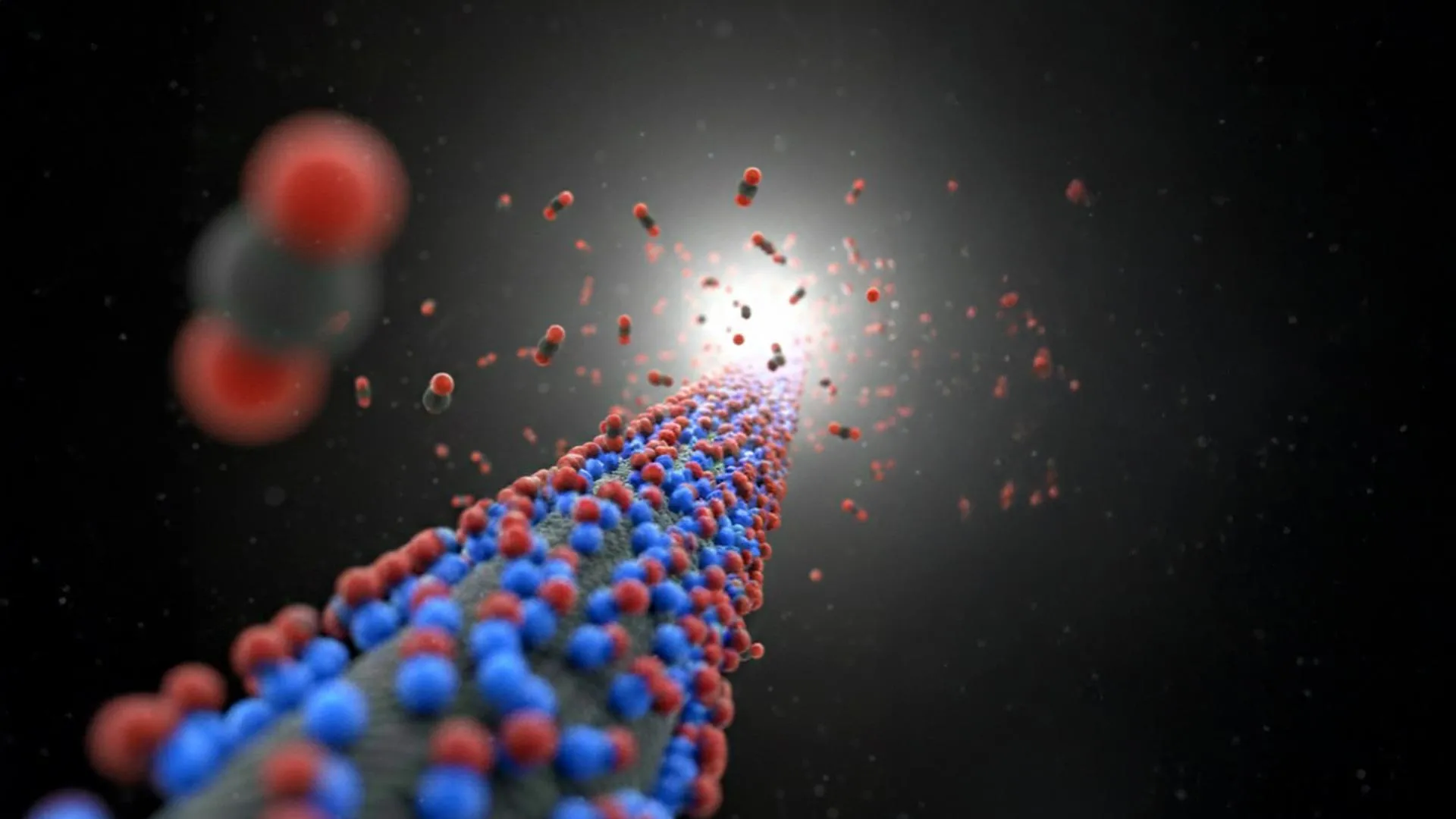
Stopping carbon dioxide (CO2) from entering the atmosphere remains a paramount global challenge in the fight against climate change. While carbon capture technologies have existed for decades, their widespread adoption has been hampered by high costs and inefficiencies, particularly with conventional methods like aqueous amine scrubbing. This established industrial process necessitates significant energy input to heat large volumes of liquid above 100°C to release captured CO2 and regenerate the scrubbing solution. The substantial energy demand translates directly into elevated operating expenses, posing a considerable barrier to large-scale implementation. Recognizing these limitations, a research team at Chiba University in Japan has developed a groundbreaking class of carbon materials, dubbed "viciazites," engineered with precisely positioned nitrogen functional groups to dramatically improve CO2 capture efficiency and reduce energy consumption.
The Imperative for Advanced Carbon Capture
The urgency to mitigate greenhouse gas emissions stems from the scientific consensus on the drivers of climate change. The Intergovernmental Panel on Climate Change (IPCC) has repeatedly highlighted the need for aggressive emission reductions across all sectors to avert the most catastrophic impacts of global warming. Carbon capture, utilization, and storage (CCUS) technologies are identified as crucial components of this strategy, particularly for industries where emissions are difficult to abate, such as cement production, steel manufacturing, and certain chemical processes. However, the economic viability of these technologies hinges on their ability to operate at competitive costs. The energy penalty associated with traditional capture methods, primarily the regeneration of sorbent materials, represents a significant portion of the overall operational expense. Therefore, innovations that lower this energy requirement are vital for accelerating the deployment of carbon capture solutions.
The Promise of Solid Sorbents and the Challenge of Control
In contrast to liquid-based systems, solid carbon materials have emerged as a promising alternative for CO2 capture. These materials, often derived from abundant and relatively inexpensive precursors, possess large surface areas that facilitate the adsorption of CO2 molecules. Crucially, they can release captured CO2 at much lower temperatures compared to amine scrubbing, especially when functionalized with nitrogen-based groups. The presence of nitrogen atoms, particularly in specific chemical configurations, enhances the material’s affinity for CO2. However, a persistent hurdle in optimizing these solid sorbents has been the lack of precise control over the placement of these nitrogen functional groups during synthesis. Traditional manufacturing methods often result in a random distribution of nitrogen atoms across the carbon matrix, making it challenging to establish definitive structure-activity relationships and identify the optimal arrangements for superior CO2 capture performance.
Chiba University’s Breakthrough: Engineering Viciazites with Precision
Addressing this critical limitation, a collaborative research effort led by Associate Professor Yasuhiro Yamada from the Graduate School of Engineering and Associate Professor Tomonori Ohba from the Graduate School of Science at Chiba University has culminated in the development of "viciazites." This novel class of carbon materials is distinguished by its meticulously engineered structure, featuring nitrogen functional groups positioned in close proximity to each other in a controlled manner. The pioneering work, published in the esteemed journal Carbon, details the synthesis and characterization of these materials, with Mr. Kota Kondo also contributing as a co-author from Chiba University. This research moves beyond the serendipitous discovery of functional materials to a deliberate, molecular-level design approach.
Strategic Synthesis of Adjacent Nitrogen Configurations
The research team employed a sophisticated, multi-step synthesis protocol to create three distinct viciazite variants, each characterized by a unique type of neighboring nitrogen configuration. The objective was to systematically investigate how the specific adjacency of different nitrogen species influences CO2 adsorption and desorption properties.
1. Adjacent Primary Amine Groups (-NH2):
To achieve the targeted arrangement of adjacent primary amine groups, the researchers initiated the process by heating coronene, a polycyclic aromatic hydrocarbon. This was followed by a bromination step, introducing bromine atoms onto the coronene structure. Finally, treatment with ammonia gas led to the substitution of bromine atoms with amine groups. This three-step synthetic pathway demonstrated a remarkable selectivity of 76%, indicating that a significant majority of the introduced nitrogen atoms were successfully positioned in the desired adjacent primary amine configurations. This level of control is a significant advancement over previous methods.
2. Adjacent Pyrrolic Nitrogen:
A second viciazite variant was synthesized to feature adjacent pyrrolic nitrogen atoms. Pyrrolic nitrogen is incorporated into a five-membered ring within the carbon structure. The synthesis of this material also involved precise chemical transformations, resulting in a high selectivity of 82% for the desired adjacent pyrrolic nitrogen arrangement. This suggests a robust and reproducible method for generating this specific functionalization.
3. Adjacent Pyridinic Nitrogen:
The third material explored by the team contained adjacent pyridinic nitrogen. Pyridinic nitrogen atoms are bonded to two carbon atoms within the aromatic ring. The synthesis for this configuration yielded a selectivity of 60%, indicating that while achievable, this specific arrangement presented a slightly greater challenge in terms of precise placement compared to the other two types.
The high selectivity achieved in these syntheses is crucial. It signifies that the researchers are not merely introducing nitrogen into the carbon material but are doing so in a manner that creates specific, ordered arrangements, thereby allowing for a clearer understanding of the structure-property relationships.
Verifying Structure and Quantifying Performance
Following their synthesis, the viciazite materials were applied to activated carbon fibers (ACFs) to create practical samples suitable for performance testing. The precise placement and nature of the nitrogen groups were rigorously confirmed using a suite of advanced analytical techniques. These included:
- Nuclear Magnetic Resonance (NMR) Spectroscopy: This technique provides detailed information about the chemical environment of atoms, allowing researchers to identify the types of nitrogen present and their connectivity.
- X-ray Photoelectron Spectroscopy (XPS): XPS is sensitive to the surface elemental composition and chemical states of a material, confirming the presence and bonding of nitrogen on the carbon surface.
- Computational Modeling: Theoretical calculations and simulations were employed to predict and validate the structures and bonding configurations of the viciazites. These models helped to interpret the experimental data and provide insights into the electronic interactions driving CO2 adsorption.
These complementary techniques collectively provided irrefutable evidence that the nitrogen atoms were indeed positioned adjacently, rather than being randomly dispersed throughout the carbon matrix. This confirmation of structural integrity is foundational to understanding the observed performance differences.
Performance Metrics: CO2 Adsorption and Desorption
When subjected to CO2 capture experiments, the viciazite materials exhibited distinct performance characteristics, directly correlating with their specific nitrogen configurations.
- Enhanced CO2 Capture: Samples featuring adjacent primary amine (-NH2) groups and those with adjacent pyrrolic nitrogen demonstrated a significantly higher capacity for adsorbing CO2 compared to untreated activated carbon fibers. This underscores the efficacy of these engineered nitrogen arrangements in enhancing CO2 affinity.
- Limited Improvement with Pyridinic Nitrogen: In contrast, the viciazite variant with adjacent pyridinic nitrogen configurations showed only marginal improvement in CO2 capture capacity. This suggests that while pyridinic nitrogen can contribute to CO2 adsorption, its adjacency may not be as beneficial as that of amine or pyrrolic groups for this specific capture mechanism.
The differential performance highlights the nuanced role of nitrogen functional group placement. It is not simply the presence of nitrogen but its specific chemical environment and proximity to other nitrogen atoms that dictates the material’s effectiveness.
The Game-Changer: Low-Temperature CO2 Release
Perhaps the most significant finding of this research relates to the energy required to release the captured CO2. The regeneration of sorbent materials is a major energy sink in carbon capture processes. The viciazites have demonstrated a remarkable ability to desorb CO2 at considerably lower temperatures.
"Performance evaluation revealed that in carbon materials where NH2 groups are introduced adjacently, most of the adsorbed CO2 desorbs at temperatures below 60 °C," stated Dr. Yamada. "By combining this property with industrial waste heat, it may be possible to achieve efficient CO2 capture processes with substantially reduced operating costs."
This observation is particularly impactful. Many industrial processes generate waste heat at temperatures below 100°C, which is often released into the atmosphere. The ability of these viciazites to utilize such low-grade heat for CO2 regeneration could revolutionize the economics of carbon capture. By integrating these materials into industrial flue gas streams, facilities could potentially capture CO2 and regenerate the sorbent using readily available waste heat, thereby minimizing the need for external energy input and drastically cutting operational expenses.
The pyrrolic nitrogen-containing viciazites, while also showing good CO2 capture, required slightly higher temperatures for desorption. However, this may be compensated by potential advantages in long-term stability due to the inherently stronger chemical bonds associated with pyrrolic structures, suggesting a trade-off between ease of regeneration and material durability that warrants further investigation.
A New Paradigm for Carbon Capture Material Design
This research establishes a clear and reproducible pathway for designing advanced carbon capture materials with tailored properties. By demonstrating that specific adjacent arrangements of nitrogen groups can be reliably synthesized and that these arrangements directly influence CO2 capture and release characteristics, the Chiba University team has provided a powerful new strategy for material development.
"Our motivation is to contribute to the future society and to utilize our recently developed carbon materials with controlled structures," Dr. Yamada emphasized. "This work provides validated pathways to synthesize designer nitrogen-doped carbon materials, offering the molecular-level control essential for developing next-generation, cost-effective, and advanced CO2 capture technologies."
The implications of this work extend beyond merely improving existing carbon capture methods. It opens the door to a new era of "designer" sorbent materials, where performance is optimized through precise control over molecular architecture. This approach has the potential to accelerate the development and deployment of CCUS technologies, making them more accessible and economically viable for a wider range of industrial applications.
Broader Applications and Future Potential
The tunable surface properties of viciazites suggest that their utility may not be limited to CO2 capture. The specific arrangements of nitrogen atoms can create unique chemical environments that are amenable to other applications. Researchers envision these materials being employed for:
- Metal Ion Removal: The nitrogen functional groups can act as chelating agents, enabling the efficient capture of heavy metal ions from wastewater streams, contributing to environmental remediation efforts.
- Catalysis: The tailored electronic and structural properties of viciazites could make them effective catalysts for various chemical reactions, offering a sustainable and potentially more efficient alternative to traditional catalysts.
The ability to engineer these materials for multiple purposes underscores their versatility and the broad scientific and industrial impact of this breakthrough.
Funding and Support for Innovation
This significant scientific advancement was made possible through the generous support of several key organizations. The research received funding from the Mukai Science and Technology Foundation, the Japan Society for the Promotion of Science (JSPS KAKENHI Grant Number JP24K01251), and the "Advanced Research Infrastructure for Materials and Nanotechnology in Japan (ARIM)" initiative of the Ministry of Education, Culture, Sports, Science and Technology (MEXT) under Grant Number JPMXP1225JI0008. Such dedicated funding for fundamental research in materials science and climate change solutions is crucial for driving the innovations needed to address global challenges.
The successful development of viciazites represents a critical step forward in the quest for efficient and affordable carbon capture solutions. By moving from random functionalization to precise molecular engineering, Chiba University researchers have paved the way for a new generation of sorbent materials with the potential to significantly contribute to global decarbonization efforts.