

The landscape of artificial intelligence in commercial operations is shifting from simple conversational interfaces to sophisticated agentic systems capable of long-term memory and autonomous decision-making. Developers at MongoDB have recently unveiled a comprehensive architectural framework for an "Agentic Event Venue Operator," a system designed to manage high-stakes environments like professional sports tournaments. This new approach addresses a critical gap in current AI implementations: the transition from stateless "demo" agents to operational agents that possess persistent memory, situational context, and the ability to record outcomes for future refinement.
In professional event management, the utility of an AI agent is often determined by its response time during crises. A standard large language model (LLM) can summarize weather reports or generate generic seating plans, but it lacks the operational depth required to navigate live disruptions. The newly proposed architecture enables an agent to remember past event histories, retrieve specific visitor profiles, respond to real-time environmental changes—such as sudden weather shifts—and document the success or failure of its interventions.
The Economic Stakes of Modern Event Operations
To understand the necessity of such advanced systems, one must look at the economic scale of global sporting events. The 2025 US Open serves as a primary benchmark for this industry, having recently shattered attendance and digital reach records. With a total player compensation pool of $90 million and an annual economic impact of more than $1.2 billion for New York City, the operational risks associated with mismanagement are immense.
Fan expectations have risen in tandem with ticket prices. Data from PwC indicates that approximately 60% of high-income sports fans in the United States are willing to spend over $250 for a special event, while 20% are prepared to exceed $1,000. For these "premier" guests, the experience must be seamless, regardless of external factors like weather. Furthermore, the U.S. Census Bureau has begun tracking the specific monetary impact of extreme weather on business sales, highlighting a growing need for predictive and reactive operational tools that can mitigate revenue loss during disruptions.

Technical Foundation: A Unified Data Layer
The core of the Agentic Event Venue Operator is built upon MongoDB Atlas, which serves as both the operational database and the semantic memory layer. By utilizing a single platform for operational records, vector embeddings, and agent checkpoints, the system eliminates the latency typically associated with synchronizing data across disparate databases.
In a scenario where a rain delay is imminent, every second counts. If a storm is 20 minutes away and hospitality capacity is shrinking, the operator cannot afford to wait for a batch summary or a delayed analytics pipeline. The agent must perceive the change, retrieve relevant guest history, decide on a redistribution of seating, and execute the plan while capacity still exists.
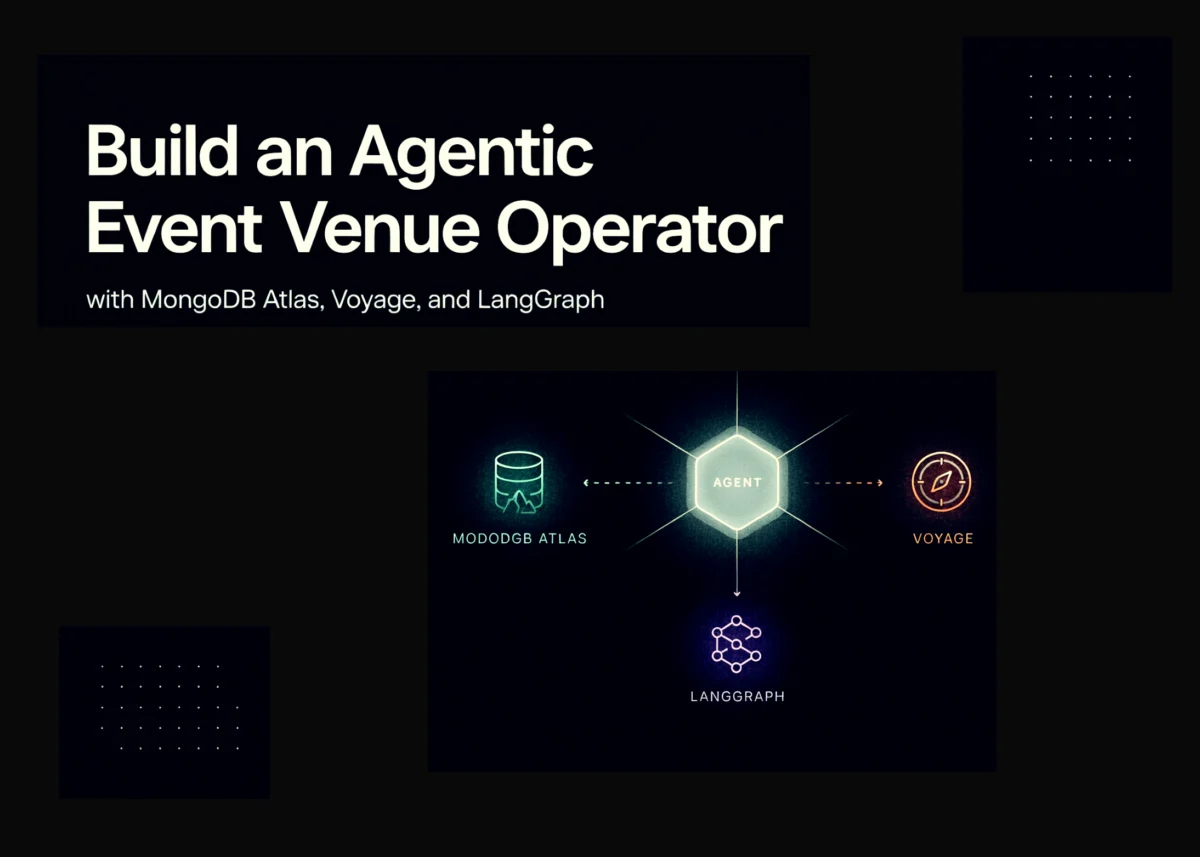
The architecture integrates several key technologies:
- MongoDB Atlas: Acts as the system of record and retrieval layer for the agent loop.
- Voyage AI: Provides high-performance embeddings for both text and multimodal data.
- LangGraph: Orchestrates the agentic workflow, allowing for complex state management and cyclical reasoning.
- Claude Vision: Enables the agent to "see" and interpret visual documents like venue maps and safety manuals.
- Langfuse: Offers optional observability and tracing to monitor the agent’s decision-making process.
The Scenario: Managing the "MongoDB Open"
The implementation is demonstrated through a fictional premier tennis tournament titled the "MongoDB Open." On Day 6 of the tournament, the system is challenged with an approaching storm and constrained hospitality capacity. The agent must manage two distinct visitor journeys:
- Mikiko: A first-time attendee seeking to maximize her experience on the grounds.
- Nina: A premier guest with high hospitality expectations and a documented history of preferences.
The agent distinguishes between these segments by querying the "Memory Store," which is partitioned into namespaces such as "Guests," "Venue," and "Operations." This ensures that the agent provides personalized solutions—such as directing a VIP to a reserved lounge while providing a general attendee with the most efficient route to covered public seating.

Implementing Persistent Memory and Hybrid Search
A significant innovation in this framework is the treatment of memory as a queryable operational asset rather than a sidecar. In production, agent memory is multifaceted; it includes personal histories, business processes, and reference documents. By storing these in MongoDB Atlas, the system maintains a flexible data model where all pieces of context remain queryable together.
To retrieve the most relevant information, the system employs a hybrid search mechanism. This combines vector similarity (semantic intent) with lexical scoring (exact keyword matching). In event operations, this is vital. A query about a "thunderstorm dinner reservation" requires the system to understand the concept of weather disruption (semantic) while identifying the specific operational term "reservation" (lexical). This dual-path retrieval ensures that the agent’s plans are both conceptually sound and operationally accurate.
Chronology of the Agentic Workflow
The development and deployment of the operator follow a structured timeline, beginning with environment initialization and ending with live agent execution.
Phase 1: Environment and Indexing
The process begins with the setup of a FastAPI application backed by MongoDB Atlas. Developers clone the reference repository and initialize Atlas collections. A critical step is the creation of the Atlas Vector Search index, which typically takes approximately 60 seconds to reach a "READY" state. This index is the engine that allows the agent to navigate thousands of documents in milliseconds.
Phase 2: Data Seeding and Visual RAG
Once the infrastructure is ready, the system is seeded with text and visual documents. The "Visual RAG" (Retrieval-Augmented Generation) component is particularly noteworthy. Operational knowledge is often stored in non-text formats, such as accessibility maps, allergen matrices, or evacuation diagrams. Each image is embedded using Voyage multimodal embeddings and stored in the memory collection. When a user asks, "What is the procedure for a storm during dinner?" the agent retrieves the relevant visual safety chart and interprets it via Claude Vision to provide an answer.

Phase 3: The LangGraph Path
The final phase involves running the LangGraph proof-of-concept. The graph follows a cyclical logic:
- Perceive: The agent reads the current venue state and identifies the rain threat.
- Retrieve: It pulls guest profiles and venue capacity limits from Atlas.
- Plan: It formulates a strategy to move guests to covered areas based on their priority and location.
- Act: It updates the venue state and writes the outcome back to the memory store.
- Persist: The result of the action is saved, ensuring that if a similar situation occurs on Day 7, the agent has a historical record of what worked.
Industry Implications and Analysis
The release of this framework marks a move toward "stateful" AI. Most current AI applications are stateless, meaning they treat every interaction as a brand-new encounter. For industries like sports, hospitality, and emergency services, statelessness is a liability.
Industry analysts suggest that the ability for an agent to "write back" to its database is the most critical feature for enterprise adoption. If an AI manages a crowd flow issue but doesn’t record that a particular exit was congested, it is doomed to repeat the mistake. The MongoDB Atlas architecture solves this by making the database the "brain" and the LLM the "processor."
Furthermore, the inclusion of observability tools like Langfuse highlights a growing demand for transparency in AI. In a high-pressure event environment, stakeholders must be able to audit why an agent made a specific decision. Tracing the retrieval calls and reasoning steps allows human operators to fine-tune the agent’s prompts and data sources, creating a feedback loop that improves safety and guest satisfaction over time.
Future Outlook and Constraints
While the "Agentic Event Venue Operator" provides a robust blueprint, developers emphasize that the current repository is a reference demo rather than a "plug-and-play" production platform. Real-world deployment would require the addition of production-grade authentication, rate limiting, and tenant isolation to ensure data security.

However, the core principles—unified data layers, multimodal retrieval, and persistent memory—are likely to become the standard for event technology. As the economic impact of major events continues to grow, the cost of operational inefficiency becomes harder to justify. Systems that can autonomously navigate the complexities of weather, high-density crowds, and premium guest expectations will likely become a competitive necessity for venue operators worldwide.
By integrating operational records and semantic memory into a single, high-performance backend, organizations can finally move past the limitations of static AI. The "MongoDB Open" demo illustrates a future where AI does not just talk about plans but actively manages the reality of the ground, ensuring that even when the rain arrives, the business—and the fan experience—continues uninterrupted.