



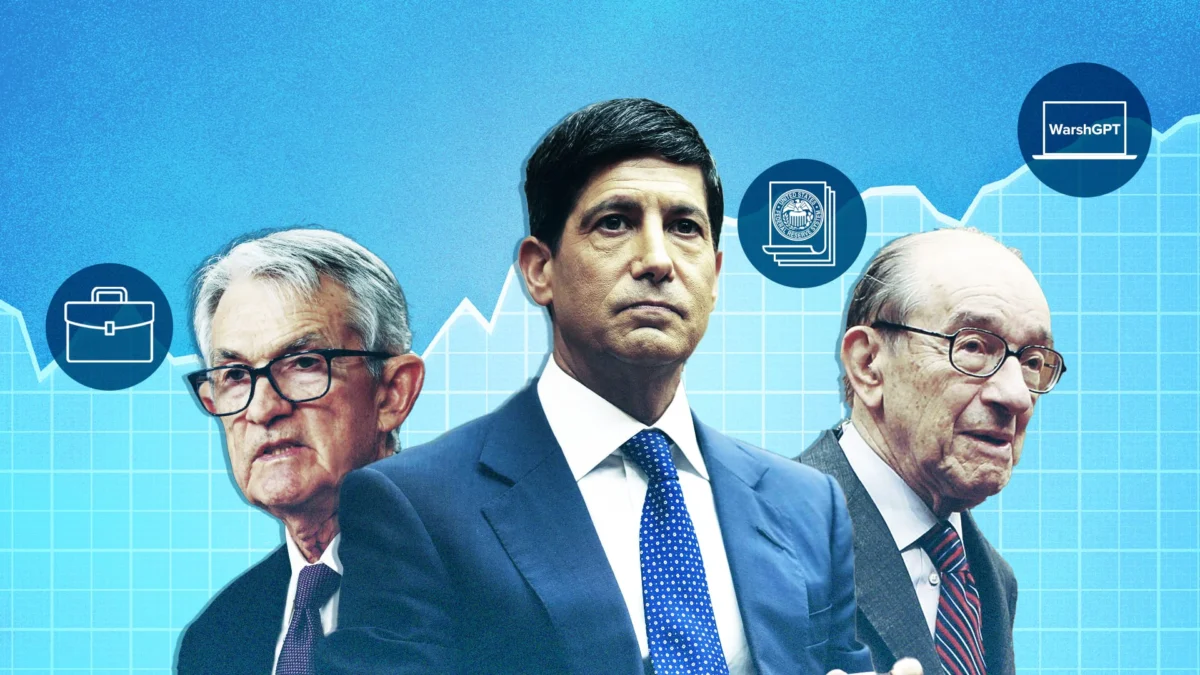
F/m Investments, a prominent financial firm with offices just a short distance from the Federal Reserve’s Washington, D.C., headquarters, has found the intellectual chasm between itself and the central bank growing significantly wider under the new leadership of Chairman Kevin Warsh. Since assuming his post in May, Warsh has initiated a sweeping overhaul of the central bank’s communication strategy, moving away from the highly transparent, forward-looking guidance that characterized previous administrations. This pivot has sent ripples through financial markets, particularly for participants like F/m Investments’ CEO Alexander Morris, whose investment theses are intricately linked to predicting the Fed’s trajectory for interest rates.
"We’ve made a pretty good business out of decoding Fedspeak," Morris stated, referring to the often-opaque, jargon-laden pronouncements favored by central bank leaders in prior eras. "And he just said he was going to go quiet on us." This deliberate shift towards a more circumspect communication style has prompted an urgent re-evaluation across the financial industry, leading some firms to embrace cutting-edge artificial intelligence tools in a bid to maintain their predictive edge.
Warsh’s Vision: A New Era of Central Bank Communication
Kevin Warsh’s ascension to the Federal Reserve chairmanship marked a decisive turn in the institution’s approach to public engagement. Known for his intellectual rigor and a past tenure as a Fed Governor from 2006 to 2011, Warsh has long been an advocate for central bank independence and a critic of what he perceived as excessive communication that could inadvertently steer markets rather than inform them. His philosophy suggests that markets, when left to their own devices, are efficient allocators of capital and that the Fed’s role is to set policy, not to hold the market’s hand through detailed forecasts. This perspective implies a belief that over-communicating can foster market dependency, potentially leading to instability when the Fed deviates from previously hinted paths.
The transition from his predecessor, Jerome Powell, has been stark. Powell’s era saw the Fed embracing a high degree of transparency, providing detailed forward guidance, conducting regular press conferences, and publishing the "dot plot" – a chart indicating individual FOMC members’ projections for future interest rates. This approach, while intended to reduce uncertainty and manage expectations, also fostered a culture where markets hung on every word, often overreacting to minor linguistic nuances or shifts in projections. Warsh’s mandate appears to be to reverse this trend, encouraging markets to focus on fundamental economic data rather than central bank tea leaves. He believes that by speaking less, the Fed can avoid creating undue market volatility and encourage investors to develop their own robust economic frameworks, thereby fostering greater market resilience and self-reliance.
The "Silence is Golden" Policy Takes Shape
The practical implications of Warsh’s new communication policy became immediately apparent. The statement issued after the Federal Open Market Committee (FOMC) meeting in June – the first under Warsh’s chairmanship – was notably terse. CNBC’s analysis revealed it contained approximately 130 words, a dramatic reduction from the 300-plus words typically seen in previous publications. Crucially, the statement conspicuously omitted any form of forward guidance, a staple of recent Fed communications that provided hints about future policy actions. Warsh himself acknowledged the statement was "shorter" and "simpler," emphasizing its purposeful exclusion of such guidance, signaling a clear departure from the predictive pronouncements of the past.
Further data underscored this shift. During his inaugural post-decision press conference as chairman, Warsh dedicated only 5% of his sentences to policy-relevant topics, according to an analysis by UBS. This figure stands in stark contrast to the 27% average observed during press conferences under former Chairman Jerome Powell. The message was clear: the new Fed would communicate policy decisions, but would largely refrain from speculating on future moves or dissecting every economic nuance in public. This recalibration is not merely cosmetic; it reflects a fundamental change in how the central bank views its interaction with financial markets, pushing the onus of interpretation and forecasting onto investors themselves.
A Historical Echo: Revisiting the Greenspan Enigma
For many seasoned market observers, Warsh’s new approach evokes memories of the Alan Greenspan era (1987-2006), a period famously characterized by its deliberate ambiguity, or "Fedspeak." Greenspan was renowned for his convoluted, often impenetrable language, which left markets scrambling to decipher his true intentions. His mastery of vague pronouncements was legendary, often described as a deliberate strategy to maintain maximum policy flexibility and prevent markets from front-running the Fed’s actions. As former Fed historian Gary Richardson, now an economics professor at the University of California, Irvine, recalls, people joked that Greenspan merely saying "good evening" could trigger a market decline, illustrating the hypersensitivity of markets to even the most tangential signals from the Fed chair. The financial media of the time even tracked a whimsical "briefcase indicator," theorizing that a bulkier briefcase carried by Greenspan to meetings signaled he had accumulated more evidence for impending changes in borrowing costs, reflecting the desperate lengths to which market participants would go to glean insights.
While Greenspan’s style was often seen as a way to maintain flexibility and avoid committing the Fed to specific future actions, it also created an environment of intense speculation and sensitivity to every minor signal. Subsequent Fed chairs, particularly Ben Bernanke, initiated a significant move towards greater transparency, introducing regular press conferences, publishing detailed minutes, and offering more explicit forward guidance in response to the profound economic uncertainty following the 2008 financial crisis. Janet Yellen and Jerome Powell continued this trend, aiming to make the Fed’s decision-making process more predictable and less prone to misinterpretation, believing that clear communication could stabilize markets. Warsh’s current shift, therefore, represents a significant recalibration, prompting questions about whether markets will adapt to less information or simply find new, more sophisticated ways to extract it.
The AI Arms Race: Decoding the New Fed
In response to this vacuum of explicit guidance, financial institutions are not merely lamenting the change; they are actively innovating. F/m Investments’ "WarshGPT" is a prime example of this proactive adaptation. Released this week, the artificial intelligence-powered tool is designed to parse nearly 1,800 documents and transcripts from Warsh’s extensive public record, including his past speeches, interviews, and academic writings. The goal is to help users understand how he might analyze complex issues related to the economy or monetary policy, effectively reverse-engineering his thought process from his historical output. This deep-learning approach seeks to identify patterns, recurring themes, and logical frameworks within his past communications, offering a structured lens through which to interpret his current and future actions.

Developed using Anthropic’s Claude model, "WarshGPT" cost less than $1,000 to build and took approximately two weeks from inception to release, including pre-rollout testing by a select group of Fed alumni and newsletter writers. While its name playfully riffs on OpenAI’s ChatGPT, its functionality is strictly focused on Warsh’s historical discourse. The bot is programmed to avoid speaking as Warsh and explicitly refrains from offering forward statements or forecasts, adhering to the very principle of reduced forward guidance that Warsh himself champions. Beyond Warsh’s communications, the product also integrates economic and political history to provide context for its responses, aiming for a holistic understanding of the Chairman’s potential analytical frameworks. This contextual integration is critical, as Warsh’s past statements often referenced historical economic precedents and geopolitical considerations.
F/m Investments is far from alone in leveraging technology to navigate the new landscape. UBS, a global financial services company, operates an interactive dashboard for its clients, specifically designed to track the Fed’s policy tone. Elena Amoruso, a strategist at the Swiss bank, explains that this tool provides an unbiased assessment of Warsh’s commentary during meetings, employing natural language processing to identify hawkish or dovish leanings without human bias. Following Warsh’s debut policy meeting last month, Amoruso’s analysis for clients concluded that his policy-relevant comments were "overwhelmingly hawkish," driven by his views on the labor market, economic growth, and the persistent state of inflation. "Arguably, this is the most high-value data set… in terms of how much one word can move dollars," Amoruso remarked, underscoring the critical importance of even minimal Fed communication in shaping market sentiment and asset valuations. Other quantitative hedge funds and algorithmic trading firms are reportedly developing similar in-house AI models, recognizing that even a fractional edge in interpreting the Fed’s stance can translate into substantial profits.
Adapting Investment Strategies: From Dot Plots to Deep Dives
The potential disappearance of the "dot plot" – a visual representation of FOMC members’ individual interest rate projections – is a significant concern for many firms. JPMorgan Asset Management’s chief global strategist, David Kelly, has articulated his team’s backup plans for such a scenario. If the central bank ceases publishing this key forward-looking indicator, Kelly’s team intends to intensify its scrutiny of speeches and public statements made by individual members of the Federal Open Market Committee (FOMC), the body responsible for setting interest rates. By analyzing the nuanced perspectives of each voting member, including their regional economic assessments and specific policy preferences, they hope to reconstruct a collective sense of the committee’s leanings and likely future actions. This shift demands a more granular, bottom-up approach to Fed watching, moving away from aggregated signals to individual voices.
Kelly, however, maintains a measured perspective, suggesting that major changes to Fed communication would likely unfold over several months, allowing institutions time to adapt their analytical frameworks and resource allocation. He also believes that the final decisions regarding communication may not be as drastic as some currently anticipate, possibly involving a hybrid approach rather than a complete cessation of all forward guidance. "Just like the Federal Reserve says it can be patient in adjusting interest rates to the economy, we can be patient in adjusting our resources," Kelly noted, emphasizing a strategic, long-term approach to adaptation rather than reactive panic. This patience reflects a recognition that institutional change within the Fed is typically incremental, not revolutionary.
Implications for Market Volatility and "Alpha" Generation
The anticipated consequence of less forward guidance from the Fed is increased market volatility following policy decisions or public appearances by officials. Without explicit signals, markets may struggle to price in future policy moves, leading to more pronounced swings as new data emerges or as interpretations of cryptic statements shift. While this might seem like a drawback for market stability, some traders and strategists view it as a potential opportunity. Steve Friedman, a former New York Fed alum and now senior macroeconomist at MacKay Shields, acknowledges the broader economic downside: "If there’s less communication about the reaction function, I actually think that’s a negative for the economy," as it can inject uncertainty into business investment and consumer confidence. However, he adds a crucial caveat: "less clarity about what the Fed may do can actually be a source of alpha for investors if you have a robust framework for thinking about the economy and monetary policy."
"Alpha" in finance refers to the excess return of an investment relative to the return of a benchmark index. In an environment of reduced transparency, investors who possess superior analytical capabilities, access to sophisticated tools like AI, or deep institutional knowledge of the Fed, stand to gain a significant advantage. This could exacerbate the divide between well-resourced institutional investors and individual retail traders, as the former can invest in the technology and expertise required to navigate the new informational landscape. This dynamic could reward active management and specialized funds that can quickly process and interpret fragmented data points.
For retail traders, the added policy uncertainty under Warsh’s leadership necessitates a greater emphasis on portfolio diversification to mitigate risks. Relying solely on publicly available, simplified interpretations may become insufficient. UC-Irvine’s Richardson predicts that investment firms looking to gain an edge will increasingly invest heavily in hiring Fed alumni – former economists, policy analysts, and other experts with intimate knowledge of the central bank’s inner workings and decision-making processes. These individuals, with their unparalleled insights into the Fed’s culture, internal debates, and historical reactions to various economic scenarios, will become invaluable assets in an environment where direct signals are scarce. Their "institutional memory" effectively becomes a form of proprietary data.
Navigating Divergent Market Expectations and Bellwethers
The immediate impact of Warsh’s communication shift is already evident in the divergent expectations forming within the market regarding future policy actions. For instance, CME’s FedWatch tool, which tracks the probabilities of future rate changes based on fed funds futures trading, indicated an almost 59% likelihood that the central bank would increase interest rates in September. Conversely, traders on Kalshi, an event prediction market, showed a prevailing belief that the Fed would most likely keep rates unchanged at that very same meeting. Such stark differences underscore the heightened uncertainty and the challenge of consensus-building in the absence of clear forward guidance, highlighting how different market segments are processing the limited information available.
Amid this uncertainty, the role of "bellwethers" within the Fed becomes even more critical. If Chairman Warsh himself dials back public speaking engagements, experts like Steve Friedman suggest closely monitoring speeches from other influential governors and regional Fed presidents. Friedman points to Fed Governor Christopher Waller as a key figure, describing him as a "bellwether" for the broader committee’s sentiment due to his consistent economic framework and influential position. Waller recently stated that the Fed should not be focused on "fighting the last war" with inflation, signaling a forward-looking approach to monetary policy, but simultaneously warned that interest rate hikes could still be a possibility. Such comments, though seemingly subtle, are now magnified in their importance, becoming crucial data points for analysts attempting to piece together the Fed’s collective stance.
Ultimately, the new era under Chairman Warsh presents a complex challenge for financial markets. While proponents argue that it fosters greater market resilience and reduces undue dependence on central bank pronouncements, critics worry about increased volatility and opacity, potentially hindering efficient capital allocation. "For ordinary investors, it’s already really hard for them to figure out what’s going on," Richardson concluded. "It’s going to become much harder." The financial world is now engaged in an intense race to adapt, with artificial intelligence emerging as a crucial, albeit still evolving, tool in the quest to decipher the Federal Reserve’s new, quieter voice and maintain an edge in an increasingly complex economic landscape. The outcome of this grand experiment in central bank communication will shape not only investment strategies but potentially the very structure of financial market analysis for years to come.