

Pasadena, CA – The Mars Science Laboratory (MSL) mission, spearheaded by NASA’s Curiosity rover, continues its unprecedented exploration of Gale Crater, with mission engineers playing a pivotal, often unsung, role in navigating the complex Martian terrain and executing critical scientific operations. As of the Earth planning date of Friday, July 27, 2026, the rover’s dedicated team, including scientists and engineers from institutions worldwide like the University of New Brunswick, Canada, remains focused on analyzing the intricate geological record preserved within Mount Sharp (Aeolis Mons). The intricate dance between scientific objectives and engineering constraints defines the daily rhythm of this enduring mission, now in its fourteenth year of operations on the Red Planet.
Precision Science in a Challenging Environment
A cornerstone of Curiosity’s scientific toolkit is the Alpha Particle X-ray Spectrometer (APXS), an instrument meticulously designed to measure the elemental chemistry of rocks, unconsolidated regolith, and even the thin Martian atmosphere. Mounted on the end of Curiosity’s 2.1-meter (7-foot) robotic arm, APXS works in tandem with the Mars Hand Lens Imager (MAHLI), a close-up camera providing microscopic views of Martian surfaces. The deployment of these instruments demands exquisite precision and a thorough assessment of the target environment, a task that falls squarely on the shoulders of the rover engineers.
Lucy Thompson, a Senior Research Scientist at the University of New Brunswick and an APXS uplink lead and strategic planner for the mission, frequently collaborates with the engineering team to ensure safe and effective instrument deployment. She highlights the critical reliance on engineers for their expertise in evaluating terrain hazards and sequencing complex arm movements. "Any target of interest that we wish to analyze has to be safe to deploy the arm, APXS, and MAHLI to," Thompson noted, underscoring the engineers’ role in safeguarding the rover’s invaluable tools. Recent operational challenges have included workspaces characterized by significant dust accumulation and varied relief. Despite these obstacles, the engineering team has consistently identified and prepared suitable areas, employing the rover’s brush to clear dust before deploying APXS and MAHLI. This past week proved no exception, with engineers successfully positioning the arm to allow for the brushing and analysis of five distinct rock targets. This meticulous process ensures the acquisition of high-quality compositional data and images, essential for tracking potential changes in chemistry, depositional environments, and alteration processes as Curiosity ascends through the diverse rock layers of Mount Sharp.
The data gathered from instruments like APXS is crucial for understanding the geological evolution of Gale Crater. By analyzing the elemental composition of various rock types—igneous, sedimentary, and altered materials—scientists can reconstruct past environmental conditions, including the presence of water and organic molecules, which are key indicators of ancient habitability. The ability to brush away dust significantly improves data quality by exposing pristine rock surfaces, free from atmospheric fallout or superficial coatings that might obscure the true chemical signature.
Navigating the Martian Frontier: A Testament to Engineering Ingenuity
Beyond instrument deployment, rover engineers bear the immense responsibility of safely driving Curiosity across the Martian landscape. This involves continuous assessment of treacherous terrain for potential hazards such as large, resistant rock blocks that could damage the rover’s six aluminum wheels, patches of soft sand or soil that could cause the rover to become bogged down, or steep slopes that could lead to slippage. These challenges are not theoretical; the mission has encountered and overcome significant engineering hurdles throughout its journey.
Early in the mission, unexpected damage to Curiosity’s wheels necessitated a fundamental re-evaluation of driving strategies. Despite the initial wear and tear, primarily caused by sharp, embedded rocks, engineers developed sophisticated algorithms and driving techniques to minimize further damage, including more frequent use of reverse driving and careful path planning. This adaptability has been crucial for the rover’s longevity. Furthermore, early in its ascent of Mount Sharp, Curiosity did encounter soft soil patches, requiring skillful navigation to extricate itself.
Despite these adversities, the engineering team has successfully piloted Curiosity over an impressive distance of more than 37 kilometers (23 miles) and an elevation gain exceeding 1.35 kilometers (4,400 feet) since its landing in August 2012. This remarkable feat of interplanetary navigation underscores the profound capabilities of human ingenuity combined with advanced robotic systems.
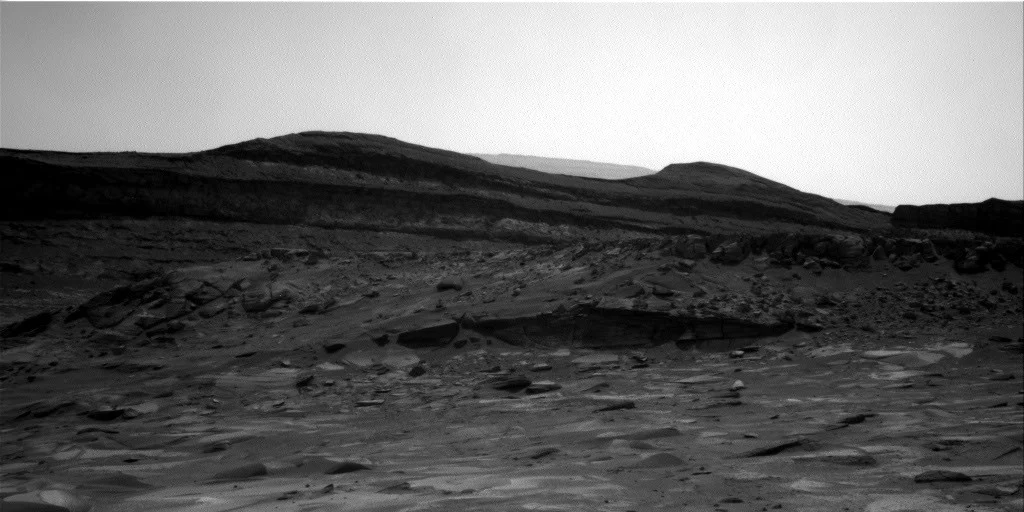
Recently, the science team requested drives to specific locations to image what they suspect could be an erosional surface within the Mg-sulfate/carbonate-bearing unit, a geological formation of significant scientific interest. The engineers adeptly accommodated these requests, successfully executing the first stop in a recent plan and preparing for a drive this weekend toward the next designated imaging location. Such precise maneuvering in response to evolving scientific priorities is a hallmark of the collaborative spirit driving the MSL mission.
The Resilience of Robotic Drilling: Overcoming Mechanical Failure
The collection of drilled rock samples for in-situ analysis by Curiosity’s internal laboratory instruments, CheMin (Chemistry and Mineralogy) and SAM (Sample Analysis at Mars), represents another critical aspect of the mission’s scientific output. These instruments provide detailed mineralogical and organic chemical analyses that are impossible to obtain with external instruments alone. However, this capability faced a severe setback in 2016 when a motor associated with the rover’s drill feed mechanism failed.
The failure of the drill feed motor posed a significant threat to the mission’s ability to acquire high-value subsurface samples. The engineering team at NASA’s Jet Propulsion Laboratory (JPL) in Pasadena, California, embarked on an extensive, behind-the-scenes effort that lasted nearly a year and a half. This intensive period involved developing entirely new drilling methods and software commands to operate the drill using alternative mechanisms. Engineers meticulously tested new procedures on Earth-based testbed rovers, simulating Martian conditions and potential failure modes. This monumental effort led to the successful implementation of a "feed-percussive" drilling technique, where the robotic arm itself provides the necessary force, bypassing the failed motor. This innovative solution not only salvaged a critical scientific capability but also demonstrated an extraordinary level of problem-solving and adaptability. Since resuming operations with the reconfigured drill, Curiosity has successfully collected more than 20 rock samples, each providing invaluable insights into Mars’ geological and environmental history.
The ability to deliver these drilled samples safely and successfully to CheMin and SAM also relies entirely on the precise sequencing of arm motions by the engineers. This involves intricate maneuvers to sieve, portion, and transfer the powdered rock samples into the small inlet ports of the internal instruments, minimizing contamination and ensuring accurate delivery.
A Panoramic View of Gale Crater: Instruments and Scientific Goals
Curiosity’s comprehensive suite of scientific instruments extends beyond APXS, MAHLI, CheMin, and SAM, offering a multi-faceted approach to understanding Mars.
- Mastcam (Mast Camera): Provides high-resolution color images and video of the Martian landscape, crucial for geological context, path planning, and identifying targets of interest. It also has multispectral capabilities to analyze surface composition.
- ChemCam (Chemistry and Camera): Uses a laser-induced breakdown spectroscopy (LIBS) technique to vaporize small spots on rocks and soil from a distance, analyzing the resulting plasma to determine elemental composition. It also features a Remote Micro-Imager (RMI) for high-resolution images of targets.
- REMS (Rover Environmental Monitoring Station): Measures atmospheric pressure, temperature, humidity, wind speed and direction, and ultraviolet radiation, providing daily weather reports and insights into Martian climate.
- RAD (Radiation Assessment Detector): Measures high-energy radiation from space, providing data crucial for understanding the radiation environment on Mars, essential for future human missions.
- DAN (Dynamic Albedo of Neutrons): Detects hydrogen, primarily in the form of water ice or hydrated minerals, beneath the surface.
These instruments collectively allow Curiosity to pursue its primary scientific goals:
- Assessing Martian Habitability: Determining whether Mars ever had environmental conditions capable of supporting microbial life.
- Characterizing Mars’ Climate: Investigating the processes and history of the Martian climate.
- Characterizing Mars’ Geology: Understanding the origin and evolution of the planet’s surface and interior.
- Preparing for Human Exploration: Providing data on radiation and surface conditions relevant to future human missions.
The ongoing ascent of Mount Sharp is central to these objectives. The mountain’s layered structure acts as a geological time capsule, with older layers at the base and progressively younger layers higher up. By tracking changes in chemistry, textures, tone, and sedimentary structures through units like the sulfate/carbonate-bearing unit, the mission aims to reconstruct the long-term environmental history of Gale Crater, from a potentially water-rich past to its current arid state. The eventual arrival at the "Yardang unit" promises further revelations about wind-sculpted terrains and later Martian geological processes.
Broader Implications and the Future of Mars Exploration
The Mars Science Laboratory mission stands as a monumental achievement in planetary exploration, demonstrating unparalleled robotic longevity and scientific return. The unwavering dedication and problem-solving prowess of the rover engineers have been fundamental to Curiosity’s success, enabling the scientific team to continuously push the boundaries of knowledge. The mission has already delivered groundbreaking discoveries, including definitive evidence of ancient streambeds and lake environments within Gale Crater that were capable of supporting microbial life. The detailed analyses of minerals and organic molecules continue to paint a clearer picture of Mars’ ancient past.
The insights gained from Curiosity’s extended mission are invaluable not only for understanding Mars’ past habitability but also for informing future missions. The engineering challenges overcome, such as wheel damage and drill repair, provide critical lessons for designing more robust and adaptable rovers. The operational strategies developed for remote, autonomous exploration, particularly in hazard avoidance and precision targeting, will directly benefit upcoming missions like the Mars Sample Return campaign, which aims to bring Martian samples back to Earth for even more sophisticated analysis.
As Curiosity continues its methodical climb up Mount Sharp, monitoring the local environment within Gale Crater and the broader Martian atmosphere, the collaboration between scientists and engineers remains the bedrock of its enduring success. The past week’s full schedule of activities, from precise arm deployments to strategic drives, is a testament to this synergy. The collective efforts of the entire Curiosity team at JPL and collaborating institutions around the globe ensure that humanity’s quest to unlock the secrets of Mars continues with unparalleled vigor and ingenuity. The journey up Mount Sharp, layer by geological layer, promises to reveal more chapters in the Red Planet’s fascinating story, bringing us ever closer to answering fundamental questions about life beyond Earth.