

NASA astronaut Chris Williams successfully returned to Earth on Sunday, marking the conclusion of an extensive eight-month science mission aboard the International Space Station (ISS). Williams, making his first journey to space, landed safely in Kazakhstan alongside Roscosmos cosmonauts Sergey Kud-Sverchkov, on his second mission, and Sergei Mikaev, also a first-time spacefarer. Their precision landing brought to an end a 241-day orbital odyssey that significantly advanced critical scientific investigations and technological demonstrations crucial for both Earth-bound benefits and future deep-space exploration.
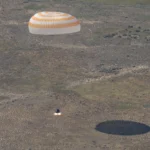
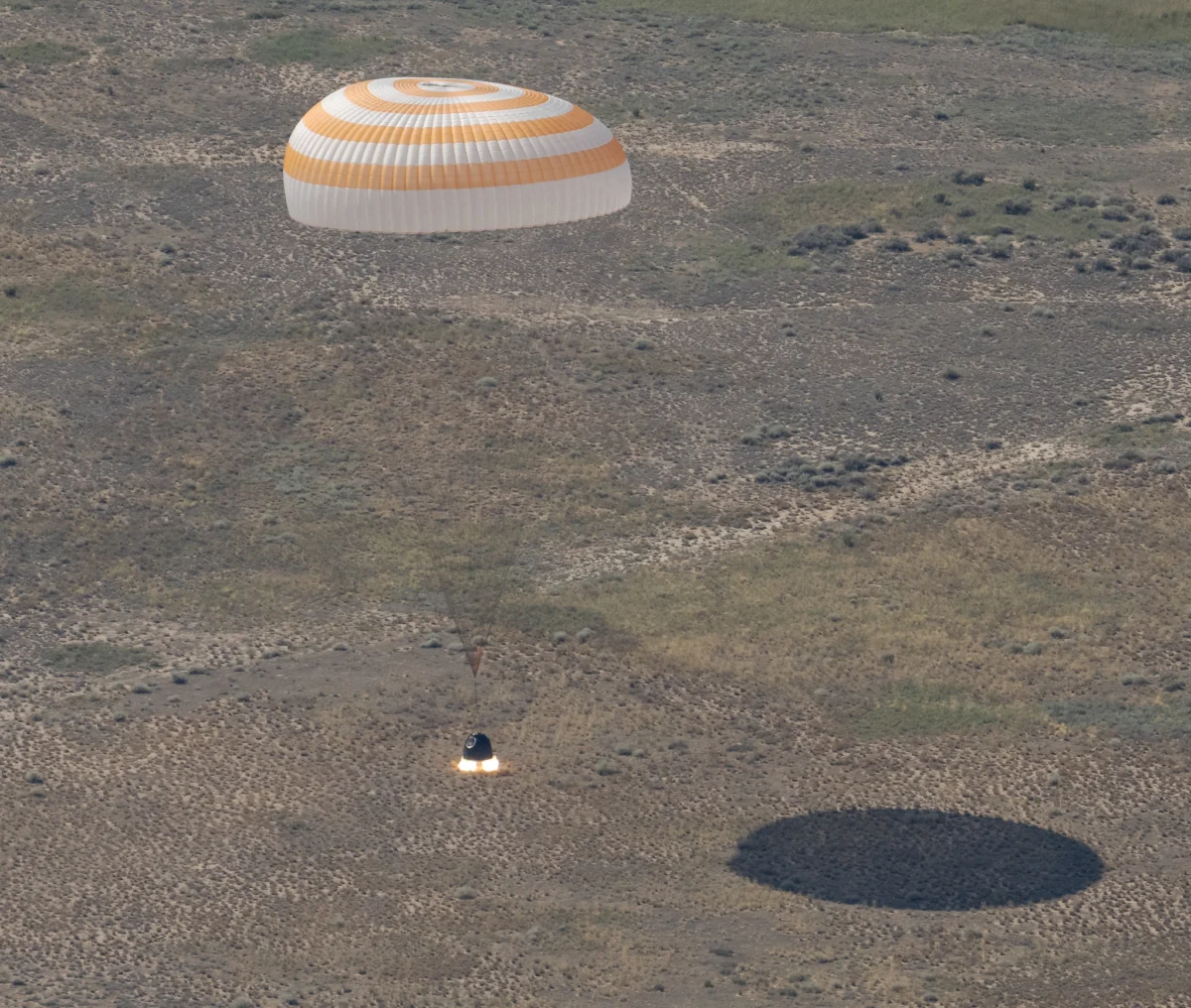
The multinational crew’s journey home culminated in a soft, parachute-assisted landing at 5:27 a.m. CDT (3:27 p.m., Kazakhstan time) in the vast steppe southeast of Dzhezkazgan, Kazakhstan. Their departure from the orbiting laboratory occurred at 2:03 a.m. CDT aboard the venerable Soyuz MS-28 spacecraft, which served as their orbital taxi for both the journey to and from the ISS. The deorbit burn, a critical maneuver to initiate their descent, began approximately three hours prior to landing, slowing the spacecraft from its orbital velocity of roughly 17,500 miles per hour (28,000 kilometers per hour) to begin its controlled plunge through Earth’s atmosphere.
A Meticulous Journey Home: The Soyuz MS-28 Descent
The Soyuz spacecraft, a cornerstone of human spaceflight, executed a flawless re-entry sequence. After undocking from the Poisk module of the ISS, the spacecraft performed a series of maneuvers to distance itself from the station. The critical deorbit burn, lasting several minutes, used the main engine to reduce the spacecraft’s velocity, initiating its trajectory towards Earth. As the Soyuz plunged into the denser layers of the atmosphere, its three modules — the orbital module, the descent module, and the instrument/propulsion module — separated. The orbital and instrument/propulsion modules burned up harmlessly upon re-entry, while the descent module, housing the crew, was protected by a robust heat shield.
The extreme temperatures generated by atmospheric friction were absorbed by the ablative heat shield, which slowly charred and peeled away, dissipating energy. At predetermined altitudes, a series of parachutes deployed: first a pilot chute, followed by a drogue chute, and finally the main parachute, which unfurled to slow the capsule to a mere 15-22 feet per second (4.5-6.7 meters per second). Just moments before touchdown, small retro-rockets fired from the base of the descent module, further softening the impact and ensuring a gentle landing for the weary crew, a testament to decades of Russian engineering and operational expertise.
An Eight-Month Orbital Odyssey: Mission Highlights
During their 241 days in space, the crew completed an astonishing 3,856 orbits of Earth, traversing an estimated 102 million miles (164 million kilometers) through the vacuum of space. Their mission commenced on November 27, 2025, with a launch aboard the Soyuz MS-28 from the Baikonur Cosmodrome in Kazakhstan, a historic site for human spaceflight. Upon arrival, they joined the Expedition 74 crew, seamlessly integrating into the ongoing operations and research agenda of the orbiting laboratory.
Chris Williams, as a flight engineer, played a pivotal role in numerous scientific investigations and technology demonstrations. His contributions spanned a wide spectrum of disciplines, from biomedical research to advanced materials science. A significant portion of his time was dedicated to advancing research for new cancer treatments. This involved conducting experiments in microgravity to study the behavior of proteins and cells, which can grow into larger, more perfect crystals in the absence of gravity’s distorting effects. Such research helps scientists better understand disease mechanisms and develop more effective therapies.
Furthermore, Williams contributed to pioneering work in improved in-space manufacturing of materials, particularly those used in high-performance computers and electronics. Microgravity offers unique conditions for creating materials with enhanced properties, free from defects caused by convection and sedimentation on Earth. This research holds immense potential for future space missions, enabling the production of spare parts and advanced components on demand, reducing reliance on costly and complex resupply missions from Earth. It also promises advancements for industries on our planet.
Spacewalks: Critical Maintenance and Upgrades
A highlight of Williams’ mission included participating in two crucial spacewalks, or Extravehicular Activities (EVAs), that were vital for the continued operation and upgrade of the space station. The first spacewalk focused on preparing the station for future power system upgrades. This involved configuring cabling and installing support hardware for new International Space Station Roll-Out Solar Arrays (iROSAs), which are designed to augment the station’s electrical power generation capabilities. These upgrades are essential to support the increasing power demands of new scientific payloads and future commercial modules.
His second spacewalk involved a complex repair operation to replace a faulty joint on the Canadarm2 robotic arm. The Canadarm2, a 57.7-foot (17.6-meter) long robotic manipulator, is a critical piece of equipment for the ISS, used for everything from docking visiting spacecraft and maneuvering modules to supporting spacewalkers and moving external payloads. A malfunctioning joint could severely impede the station’s operational flexibility and safety. The successful replacement of this component ensured the continued robust functionality of the robotic arm, a testament to the crew’s intricate training and execution under challenging conditions in the vacuum of space.
An Enduring Symbol of International Collaboration
The return of the Soyuz MS-28 crew, comprising astronauts from both NASA and Roscosmos, once again underscored the enduring strength of international collaboration in space. Despite geopolitical complexities on Earth, the International Space Station remains a shining example of peaceful cooperation and shared scientific endeavor among nations. For more than 25 years, the ISS has maintained a continuous human presence in low Earth orbit, a feat made possible only through the combined expertise, resources, and commitment of multiple space agencies, including those of the United States, Russia, Europe, Japan, and Canada.
The station’s design and operation are intrinsically interdependent, with each module and system playing a vital role in sustaining life and enabling research. This intricate dance of international partnership allows for a broader range of scientific investigations, more robust operational support, and a collective sharing of the risks and rewards of space exploration. The missions of individuals like Williams, Kud-Sverchkov, and Mikaev are direct beneficiaries and perpetuators of this global commitment to pushing the boundaries of human knowledge.
Post-Landing Procedures and Reintegration
Immediately following their landing, specialized recovery teams from Roscosmos, supported by NASA personnel, rapidly converged on the landing site. These teams are equipped to provide immediate medical assessment and assistance to the returning crew members, who must quickly readapt to Earth’s gravity after months in microgravity. Astronauts and cosmonauts typically experience transient effects such as orthostatic intolerance (difficulty standing upright), muscle weakness, and balance issues.
After initial medical checks and a brief rest in the field, the crew members were transported by helicopter to Karaganda, Kazakhstan, the primary base for recovery operations. There, more extensive medical evaluations and initial debriefings took place. Following this, Chris Williams boarded a NASA aircraft specifically configured for astronaut transport, bound for the agency’s Johnson Space Center in Houston, Texas. Upon arrival, he will undergo a comprehensive post-flight rehabilitation program and participate in detailed scientific studies to analyze the physiological and psychological effects of long-duration spaceflight, data that is invaluable for planning future missions to the Moon and Mars. His journey back to Houston will signify the full completion of his first space mission, transitioning from orbital explorer to terrestrial scientist.
Official Reactions and Broader Implications
Statements from both NASA and Roscosmos leadership emphasized the success of the mission and the invaluable contributions of the returning crew.
NASA Administrator Bill Nelson remarked, "We extend our deepest congratulations to Chris Williams, Sergey Kud-Sverchkov, and Sergei Mikaev on a successful mission and a safe return to Earth. Their dedication to scientific discovery and the diligent maintenance of our orbiting laboratory are crucial for expanding humanity’s reach into the cosmos. Chris’s work, from advancing cancer research to critical spacewalks, directly benefits life on Earth and prepares us for the challenges of sending humans further into the solar system under the Artemis program."
A representative from Roscosmos echoed these sentiments, stating, "The safe return of our cosmonauts and our NASA colleague is a testament to the robust design of the Soyuz spacecraft and the unwavering commitment of our ground support teams. The International Space Station continues to be a beacon of international cooperation, and we are proud of the scientific achievements and technical prowess demonstrated by this crew. Their work contributes significantly to our collective understanding of space and its potential."
The Enduring Legacy of the International Space Station
The work performed by Williams and his crewmates underscores the profound and multifaceted importance of the International Space Station. For over a quarter-century, the ISS has served as humanity’s outpost in low Earth orbit, a unique microgravity laboratory where research breakthroughs are possible that simply cannot be replicated on Earth. It has fundamentally transformed our understanding of human physiology in space, advanced materials science, and provided a platform for Earth observation and technology development.
The station’s role extends beyond pure scientific discovery; it is a critical proving ground for overcoming the challenges of human spaceflight. Every experiment on human health, every test of advanced life support systems, and every demonstration of robotic capabilities contributes directly to NASA’s ambitious Artemis program, which aims to return humans to the Moon and establish a sustained lunar presence. Lessons learned on the ISS regarding radiation shielding, closed-loop environmental control, and crew autonomy are directly applicable to the longer, more distant journeys to the Moon and eventually to Mars.
Moreover, the ISS is instrumental in expanding commercial opportunities in low Earth orbit. With the increasing involvement of private companies in space, the station serves as a testbed for commercial modules, private astronaut missions, and in-space manufacturing services, paving the way for a vibrant commercial space economy. This commercialization is seen as a key step in freeing up NASA resources for deep space exploration while fostering innovation and accessibility in low Earth orbit.
In conclusion, the successful return of Chris Williams, Sergey Kud-Sverchkov, and Sergei Mikaev not only celebrates the culmination of a productive mission but also reinforces the vital role of the International Space Station as a hub for scientific advancement, international partnership, and a stepping stone for humanity’s ambitious future in space. Their journey adds another chapter to the ongoing saga of human exploration, inspiring future generations and providing tangible benefits for all on Earth.