



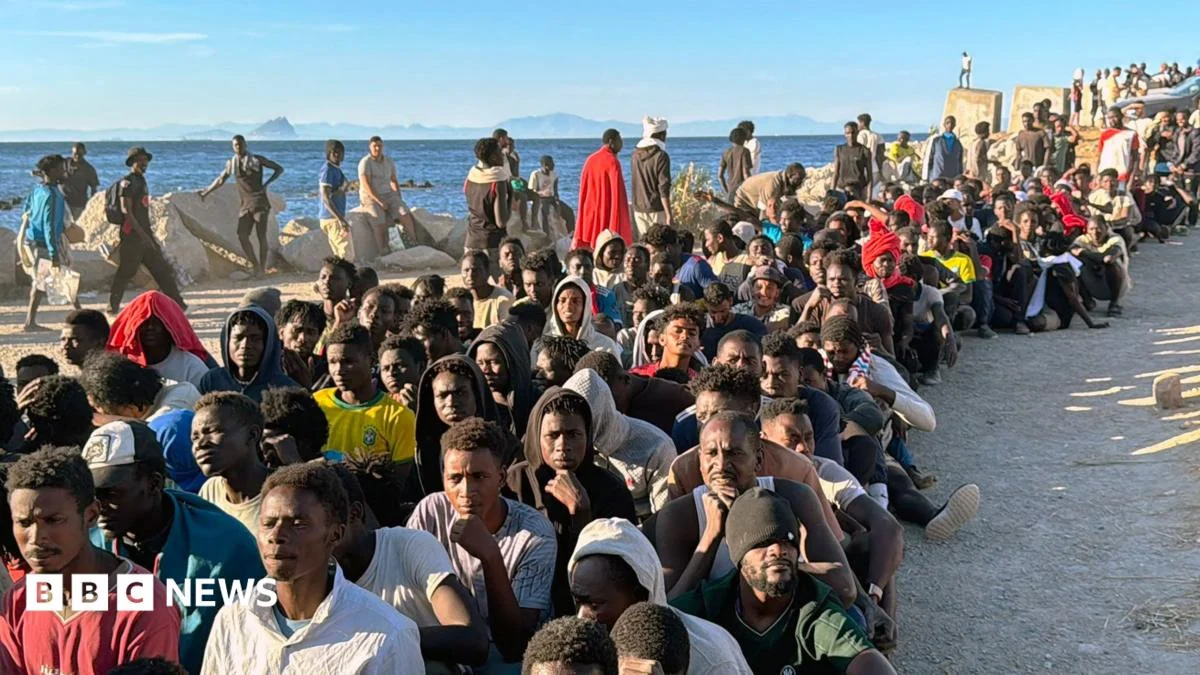
Spain has issued a stern warning to Italy, threatening to implement unspecified "proportionate counter-measures" should Rome fail to reverse its decision to impose temporary border controls, a move taken in response to a recent mass influx of migrants into the Spanish North African exclave of Ceuta. The diplomatic dispute, which flared on Friday, August 6th, underscores the profound strain placed on the European Union’s cherished Schengen Area principles of free movement, while simultaneously exposing deeper fissures within the bloc regarding shared responsibility for migration management.
The unprecedented humanitarian and security challenge began last week when an estimated 78,000 migrants, predominantly from neighbouring Morocco, surged into Ceuta by sea and land over Thursday and Friday. This sudden and overwhelming arrival, which tragically resulted in approximately 100 fatalities, prompted an immediate and decisive reaction from Italy. Citing security concerns and the need to protect its own borders, Italy partially suspended its Schengen arrangement with Spain. This suspension entailed the closure of maritime and air entry points to Spanish nationals and the reinforcement of land border controls, effective immediately.
The Catalyst: Ceuta’s Unprecedented Mass Influx
The events of last week represented one of the most significant and concentrated migratory movements into European territory in recent memory. For decades, Ceuta, along with its sister exclave Melilla, has served as a critical, albeit heavily fortified, gateway for migrants seeking to reach Europe from Africa. However, the sheer scale and rapidity of the recent crossings dwarfed previous incidents. On May 17th and 18th, thousands of individuals, including many families and unaccompanied minors, overwhelmed the Spanish border defenses, some swimming around breakwaters, others clambering over fences. Spanish authorities, initially caught off guard, mobilized significant resources, including military personnel, to manage the crisis. While the vast majority of the migrants were eventually returned to Morocco, the humanitarian aftermath, particularly concerning unaccompanied minors, continues to pose a significant challenge. Spanish Youth Minister Sira Rego confirmed on Friday that nearly 1,400 minors, some described as "very young boys and girls," remained in Ceuta. She acknowledged the system had been "overwhelmed" but stated efforts were underway to bring the situation under control, prioritizing the most vulnerable cases.
Italy’s Response and the Schengen Dilemma
Italy’s decision to partially suspend its Schengen agreement with Spain was a direct, albeit unilateral, reaction to the perceived security and migratory pressures stemming from the Ceuta events. The Schengen Borders Code allows member states to temporarily reintroduce border controls at internal borders in exceptional circumstances that constitute a serious threat to public policy or internal security. Such measures are typically communicated to the European Commission and other member states. However, Spain quickly condemned Italy’s actions as "unjustified" and "discriminatory against the Spanish population," asserting that the measures lacked a legitimate basis given the Spanish government’s swift response to control the situation in Ceuta. Madrid demanded that Italy reverse its decision by Sunday, August 9th, warning of "proportionate measures to protect the interests and dignity of its citizens" if the deadline was not met. The nature of these potential reprisals, whether economic, diplomatic, or otherwise, was not specified, adding an element of uncertainty to the escalating row.
A Diplomatic Stand-off: Spain’s Ultimatum Meets Italian Defiance
Italy’s prompt response to Spain’s ultimatum was one of defiance. Rome declared it would not accept "ultimatums or impositions" from Madrid. Italian officials stated their intention to maintain border checks until at least August 15th, citing intelligence suggesting that Spain "expects a new wave of migration" to hit Ceuta around that date. This claim, however, was quickly contradicted by Spain. The Spanish prime minister’s office, while acknowledging they were monitoring the situation, told El País newspaper they did not anticipate a repeat of last week’s scenes. Reports of a potential second wave appear to have been fuelled primarily by social media activity among Moroccan users planning another attempt, rather than official intelligence from Madrid. This divergence in information further complicated the diplomatic exchange, with Spain viewing Italy’s justification as based on unsubstantiated rumours.
The Role of Morocco and Underlying Geopolitical Tensions
The mass crossings into Ceuta did not occur in a vacuum; they are deeply intertwined with the complex and often contentious relationship between Spain and Morocco. For decades, the two Spanish exclaves of Ceuta and Melilla, situated on Morocco’s northern coast, have been a persistent "bone of diplomatic contention." Morocco does not recognize Spanish sovereignty over them, viewing them as historical Moroccan territories under occupation. This underlying tension frequently manifests in varying degrees of border control enforcement by Moroccan authorities.
A critical factor preceding the recent influx was a ruling by Spain’s Supreme Court. This ruling stipulated that migrants intercepted at sea while attempting to reach Ceuta or Melilla could not be summarily returned to Morocco without due process. This judicial decision, aimed at upholding international human rights standards, was seized upon by Morocco as a key element in the crisis. An unnamed Moroccan government source, briefing local outlets, reportedly laid blame squarely on Spain’s Supreme Court, stating that "the deterrent element of the system collapsed and the dam gave way, not under the weight of the criminals, but of a judge’s decision." This assertion suggests a deliberate loosening of Moroccan border controls, possibly as a form of diplomatic pressure or retaliation against Spain for various grievances, including Madrid’s shifting stance on the disputed Western Sahara territory. The question of why Morocco’s border guards did not attempt to stop the thousands of individuals crossing into Ceuta remains central to understanding the crisis.
Furthermore, the EU’s Migration Commissioner, Magnus Brunner, suggested that criminal networks spreading disinformation were partly to blame for the mass crossings – an assertion that the Spanish government has echoed. These networks often exploit vulnerabilities and spread false promises, exacerbating migratory pressures. Moroccan media reports also indicate fresh online calls to coordinate another mass border-crossing attempt, mirroring the social media activity observed before last week’s influx.
Broader EU Reactions and Schengen’s Strain
The diplomatic spat between Spain and Italy, triggered by the Ceuta crisis, has sent ripples across the European Union, exposing vulnerabilities within the Schengen Area. The principle of open internal borders is a cornerstone of European integration, and any unilateral suspension by a member state raises concerns about its integrity. Italy’s decision, while criticized by Spain, found support from other EU nations. Finland and Denmark backed Italy’s move, indicating a shared apprehension about unchecked migratory flows and the potential for a domino effect. More strikingly, the Czech Republic went further, calling for Spain’s membership in the Schengen Area to be temporarily suspended. This radical suggestion underscores the depth of concern among some member states regarding Spain’s perceived inability to fully control its external borders, particularly in a context where external pressures can quickly translate into internal EU challenges.
The incident highlights the ongoing struggle within the EU to forge a cohesive and equitable common migration policy. Countries on the EU’s external borders, like Spain, Greece, and Italy, often bear the brunt of migratory arrivals and frequently call for greater solidarity and burden-sharing from their northern partners. Unilateral actions like Italy’s partial Schengen suspension, while understandable from a national security perspective, risk undermining the very foundation of European cooperation and exacerbating divisions.
Economic and Geopolitical Implications
Should Spain proceed with its threatened "proportionate counter-measures," the implications could extend beyond mere diplomatic rhetoric, potentially impacting the significant economic ties between the two nations. Spain and Italy are major trading partners within the EU. In 2022, bilateral trade in goods between Spain and Italy amounted to approximately €60 billion, with significant flows in sectors such as automotive, machinery, and agricultural products. Any retaliatory measures, such as increased customs checks, restrictions on certain imports, or even targeted sanctions, could disrupt supply chains, harm businesses, and negatively impact citizens in both countries. Such actions would also set a dangerous precedent for intra-EU disputes, potentially leading to a fragmentation of the single market.
Geopolitically, the crisis further complicates the EU’s relationship with North Africa. Morocco is a crucial partner in migration management, counter-terrorism efforts, and regional stability. However, the Ceuta events demonstrate the fragility of this partnership and Morocco’s willingness to use migration as leverage in its diplomatic dealings with Spain and, by extension, the EU. The long-term implications for the EU’s strategy in the Mediterranean, its external border management, and its ability to present a united front on migration remain uncertain.
Looking Ahead: Uncertainty and Monitoring
As the Sunday, August 9th, deadline for Italy’s reversal of border controls looms, the situation remains fraught with uncertainty. The immediate challenge for Spain is to manage the humanitarian crisis in Ceuta, particularly the welfare of the unaccompanied minors, and to re-establish full control over its borders. For Italy, the justification for its continued border checks rests on unconfirmed intelligence of a new wave of migrants, a claim Spain refutes. The broader implications for the Schengen Area and the principle of free movement within the EU are significant. The episode serves as a stark reminder of the complex interplay of migration pressures, geopolitical rivalries, and internal EU solidarity that continue to test the bloc’s resilience and its commitment to shared values. The coming days will be critical in determining whether this diplomatic rift can be mended through dialogue or if it will escalate into a more protracted and damaging dispute between two prominent EU member states.