

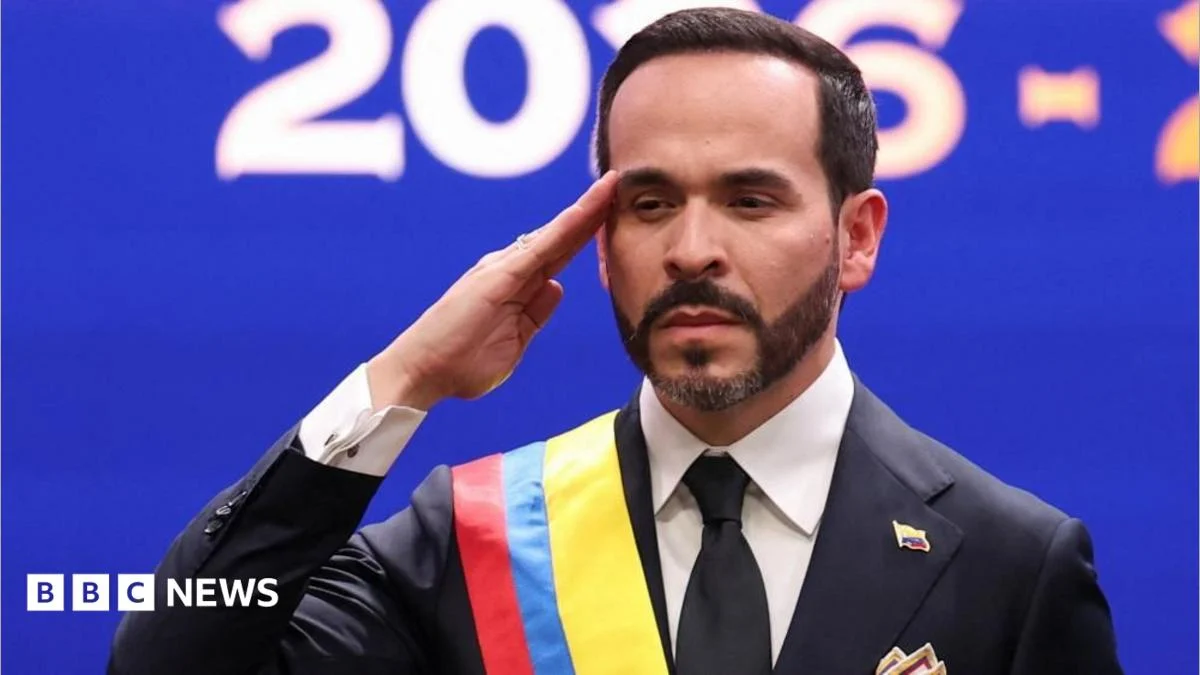
In a significant diplomatic and financial commitment, the United States has pledged a substantial £1 billion (approximately $1.27 billion USD) assistance package to Colombia, coinciding with the inauguration of its new right-wing president, Abelardo de la Espriella, on Friday. This substantial aid underscores a dramatic recalibration of US-Colombian relations, signaling a renewed partnership aimed at tackling shared security and economic objectives, particularly the fight against organized crime and illegal immigration.
A New Era of US-Colombia Relations and a Bold Inaugural Address
Abelardo de la Espriella, a staunch ally of former US President Donald Trump, took the oath of office in a ceremony that immediately underscored his confrontational approach to governance. In a powerful maiden speech delivered to troops at a nearby military base, de la Espriella declared an "all-out war" on what he termed "narco-terrorism," promising to crush armed insurgents, rebuild the nation, and defend democracy "by reason or by force." Adopting the self-appointed nickname "the Tiger," he asserted that under his leadership, the state would be "forceful and decisive against crime," guaranteeing that "there will not be a single place in our territory where criminals can feel safe."
The US State Department was quick to welcome the new administration, issuing a statement that hailed a "new era in US-Colombia relations." The announced financial support, described as a "security package," is designed to bolster de la Espriella’s efforts in achieving "our shared goals," which prominently feature combating organized crime and stemming illegal immigration. This rapid and substantial commitment highlights Washington’s eagerness to forge a robust alliance with the new conservative government, following a period of strained relations under the preceding left-wing administration.
A Dramatic Political Shift in Colombia
De la Espriella’s ascent to the presidency marks a profound ideological shift for Colombia. He replaces the left-wing former leader, Gustavo Petro, whose administration frequently found itself at odds with the Trump White House and pursued a different path regarding internal conflict resolution and international alliances. Petro had advocated for peace talks with various armed groups and often voiced criticism of US foreign policy, particularly concerning military interventions and economic sanctions.
The political trajectory leading to de la Espriella’s victory was closely observed by Washington. Former President Trump had openly endorsed de la Espriella during the election campaign, predicting a "much better relationship" with his new counterpart following his victory in June. This endorsement, coupled with the swift financial pledge, reinforces the perception of a deliberate strategic alignment between the two nations, underpinned by ideological common ground.
The inauguration itself was attended by a high-level US delegation led by then-acting Attorney General Todd Blanche, who has since been confirmed to the post. The presence of such a senior US official underscored the significance Washington placed on the transition. Notably, the ceremony also saw the attendance of embattled FIFA president Gianni Infantino, adding an unexpected international dimension to the event.
Symbolic Choice of Inauguration Location
In a significant departure from tradition, President de la Espriella chose to take his oath of office not in Colombia’s capital, Bogotá, but in the volatile western city of Cali. This unconventional choice was a deliberate and potent signal of his administration’s tough stance on illegal armed groups operating extensively in the region. Cali and its surrounding Valle del Cauca department have long been hotspots for drug trafficking, paramilitary activity, and the presence of various criminal organizations. By inaugurating in Cali, de la Espriella aimed to project an image of direct engagement with the nation’s most pressing security challenges, symbolically bringing the fight against crime to its very heartlands rather than confining it to the distant corridors of power in the capital.
Abelardo de la Espriella: From Controversial Lawyer to President
Before entering politics, Abelardo de la Espriella carved out a successful, albeit controversial, career as a lawyer. His clientele notably included drug-trafficking paramilitaries, footballers, and individuals accused of fraud. This background has drawn criticism, with some analysts and human rights groups expressing concerns about the implications of his confrontational style for an already highly polarized nation. Critics argue that his approach could exacerbate social divisions and potentially lead to human rights abuses in the pursuit of his "all-out war" agenda.
De la Espriella has consistently vowed a sharp break from his left-wing predecessor’s policies. In stark contrast to Petro’s emphasis on peace talks and social programs as a means to address the root causes of conflict, de la Espriella has promised a brutal crackdown on the activities of armed groups. His proposed measures include the construction of "mega-prisons," a concept often associated with a punitive, zero-tolerance approach to crime, echoing strategies implemented in other Latin American nations.
Deepening Security Alliances: US and Israel
A cornerstone of de la Espriella’s foreign policy is the forging of strong military alliances with the United States and Israel. This stance represents another significant departure from Petro’s administration, which had often been critical of Israel’s Prime Minister Benjamin Netanyahu and pursued a more non-aligned foreign policy. The new president’s alignment with Washington and Tel Aviv signals a clear geopolitical orientation that prioritizes security cooperation with traditional Western allies.
In one of his first acts as president, de la Espriella announced Colombia’s intention to join the "Shield of the Americas" security partnership, an initiative founded by former US President Trump. The US swiftly welcomed this decision, reiterating its readiness to "support the de la Espriella administration’s efforts to defeat the vicious narco-terrorist and criminal organisations" that threaten regional security. This move solidifies Colombia’s position within a broader security framework favored by Washington, potentially enhancing intelligence sharing, joint military exercises, and coordinated efforts against transnational crime.
Broader Implications: Security, Immigration, and Economy
The US State Department further elaborated on the shared goals underpinning the renewed partnership, highlighting not only the fight against organized crime but also halting illegal immigration through "closer coordination on border security." Colombia, geographically positioned as a key transit country for migrants heading north, including those traversing the treacherous Darién Gap, plays a critical role in regional migration patterns. Increased cooperation on border security could entail enhanced surveillance, intelligence sharing, and coordinated efforts to disrupt human smuggling networks.
Beyond security, Washington has also identified de la Espriella’s "pro-growth agenda" as a significant opportunity to "increase trade and deepen economic ties between our countries." The US has historically been Colombia’s largest trading partner, and a renewed focus on economic collaboration could lead to expanded bilateral trade agreements, increased foreign direct investment, and joint initiatives aimed at fostering economic development. Such a "pro-growth agenda" typically prioritizes market-friendly policies, deregulation, and incentives for private sector investment, which align with the economic philosophies often favored by conservative administrations.
Background Context: A History of US-Colombia Cooperation
The substantial US aid package echoes historical precedents, most notably "Plan Colombia," initiated in 2000. This multi-billion-dollar aid program, primarily focused on counter-narcotics and counter-insurgency efforts, transformed US-Colombia relations and significantly shaped Colombia’s internal conflict. While controversial due to its military focus and environmental impact, Plan Colombia is often credited with helping to stabilize the country, weaken armed groups like the FARC, and reduce coca cultivation, albeit with varying degrees of long-term success.
However, the landscape has evolved. While FARC largely demobilized, new criminal groups, dissident factions, and the ELN (National Liberation Army) continue to pose significant threats. Coca cultivation and cocaine production have seen surges in recent years, reaching record levels according to UNODC and DEA reports. The new aid package suggests a return to a more robust, security-focused strategy, potentially drawing lessons from Plan Colombia while adapting to contemporary challenges such as increased international drug demand, new trafficking routes, and the nexus of organized crime with illegal mining and human trafficking.
Chronology of Key Events
- June [Year]: Abelardo de la Espriella wins the Colombian presidential election, with a clear endorsement from former US President Donald Trump.
- [Date of Inauguration]: Abelardo de la Espriella is sworn in as President of Colombia.
- [Date of Inauguration]: US delegation, led by then-acting Attorney General Todd Blanche, attends the inauguration in Cali.
- [Date of Inauguration]: President de la Espriella delivers a fiery maiden speech, declaring "all-out war" on "narco-terrorism."
- [Date of Inauguration]: US State Department issues a statement hailing a "new era" and pledges £1 billion in assistance.
- Immediately Post-Inauguration: President de la Espriella announces Colombia will join the "Shield of the Americas" security partnership.
Potential Implications and Challenges Ahead
The invigorated US-Colombia partnership carries significant implications for regional stability. A strengthened Colombian state, backed by US resources, could exert greater pressure on transnational criminal organizations that operate across borders, potentially affecting drug flows through Central America and Mexico. It could also influence the dynamics with neighboring countries, particularly Venezuela, given historical tensions and shared border challenges related to migration and illicit activities.
Domestically, de la Espriella’s "all-out war" strategy faces a complex reality. While proponents argue it is necessary to restore order and dismantle criminal networks, critics warn that a purely military approach risks alienating communities, exacerbating human rights concerns, and failing to address the underlying socio-economic factors that fuel recruitment into armed groups. The proposed "mega-prisons," for instance, could be effective in housing large numbers of criminals but raise questions about due process, rehabilitation, and long-term societal integration.
Furthermore, the emphasis on "pro-growth" economic policies, while aiming to boost trade and investment, will need to be carefully balanced with efforts to reduce inequality and provide opportunities in marginalized regions, which are often the most susceptible to the influence of illegal armed groups. The success of this new era will ultimately depend not only on the scale of financial aid but also on the nuanced implementation of policies that balance security imperatives with human rights, social development, and sustainable peace-building efforts. The coming years will be a critical test for this renewed alliance and for Colombia’s path forward under its new, decisively right-wing leadership.