


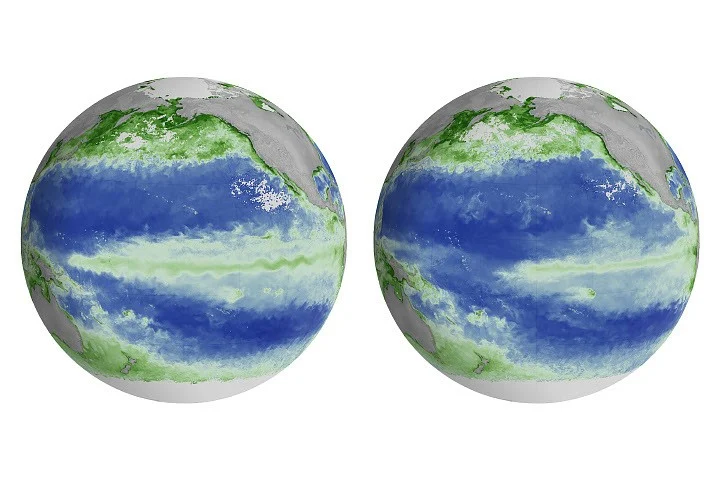
Global oceanic systems are currently under the profound influence of a strengthening El Niño event, officially declared in June 2026, with satellite data for August 10, 2026, providing a stark visualization of its early ecological impacts. Measurements of chlorophyll-a concentrations at the sea surface, a critical indicator of phytoplankton abundance, have shown significant reductions in key equatorial Pacific regions. This shift signals fundamental alterations in the ocean’s nutrient supplies, with potentially far-reaching consequences for marine ecosystems and global climate patterns. Scientists from NASA and NOAA are closely monitoring these developments, leveraging advanced satellite technology, including NASA’s recently launched Plankton, Aerosol, Cloud, ocean Ecosystem (PACE) mission, to gain unprecedented insights into this dynamic natural phenomenon.
The Onset and Strengthening of the 2026 El Niño
The naturally recurring El Niño-Southern Oscillation (ENSO) cycle is one of the most significant drivers of global climate variability. Characterized by warmer-than-normal sea surface temperatures (SSTs) in the equatorial Pacific Ocean and associated changes in atmospheric and oceanic circulation, El Niño events typically occur every two to seven years and can persist for nine to twelve months, sometimes longer. Their regional and global effects are diverse, ranging from altered precipitation patterns leading to floods in deserts and droughts in normally wet regions, to shifts in the pathways and intensity of tropical cyclones, and disruptions to marine life.
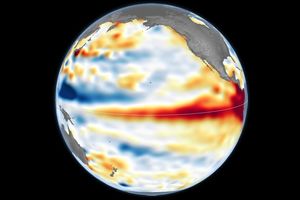
The current El Niño was officially declared underway in June 2026, marking a significant transition from neutral conditions. The National Oceanic and Atmospheric Administration’s (NOAA) Climate Prediction Center has been closely tracking its progression, forecasting a high likelihood – 97 percent – that this El Niño will continue to strengthen through the end of 2026 and persist into the early Northern Hemisphere spring of 2027. This projection underscores the potential for sustained and intensified impacts across various Earth systems. Even in its nascent stages, the 2026 event has exhibited characteristic physical signatures. Satellite observations have confirmed warmer-than-normal sea surface temperatures across vast stretches of the equatorial Pacific, accompanied by higher-than-normal sea surface heights, both classic hallmarks of an unfolding El Niño. These physical changes are the precursors to the ecological shifts now being observed.
Chlorophyll-a: A Window into Ocean Health
At the heart of the observed ecological shifts lies chlorophyll-a, the primary photosynthetic pigment found in most phytoplankton. Phytoplankton, microscopic marine algae, form the base of the vast oceanic food web. Through photosynthesis, they convert sunlight into energy, consuming carbon dioxide and releasing oxygen, making them vital to both marine ecosystems and the global carbon cycle. Their abundance and distribution are directly influenced by the availability of essential nutrients, such as nitrates, phosphates, and silicates, which are typically brought to the surface through processes like upwelling.

Satellite measurements of chlorophyll-a concentrations thus provide a critical diagnostic tool for assessing the health and productivity of ocean waters. Higher concentrations indicate a thriving phytoplankton population, signifying a robust primary production zone capable of supporting a diverse marine food web. Conversely, lower concentrations suggest nutrient scarcity and reduced biological activity, which can cascade through the entire ecosystem. The Ocean Color Instrument (OCI) on NASA’s PACE satellite, launched in February 2024, is now at the forefront of these observations, offering unprecedented detail in monitoring ocean color and, by extension, phytoplankton dynamics.
Satellite Evidence of Ecological Disruption
Comparing satellite data from June 2025, when oceanic conditions were neutral, with June 2026, as the El Niño was strengthening, reveals a dramatic and telling difference. The most pronounced change is evident in the central Pacific, particularly along the equator north of New Zealand. Here, chlorophyll-a concentrations in June 2026 are substantially lower than those recorded in the previous year. This reduction in chlorophyll-a directly indicates a significant decrease in phytoplankton abundance in these vital waters.
Matthew Kehrli and Graham Trolley, oceanographers in the Ocean Ecology Laboratory at NASA’s Goddard Space Flight Center, confirm that this observed change is an expected consequence of El Niño conditions. They explain the underlying oceanographic mechanisms: during an El Niño, the easterly equatorial trade winds, which typically push warm surface waters westward, weaken considerably. This weakening allows the warm surface layer of the ocean to extend deeper than usual, effectively suppressing the upwelling of cool, nutrient-rich water from the deep ocean. This upwelling is the primary mechanism by which vital nutrients are brought to the surface, fueling phytoplankton growth. With suppressed upwelling, the surface waters become nutrient-depleted, leading to a decline in phytoplankton populations.
As the 2026 El Niño is projected to strengthen further, Kehrli and Trolley anticipate that these differences in the central Pacific will become even more pronounced. They suggest that this could manifest as a greater disparity in chlorophyll values across the affected region, a broadening of the area experiencing reduced surface chlorophyll-a concentrations, or a combination of both, depending on the evolving behavior of the equatorial trade winds.
Ripple Effects Through the Marine Food Web
The decline in phytoplankton abundance at the base of the marine food web has profound and widespread ripple effects throughout the entire ecosystem, extending from microscopic organisms to apex predators and even impacting human economies. With less phytoplankton available, zooplankton, the primary grazers of phytoplankton, face a scarcity of food. This reduction in zooplankton, in turn, impacts fish populations that feed on them, leading to less food for seabirds and marine mammals that prey on fish.
Historical El Niño events provide stark precedents for these ecological disruptions. For instance, past strong El Niños have been associated with dramatic declines in catch for Peru’s anchovy fisheries. This vital industry, a cornerstone of the Peruvian economy and a significant global source of fishmeal, is highly sensitive to changes in ocean conditions. The mechanisms are consistent: warmer surface waters, reduced upwelling, and consequently, lower phytoplankton abundance directly impact the anchovy populations.
In 2026, with the current El Niño intensifying, Peru’s Ministry of Production (PRODUCE) has already taken preemptive and responsive measures. Reports indicate that the Ministry has repeatedly suspended anchovy fishing activities in the north-central zone to safeguard the country’s main fishing resource and allow stocks to recover. These closures, while economically challenging for local communities and the industry, are deemed necessary to prevent further depletion of fish stocks and ensure long-term sustainability. The ecological stress is also visibly affecting wildlife, with local news outlets reporting sightings of pelicans venturing into Peruvian ports and urban areas, a clear sign of their desperate search for food in their usual foraging grounds. Such observations underscore the immediate and tangible impact of El Niño on coastal ecosystems and the broader marine environment.
The Prospect of Recovery and La Niña’s Influence
Despite the severe disruptions caused by El Niño, the ocean often exhibits a remarkable capacity for recovery. Scientists have observed a phenomenon known as a "chlorophyll rebound" in the equatorial Pacific following El Niño events, characterized by higher-than-normal concentrations of chlorophyll-a. Research suggests that this resurgence is fueled by increased iron concentrations delivered in ocean currents and dust originating from drier land in parts of Central and South America. These nutrients, once again available in sufficient quantities, help to reignite phytoplankton growth, initiating a recovery phase that does not necessarily require the immediate onset of a La Niña event.
La Niña, the opposite phase of ENSO, is characterized by cooler-than-normal SSTs in the equatorial Pacific and stronger-than-normal easterly trade winds. It often follows El Niño events, although not always directly. When a strong La Niña occurs, it typically enhances oceanic upwelling, bringing abundant cold, nutrient-rich water to the surface. This creates highly favorable conditions for phytoplankton blooms. A notable example occurred during the strong La Niña of 1998–1999, which led to a massive phytoplankton bloom in the eastern Pacific and a dramatic increase in fish populations, demonstrating the ocean’s ability to rebound vigorously under favorable conditions. Understanding the mechanisms behind both natural recovery and La Niña-driven resurgence is crucial for predicting the long-term impacts and recovery trajectories of marine ecosystems.
Advanced Tools for Deeper Understanding: The PACE Mission
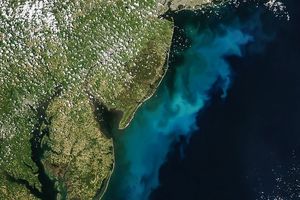
The scientific community is exceptionally well-equipped to study the 2026 El Niño, thanks to new observational capabilities. The PACE mission, launched by NASA in February 2024, represents a monumental leap forward in Earth observation. This mission is designed to provide global, near-daily hyperspectral measurements across a broader range of light wavelengths than ever before. This advanced capability allows scientists to differentiate between various types of phytoplankton, providing a much more nuanced understanding of how specific communities respond to environmental stressors like El Niño.
Kehrli and Trolley highlight the significance of PACE for the current El Niño event: "The scientific community will be able to observe the 2026 El Niño with data across more wavelengths of light than ever before." This means researchers can move beyond simply measuring total chlorophyll-a to identifying changes in the composition of phytoplankton communities, which can have different implications for the food web and carbon cycling.
The utility of PACE extends beyond the marine realm. Its advanced sensors are also capable of measuring plant pigment composition on land, offering insights into terrestrial vegetation responses to El Niño-induced shifts in temperature and precipitation. Furthermore, PACE monitors clouds and aerosols in the atmosphere, components that are intrinsically linked to and influenced by El Niño’s atmospheric circulation changes. This holistic approach provided by PACE allows scientists to study the interconnectedness of Earth’s systems, offering a comprehensive view of El Niño’s cascading effects from the ocean depths to the atmosphere above. The data collected during this El Niño event will be invaluable for refining climate models, improving predictions of future ENSO events, and enhancing our understanding of Earth’s complex climate system.
Broader Implications and Future Outlook
The 2026 El Niño serves as a critical testbed for understanding the complex interplay between oceanic and atmospheric phenomena and their profound impacts on global ecosystems and human societies. The observed reductions in primary productivity underscore the fragility of marine food webs and the direct economic vulnerabilities of fishing communities. As the event progresses, continued monitoring by satellites like PACE, coupled with in-situ measurements and advanced modeling, will be essential.
The data gathered will not only help to track the immediate consequences but also to refine our understanding of how ecosystems adapt and recover. The prospect of a post-El Niño chlorophyll rebound, potentially amplified by a subsequent La Niña, offers a glimmer of hope for ecological recovery, but the interim period of disruption can be severe. This event also highlights the increasing importance of international collaboration in climate science and resource management, as El Niño’s impacts transcend national borders, affecting weather patterns, agricultural yields, and marine resources worldwide.
Ultimately, the 2026 El Niño underscores the dynamic nature of our planet and the critical role of continuous scientific observation in navigating its challenges. The insights gained from this event, particularly through the unprecedented capabilities of the PACE mission, will be instrumental in developing more resilient strategies for environmental conservation and sustainable resource management in a changing climate.