

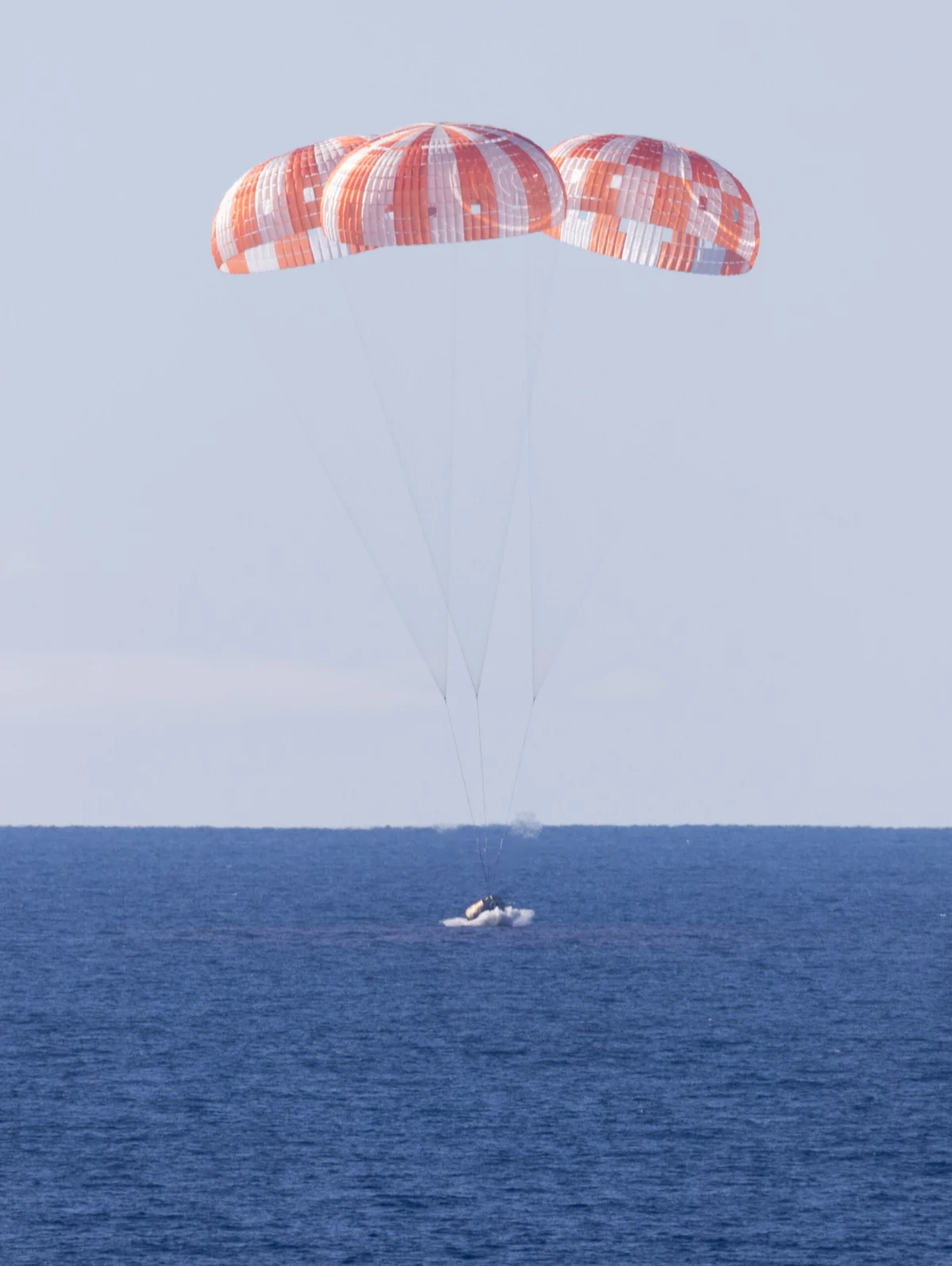
The four astronauts of the Artemis II mission have successfully concluded their historic journey around the Moon, splashing down safely off the coast of San Diego, California, on Friday, April 10, at 5:07 p.m. PDT. This monumental 10-day test flight, undertaken aboard NASA’s Orion spacecraft, has not only marked humanity’s furthest venture into deep space in over half a century but also established new distance records, pushing the boundaries of human exploration and validating critical systems for future lunar missions.
The crew, comprising NASA astronauts Reid Wiseman, Victor Glover, and Christina Koch, alongside Canadian Space Agency (CSA) astronaut Jeremy Hansen, completed a remarkable voyage that saw them travel a maximum distance of 406,771 kilometers (252,756 miles) from Earth. Their return signifies a critical milestone for NASA’s Artemis program, designed to return humans to the lunar surface and establish a sustained presence there, ultimately laying the groundwork for missions to Mars.
A Triumphant Return and Official Acclaim
Upon their oceanic re-entry, the Orion capsule executed a precise splashdown, a testament to the meticulous engineering and rigorous testing of its re-entry, descent, and landing systems. A joint team from NASA and the U.S. Navy was on standby, swiftly recovering the crew from the capsule in the open Pacific Ocean. The astronauts were then transported by helicopter to the USS John P. Murtha, where they underwent initial medical examinations. The crew members are anticipated to return to NASA’s Johnson Space Center in Houston by Saturday, April 11, for further debriefing and medical evaluations.
Jared Isaacman, NASA Administrator, extended a warm welcome and congratulations to the returning crew. "Reid, Victor, Christina, and Jeremy: welcome home and congratulations on a truly historic achievement," Isaacman stated. He further acknowledged the foundational support for the mission, adding, "NASA thanks President Donald Trump and his allies in Congress for providing the mandate and resources that made this mission and the future of Artemis possible." This recognition underscores the bipartisan and long-term commitment required for such ambitious space endeavors, with the Artemis program initiated under the Trump administration and continuing under subsequent leadership.
Isaacman emphasized the profound significance of the mission: "Artemis II demonstrated extraordinary skill, courage, and dedication as the crew carried Orion, the Space Launch System [SLS], and human exploration farther than ever before. As the first astronauts to fly in this rocket and spacecraft, the crew accepted considerable risk in service of the knowledge gained and the future we are determined to build." He also lauded the contributions of the vast workforce and international partners, whose expertise was indispensable to the mission’s success. "With the Artemis II mission completed, attention now confidently shifts to the assembly of Artemis III and preparations to return to the lunar surface, establish a base, and never leave the Moon again."
Amit Kshatriya, NASA Associate Administrator, echoed these sentiments, highlighting the validation of the entire system. "The Artemis II crew is home. Re-entry, descent, and landing systems performed as designed, and the final test was completed as planned. This moment belongs to the thousands of people, from fourteen different countries, who built this vehicle, tested it, and placed their trust in it," Kshatriya remarked. "Their work protected four human lives traveling at 25,000 miles per hour, and brought them safely back to Earth. Artemis II has validated the vehicle, the teams, the architecture, and the international collaboration that will take humanity back to the lunar surface. Reid, Victor, Christina, and Jeremy carried the hopes of this world farther than humans have traveled in over half a century. 53 years ago, humanity left the Moon. This time, we have returned to stay. The future is ours to conquer."
Mission Chronology: A Journey of Records and Validation
The journey began with a spectacular launch on April 1, at 6:35 p.m., from Launch Pad 39B at NASA’s Kennedy Space Center in Florida. The mighty Space Launch System (SLS) rocket, the most powerful rocket in the world, generated nearly four million kilograms (8.8 million pounds) of thrust at liftoff. This colossal American-made rocket flawlessly propelled the Orion spacecraft, which the crew affectionately named "Integrity," into Earth orbit with pinpoint precision, following a smooth countdown orchestrated by the Artemis launch control team.
The SLS rocket, a key component of the Artemis program, represents a new era in heavy-lift capabilities. Standing taller than the Statue of Liberty, its immense power is designed to send Orion and its crew, along with critical cargo, directly to the Moon. Its successful performance on Artemis II was a crucial demonstration of its readiness for crewed deep-space missions.
During the first day in space, the astronauts and ground teams meticulously inspected the Orion spacecraft to confirm all systems were operating optimally before commencing the trans-lunar injection. This critical phase also saw the deployment of four small CubeSats from NASA’s international partners into Earth orbit, designed for various scientific and technological demonstrations, further enhancing the mission’s scope beyond just human spaceflight validation.
On the second day, with all systems confirmed "Go," Orion’s service module engine ignited, propelling the astronauts onto a trajectory that would take them looping around the Moon. The closest approach to the lunar surface saw them soar 6,545 kilometers (4,067 miles) above it, a precise maneuver designed to test the spacecraft’s navigation and propulsion systems in the deep-space environment.
Throughout their mission, Wiseman, Glover, Koch, and Hansen covered a total distance of 1,117,659 kilometers (694,481 miles). This lunar flyby took them farther than any human has ever traveled, surpassing the previous distance record set by the Apollo 13 astronauts in 1970. The Apollo 13 mission, while a testament to human ingenuity in crisis, was an unplanned slingshot around the Moon. Artemis II, in contrast, was a deliberate, controlled journey designed to push the boundaries of distance and duration for human deep-space travel, thereby testing Orion’s resilience to radiation exposure and extreme temperature variations in the unforgiving environment beyond Earth’s protective magnetosphere.
Rigorous Testing and Scientific Endeavors
The primary objective of Artemis II was to thoroughly evaluate the Orion spacecraft’s performance with astronauts aboard. Engineers subjected Orion to a comprehensive assessment, with the crew actively participating in various tests. A critical aspect was the validation of the spacecraft’s life support systems, confirming Orion’s capability to sustain human life in deep space for extended periods. This involved monitoring air quality, water recycling, temperature control, and waste management systems, all essential for long-duration missions.
Furthermore, the crew conducted several piloting demonstrations, taking manual control of the spacecraft. These exercises were vital for validating Orion’s maneuverability and gathering data that will inform future rendezvous and docking operations with crewed lunar landers during Artemis III and subsequent missions. The ability for astronauts to manually control the spacecraft is a crucial safety feature and provides flexibility in unforeseen circumstances.
A series of additional tests were completed to guide NASA’s future lunar missions. These included evaluations of spacecraft operations during crew exercises, emergency equipment and procedures, the Orion crew survival system spacesuits, and other critical ship systems. The performance of these systems is paramount to ensuring the safety and efficiency of future lunar landings and the establishment of a lunar base.
Beyond technical validation, the Artemis II crew actively supported scientific research. Among these investigations was AVATAR (Advanced Vision and Tracking for Astronaut Readiness), which studies how human tissue responds to microgravity and the deep-space radiation environment. Other human research studies focused on performance metrics, sleep patterns, and psychological well-being, collecting essential health data for long-duration missions to the Moon and eventually Mars. Understanding these physiological and psychological impacts is critical for mitigating risks and optimizing crew health and performance far from Earth.
Unprecedented Views and Lunar Reconnaissance
During their lunar flyby on April 6, the astronauts leveraged their unique vantage point to capture over 7,000 images of the lunar surface and a rare solar eclipse, where the Moon obscured the Sun from Orion’s perspective. These images offer breathtaking views, including Earthrise and Earthset, impact craters, ancient lava flows, our Milky Way galaxy, surface fractures, and variations in color across the lunar terrain.
The crew specifically documented the topography along the terminator – the boundary between lunar day and night. The low-angle sunlight at the terminator casts long shadows, creating illumination conditions similar to those expected at the Moon’s South Pole region, where Artemis III astronauts are slated to land in 2028. These observations are crucial for mission planning, helping to identify potential hazards and scientifically interesting sites for future landings.
Additionally, the astronauts proposed potential names for two lunar craters, contributing to the ongoing mapping and nomenclature of the Moon. They also reported flashes from meteoroid impacts on the Moon’s dark side, providing valuable data on the micrometeoroid environment in lunar orbit, which is important for designing protective measures for future lunar habitats and spacecraft. The scientific investigations conducted during Artemis II will pave the way for future surface missions, advancing operational procedures and enabling astronauts to make informed judgments to identify high-interest areas for science and exploration.
Looking Ahead: Artemis III and Beyond
With the Artemis II crew safely back on Earth, NASA and its international and commercial partners are now fully focused on preparations for the Artemis III mission, slated for the coming year. Artemis III will mark humanity’s return to the lunar surface, with a new crew aboard Orion testing integrated operations with commercially developed lunar landers in low Earth orbit before the final descent to the Moon. This mission aims to land the first woman and the first person of color on the Moon, a significant step toward diversity and inclusion in space exploration.
The Artemis program is envisioned as a golden age of innovation and exploration. NASA plans to send Artemis astronauts on increasingly challenging missions, exploring more regions of the Moon to achieve scientific discoveries and economic benefits. The ultimate goal is to establish a sustained human presence on the lunar surface, learning to live and work in deep space, and using the Moon as a proving ground for the ambitious journey to Mars. The insights gained from Artemis II, from the performance of the SLS rocket and Orion spacecraft to the invaluable human data collected, are instrumental in realizing this grand vision.
The success of Artemis II underscores the power of international collaboration and the unwavering human spirit of exploration. It is a testament to the thousands of engineers, scientists, and support personnel across multiple nations who have dedicated their lives to advancing humanity’s reach into the cosmos. As humanity looks towards a future beyond Earth, the Artemis program stands as a beacon of progress, promising a new era of lunar discovery and setting the stage for the ultimate human voyage to the Red Planet.
For more information on the Artemis program, please visit:
https://www.nasa.gov/artemis (English)
https://ciencia.nasa.gov/artemis (Español)