
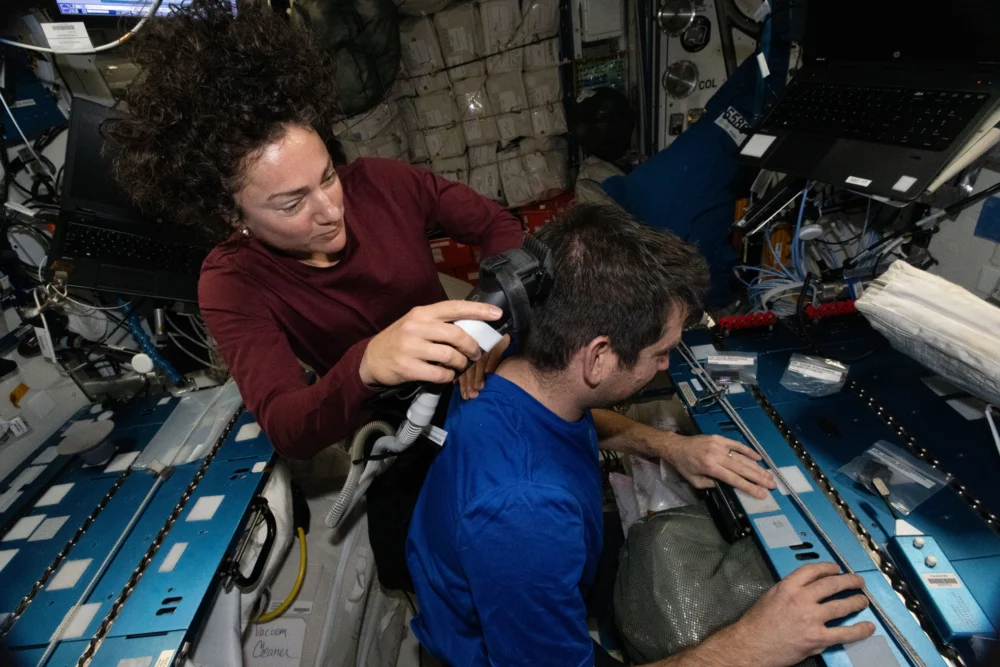
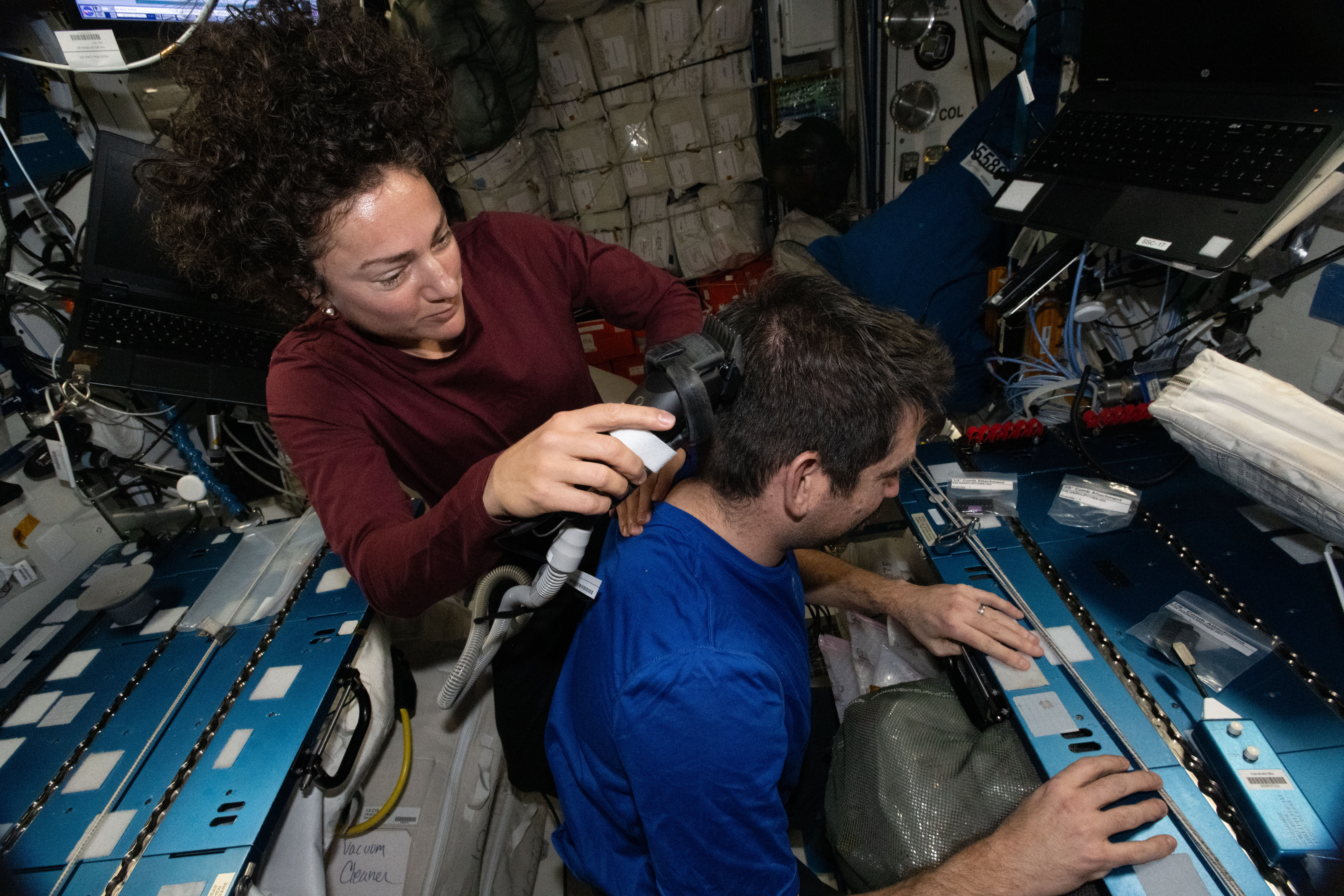
A routine act of personal grooming took on a uniquely intricate dimension aboard the International Space Station (ISS) on March 1, 2026, as NASA astronaut Jessica Meir provided a haircut for her fellow astronaut, Jack Hathaway. The seemingly simple task, documented in an image credited to NASA/Chris Williams, underscored the meticulous planning and innovative solutions required for daily life in the microgravity environment of Earth’s orbiting laboratory. Meir utilized a specialized electric razor equipped with an integrated vacuum system, a critical tool designed to capture every loose hair clipping and prevent it from dispersing into the station’s delicate atmosphere, a testament to the comprehensive approach NASA and its international partners take toward maintaining crew health and operational integrity in space.
The Nuances of Microgravity Grooming
The act of cutting hair in space is far from its terrestrial counterpart. On Earth, gravity ensures hair clippings fall to the floor, where they can be swept up and disposed of. In microgravity, however, any loose particle, no matter how small, becomes a potential hazard. Hair clippings could float indefinitely, posing risks to sensitive equipment, clogging air filters, or even entering an astronaut’s eyes, nose, or mouth. This necessitates specialized tools and procedures to ensure the station’s pristine environment remains uncontaminated and crew safety is maintained.
The electric razor employed by Astronaut Meir is a prime example of such adaptation. Engineered with a powerful suction mechanism, it functions much like a miniature, personal vacuum cleaner, drawing in each severed strand of hair immediately as it is cut. This design is crucial for preventing the spread of bio-debris, which could otherwise interfere with the station’s complex life support systems, sensitive scientific instruments, or create uncomfortable and unhygienic conditions for the crew. The collected hair is then safely sealed and stored for eventual disposal, typically during resupply missions when cargo vehicles are deorbited and incinerated upon re-entry into Earth’s atmosphere.
Beyond the technical aspect, the process of a haircut in space also highlights the unique social dynamics and reliance among crew members. Personal grooming tasks often become shared responsibilities, fostering camaraderie and mutual support essential for long-duration missions. Astronauts assist each other with various tasks that would be simple on Earth but demand cooperation in microgravity, reinforcing team cohesion.
Life Aboard the International Space Station: Beyond Scientific Research
While the ISS is primarily known as a cutting-edge scientific laboratory, enabling research across various disciplines from biology and physics to Earth observation and technology development, it is also a human habitat. The daily lives of astronauts are meticulously structured to balance demanding scientific work with essential personal care, maintenance, and well-being. The image of Meir trimming Hathaway’s hair provides a window into this often-overlooked aspect of spaceflight – the routine yet critical tasks that sustain life and morale hundreds of kilometers above Earth.
Weekends on the ISS are typically designated for what astronauts refer to as "housekeeping" tasks. These periods are vital for maintaining the station’s habitability and operational efficiency. Beyond personal hygiene like haircuts, these duties include a wide array of activities:
- Cleaning modules: Wiping down surfaces, cleaning air filters, and tidying up living and working areas to prevent dust and microbial buildup.
- Equipment maintenance: Performing routine checks and minor repairs on life support systems, exercise equipment, and scientific instruments.
- Inventory management: Organizing and tracking thousands of items, from food and spare parts to experimental samples.
- Personal time and exercise: Allowing crew members downtime for communication with family, relaxation, and rigorous daily exercise routines crucial for combating muscle atrophy and bone density loss in microgravity.
The emphasis on cleanliness and order in space is paramount. The closed-loop environment of the ISS means that anything released into the air or left untended can have disproportionate effects. Air filtration systems, for instance, work tirelessly to remove particulates, odors, and carbon dioxide, and their efficiency can be compromised by excessive loose debris. Maintaining a clean and organized habitat not only ensures the smooth operation of the station but also significantly contributes to the psychological well-being of the crew, creating a more comfortable and less stressful living environment during their months-long missions.
A Brief History of Space Hygiene and Evolution of Grooming Tools
The challenge of personal hygiene in space has evolved significantly since the dawn of human spaceflight. Early missions, characterized by shorter durations, had simpler solutions.
- Vostok and Mercury (early 1960s): These pioneering missions were too brief for extensive grooming needs. Astronauts and cosmonauts relied on pre-flight preparation and minimal in-flight care, often for just a few days.
- Gemini and Apollo (mid-to-late 1960s): As missions extended to weeks, basic hygiene became more important. Astronauts used wet wipes for cleaning, and hair management was often minimal or addressed with simple combs. The primary concern was the mission’s objective, not comfort grooming.
- Skylab (1970s): The United States’ first space station provided more living volume and longer mission durations (up to 84 days). Skylab featured a rudimentary "shower" system that involved a fabric cylinder and a spray nozzle, though it was complex and rarely used due to water consumption and recovery challenges. Hair washing was still a logistical hurdle.
- Mir Space Station (1980s-2000s): The Soviet/Russian Mir station hosted numerous long-duration missions, some lasting over a year. Cosmonauts developed more robust routines for hygiene, including specialized no-rinse shampoos and sponges. Haircuts were performed with basic clippers, often with a second crew member holding a vacuum cleaner nozzle nearby to catch clippings.
- International Space Station (present): Building on decades of experience, the ISS incorporates advanced life support systems and hygiene solutions. Water is recycled extensively (up to 93% recovery), and tools like the vacuum-attached razor have become standard. Crew members use special shampoos that don’t require rinsing, body wipes, and toothpaste that can be swallowed to minimize waste. The focus is on sustainability and comfort for missions that typically last six months, with some extending to a year or more.
The evolution of these tools and practices reflects a growing understanding that long-duration space missions require not only advanced technology for scientific pursuits but also comprehensive systems to support human life and well-being in an alien environment.
The Crew Members: Jessica Meir and Jack Hathaway
Jessica Meir, a highly accomplished NASA astronaut, was selected in 2013. Prior to her astronaut career, she earned a Ph.D. in Marine Biology and worked as a research physiologist. She completed her first spaceflight as part of Expedition 61/62 from September 2019 to April 2020, spending 205 days in space. During this mission, she participated in three spacewalks, including the first all-female spacewalk alongside Christina Koch. Her presence on the ISS in March 2026, performing a haircut, implies a subsequent mission assignment, further showcasing her invaluable contributions to human space exploration. Meir’s background in biological research makes her particularly attuned to the intricacies of maintaining a sterile and healthy environment, even during seemingly mundane tasks.
Jack Hathaway is one of NASA’s newest generation of astronauts, having been selected in the 2021 class. An accomplished U.S. Navy commander and test pilot, Hathaway brings a wealth of operational experience to the astronaut corps. His selection signifies a commitment to future deep-space missions, including potential lunar and Martian expeditions. While the March 1, 2026, event would mark one of his earlier missions aboard the ISS, it represents a crucial step in his operational training and integration into the spaceflight community. For new astronauts, these early missions are not only about conducting science but also about mastering the daily routines and challenges of living and working effectively in microgravity.
Both astronauts exemplify the diverse skill sets and dedication required for modern space exploration, where scientific acumen, engineering prowess, and practical adaptability are equally valued.
Broader Implications: Future of Space Living and Exploration
The seemingly simple act of a haircut on the ISS carries significant implications for the future of space exploration, particularly as humanity sets its sights on longer-duration missions to the Moon (via the Artemis program) and eventually Mars.
- Self-Sufficiency for Deep Space: Missions to Mars will involve journeys lasting several years, making resupply missions from Earth impractical and extremely costly. This necessitates highly robust, closed-loop life support systems that can sustain crew members with minimal external input. Every resource, from water to air, and every waste product, including hair clippings, must be managed with extreme efficiency. The vacuum-razor technology is a micro-example of the self-sufficiency principle that will be scaled up for deep-space habitats.
- Psychological Well-being: Maintaining a sense of normalcy and routine, including personal grooming, is critical for the psychological health of astronauts during prolonged isolation. The ability to look and feel presentable can boost morale, reduce stress, and foster a healthier crew dynamic. As missions extend, the psychological impact of confinement and separation from Earth becomes a more prominent factor in mission success.
- Engineering Challenges and Innovation: The development of tools like the vacuum-attached razor drives innovation in engineering and material science. These challenges push the boundaries of miniaturization, efficiency, and reliability, with potential spin-off benefits for terrestrial applications in areas requiring extreme cleanliness or specialized waste management.
- Public Engagement and Humanization of Spaceflight: Images and stories of astronauts performing everyday tasks like getting a haircut humanize the often-abstract concept of space exploration. They make the experience relatable to the public, fostering greater interest and support for space programs. It demonstrates that despite the extraordinary environment, astronauts are still people with basic needs, and space agencies are dedicated to meeting those needs.
Official Perspectives and Continuous Development
NASA and its international partners consistently emphasize the paramount importance of crew safety and well-being. A clean and healthy environment is a fundamental component of mission success. While no specific statement was released regarding this particular haircut, the general stance of space agencies is clear:
- Crew Health and Safety: "The health and safety of our astronauts are always our top priority," a common refrain from NASA officials. This extends to ensuring a hygienic living environment, preventing potential health issues from airborne contaminants.
- Life Support System Development: NASA continuously invests in research and development for advanced life support systems (ECLSS – Environmental Control and Life Support System). These systems are designed to recycle resources and manage waste, and every aspect of daily life, including personal hygiene, is integrated into this holistic approach. The current ISS ECLSS can filter up to 93% of water from humidity, urine, and other sources, and effectively manage air quality, preventing the accumulation of particulates.
- Training and Preparedness: Astronauts undergo extensive training not only in scientific procedures but also in operational skills, including the proper use of all station equipment, even seemingly minor ones like specialized grooming tools. This ensures they are prepared for all aspects of living independently in space.
The image of Jessica Meir trimming Jack Hathaway’s hair on the International Space Station, far from being a mere anecdote, serves as a poignant illustration of the ingenuity, cooperation, and meticulous attention to detail that underpins human endeavors in space. It highlights the complex interplay between advanced technology, human resilience, and the daily routines essential for sustaining life and achieving ambitious scientific goals hundreds of miles above our planet. As humanity ventures further into the cosmos, these seemingly small acts of self-care and mutual support will remain critical components of successful exploration.