

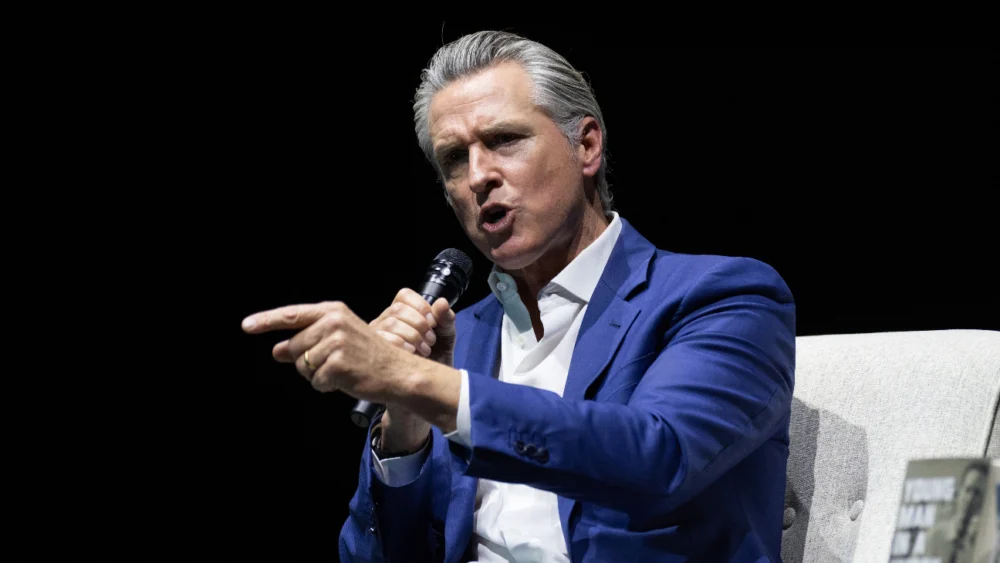
California Governor Gavin Newsom has ignited a significant debate by drawing a stark comparison between Israel and an "apartheid state" and openly questioning the future of U.S. military support for the nation. The remarks, made during a public event promoting his new memoir, Young Man in a Hurry: A Memoir of Discovery, position Newsom, a prominent figure in the Democratic Party and a widely anticipated contender for the 2028 presidential race, at the forefront of a growing internal party discussion regarding American foreign policy in the Middle East.
The candid exchange occurred on stage with Jon Favreau, host of the popular podcast Pod Save America. When pressed about the U.S.-Israel relationship and whether it warrants reconsideration, Governor Newsom expressed deep concern, stating, "It breaks my heart, because the current leadership in Israel is walking us down the path where I don’t think you have a choice about that consideration." This sentiment suggests a belief that the actions of the current Israeli government are pushing the United States toward a necessary reevaluation of its long-standing alliance and substantial military aid.
Newsom’s comments arrive at a critical juncture, with ongoing devastation in Gaza and the protracted conflict with Iran casting a long shadow over regional stability. Furthermore, these remarks resonate with a discernible shift in the Democratic Party’s base, where public sentiment towards Israel has become increasingly critical. Recent electoral dynamics in key primary races have underscored this trend, with even tangential connections to Israel proving to be a potential electoral liability for Democratic candidates. A recent analysis by Politico highlighted this phenomenon, noting that "ties to Israel plague Democrats in top primaries post-Gaza," indicating a growing disconnect between the party’s traditional foreign policy stances and the evolving views of its constituents.
The governor’s remarks also specifically targeted Israeli Prime Minister Benjamin Netanyahu, a figure Newsom has publicly criticized on numerous occasions. Addressing Netanyahu’s political standing, Newsom remarked, "The issue of [Netanyahu] is interesting. He’s got his own domestic issues. He’s trying to stay out of jail. He’s got an election coming up. He’s potentially on the ropes. He’s got folks, the hard line, that want to annex the West Bank. I mean, [Thomas Friedman] and others are talking about [Israel] appropriately as sort of an apartheid state." This direct linkage between Netanyahu’s political vulnerabilities and the potential for annexation of the West Bank, a move widely condemned internationally, further contextualizes Newsom’s strong stance.
The governor’s reference to Thomas Friedman, a prominent columnist for The New York Times, underscores the intellectual currents informing his perspective. Friedman has consistently voiced concerns that Israel is heading towards becoming an apartheid state, a narrative that appears to be gaining traction within certain political circles. In a recent column, Friedman articulated this concern with urgency, arguing that "If the war in Iran enables Netanyahu to win the Israeli elections planned for this year, it will be a major propellant to his efforts to annex the West Bank, cripple the Israeli Supreme Court and make Israel an apartheid state, which would be a major blow to American interests in the region beyond Iran." Friedman’s analysis suggests that the annexation of the West Bank, coupled with perceived erosions of democratic institutions within Israel, could fundamentally alter its character and its relationship with international allies.
Context of the Remarks and Shifting U.S. Political Landscape
Governor Newsom’s statements are not isolated pronouncements but rather reflect a broader evolution within the Democratic Party and American society concerning the Israeli-Palestinian conflict. For decades, bipartisan consensus in Washington has largely supported a strong U.S.-Israel alliance, characterized by significant military and financial aid. However, particularly in recent years, and amplified by the current humanitarian crisis in Gaza, a vocal segment of the Democratic base, including many progressive lawmakers and younger voters, has increasingly challenged this status quo.
The scale of the conflict, the high civilian casualties, and the perceived lack of accountability for actions on the ground have fueled this shift. Social media platforms have played a significant role in disseminating images and narratives from the conflict, increasing public awareness and, for many, fostering a sense of outrage. This has created a palpable tension between the traditional foreign policy establishment and a growing progressive wing that advocates for a more critical, and at times conditional, approach to U.S. support for Israel.
The reference to "apartheid" is a particularly potent and controversial charge. The term, often used in the context of the historical system of racial segregation and discrimination in South Africa, implies a system of institutionalized racial segregation and discrimination. When applied to Israel, it suggests that the state’s policies towards Palestinians, particularly in the occupied territories, constitute such a system. International human rights organizations, such as Human Rights Watch and Amnesty International, have previously published reports that use this terminology to describe Israeli policies. However, the Israeli government vehemently rejects these characterizations, arguing that they are biased and inaccurate, and that Israel is a democracy that faces unique security challenges.
Potential Implications and Reactions
Governor Newsom’s willingness to publicly voice such critical sentiments, particularly his direct questioning of future U.S. military support, carries significant weight. As a prominent Democrat with presidential aspirations, his words are scrutinized and interpreted as potential indicators of future policy directions.
1. Domestic Political Ramifications:
Newsom’s comments could further energize progressive factions within the Democratic Party who have been advocating for a more critical stance on Israel. Conversely, they could alienate more centrist Democrats and pro-Israel advocacy groups, potentially creating internal party divisions. The timing of his remarks, coinciding with an election cycle where foreign policy often plays a role, suggests a strategic positioning within the broader political discourse.
2. U.S.-Israel Relations:
If these sentiments were to translate into policy, they could signal a significant shift in the U.S.-Israel relationship. A reconsideration of military aid, a cornerstone of the alliance, would have profound implications for Israel’s security and its regional standing. It could also lead to increased diplomatic pressure on Israel regarding its policies in the West Bank and Gaza.
3. Regional Dynamics:
Such a shift in U.S. policy could also have ripple effects across the Middle East. Arab nations, many of which have normalized relations with Israel in recent years through the Abraham Accords, would likely be observing such developments closely. The perception of a weakened U.S. commitment to Israel could alter regional power balances and potentially embolden adversaries.
4. International Law and Human Rights Discourse:
Newsom’s use of the term "apartheid" places the issue squarely within the discourse of international law and human rights. It elevates the debate beyond a purely geopolitical discussion to one that engages with fundamental principles of equality and justice. This could encourage further scrutiny of Israel’s actions by international bodies and human rights advocates.
Broader Context of the Conflict
The current situation in Gaza is a focal point of international concern. Following the October 7th attacks by Hamas on Israel, which resulted in significant Israeli casualties and the taking of hostages, Israel launched a comprehensive military operation in Gaza. This operation has led to widespread destruction, a severe humanitarian crisis, and a tragically high number of Palestinian civilian deaths. International bodies, including the United Nations, have repeatedly called for a ceasefire and expressed grave concerns about the humanitarian situation and the protection of civilians.
The ongoing war with Iran, alluded to by Newsom, adds another layer of complexity. While the direct confrontation between Israel and Iran has been ongoing through proxy forces and cyber warfare for years, recent escalations, including direct missile exchanges, have heightened tensions significantly. This broader regional instability underscores the delicate geopolitical balance that any significant shift in U.S. foreign policy would have to navigate.
Analysis of Implications
Newsom’s remarks suggest a belief that the current trajectory of Israeli policy, particularly under Prime Minister Netanyahu’s leadership, is unsustainable and detrimental to both American interests and the prospects for a lasting peace. His reference to annexation and the potential undermining of the Israeli Supreme Court indicates a concern about the erosion of democratic norms and the rule of law, which are often seen as foundational to the U.S.-Israel alliance.
The comparison to an "apartheid state," while highly contentious, reflects a growing segment of opinion that views the situation through a human rights lens, emphasizing the disparities in rights and treatment between Israelis and Palestinians. If this perspective gains further traction within the Democratic Party, it could lead to a more active and vocal role for the U.S. in advocating for Palestinian rights and a more critical examination of Israeli policies that are perceived as discriminatory.
The potential impact on U.S. military support is a significant aspect of Newsom’s statement. For decades, the U.S. has provided billions of dollars in military aid to Israel, viewing it as a key strategic partner in a volatile region. Any move to reconsider or reduce this aid would represent a monumental shift in American foreign policy and would undoubtedly be met with strong opposition from pro-Israel lobbying groups and many members of Congress.
Furthermore, the governor’s anticipation of future presidential aspirations means these comments are likely to be a recurring theme in his political career. They position him as a leader willing to engage with complex and controversial foreign policy issues, potentially appealing to a Democratic base that is increasingly seeking a more values-driven approach to international relations.
The coming months and years will reveal whether Governor Newsom’s bold statements are indicative of a broader policy shift or represent a moment of candid reflection. Regardless, his remarks have undeniably injected a new level of urgency and directness into the ongoing debate surrounding the U.S.-Israel relationship and its future.