


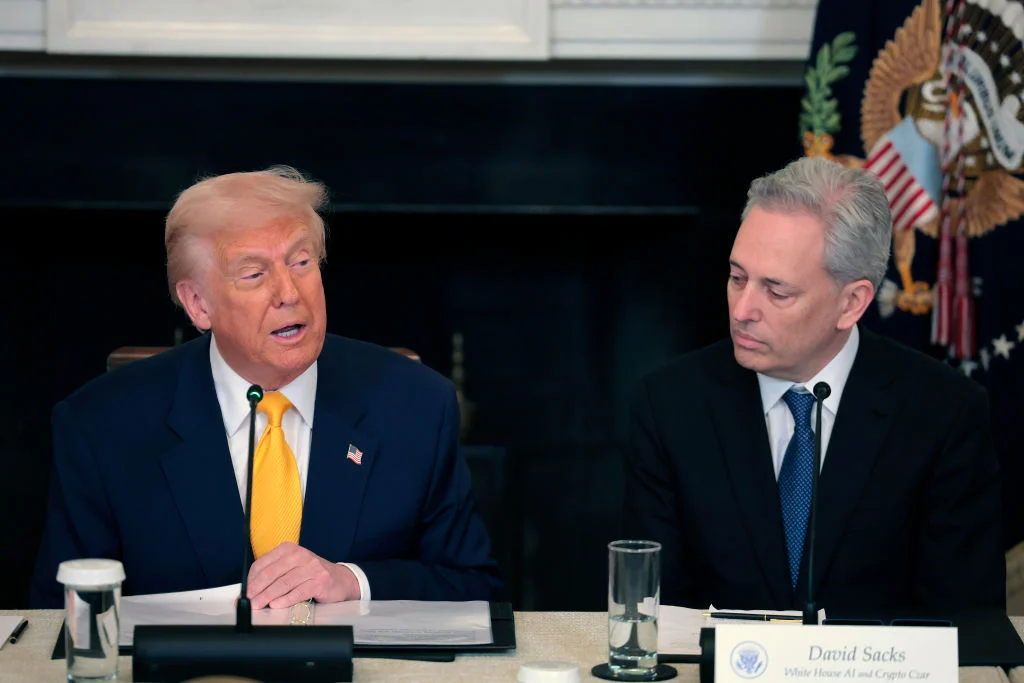
Longtime entrepreneur, investor, and prominent podcaster David Sacks has confirmed the conclusion of his temporary tenure as a special government employee serving as an unofficial AI and crypto czar for former President Donald Trump. Sacks, a well-known figure in Silicon Valley and a member of the "PayPal Mafia," is now transitioning into a new capacity as co-chair of the President’s Council of Advisors on Science and Technology (PCAST), a federal advisory body. This shift, announced during a Thursday interview with Bloomberg, marks a significant change in Sacks’ direct access to the presidential power center, moving him from an influential, policy-shaping role to a more traditional advisory position.
A Strategic Reassignment or a Demotion?
Sacks’ 130-day non-consecutive stint as a special government employee, a role often utilized to bring outside expertise into government without full-time commitment, afforded him direct lines of communication to former President Trump and a tangible hand in shaping nascent policy directives concerning artificial intelligence and cryptocurrencies. These two rapidly evolving technological frontiers are increasingly viewed as critical for national security, economic competitiveness, and future innovation. His role was largely interpreted as a strategic move by the Trump campaign to court the influential tech and crypto communities, signaling a more favorable regulatory environment should Trump return to the White House.
In his new capacity as co-chair of PCAST, alongside senior White House technology adviser Michael Kratsios, Sacks indicated an expanded purview. "I think moving forward as co-chair of PCAST, I can now make recommendations on not just AI but an expanded range of technology topics," Sacks told Bloomberg. "So yes, this is how I’ll be involved moving forward." While this statement suggests a broader mandate, the practical reality of PCAST’s function traditionally places it further from the immediate levers of power. Unlike Sacks’ previous role, which allowed for direct policy influence, PCAST’s mandate is to study issues, produce reports, and forward recommendations up the chain of command, rather than to craft or enact policy directly. This distinction has led some political observers and tech analysts to question whether the move represents a strategic realignment of Sacks’ influence or a more subtle step away from the core decision-making apparatus.
The Illustrious Composition of the New PCAST
Despite the perceived reduction in direct policy-making authority, the newly constituted PCAST under Sacks’ co-chairmanship is undeniably designed with an unprecedented level of industry leadership. Sacks himself emphasized to Bloomberg that this particular iteration boasts "the most star power of any group like this" ever assembled. The initial roster of 15 members reads like a who’s who of global technology titans, underscoring a deliberate effort to bring top-tier industry expertise into the advisory fold.
Among the prominent figures named are Jensen Huang, CEO of Nvidia, a company at the forefront of AI hardware and a critical player in the semiconductor industry; Mark Zuckerberg, CEO of Meta Platforms, whose ventures span social media, virtual reality, and advanced AI research; Larry Ellison, co-founder and CTO of Oracle, a dominant force in enterprise software and cloud computing; and Sergey Brin, co-founder of Google, a pioneer in search technology and foundational AI development. Other notable members include venture capitalist Marc Andreessen, a luminary in the internet and crypto spaces; Lisa Su, CEO of AMD, a key competitor in the semiconductor market; and Michael Dell, founder and CEO of Dell Technologies, a global leader in computer hardware. The sheer concentration of billionaires and industry founders on this council is a stark departure from previous PCAST compositions, which often skewed heavily academic or included a broader mix of government and non-profit representatives. This composition signals a clear intent to tap directly into the strategic thinking and practical experience of the very executives who are shaping the future of technology, raising expectations for the depth and relevance of the council’s recommendations.
A Focused Agenda for Technological Advancement
Sacks outlined a robust agenda for the new PCAST, indicating that the council will delve into critical areas such as artificial intelligence, advanced semiconductors, quantum computing, and nuclear power. These domains are not only at the cutting edge of scientific discovery but also hold immense strategic importance for national competitiveness and security in the 21st century.
Near-term attention, Sacks noted, will be directed towards advancing former President Trump’s national AI framework, which was unveiled just the previous week. This framework is explicitly designed to address what Sacks characterized as a convoluted and inefficient regulatory landscape for AI across the United States. He articulated the challenge: "You’ve got 50 different states regulating this in 50 different ways, and it’s creating a patchwork of regulation that’s difficult for our innovators to comply with." This sentiment echoes widespread concerns within the tech industry about the potential for fragmented state-level regulations to stifle innovation, create legal complexities, and disadvantage American companies on the global stage. A unified national strategy, as envisioned by the Trump framework, would aim to streamline regulatory oversight, establish clear guidelines, and foster a more predictable environment for AI development and deployment. The council’s role would be instrumental in refining and advocating for such a framework, translating industry insights into actionable recommendations that could shape future federal policy.
The Unspoken Factor: Foreign Policy Dissent
While Sacks presented his transition as a natural evolution of his advisory role, a significant undercurrent in the public discourse revolves around whether recent controversial comments he made on foreign policy played a role in this reassignment. Earlier this month, on the widely popular "All In" podcast, which Sacks co-hosts with fellow venture capitalists Chamath Palihapitiya, Jason Calacanis, and David Friedberg, Sacks publicly urged the Trump administration to seek an exit from the U.S.-backed conflict involving Iran.
During the podcast episode, Sacks articulated a series of escalating and concerning scenarios, including potential attacks on critical oil infrastructure in neighboring countries, the destruction of vital desalination plants, and the chilling prospect of nuclear engagement by Israel. He made a forceful call for the administration to find a "polite way out" of the escalating tensions in the Middle East. Such direct public commentary on a highly sensitive foreign policy issue, particularly by an individual perceived to be close to the administration, immediately drew attention. Former President Trump himself publicly responded to Sacks’ comments, telling reporters that Sacks "hadn’t spoken to him" about the war. This public distancing by Trump, coupled with the timing of Sacks’ transition, has fueled speculation among political analysts and media outlets that Sacks’ outspoken foreign policy views may have contributed to his move from a direct policy-shaping role to a more insulated advisory capacity within PCAST.
When pressed by Bloomberg on Thursday about the podcast episode and its potential implications, Sacks largely sidestepped the direct connection, stating, "I’m not on the foreign policy team or the national security team." He clarified that his podcast comments represented his personal views, distinct from any official governmental stance. While this explanation maintains a clear boundary between personal opinion and official duty, the optics of a key, albeit unofficial, advisor publicly diverging from the administration’s perceived foreign policy direction on such a critical matter are undeniable. The ongoing regional tensions involving Iran and U.S. allies have been a focal point of global diplomacy, and any perceived discord within an administration’s inner circle is often scrutinized for its potential political ramifications.
A Look Back: PCAST’s Historical Impact and Varied Fortunes
To fully appreciate the significance of Sacks’ new role, it is essential to consider the historical context and varied influence of PCAST across different presidential administrations. The council, or a body akin to it, has existed in some form since the era of President Franklin D. Roosevelt, serving as a vital link between the scientific and technological communities and the executive branch. However, its actual impact has fluctuated significantly.
President Barack Obama’s administration is widely regarded as having presided over one of the most productive iterations of PCAST on record. During his eight years in office, Obama’s council churned out an impressive 36 reports, two of which notably led to concrete policy changes. A prime example was an FDA rule that opened the market for over-the-counter hearing aids, a policy directly influenced by PCAST’s recommendations aimed at improving public health access and reducing costs. This era demonstrated the potential for PCAST to be a powerful engine for evidence-based policy reform.
In stark contrast, President Trump’s first-term council struggled to gain traction. It took nearly three years just to name its initial members, ultimately producing only a handful of reports and failing to make any particular lasting mark on federal policy. This period highlighted the vulnerability of PCAST to administrative priorities and engagement levels. Similarly, President Biden’s council, while comprising highly distinguished academics—including Nobel laureates, MacArthur fellows, and National Academy members—issued a modest number of reports before the administration concluded, leaning more on scholarly rigor than on direct industry representation.
The current PCAST, under Sacks’ co-chairmanship, is distinctly different. Its composition, built almost entirely from the executive suites of the companies shaping the very technology it will advise on, represents a deliberate strategy to bring unprecedented industry power and perspective directly into the advisory process. This could either lead to highly pragmatic and impactful recommendations or, conversely, raise questions about potential conflicts of interest and the balance of perspectives.
Ethical Considerations and the Blurred Lines of Government Service
Sacks’ previous role as a special government employee, particularly one focused on areas where he and his firm, Craft Ventures, have significant financial stakes, previously drew sharp criticism from ethics experts and lawmakers. TechCrunch had reported last year on the ethics waivers Sacks obtained to maintain his financial interests in AI and crypto companies while simultaneously shaping federal policy in these exact domains. This arrangement raised concerns about the potential for personal financial gain to influence policy recommendations, blurring the lines between public service and private interest.
While his new role within PCAST is still advisory, the presence of numerous tech billionaires on the council, many of whom also have substantial financial interests in the very technologies they will be advising on, reignites these ethical discussions. The structure of PCAST, as an advisory body, may offer some insulation against direct conflicts compared to a policy-making role. However, the influence of its recommendations on market sentiment, regulatory direction, and public investment in specific technologies could still indirectly benefit the companies and individuals involved. Transparency and strict adherence to ethical guidelines will be paramount to ensure that PCAST’s advice serves the broader public interest rather than specific corporate agendas.
The Path Forward: Sacks as an Unencumbered Executive and Broader Implications
With this transition, David Sacks is once again positioned as an "unencumbered executive," free to fully resume his life as an investor and entrepreneur without the constraints, albeit temporary, of a direct government advisory role. A spokesperson for Craft Ventures has yet to comment on Sacks’ specific next steps or how this new role will integrate with his existing professional commitments. However, the shift allows him greater freedom in his public commentary and private investments, removing the direct scrutiny associated with a policy-shaping position.
For the Trump administration, this reshuffling of tech advisory roles signals a continued, albeit potentially recalibrated, engagement with the technology sector. The formation of such a high-profile PCAST, packed with industry leaders, indicates a clear intent to leverage private sector expertise in crafting a national technology strategy, particularly in areas like AI, which are central to global power dynamics. The challenge, however, will be translating the council’s recommendations into effective policy, given PCAST’s historically varied influence and the complexities of legislative processes.
Ultimately, Sacks’ transition from a direct policy advisor to a co-chair of a revamped PCAST represents a significant development in the intersection of Silicon Valley and Washington. It highlights the Trump administration’s evolving strategy for engaging with critical technological advancements, the enduring tension between personal views and public service, and the persistent ethical questions that arise when private industry leaders step into government advisory roles. The success of this new PCAST will depend not only on the brilliance of its members but also on its ability to navigate the political landscape, translate its insights into actionable policy, and uphold public trust amidst an increasingly complex technological and ethical environment.