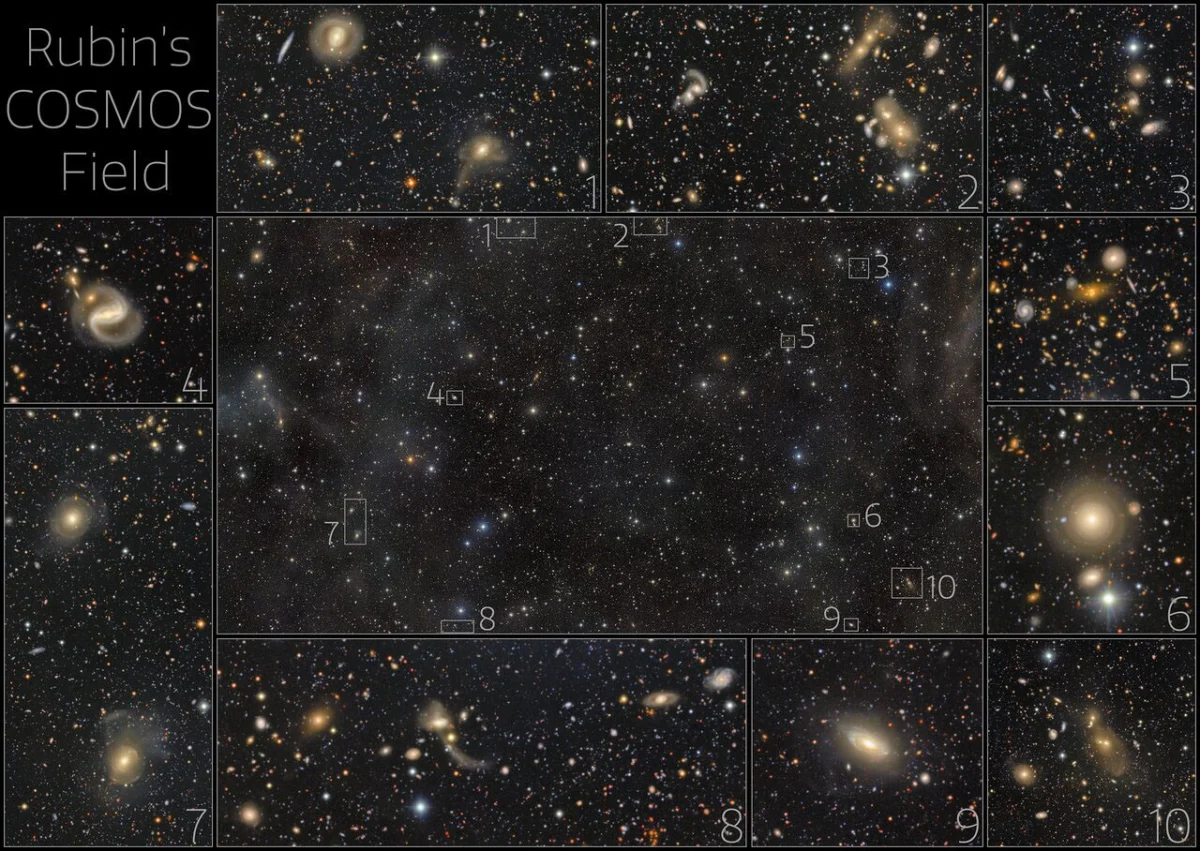
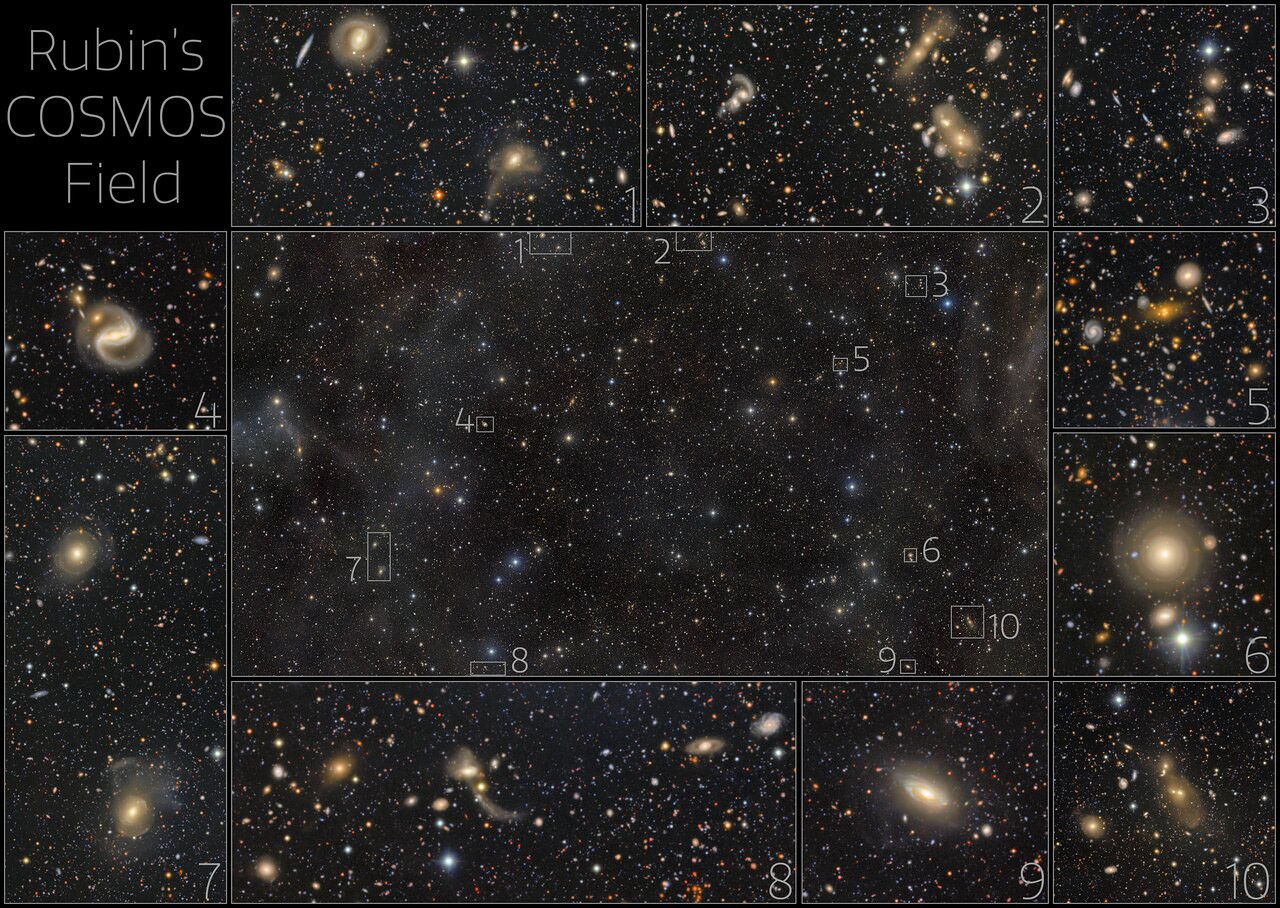
The NSF-DOE Vera C. Rubin Observatory has released an exceptionally deep image of the renowned COSMOS field and its surroundings in the constellation Sextans, revealing over half a million galaxies within its central panel alone. This groundbreaking visualization, published on August 7, 2026, marks the Early Data Preview 2 (EDP2), the first public data release based on observations from Rubin’s formidable Legacy Survey of Space and Time (LSST) Camera. The image presents a breathtaking panorama crowded with galaxies and galaxy clusters spanning an immense range of distances and cosmic ages, offering an unprecedented glimpse into the universe’s vast and dynamic structure. Only a handful of foreground stars from our own Milky Way galaxy punctuate this galactic tapestry, providing a relatively unimpeded view into the deep cosmos.
A New Era of Astronomical Discovery with Rubin Observatory
The release of this image signifies a pivotal moment for the Vera C. Rubin Observatory, a cutting-edge astronomical facility located atop Cerro Pachón in Chile. Jointly funded by the National Science Foundation (NSF) and the U.S. Department of Energy (DOE), Rubin is poised to revolutionize our understanding of the universe through its ambitious Legacy Survey of Space and Time (LSST). Unlike traditional telescopes that focus on specific targets for extended periods, Rubin is designed to conduct a decade-long survey of the entire visible night sky, cataloging billions of celestial objects and detecting transient events as they unfold. This first data preview, EDP2, demonstrates the extraordinary capabilities of its LSST Camera, a 3.2-gigapixel behemoth, the largest digital camera ever constructed for astronomy. The camera’s immense field of view allows it to capture a patch of sky seven times larger than the full Moon in a single exposure, a critical feature for its wide-field survey mission.
The image of the COSMOS field was meticulously created by combining multiple observations from the LSST Camera into a deep co-added image, showcasing the observatory’s ability to peer far into the cosmic past. This initial release underscores the immense potential of Rubin to generate a dynamic, time-domain view of the universe, moving beyond static snapshots to capture the ever-evolving cosmos.
The Illustrious COSMOS Field: A Window to the Early Universe
The COSMOS (Cosmic Evolution Survey) field is a designated patch of sky several times larger than the full moon, located in the northern part of the constellation Sextans. It has long been a prime target for major astronomical observatories due to its unique characteristics. Crucially, the COSMOS field contains comparatively few bright stars from our own Milky Way galaxy, offering astronomers a relatively unimpeded view of other galaxies outside our galactic neighborhood. This clarity makes it an ideal "cosmic census" region, allowing researchers to study large populations of galaxies across a vast range of cosmic epochs without significant foreground interference.
Prior to Rubin, the COSMOS field has been extensively observed by an array of world-leading telescopes, including the Hubble Space Telescope and, more recently, the James Webb Space Telescope. Hubble’s initial observations provided unprecedented detail into the morphologies and distribution of distant galaxies, laying foundational groundwork. Webb has since pushed the boundaries further, revealing even fainter and more distant galaxies with its infrared capabilities, probing the universe closer to the Big Bang. Rubin’s contribution, as evidenced by this EDP2 image, complements these observations by providing an exceptionally wide and deep survey, capturing a broader statistical sample of galaxies over a large area, which is crucial for understanding large-scale cosmic structures and evolutionary trends. The combination of depth and breadth from Rubin, alongside the exquisite detail from Hubble and Webb, creates a multi-faceted approach to unraveling galactic evolution.
A Tapestry of Galaxies: The Image’s Profound Revelations
The central panel of the Rubin image is a dense panorama, teeming with galaxies. The conservative estimate of over half a million galaxies packed into this single view is a testament to both the sheer scale of the universe and the Rubin Observatory’s unparalleled imaging power. These galaxies display an astonishing variety of shapes and sizes, from majestic spirals reminiscent of our own Milky Way, to chaotic, star-forming irregulars, and ancient, quiescent ellipticals. This morphological diversity offers crucial clues about the evolutionary pathways of galaxies, influenced by factors such as mergers, interactions, and the availability of gas for star formation.
The image also provides a profound sense of cosmic depth. Many of the visible galaxies are so incredibly far away that their light has traveled for billions of years before reaching Earth. Observing these distant galaxies is akin to looking back in time, allowing astronomers to study the universe as it was in its infancy and adolescence. The light from the most distant objects has journeyed across vast cosmic distances, stretching and reddening due to the expansion of the universe—a phenomenon known as redshift. By analyzing the redshift of these galaxies, astronomers can accurately determine their distances and, consequently, their ages, constructing a chronological map of cosmic evolution.
To further illustrate the richness of this data, the outer panels of the image feature ten zoomed-in views of corresponding small regions highlighted in the central panel. These magnified sections reveal intricate details within individual galaxies and smaller groupings, showcasing stellar nurseries, tidal tails from galactic interactions, and the subtle structures that betray their evolutionary history. This combination of wide-field coverage and the ability to resolve fine details makes Rubin’s data invaluable for a broad range of astrophysical studies.
The Legacy Survey of Space and Time (LSST): A Dynamic Universe in Motion
The Vera C. Rubin Observatory’s primary mission is to conduct the Legacy Survey of Space and Time (LSST), a ten-year observational campaign designed to map the visible sky repeatedly and comprehensively. A cornerstone of this survey strategy involves revisiting key fields like COSMOS every couple of days. This frequent re-observation is not merely for deeper imaging but, more significantly, to capture the dynamic nature of the cosmos.
The LSST will create a "movie" of the night sky, enabling astronomers to detect changes over time. This includes identifying transient phenomena such as supernovae (exploding stars), gamma-ray bursts, and active galactic nuclei (AGN) whose brightness fluctuates. It will also track the movements of countless asteroids and Kuiper Belt Objects within our own solar system, improving our understanding of its formation and potential impact threats. Furthermore, the repeated imaging will allow for the detection of subtle shifts caused by gravitational lensing, where the gravity of massive objects like galaxy clusters distorts the light from background galaxies. This phenomenon is a powerful tool for mapping the distribution of dark matter, an invisible substance that makes up a significant portion of the universe’s mass.
The sheer volume of data expected from the LSST is staggering – an estimated 20 terabytes of data every night, accumulating to petabytes over the ten-year survey. Managing, processing, and analyzing this unprecedented deluge of information presents a significant computational challenge, driving innovation in data science and machine learning within the astronomical community.
Technological Marvel: The LSST Camera’s Prowess
At the heart of Rubin’s observational power lies the LSST Camera, a marvel of engineering. Weighing over 3 tons and featuring a primary mirror 8.4 meters in diameter, the camera’s focal plane is populated by 189 charge-coupled devices (CCDs), each with 16 megapixels, totaling 3.2 gigapixels. This enormous sensor array allows the camera to capture a massive swatch of the sky in each exposure, making it exceptionally efficient for wide-field surveys. Its rapid readout capabilities and sophisticated filters enable quick successive observations across different wavelengths, providing crucial color information about celestial objects.
The precision and sensitivity of the LSST Camera are paramount to its mission. It can detect faint objects down to magnitude 27, equivalent to seeing a candle flame on the Moon. This sensitivity, combined with its wide field of view and rapid cadence, allows it to survey the entire visible sky roughly every three nights, creating an unparalleled time-domain astronomical dataset. The data quality from EDP2, as demonstrated by the COSMOS field image, confirms that the camera is performing to its ambitious specifications.
A Collaborative Endeavor with Global Implications
The Vera C. Rubin Observatory and the LSST are monumental undertakings that embody international collaboration and scientific partnership. The project is a joint initiative of the National Science Foundation (NSF) and the U.S. Department of Energy (DOE), with contributions from numerous institutions and countries worldwide. The credits for this specific image and its explanation highlight this collaborative spirit, listing the NSF-DOE Vera C. Rubin Observatory, NOIRLab, SLAC National Accelerator Laboratory, and the Association of Universities for Research in Astronomy (AURA) as key contributors to the image and data.
The team behind the explanation and presentation of the Astronomy Picture of the Day (APOD) includes distinguished authors and editors such as Cecilia Chirenti, Jerry Bonnell, Robert Nemiroff, and Keighley Rockcliffe. APOD, a service of the Astrophysics Science Division (ASD) at NASA/GSFC, NASA Science Activation, and Michigan Tech. University, plays a crucial role in disseminating cutting-edge astronomical discoveries to a global public audience, bridging the gap between complex scientific research and widespread understanding. This commitment to open access and public engagement is a core tenet of the Rubin Observatory, which aims to make its data publicly available to the entire scientific community and beyond.
Implications for Astronomy and Cosmology
The data stream from the Rubin Observatory, exemplified by this stunning COSMOS field image, will have profound implications across nearly every field of astronomy and cosmology:
- Dark Energy and Dark Matter: By mapping the distribution of galaxies and galaxy clusters over cosmic time and through gravitational lensing effects, LSST will provide unprecedented constraints on the nature of dark energy, the mysterious force accelerating the expansion of the universe, and dark matter, which dictates the gravitational scaffolding of the cosmos.
- Galaxy Formation and Evolution: The survey will provide a vast statistical sample of galaxies at different cosmic epochs, allowing astronomers to trace their formation, growth, and interactions in exquisite detail, refining our models of galaxy evolution.
- Transient Astronomy: The repeated observations will lead to the discovery of millions of transient events, including rare types of supernovae, tidal disruption events (where stars are torn apart by black holes), and flaring active galactic nuclei, offering new insights into extreme astrophysical phenomena.
- Solar System Science: The survey will catalog billions of objects, significantly increasing the known population of asteroids, Kuiper Belt Objects, and potentially even undiscovered dwarf planets in our solar system, improving our understanding of its dynamics and formation.
- Fundamental Physics: Beyond astrophysics, the LSST data could potentially reveal new physics, such as subtle deviations from general relativity or evidence for exotic particles, by probing the largest structures in the universe.
The ability to observe changes in the sky over ten years will transform astronomy from a mostly static observational science into a dynamic, time-domain discipline, revealing the universe not just as a collection of objects, but as an active, evolving system.
The Future of Cosmic Exploration
The release of the COSMOS field image from the Vera C. Rubin Observatory’s Early Data Preview 2 is more than just a beautiful picture; it is a powerful harbinger of a new era in astronomy. It underscores the observatory’s immense capability to unravel the universe’s most profound mysteries, from the nature of dark energy to the evolution of galaxies and the dynamic behavior of transient cosmic events. As Rubin embarks on its ten-year Legacy Survey of Space and Time, astronomers and the public alike can anticipate a continuous stream of groundbreaking discoveries that will undoubtedly reshape our understanding of the cosmos for generations to come. The universe is about to reveal its secrets in unprecedented detail, and the Rubin Observatory will be our tireless eye on this grand cosmic spectacle.