


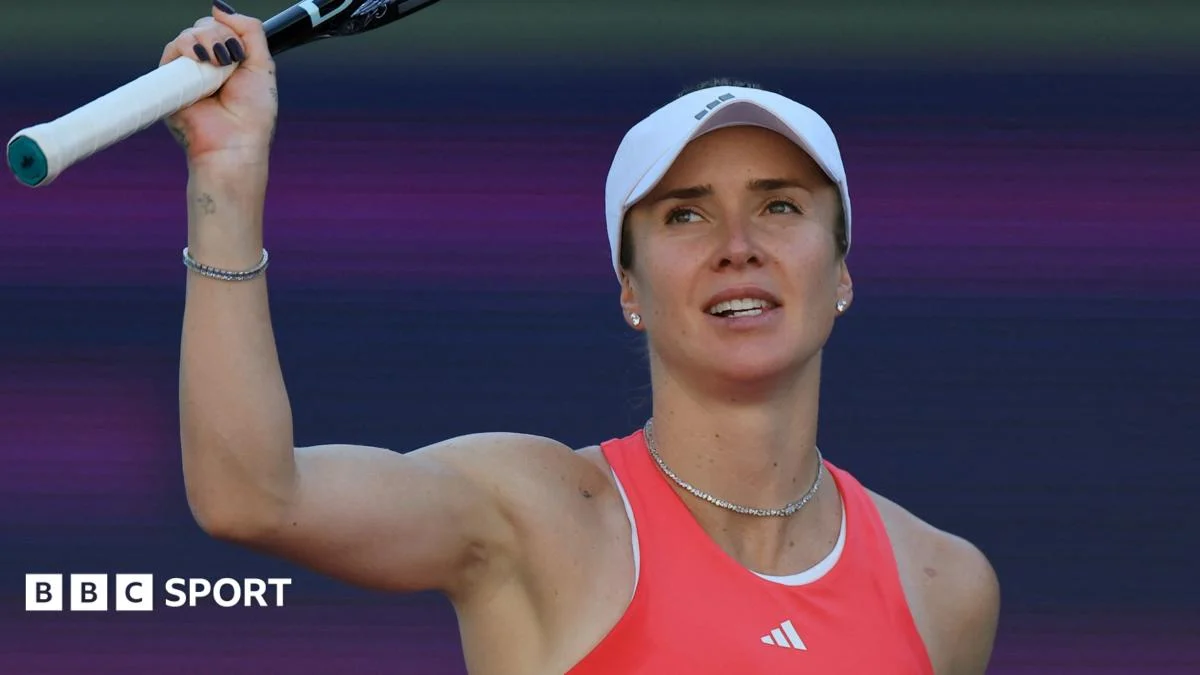
Elina Svitolina channeled her frustration into a galvanizing force, orchestrating a remarkable turnaround against Karolina Muchova at the WTA Finals, a victory that breathes significant life into her aspirations of reaching the semi-finals. The Ukrainian powerhouse, who had faced a demoralizing opening defeat, dug deep into her reserves, both physically and mentally, to overcome the Wimbledon runner-up with a resilient 3-6, 6-2, 6-2 triumph. This hard-fought win not only salvages her campaign in the prestigious season-ending championship but also underscores her enduring capacity for resilience on the grandest stages of women’s tennis.
The initial stages of the match offered a stark and concerning echo of Svitolina’s opening group stage encounter against Mirra Andreeva. The scoreline of 6-4, 6-0 against Andreeva on Monday had signaled a difficult start to her WTA Finals campaign, and the early exchanges with Muchova suggested a similar trajectory. Svitolina found herself immediately on the back foot, struggling to find her rhythm and facing the prospect of an early deficit. The pressure mounted, exacerbated by a medical timeout taken for a persistent issue with her right hip after surrendering the first set. In the immediate aftermath of this break, she found herself staring down the barrel of an early break point in the second set, a situation that could have easily tipped the scales irrevocably in Muchova’s favor.
However, it was at this critical juncture that Svitolina’s inner resolve appeared to ignite. Saving that crucial break point proved to be a pivotal moment, a turning point that allowed her to recalvert her focus and begin to systematically dismantle Muchova’s game. From that moment onwards, the narrative of the match shifted dramatically. Svitolina, known for her defensive prowess and tenacious baseline game, began to impose her will on the contest. She gradually wore down the dynamic Czech, who had reached the final at Wimbledon earlier in the year, a testament to her own impressive form.
The statistics from the match paint a clear picture of Svitolina’s grinding approach. Karolina Muchova, despite periods of offensive brilliance, was ultimately undone by a significant number of unforced errors. A tally of 39 unforced errors throughout the three-set encounter, with a disproportionate number stemming from her forehand wing, indicates that Svitolina’s consistent pressure and strategic shot placement forced Muchova into uncomfortable and ultimately costly situations. This sustained pressure, a hallmark of Svitolina’s game, chipped away at Muchova’s confidence and rhythm, paving the way for the Ukrainian’s resurgence.
The decisive break in the third set proved to be a fatal blow for Muchova. Having already surrendered an early advantage, the Czech player’s struggles were compounded by a series of service issues, including her eighth double fault of the match, which further ceded momentum to Svitolina. The Ukrainian, in contrast, exhibited clinical efficiency in capitalizing on these opportunities. The culmination of her effort was met with a powerful display of emotion, as Svitolina tipped her head back and let out a roar of triumph, a visceral reaction to securing a victory that had seemed improbable just hours earlier.
The Power of Frustration: Svitolina’s Emotional Turning Point
In the post-match interview, Svitolina candidly addressed the emotional undercurrents that fueled her comeback. "I was really angry at myself after the first match and the first set," she revealed to Sky Sports. This admission highlighted the internal struggle she had been experiencing, a frustration born from her opening match disappointment and the difficult start to her second outing. She elaborated on the dual nature of such emotions, acknowledging that "sometimes it [channelling frustration] happens in a good way and sometimes in a bad way." For Svitolina, on this occasion, the frustration served as a potent catalyst. "I tried to direct my anger towards the ball and I found my game in the end," she stated, underscoring her ability to harness negative energy and translate it into positive action on the court. This mental fortitude, the capacity to self-motivate and recalibrate under pressure, is a defining characteristic of elite athletes.
Statistical Milestones and Season-Long Dominance
This victory over Muchova, ranked within the top 10 at the time of the match, represents a significant achievement for Svitolina. It marks her ninth victory against a top-10 opponent this year, a statistic that speaks volumes about her consistent high-level performance throughout the 2023 season. Furthermore, it is her first win at the WTA Finals since her triumphant campaign in 2019, when she captured the coveted title, adding another layer of historical significance to her current resurgence. Her ability to consistently challenge and defeat the world’s best players throughout the year, despite a period away from the sport due to maternity leave, has been one of the compelling narratives of the women’s tennis season.
Navigating the Path to the Semi-Finals
The implications of Svitolina’s hard-won victory extend beyond the immediate match. Her win keeps her alive in the race for a coveted semi-final spot in California. However, her fate is not entirely in her own hands. The scenario for her qualification hinges on the outcome of another crucial group match: the encounter between Aryna Sabalenka and Mirra Andreeva. Until that match concludes, Svitolina will be in a state of anticipation, keenly awaiting the results that will determine her next step in the tournament. This element of suspense adds another layer of drama to the concluding stages of the group phase.
Broader Context: The WTA Finals and Global Tennis Landscape
The WTA Finals, held in [Insert Location if known, otherwise state "a prestigious venue"], represents the pinnacle of the women’s professional tennis season. It brings together the top eight singles players and top eight doubles teams of the year, competing for substantial prize money and the ultimate bragging rights. The tournament format typically involves a round-robin group stage, followed by semi-finals and a final. Svitolina’s presence in this elite field, especially after her return to the tour, underscores her remarkable comeback and enduring talent.
Concurrent Action: ATP Tour Updates from Stockholm
In parallel to the WTA Finals drama, the ATP Tour was also in action at the Stockholm Open. British player Cameron Norrie experienced a setback, falling 7-5, 6-3 to world number 10 Taylor Fritz. This result highlights the competitive nature of the men’s tour and the challenges faced by players in securing victories against highly-ranked opponents.
However, there was a notable success story at the Stockholm Open with Denmark’s Holger Rune’s progression to the quarter-finals. This achievement carries particular significance given Rune’s recent history with the event. Exactly one year prior, he suffered a ruptured Achilles tendon at the same tournament, an injury that sidelined him for an extended period. Rune only made his return to the ATP Tour in October of this year, following a demanding twelve-month rehabilitation process. His victory over Miomir Kecmanovic, with a scoreline of 2-6, 6-1, 6-4, signifies a triumphant return and a testament to his resilience and dedication to overcoming adversity. His journey at the Stockholm Open serves as an inspiring narrative of recovery and renewed competitive spirit.
Analysis and Implications
Svitolina’s victory is more than just a single match win; it is a powerful demonstration of mental fortitude and strategic adaptation. Her ability to overcome a physical setback and a poor start, fueled by her own internal drive, is a characteristic that often separates good players from great ones. For the WTA Finals, her continued presence ensures continued intrigue, especially given her history of success at the event. Her comeback narrative adds emotional depth to the tournament, resonating with fans who appreciate stories of perseverance.
For Karolina Muchova, the match represents a missed opportunity. While her inherent talent is undeniable, the high number of unforced errors indicates areas for improvement in terms of consistency under pressure. Her journey in the WTA Finals will now depend on her ability to regroup and perform in her remaining matches.
The broader implication for Svitolina is the reinforcement of her status as a genuine contender. Her consistent performance against top-ranked players throughout the year, coupled with this dramatic turnaround, signals that she is a force to be reckoned with, even after a period away from the sport. The remaining group matches at the WTA Finals will undoubtedly be closely watched, with Svitolina’s potential progression adding a compelling storyline to the tournament’s conclusion. Her journey exemplifies the unpredictable and captivating nature of professional tennis, where mental strength and the ability to overcome adversity are often as crucial as raw talent.