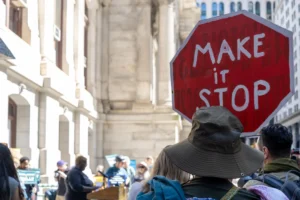


Barcelona, Spain – Spain was plunged into widespread disruption on Wednesday as the nation’s first general strike in 14 years unfolded, called by major trade unions to protest an escalating housing crisis and the crippling cost of living. While tens of thousands marched peacefully in cities across the country, the demonstrations in Barcelona descended into violent clashes between groups of masked men, some identified as radical elements, and riot police, underscoring the deep-seated frustration gripping the Iberian nation just weeks before crucial parliamentary elections.
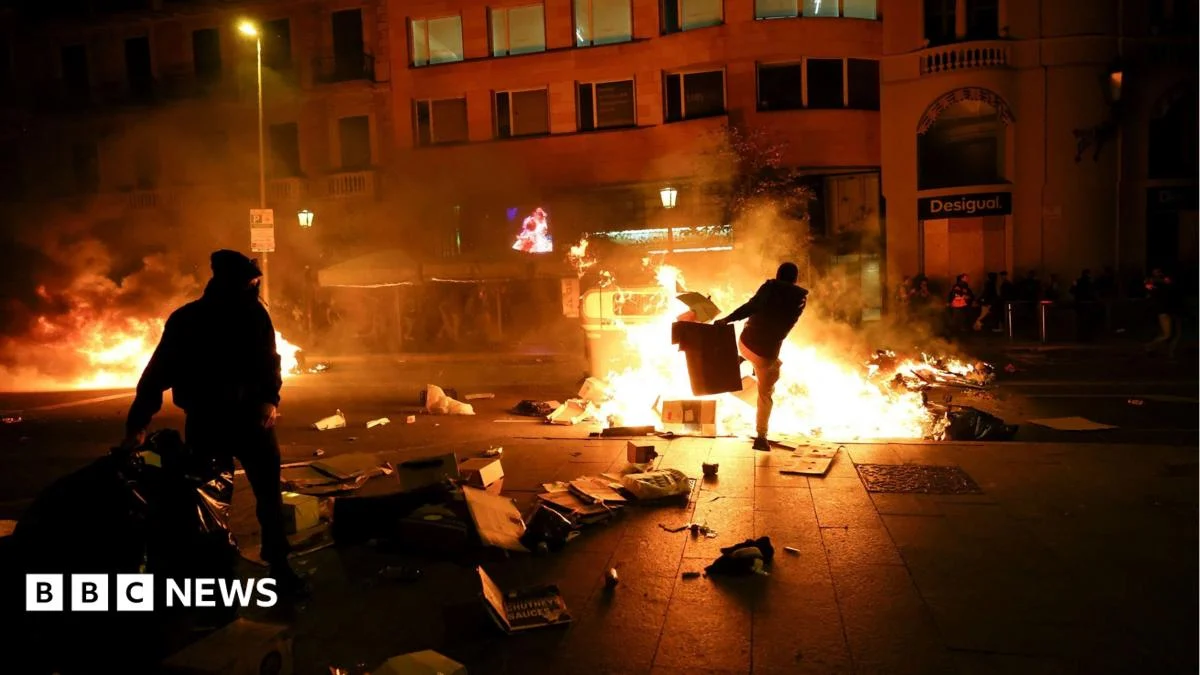
The day of action, spearheaded by the UGT and CC OO unions, saw an estimated 120,000 people take to the streets of the capital, Madrid, and over 50,000 in Barcelona. However, the latter city became the focal point of unrest, with footage capturing scenes of masked individuals setting ablaze rubbish bins, smashing shop windows, and engaging in confrontations with police who responded with tear gas and baton charges. The nationwide strike severely impacted public services, including transport, leading to significant delays and cancellations across Spain.
The Spark: A Tragic Eviction and the Housing Crisis
The immediate catalyst for this unprecedented display of public anger was the tragic case of Maricarmen Abascal, an 87-year-old woman evicted from her Madrid flat in late September after seven decades of residency. She died in hospital weeks later. Her story, which garnered widespread media attention and ignited public outrage, symbolized the brutal realities of Spain’s soaring rental prices and the precariousness faced by many, particularly the elderly and vulnerable. Abascal had reportedly faced a tripling of her rent under new landlords, a stark illustration of the unregulated and often predatory practices in the rental market.
Activists and housing unions had rallied around Abascal’s case, transforming her personal tragedy into a potent symbol of a systemic crisis. Gonzalo Álvarez, 27, a sales professional who volunteers for a housing union dedicated to tenant protection, described Abascal’s eviction as "the little fire" that ignited the protest movement. He knew the elderly woman personally and expressed deep distress over her treatment, highlighting a sentiment shared by many Spaniards who feel increasingly vulnerable to market forces beyond their control.
Economic Squeeze: Unaffordable Housing and Stagnant Wages
The economic grievances driving the strike are profound and multi-faceted. Spain has been grappling with a significant increase in the cost of living, exacerbated by inflationary pressures across Europe. However, the housing crisis stands out as particularly acute. In Madrid, for example, the average monthly rent for a modest 50-square-meter apartment reached approximately €1,170 ($1,300; £1,000) in October, according to property portal Idealista. This figure represents nearly half of Spain’s average gross monthly salary, which hovers around €2,460.
This stark disparity far exceeds the 30% affordability threshold typically recommended by housing experts and public institutions, pushing many households to the brink. Protesters like Olga Domingo, a 37-year-old teacher, articulated this unsustainable reality: "The housing situation is outrageous. The current cost of living compared to wages is completely unsustainable." She also pointed to "government cuts" as a contributing factor to the erosion of public services and quality of life. The struggle is particularly acute for young people and families, with many like Gonzalo Álvarez finding homeownership an "impossible" dream given current rent and purchase prices. He and his girlfriend, a dental hygienist, spend €1,000 on their one-bedroom flat in Madrid’s Arganzuela district, meaning each dedicates roughly half their salary to housing alone, before even accounting for other essential bills like "food, electricity, water, [and] gas."
Chronology of a Day of Discontent
The day began with early morning disruptions across Spain. Commuters in major cities like Madrid and Barcelona faced significant challenges as traffic was halted on several main roads, and public transport services operated on reduced schedules. Picket lines formed outside businesses and public institutions, urging compliance with the strike call.
- Morning (Pre-dawn to 10:00 AM): Initial reports confirmed widespread disruption to public transport and early morning traffic. Data from Red Eléctrica, Spain’s power operator, indicated a 7.5% drop in industrial electricity consumption during the early hours of Wednesday, a key indicator of strike participation, though notably lower than the 15%+ reduction seen during the last general strike 14 years prior.
- Mid-morning (10:00 AM – 1:00 PM): Major demonstrations began to gather momentum. In Madrid, thousands converged, eventually swelling to an estimated 120,000 participants, marching through the city center. Similar scenes unfolded in Barcelona and other regional capitals.
- Afternoon (1:00 PM – 6:00 PM): Protests continued, generally peaceful in most locations. Union leaders expressed satisfaction with turnout, hailing the strike as a "success" with "massive" and "very significant" participation.
- Evening (6:00 PM onwards): As night fell, the situation in Barcelona deteriorated significantly. Groups of masked individuals, separating from the main body of peaceful protesters, engaged in acts of vandalism and confrontation.
- Disturbances were particularly concentrated in the Passeig de Gràcia, a major shopping artery, and areas close to the iconic Plaça de Catalunya.
- Rubbish bins were set alight, leading to small fires in the middle of streets.
- Shop windows were smashed, and local media reported looting incidents targeting stores, including a Lego store. Protesters were also observed attempting to breach the Apple Store.
- Police, present in heavy numbers with helmets and riot shields, responded to the violence with tear gas, eventually making dozens of arrests for a variety of incidents.
- Spanish reports also indicated attacks on estate agency offices, directly linking the unrest to the housing grievances.
Official Reactions and Political Undercurrents
The general strike unfolded against a highly charged political backdrop, with parliamentary elections scheduled for November 29. This proximity to the polls injected a strong political dimension into the discourse surrounding the strike.
Union and Government Perspectives:
Pepe Álvarez, head of the prominent UGT labour union, declared the strike a resounding success, citing "massive" participation. Unai Sordo of the CC OO union echoed this sentiment, calling turnout "very significant."
Prime Minister Pedro Sánchez, whose Socialist Workers’ Party (PSOE) leads a left-wing coalition government, defended the right to strike earlier in the week, stating on Spanish TV: "What is nonsense is to question the rights of workers to strike." This stance aligns with his government’s broader progressive agenda, which has often sought to champion workers’ rights and social protections, albeit with varying degrees of success on issues like housing affordability.
Opposition and Business Criticism:
The conservative People’s Party (PP), currently leading in pre-election polls, vehemently condemned the strike. PP leader Alberto Núñez Feijóo dismissed the general strike as "nonsense" and launched a scathing attack on the unions, labelling them "mafia" and "trash." Miguel Tellado, a PP spokesman, went further, accusing the government of attempting to "weaponise the strike for electoral gain," suggesting that the ruling coalition was exploiting the unrest to warn voters against allowing a right-wing government to be formed – an outcome that polls suggest is increasingly likely.
Miguel Garrido, vice-president of CEOE, Spain’s largest business association, also criticised the strike, arguing that businesses had little to do with the price of housing. He stated, "This is not a strike for labour-related reasons, but rather for political ones, and it is closely linked to the early calling of elections." This perspective underscores the deep ideological divide in Spain regarding economic policy, the role of unions, and the state’s intervention in the market.
Broader Impact and Implications
The general strike serves as a powerful indicator of public discontent and a critical barometer for the upcoming elections. Its scale and the intensity of the grievances highlight a growing chasm between the lived realities of many Spaniards and the political solutions offered.
Political Implications:
The strike’s timing is undeniably strategic, just weeks before a national election. It forces the issues of housing and cost of living to the forefront of the political debate. For the incumbent left-wing government, it represents both a challenge and an opportunity: to demonstrate empathy with the plight of citizens while simultaneously fending off accusations of political opportunism. For the conservative opposition, it is a chance to portray the left as destabilizing and economically irresponsible. The turnout, while significant, did not surpass the last general strike’s industrial participation, suggesting a complex public sentiment that may not uniformly translate into a clear electoral mandate for any single party based solely on this event.
Economic Implications:
Beyond the immediate disruption to transport and commerce, the strike signals deeper structural economic issues. The unsustainability of housing costs, coupled with a general increase in living expenses that outpaces wage growth, points to a potential long-term drag on consumer spending and economic stability. While the CEOE argued against the strike’s economic relevance to businesses, the underlying issues certainly impact business health through reduced consumer purchasing power and potential social unrest.
Social Implications:
The clashes in Barcelona, though isolated from the main peaceful protests, underscore the potential for social unrest when economic frustrations reach a boiling point. The targeting of commercial establishments and confrontations with police reflect a segment of the population whose anger transcends traditional protest methods. The tragic story of Maricarmen Abascal has also brought into sharp focus the vulnerabilities within Spanish society, particularly among the elderly and those on fixed incomes, igniting a broader conversation about social protection and welfare.
As Spain approaches its parliamentary elections, the echoes of Wednesday’s general strike will undoubtedly reverberate through the campaigns. The core issues of affordable housing, sustainable wages, and the escalating cost of living are now firmly entrenched at the heart of the national debate, challenging all political parties to offer credible and impactful solutions to a deeply frustrated populace. The nation watches closely to see how this wave of public discontent will ultimately shape its political future.