

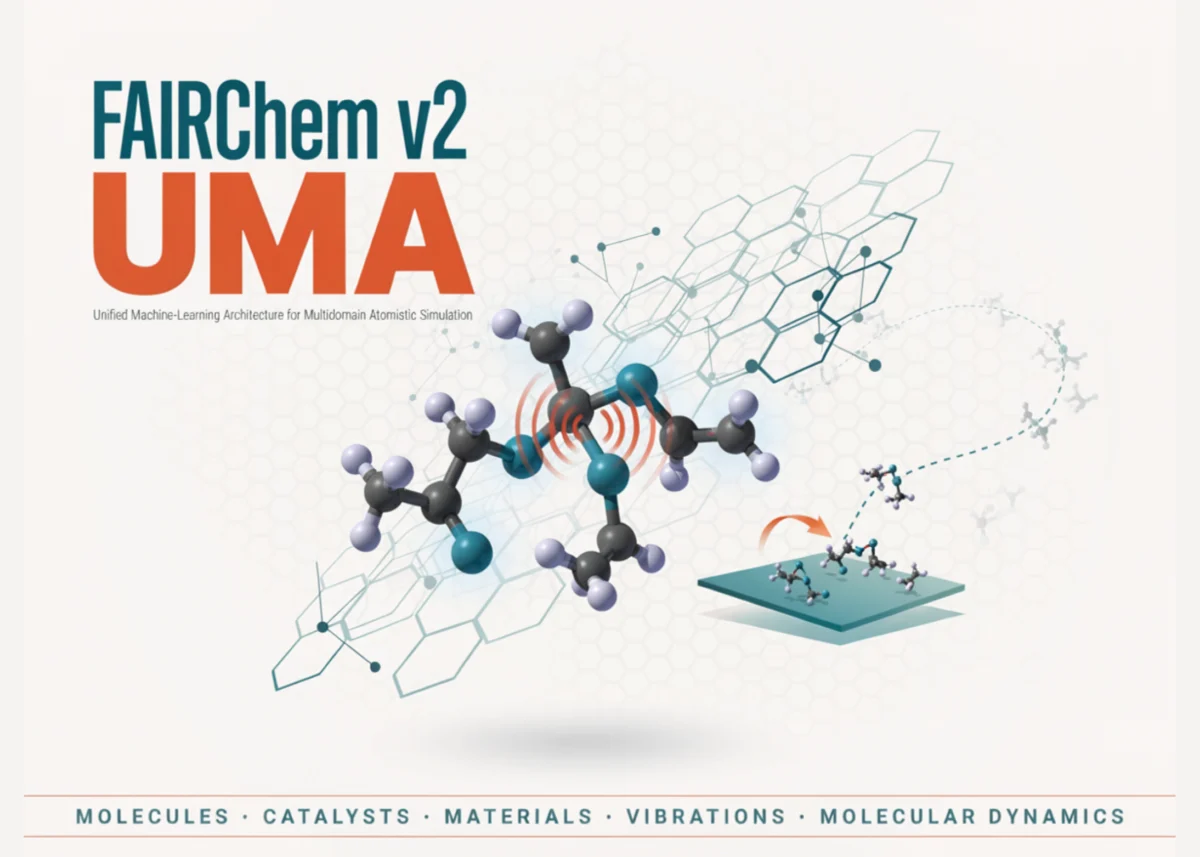
The field of computational chemistry and materials science is currently undergoing a paradigm shift, moving away from computationally expensive first-principles methods toward highly efficient machine learning interatomic potentials (MLIPs). Central to this evolution is the release of FAIRChem v2, a comprehensive software framework developed by Meta’s Fundamental AI Research (FAIR) team. By integrating the Universal Machine-learning Interatomic Potential (UMA), FAIRChem v2 provides a unified platform capable of simulating diverse chemical systems—ranging from isolated gas-phase molecules to complex catalytic surfaces and crystalline solids—under a single architectural umbrella. This advancement addresses a long-standing challenge in the scientific community: the need for specialized models for different classes of matter. With UMA, researchers can now apply a single pretrained model to tasks that previously required distinct, often incompatible, simulation tools.
The Technological Foundation of FAIRChem v2 and UMA
At its core, FAIRChem v2 is designed to democratize access to high-fidelity atomistic simulations. Traditionally, scientists relied on Density Functional Theory (DFT) to calculate the electronic structure of atoms. While accurate, DFT scales poorly with the number of atoms, often requiring supercomputing clusters for systems involving more than a few hundred particles. MLIPs like UMA circumvent this bottleneck by "learning" the potential energy surface from vast quantities of DFT data. Once trained, these models can predict energies and forces orders of magnitude faster than traditional methods, enabling the simulation of larger systems over longer timescales.
The UMA model, specifically the version explored in recent implementations such as uma-s-1p2, is distinguished by its "domain-aware" versatility. It is trained on the Open Catalyst Project (OCP) datasets, including OC20 and OC22, as well as extensive molecular and materials databases. This broad training allows it to function across three primary domains: omol (molecular chemistry), oc20 (catalysis and surface science), and omat (inorganic materials). By utilizing the Atomic Simulation Environment (ASE), a standard Python library for atomistic modeling, FAIRChem v2 allows users to initialize task-specific "calculators" that interface directly with the UMA model to provide the necessary physical quantities for simulation.
Chronology of Development: From Open Catalyst to FAIRChem
The trajectory of FAIRChem v2 began in 2020 with the launch of the Open Catalyst Project, a collaborative effort between Meta AI and Carnegie Mellon University. The project’s initial goal was to accelerate the discovery of catalysts for renewable energy storage, such as those used in hydrogen production and carbon capture.
- 2020 – The OC20 Dataset: The team released the largest dataset of its kind, featuring over 1.2 million DFT relaxations of molecular adsorptions on various catalytic surfaces.
- 2022 – Expansion to OC22: Recognizing the need for more complex oxide-based catalysts, the researchers expanded the dataset to include diverse chemical environments and oxygen-containing systems.
- 2023 – The Emergence of Foundation Models: The focus shifted from task-specific models to "foundation models" for chemistry. This led to the development of architectures like EquiformerV2 and eventually the UMA series.
- 2024 – FAIRChem v2 Integration: The release of FAIRChem v2 consolidated these models and datasets into a streamlined, user-friendly repository. This version introduced enhanced support for Hugging Face Hub, allowing researchers to download gated model weights and deploy them instantly on local or cloud-based GPU instances.
Practical Applications in Molecular Chemistry
In the molecular domain (omol), the UMA potential demonstrates remarkable precision in predicting the fundamental properties of small molecules. A primary workflow involves single-point energy and force predictions. For instance, evaluating a water molecule (H2O) allows researchers to calculate atomization energy—the energy required to separate a molecule into its constituent atoms. UMA’s predictions for H2O atomization energy closely align with experimental values (approximately 9.5 eV), showcasing the model’s ability to capture the intricacies of covalent bonding.
Furthermore, UMA is "spin-aware," a critical feature for modeling transition metals and reactive intermediates. In a comparative study of methylene (CH2), the model can distinguish between the singlet and triplet electronic states. Since the triplet state is the ground state for methylene, the model correctly predicts a negative energy gap when subtracting the singlet energy from the triplet energy. This capability is vital for organic chemists studying reaction mechanisms where spin-state transitions dictate the pathway of a chemical transformation.
Vibrational analysis and geometry optimization also benefit from this framework. By using the LBFGS (Limited-memory Broyden–Fletcher–Goldfarb–Shanno) optimizer, FAIRChem v2 can relax distorted molecular structures to their most stable configurations. The resulting bond lengths and angles—such as the 0.958 Å O-H bond and 104.5° angle in water—match experimental data with high fidelity. These optimized structures can then be subjected to finite-difference vibrational analysis to determine normal-mode frequencies, which are essential for calculating zero-point energy (ZPE) and thermal corrections in thermodynamic cycles.
Advancements in Catalysis and Surface Science
The oc20 domain within FAIRChem v2 focuses on the interaction between molecules and solid surfaces, a cornerstone of industrial chemistry. A typical simulation involves placing an adsorbate, such as carbon monoxide (CO), on a metallic slab like Copper (Cu100). This process requires the management of periodic boundary conditions and atomic constraints, where the bottom layers of the slab are "frozen" to simulate the bulk of the material while the surface layers and the adsorbate are allowed to relax.

The UMA potential facilitates the calculation of adsorption energy, which determines how strongly a molecule clings to a catalyst. This value is a primary descriptor in the Sabatier principle, which states that the best catalysts bind molecules neither too weakly nor too strongly. By automating these calculations through FAIRChem v2, researchers can screen thousands of potential catalyst-adsorbate combinations in a fraction of the time required by DFT, significantly accelerating the search for materials that can convert CO2 into useful fuels or produce green hydrogen efficiently.
Inorganic Materials and Equation-of-State Fitting
In the realm of materials science (omat), FAIRChem v2 excels at predicting the bulk properties of crystalline solids. Using iron (Fe) in its body-centered cubic (BCC) phase as a benchmark, the framework can perform full cell relaxations. Unlike molecular simulations where only atomic positions move, materials simulations often require the simulation cell itself to change shape and volume to minimize internal stress.
By applying a Frechet cell filter and the FIRE optimizer, UMA can determine the equilibrium lattice constant of iron (approximately 2.866 Å). Beyond simple relaxation, the framework allows for the generation of an "Equation of State" (EOS). By sampling the system’s energy across a range of compressed and expanded volumes and fitting the data to the Birch–Murnaghan equation, researchers can derive the Bulk Modulus. For BCC iron, the predicted Bulk Modulus of approximately 170 GPa serves as a testament to the model’s physical accuracy in capturing the stiffness and compressibility of metallic systems.
Molecular Dynamics and Potential Energy Surface Scanning
Static calculations only tell part of the story; real-world chemistry occurs at finite temperatures. FAIRChem v2 supports Langevin molecular dynamics (MD), which introduces stochastic forces and friction to simulate a system coupled to a heat bath. Running a 0.5-picosecond MD trajectory of water at 300 K allows scientists to observe the fluctuation of bond lengths and potential energies over time. These simulations are crucial for understanding the entropy and dynamical stability of molecules and materials.
Additionally, the framework enables Potential Energy Surface (PES) scanning. By systematically varying a specific internal coordinate, such as the distance between the oxygen and hydrogen atoms in water, researchers can map the energy profile of a bond stretch. This profile reveals the anharmonicity of the bond and the energy required for dissociation, providing insights that are critical for modeling high-energy collisions and chemical reactions.
Broader Impact and Future Implications
The implications of FAIRChem v2 and the UMA potential extend far beyond academic curiosity. The ability to perform multi-domain simulations with a single tool has direct applications in several high-stakes industries:
- Renewable Energy: Accelerating the development of electrocatalysts for water splitting and fuel cells.
- Pharmaceuticals: Improving the accuracy of drug-protein binding simulations and molecular crystal polymorph prediction.
- Carbon Capture: Designing new Metal-Organic Frameworks (MOFs) that can selectively filter greenhouse gases from industrial exhaust.
- Materials Engineering: Discovering lighter, stronger alloys for aerospace and automotive applications by screening thousands of crystalline structures.
The community response to FAIRChem v2 has been overwhelmingly positive, particularly regarding its integration with the Hugging Face ecosystem. This move reflects a broader trend in "Open Science," where the weights of powerful AI models are made accessible to the global research community. By lowering the barrier to entry—requiring only a basic knowledge of Python and access to consumer-grade GPUs—Meta is empowering a new generation of computational scientists.
As the UMA models continue to evolve, future versions are expected to handle even more complex systems, including liquid-phase chemistry and highly disordered amorphous materials. The current architecture already supports multi-GPU inference, hinting at a future where million-atom simulations become routine. In conclusion, FAIRChem v2 and the UMA potential represent a milestone in the convergence of artificial intelligence and physical science, providing a reusable, scalable, and highly accurate foundation for the future of molecular and materials discovery.