

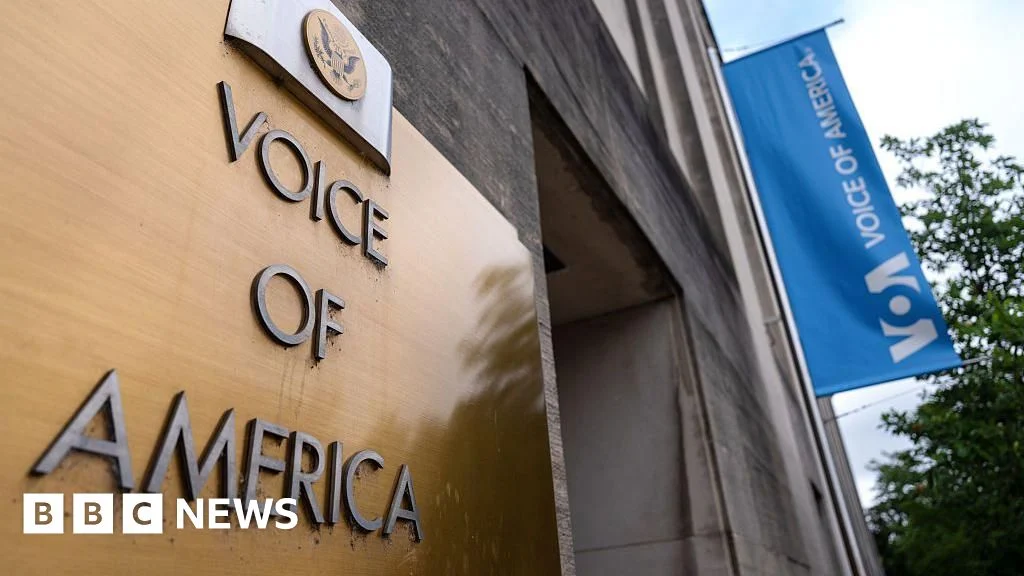
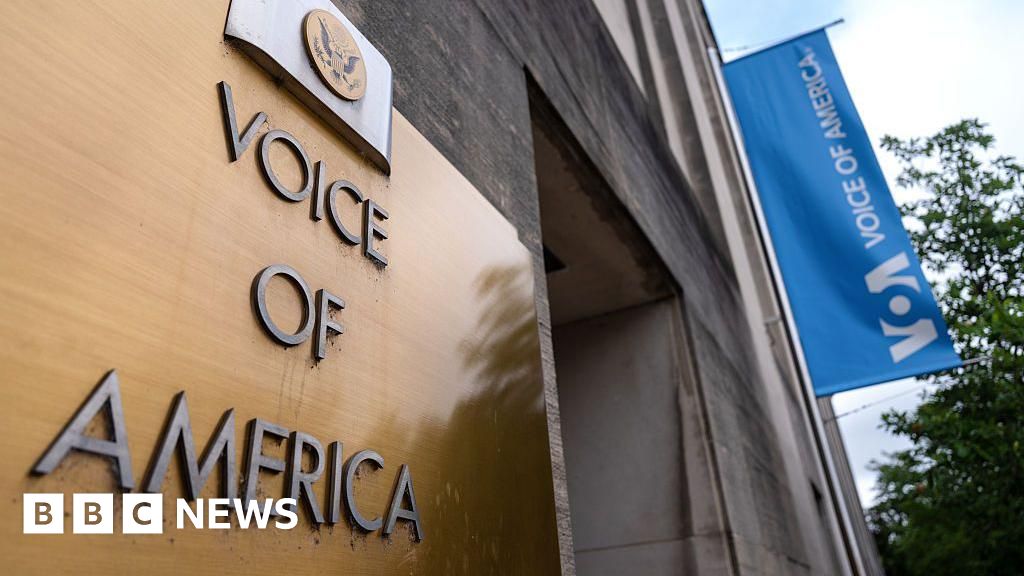
A U.S. District Court judge has ruled that the effective closure of the Voice of America (VOA) last year was "illegal" and has mandated the immediate reinstatement of hundreds of its journalists. District Court Judge Royce Lamberth has given federal authorities a one-week deadline to restore the international broadcaster to full operation, marking a significant legal setback for the previous administration’s efforts to reshape the U.S. Agency for Global Media (USAGM). This landmark decision underscores the importance of journalistic independence for federally funded news organizations and highlights the judiciary’s role in upholding statutory mandates against executive overreach.
The Genesis of Voice of America: A Beacon Against Propaganda
The Voice of America was established in 1942, amidst the tumultuous backdrop of World War Two, with a critical mission: to counter the pervasive propaganda disseminated by Nazi Germany and its allies. Its inaugural broadcast on February 1, 1942, famously declared, "The news may be good or bad for us – we will tell you the truth." This commitment to factual reporting, even when inconvenient, became VOA’s enduring ethos. During the Cold War, VOA solidified its role as a vital instrument of American foreign policy and a powerful voice of democratic ideals behind the Iron Curtain. It provided accurate, objective, and comprehensive news and information to populations in countries where access to independent media was severely restricted or non-existent, often broadcasting in dozens of languages to audiences yearning for unfiltered information.
The organization’s journalistic independence is enshrined in the VOA Charter, codified into U.S. law as Public Law 94-350 in 1976. This charter explicitly mandates VOA to "serve as a consistently reliable and authoritative source of news," ensuring that its news reporting is "accurate, objective, and comprehensive." It further stipulates that VOA "will present the policies of the United States clearly and effectively" but also "will present a balanced and comprehensive projection of significant American thought and institutions." This legislative framework was designed to shield VOA from political interference, differentiating it from mere state propaganda and cementing its credibility as a journalistic entity. Before the recent disruptions, VOA broadcast television, radio, and digital content in nearly 50 languages, reaching millions of listeners and viewers worldwide and serving as a crucial component of U.S. public diplomacy.
The Trump Administration’s Campaign Against VOA
The legal battle stems from a series of aggressive actions taken by the administration of former President Donald Trump against VOA and its parent organization, the USAGM. These actions were part of a broader pattern of criticism leveled by Trump against various U.S. media outlets, which he frequently labeled as "fake news" and accused of partisan bias. VOA, despite its statutory mandate for objectivity, became a specific target.
A Timeline of Disruption:
- Early 2020: President Trump begins publicly criticizing VOA, accusing it of promoting "left-wing bias" and aligning with foreign adversaries, particularly concerning its coverage of the COVID-19 pandemic. These accusations directly contradicted VOA’s charter and its long-standing commitment to factual reporting.
- June 2020: Just weeks after returning to office following a period of convalescence, President Trump issues an executive order targeting U.S. international broadcasters. The order aimed to "eliminate to the maximum extent consistent with applicable law" outlets such as VOA, Radio Free Europe/Radio Liberty, and Radio Free Asia. This signaled a clear intent to dismantle or severely curtail their operations.
- Late 2020: The administration appoints Kari Lake to head the US Agency for Global Media (USAGM), the independent federal agency that oversees and funds VOA, Radio Free Europe/Radio Liberty, Radio Free Asia, and other U.S. government-funded international media outlets. Crucially, Lake’s appointment was never confirmed by the U.S. Senate, making her tenure as acting CEO a point of contention in subsequent legal challenges.
- Winter 2020 – Spring 2021: Under Lake’s leadership, USAGM undergoes a drastic restructuring. More than 85% of the agency’s employees, including over 1,000 staff at VOA alone, are effectively dismissed or placed on paid administrative leave. This sweeping personnel change effectively crippled VOA’s operational capacity, leaving only a handful of employees to manage its extensive global broadcasts. The Persian Service, a critical component of VOA’s outreach to Iran, faced severe staffing shortages. This became acutely problematic when reporters were urgently needed to cover escalating tensions between Israel and Iran in June, forcing a partial recall of some previously sidelined journalists.
- Throughout 2021-2022: The mass suspensions and the operational paralysis of VOA continued, prompting internal dissent and external condemnation from press freedom advocates and some members of Congress. The prolonged administrative leave for hundreds of experienced journalists represented not only a significant financial burden on taxpayers but also a profound loss of institutional knowledge and journalistic capacity.
These actions were widely seen as an attempt to transform VOA from an independent journalistic entity into a direct propaganda arm of the executive branch, a move directly at odds with its statutory charter.
The Legal Challenge and Judge Lamberth’s Rulings
The extraordinary measures taken by the Trump administration against VOA did not go unchallenged. Three VOA journalists, directly impacted by the mass suspensions, filed a lawsuit against the administration, arguing that the actions were unlawful and violated the organization’s statutory independence. The case landed before U.S. District Court Judge Royce Lamberth, a veteran judge known for his conservative leanings and strict interpretation of the law.
Last week, Judge Lamberth delivered a crucial preliminary ruling that laid the groundwork for his more expansive decision. He determined that Kari Lake, as an unconfirmed acting head of USAGM, lacked the legal authority to order the suspension of the agency’s workforce. The U.S. Constitution requires Senate confirmation for principal officers of the United States, and Lake’s temporary status meant she could not wield the full powers of a Senate-confirmed CEO, particularly regarding such significant personnel actions. This ruling immediately cast doubt on the legality of the widespread dismissals.
In Tuesday’s decisive ruling, Judge Lamberth escalated his condemnation of the administration’s actions. He described the decision to sack the journalists as "arbitrary and capricious," a legal term indicating a lack of rational basis or disregard for proper procedure. The judge explicitly stated that the government had failed to consider fundamental legislation, namely the VOA Charter, which specifically determines the languages and regions the VOA is mandated to serve. This legislative mandate is not merely a guideline but a legal obligation, and by sidelining hundreds of journalists critical to fulfilling this mission, the administration acted outside its legal bounds.
"Defendants have provided nothing approaching a principled basis for their decision," Lamberth wrote in his ruling, underscoring the lack of a coherent and legally defensible justification for the mass firings. He ordered the authorities to reinstate the hundreds of journalists within one week, effectively commanding the full restoration of VOA’s operations. The ruling represents a powerful affirmation of the VOA Charter and a significant check on executive attempts to politicize federally funded independent media.
Reactions and Future Implications
The ruling was met with profound relief and gratitude by those directly affected and by advocates for press freedom. Patsy Widakuswara, one of the VOA journalists who sued the Trump administration, expressed her deep appreciation for the judge’s decision. Speaking to the Associated Press news agency, Widakuswara stated, "We hope the American people will continue to support our mission to produce journalism, not propaganda." Her words encapsulate the core struggle at the heart of the case: preserving the distinction between independent journalism and state-controlled messaging.
The immediate future of the USAGM and VOA remains somewhat uncertain, despite the clear judicial order. It is unclear whether Kari Lake’s nominated successor, Sarah Rogers—whose appointment would also require Senate confirmation—will choose to appeal Judge Lamberth’s ruling. An appeal would likely prolong the legal battle and delay the full operational restoration of VOA, potentially incurring further legal costs and administrative complexities. Should Rogers decide to appeal, the case could move to a higher court, further extending the period of instability for VOA staff and its global audience. However, given the strength of Judge Lamberth’s ruling, particularly concerning the statutory mandates of the VOA Charter and the procedural irregularities surrounding Lake’s appointment, the prospects for a successful appeal might be challenging.
Broader Impact and Enduring Significance
Judge Lamberth’s ruling extends far beyond the immediate reinstatement of VOA journalists; it carries profound implications for press freedom, government accountability, and the integrity of U.S. public diplomacy.
1. Upholding Journalistic Independence: The decision is a robust defense of the VOA Charter and the principle that federally funded international broadcasters must maintain journalistic independence, free from direct political manipulation. This is crucial for their credibility with international audiences, particularly in regions where independent media is scarce. If VOA were perceived as a mouthpiece for a particular administration, its ability to effectively counter disinformation and promote democratic values would be severely undermined.
2. Checks and Balances: The judiciary’s intervention serves as a powerful reminder of the system of checks and balances inherent in American governance. It demonstrates that executive actions, even those taken under the guise of administrative reform, are subject to judicial review and must adhere to established laws and constitutional principles. This ruling reaffirms that no branch of government is above the law.
3. U.S. Soft Power and Global Influence: VOA and other USAGM entities play a critical role in projecting U.S. values, culture, and information globally. Their effective closure or politicization severely damages America’s "soft power" – its ability to influence through attraction rather than coercion. In an increasingly competitive global information environment, where adversaries like Russia and China actively engage in sophisticated disinformation campaigns, a credible and independent VOA is more vital than ever. The disruption of VOA’s services likely created information vacuums in critical regions, potentially allowing hostile narratives to proliferate unchecked.
4. Employee Morale and Stability: The ruling provides much-needed clarity and vindication for the hundreds of journalists who were unjustly sidelined. The period of administrative leave, often accompanied by uncertainty about their professional future, took a significant toll on morale. Their reinstatement is not just a legal victory but a restoration of dignity and purpose for dedicated professionals committed to public service journalism.
5. Future of USAGM: The case highlights the necessity of stable, Senate-confirmed leadership for USAGM. The controversy surrounding Lake’s unconfirmed status underscored the vulnerabilities when key agencies are led by acting officials without full legislative oversight. It reinforces the importance of following established protocols for appointments to ensure accountability and legitimate authority.
6. Media Polarization and Public Trust: The context of Trump’s broader attacks on the media, which studies suggest American news consumers view as highly polarized, adds another layer to this ruling. It underscores the challenges faced by news organizations, even those with a public service mandate, in navigating an environment of deep political division and distrust. The judge’s ruling, however, reaffirms that facts and legal mandates should ultimately prevail over political accusations.
In conclusion, Judge Lamberth’s ruling is a resounding victory for journalistic integrity and legal process. It not only mandates the immediate return of hundreds of Voice of America journalists to their vital work but also sends a clear message about the limits of executive power and the enduring importance of a free and independent press in upholding democratic principles both at home and abroad. The international community, particularly those in regions reliant on VOA for unbiased news, will undoubtedly watch closely to ensure the ruling’s full and swift implementation.