

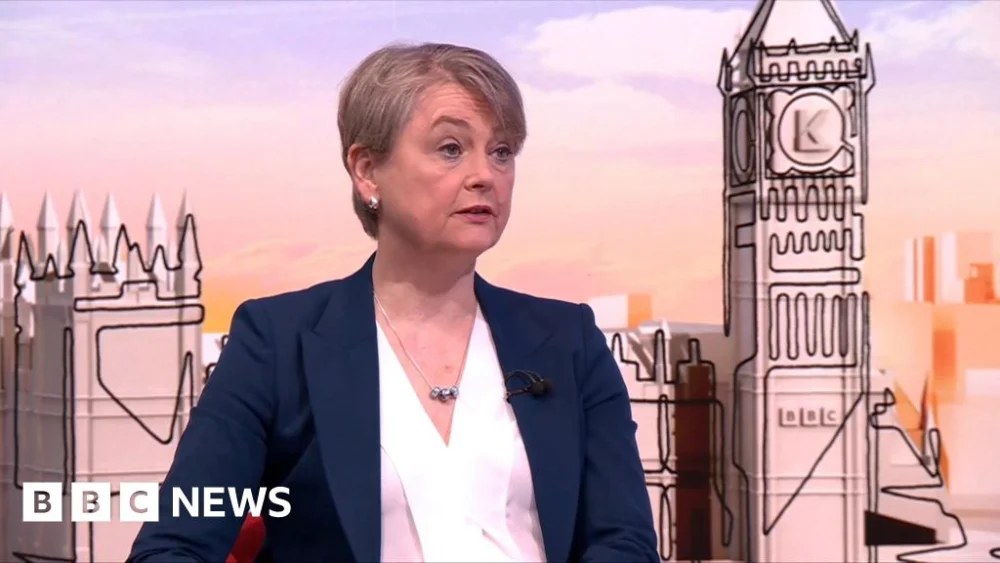
Foreign Secretary Yvette Cooper has firmly pushed back against critical remarks made by President Donald Trump regarding the United Kingdom’s strategic approach to the escalating conflict in Iran. Speaking on the prominent BBC programme "Sunday with Laura Kuenssberg," Cooper underscored the UK’s commitment to independent decision-making, asserting that London’s actions are solely guided by its national interest, not the dictates of any other nation. This robust defence comes amidst a period of heightened geopolitical tension in the Middle East and a noticeable strain on the long-standing "special relationship" between Washington and London.
The Diplomatic Spat Unfolds: A Clash of Perspectives
The immediate catalyst for the diplomatic exchange was a social media post by President Trump, which appeared to dismiss potential British military contributions to the region. In his characteristic direct style, Trump tweeted, "We don’t need people that join Wars after we’ve already won!" This comment was reportedly made in response to intelligence or discussions suggesting the UK was contemplating the deployment of its advanced aircraft carriers to the Middle East, a significant projection of naval power. The President’s tweet carried an implicit critique of the timeliness and perceived necessity of UK involvement, framing it as a post-facto intervention.
Foreign Secretary Cooper’s response on national television was measured yet resolute. "It won’t surprise you that we don’t agree with President Trump on every issue," she stated, acknowledging the occasional divergence in policy between the two close allies. She then articulated the core principle of British foreign policy: "It’s the prime minister’s job to take decisions in the UK’s national interest… not in the interest of any other country." This statement served as a clear affirmation of British sovereignty and strategic autonomy, particularly pertinent in an era where global alliances are being re-evaluated and national interests are often asserted more overtly. The exchange highlights the complex dance of diplomacy, where allies must sometimes publicly disagree even while maintaining broader strategic alignment.
Background to the Tensions: The Iran Crisis and Regional Instability
The backdrop to this diplomatic friction is the deeply volatile situation in the Persian Gulf, marked by a significant escalation of tensions between the United States and Iran. This crisis intensified considerably following the Trump administration’s unilateral withdrawal from the Joint Comprehensive Plan of Action (JCPOA), commonly known as the Iran nuclear deal, in May 2018. The US subsequently re-imposed and expanded stringent sanctions on Iran, targeting its oil exports, financial sector, and key industries, with the stated aim of compelling Tehran to negotiate a new, more comprehensive agreement addressing its ballistic missile programme and regional activities.
Iran, in response, began to scale back its commitments under the JCPOA, exceeding limits on uranium enrichment and stockpiles. The period leading up to Trump’s tweet saw a series of provocative incidents that ratcheted up regional tensions:
- May-June 2019: Several commercial oil tankers in the Gulf of Oman and near the Strait of Hormuz were attacked, with the US and its allies attributing the assaults to Iran. These included attacks on four tankers off the coast of Fujairah in May and two more in the Gulf of Oman in June.
- June 2019: Iran shot down a US RQ-4 Global Hawk surveillance drone over the Strait of Hormuz, claiming it had violated Iranian airspace. The US maintained the drone was in international airspace. This incident brought Washington and Tehran to the brink of military confrontation, with President Trump reportedly approving and then calling off retaliatory strikes at the last minute.
- July 2019: Iran seized a British-flagged oil tanker, the Stena Impero, in the Strait of Hormuz, claiming it had violated maritime regulations. This action was widely seen as a retaliatory measure for the earlier seizure of an Iranian tanker, the Grace 1 (later renamed Adrian Darya-1), by British Royal Marines off Gibraltar, on suspicion of violating EU sanctions against Syria.
These events underscored the fragility of maritime security in one of the world’s most critical shipping lanes, through which approximately one-fifth of global oil supply passes. The UK, with its significant maritime interests and historical presence in the region, found itself increasingly drawn into the security efforts to protect international shipping.
The "Special Relationship" Under Strain: A History of Alignment and Divergence
The relationship between the United States and the United Kingdom, often lauded as the "special relationship," has historically been characterized by close military, intelligence, and diplomatic cooperation. From shared efforts in two World Wars to the Cold War alliance and joint operations in Afghanistan and Iraq, the two nations have frequently acted in concert on the global stage. However, this partnership has never been entirely without its points of friction. Historical examples, such as the Suez Crisis in 1956, demonstrated the potential for significant policy divergence, even between the closest allies.
In the contemporary context, several factors have placed unique pressures on this bond:
- Differing Approaches to Iran: While both nations share concerns about Iran’s nuclear ambitions and regional destabilisation, the UK, along with France and Germany, has consistently advocated for preserving the JCPOA as the best mechanism for constraining Iran’s nuclear programme, even while acknowledging its imperfections. The US, under Trump, adopted a maximalist pressure campaign, often at odds with its European allies’ diplomatic efforts.
- Brexit’s Influence on UK Foreign Policy: The UK’s decision to leave the European Union has spurred a broader re-evaluation of its global role. While seeking to forge new trade deals and deepen alliances worldwide, the UK has also aimed to project an image of an independent, globally-minded nation capable of making its own strategic choices. This desire for strategic autonomy can sometimes lead to different foreign policy priorities than those of its closest allies.
- President Trump’s "America First" Doctrine: The Trump administration’s foreign policy approach prioritised American interests above multilateralism, often challenging established alliances and international norms. This transactional approach sometimes led to direct criticism of allies perceived as not contributing sufficiently or acting in opposition to US goals.
The exchange between Trump and Cooper thus represents a microcosm of these broader trends, highlighting the inherent tension between alliance solidarity and national sovereignty.
The UK’s Defence Posture and Naval Ambitions: The Carrier Strike Group Vision
President Trump’s dismissive comment about UK aircraft carriers touches upon a cornerstone of Britain’s modern defence strategy: the re-establishment of a credible carrier strike capability. The Royal Navy currently operates two Queen Elizabeth-class aircraft carriers, HMS Queen Elizabeth and HMS Prince of Wales, which are the largest warships ever built for the UK.
- HMS Queen Elizabeth: Commissioned in December 2017, the lead ship of the class, displacing approximately 65,000 tonnes.
- HMS Prince of Wales: Commissioned in December 2019, the second ship, with similar specifications.
These carriers are designed to operate the F-35B Lightning II stealth fighter jets, alongside a range of helicopters, forming a potent Carrier Strike Group (CSG). The vision behind these carriers is to provide the UK with a global reach and power projection capability, enabling it to respond to crises, protect maritime trade routes, and participate in international security operations anywhere in the world. A deployment to the Middle East would underscore this renewed ambition, marking a significant return of high-end naval power to a strategically vital region.
The UK’s commitment to maintaining a robust defence posture is also reflected in its adherence to the NATO pledge to spend at least 2% of its Gross Domestic Product (GDP) on defence. In recent years, the UK has consistently met or exceeded this target, underlining its role as a significant military power. The deployment of a carrier strike group, even if only considered, signifies a willingness to use these capabilities to protect national interests and contribute to international security, rather than merely holding them in reserve. This active approach stands in contrast to President Trump’s implied suggestion that UK military assets might be superfluous in situations where the US believes it has already secured victory.
Foreign Secretary Cooper’s Firm Stance: Upholding UK Sovereignty
Yvette Cooper’s appearance on "Sunday with Laura Kuenssberg" served as a critical platform for the UK government to articulate its position directly to a domestic and international audience. Her statements were carefully crafted to convey several key messages:
- Independent Decision-Making: By stating that the Prime Minister’s job is to act "in the UK’s national interest… not in the interest of any other country," Cooper unequivocally asserted Britain’s right to strategic autonomy. This is particularly important in the post-Brexit context, where the UK is keen to demonstrate its capacity to operate independently on the world stage, free from the perceived constraints of larger blocs or the undue influence of allies.
- Acknowledgement of Disagreement: Her opening remark, "It won’t surprise you that we don’t agree with President Trump on every issue," was a diplomatic way of acknowledging known policy divergences without escalating the rhetoric. It framed the disagreement as a natural part of a complex alliance, rather than a fundamental rupture.
- Strategic Rationale for UK Engagement: While not explicitly detailing potential carrier deployments, Cooper’s broader message implied that any UK military involvement in the Middle East would be based on a thorough assessment of British security, economic, and diplomatic interests, including the protection of shipping lanes and de-escalation of regional tensions.
Her statements were consistent with the broader UK government narrative that while the "special relationship" with the US remains vital, it does not preclude London from pursuing its own distinct foreign policy objectives or from disagreeing with Washington when national interests dictate.
Reactions and Broader Implications
While specific detailed reactions from other parties beyond the immediate exchange were not immediately publicised, the diplomatic spat carried significant implications:
- For the "Special Relationship": The incident underscores the transactional nature of the US-UK relationship under the Trump administration. While it did not fundamentally shatter the alliance, it highlighted the need for careful diplomatic navigation and the potential for public disagreements to test its resilience. It also served as a reminder that the UK cannot always rely on unquestioning US support for its diplomatic initiatives or expect a unified front on all issues.
- For UK Foreign and Defence Policy: The episode reinforced the UK’s commitment to projecting a global presence and acting decisively in defence of its interests. It validated the strategic investment in assets like the aircraft carriers, demonstrating their relevance in real-world scenarios. It also affirmed the UK’s pursuit of a multilateral foreign policy, often aligning with European partners on issues like Iran, even when differing from the US.
- For Regional Stability: The public disagreement between two major Western powers could, inadvertently, be perceived by regional actors as a sign of disunity within the international front attempting to manage the Iran crisis. While the UK and US fundamentally share the goal of preventing a nuclear-armed Iran and ensuring regional stability, differing tactics and public spats can complicate diplomatic efforts and risk miscalculation.
- Domestic Political Repercussions: For the UK government, asserting national interest and independence from US policy can play well with a domestic audience, particularly in a post-Brexit political landscape. It projects an image of strength and sovereignty, which resonates with certain political narratives. Conversely, excessive friction with the US could raise concerns about the strength of a key alliance.
The exchange between President Trump and Foreign Secretary Cooper encapsulates the intricate dynamics of contemporary international relations. It showcases the delicate balance allies must strike between solidarity and sovereignty, particularly when confronting complex geopolitical challenges like the Iran crisis. The UK’s assertion of its national interest, even in the face of criticism from its closest ally, signals a determined approach to defining its own role and responsibilities on the global stage, independent of external pressures. As the Middle East continues to navigate periods of instability, the ability of nations to maintain alliances while safeguarding distinct national interests will remain a defining challenge.