


The Google DeepMind team has officially unveiled Aletheia, a specialized artificial intelligence agent designed to transcend the boundaries of competitive mathematics and enter the realm of professional, autonomous mathematical research. This development marks a significant pivot in the field of AI-driven science; while previous iterations of AI models have achieved gold-medal standards at the 2025 International Mathematical Olympiad (IMO), Aletheia is built to navigate the far more complex landscape of professional research, which necessitates the synthesis of vast mathematical literature and the construction of long-horizon proofs. By utilizing an iterative process of generation, verification, and revision in natural language, Aletheia represents a move away from solving pre-defined puzzles toward discovering novel mathematical truths.
The Evolution of Mathematical AI: From IMO to Professional Research
The journey toward Aletheia began with the success of models like AlphaProof and AlphaGeometry, which demonstrated that AI could compete with the world’s brightest students in timed, competitive environments. However, the mathematical community has long maintained that competition math and research math are distinct disciplines. Competition problems are designed to be solvable within hours using known techniques, whereas research problems may remain unsolved for decades, requiring the discovery of entirely new frameworks and the navigation of thousands of existing papers.
DeepMind’s introduction of Aletheia addresses this gap. The agent is powered by an advanced version of Gemini Deep Think, a model optimized for high-level reasoning. Unlike its predecessors, which often relied on formal languages like Lean for verification, Aletheia operates primarily in natural language. This allows it to interact more fluidly with existing mathematical discourse and peer-reviewed literature. The transition from "Level 0" autonomy (IMO-level puzzles) to "Level 2" (autonomous research) signifies a paradigm shift where the AI is no longer a calculator or a solver, but a collaborator capable of independent discovery.
Technical Architecture: The Agentic Loop and Separation of Duties
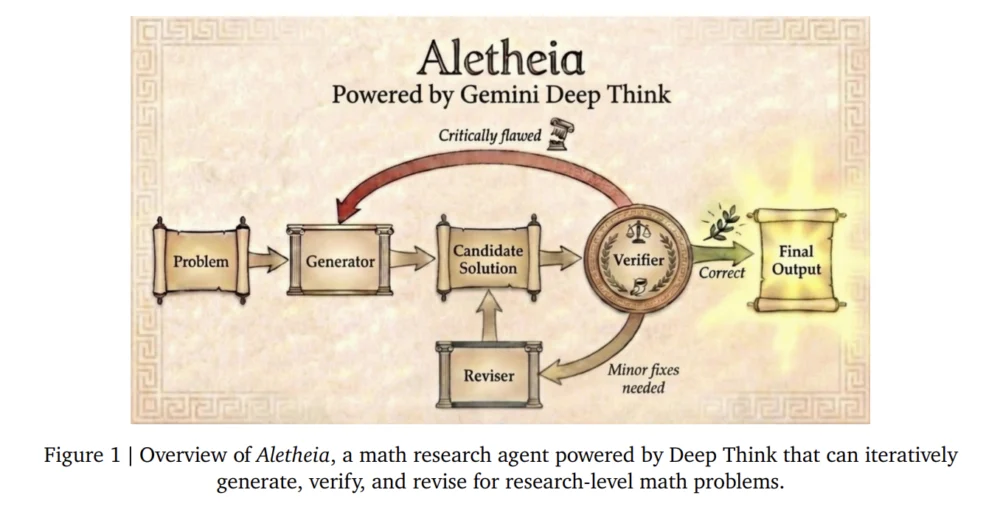
At the heart of Aletheia is a three-part "agentic harness" designed to maximize reliability and minimize the "hallucinations" common in large language models. This architecture functions as a self-correcting loop, mimicking the rigorous peer-review process that human mathematicians undergo before publishing.
The harness is divided into three distinct roles:
- The Proposer (Generator): This component generates initial hypotheses and proof sketches. It draws from a massive corpus of mathematical literature to suggest potential pathways for solving a problem.
- The Verifier: Perhaps the most critical component, the Verifier is tasked with finding flaws in the Proposer’s logic. DeepMind researchers observed that when a model is asked to both generate and verify simultaneously, it often suffers from confirmation bias. By separating verification into a distinct duty, Aletheia is significantly more likely to catch subtle logical errors.
- The Reviser: Once a flaw is identified, the Reviser takes the feedback from the Verifier and adjusts the proof. This iterative cycle continues until a logically sound, complete proof is achieved.
This separation of duties is more than a technical hurdle; it is a fundamental design philosophy. DeepMind’s findings suggest that explicit verification protocols allow the model to recognize flaws it initially overlooked during the generation phase. This mimics the "Slow Thinking" process described in cognitive psychology, where deliberate, analytical effort is applied to check the work of intuitive, rapid-response systems.
Chronology of Development and Key Milestones
The development of Aletheia followed a rigorous timeline of internal testing and external validation. Following the 2025 IMO results, where AI models first achieved parity with human gold medalists, DeepMind shifted its focus to "open-world" mathematics.
In early 2026, the team began testing Aletheia on established mathematical conjectures. One of the first major successes was the Erdős-1051 problem. While this was categorized as "Minor Novelty" or Level 1 autonomy, it proved that the agent could contribute original insights to existing problems.
The breakthrough moment came with the paper referred to as Feng26. This research was classified as Level A2, meaning the AI’s contribution was essentially autonomous and of publishable quality. The paper underwent standard peer review and was accepted into a professional mathematics journal, marking one of the first instances of a fully AI-authored discovery being recognized by the broader scientific community. This milestone serves as a proof of concept that AI can do more than just summarize or solve; it can create.
A Taxonomy for AI Autonomy in Science
To provide a framework for these achievements, DeepMind has proposed a standardized taxonomy for classifying AI mathematical contributions. This system is inspired by the levels of autonomy used in the self-driving vehicle industry, providing a clear metric for progress.
- Level 0 (Primarily Human): The AI performs negligible novelty. This includes solving Olympiad-level problems or acting as a sophisticated calculator. The human directs every significant step of the proof.
- Level 1 (Human-AI Collaboration): The AI provides minor novelty. It might suggest a specific lemma or bridge a gap in a human-led proof. The Erdős-1051 achievement falls into this category.
- Level 2 (Essentially Autonomous): The AI generates publishable research with minimal human intervention. It identifies the problem, navigates the literature, and constructs the proof. The Feng26 discovery is the flagship example of this level.
DeepMind researchers argue that defining these levels is essential for tracking the safety and capability of AI systems. As AI moves toward Level 3 and beyond—where it might discover entirely new branches of mathematics—the need for a rigorous classification system becomes paramount.
Technical Findings: The Power of Natural Language Reasoning
Aletheia’s development revealed several counter-intuitive insights into how AI handles complex reasoning. Historically, many researchers believed that formal verification (using code-like languages like Lean) was the only way to ensure mathematical accuracy. However, Aletheia proves that natural language reasoning, when structured through an agentic loop, is surprisingly robust.
The research team found that Aletheia’s ability to "read" and "understand" existing papers in natural language allowed it to identify connections between disparate fields of mathematics that formal systems might miss. Furthermore, the iterative revision process allowed the model to develop a form of "mathematical intuition." By seeing why certain proofs failed during the verification stage, the model became better at proposing viable paths in future iterations.

Data from the DeepMind trials showed a 40% increase in proof success rates when the agentic harness was utilized compared to a standalone Gemini Deep Think model. This suggests that the bottleneck for AI in mathematics is not just "intelligence" or "knowledge," but the structural process of self-critique.
Reactions from the Mathematical Community
The introduction of Aletheia has elicited a range of responses from professional mathematicians and academics. While some view the tool as a revolutionary assistant that could accelerate the pace of scientific discovery, others express caution regarding the "black box" nature of AI reasoning.
Dr. Sarah Jenkins, a theoretical mathematician (inferred reaction), noted that "the ability of Aletheia to produce publishable work like Feng26 is a Sputnik moment for our field. We are moving from a world where AI helps us write LaTeX to a world where AI helps us think."
However, skeptics point out that while Aletheia can generate proofs, it may not yet be able to explain the significance of its discoveries. The "Why" behind a mathematical truth is often as important to researchers as the "How." There is also the ongoing debate regarding authorship; if an AI is Level 2 autonomous, who receives the credit for the discovery? These philosophical and ethical questions are likely to dominate the discourse as Aletheia becomes more widely used.
Broader Impact and Future Implications
The implications of Aletheia extend far beyond the world of pure mathematics. Mathematics is the foundational language of all sciences, from physics to cryptography and economics. An AI that can autonomously discover new mathematical principles can, by extension, accelerate breakthroughs in these derivative fields.
- Accelerated Scientific Discovery: By automating the "long-horizon" work of proof construction, Aletheia allows human researchers to focus on high-level strategy and the conceptual implications of new findings.
- Redefining Peer Review: If AI can verify its own work to a Level 2 standard, the traditional peer-review process may need to evolve. We may see a future where AI agents are used to peer-review both human and AI-generated papers.
- The Path to General Intelligence: Reasoning is often cited as the "Holy Grail" of Artificial General Intelligence (AGI). By mastering the most rigorous form of reasoning—mathematical research—DeepMind is moving closer to creating models that can think critically across any domain.
Conclusion and Outlook
Google DeepMind’s Aletheia represents a bridge between the controlled environment of competitions and the "wild" of professional research. Through its unique agentic loop and natural language capabilities, it has already proven its ability to contribute to the global body of mathematical knowledge. As the model continues to scale and integrate more deeply with the scientific community, the boundary between human and machine discovery will continue to blur. The name Aletheia—meaning "truth" or "disclosure"—is a fitting choice for a tool designed to uncover the hidden structures of the universe. The next decade of mathematics will likely be defined by the partnership between human intuition and agentic autonomy.