


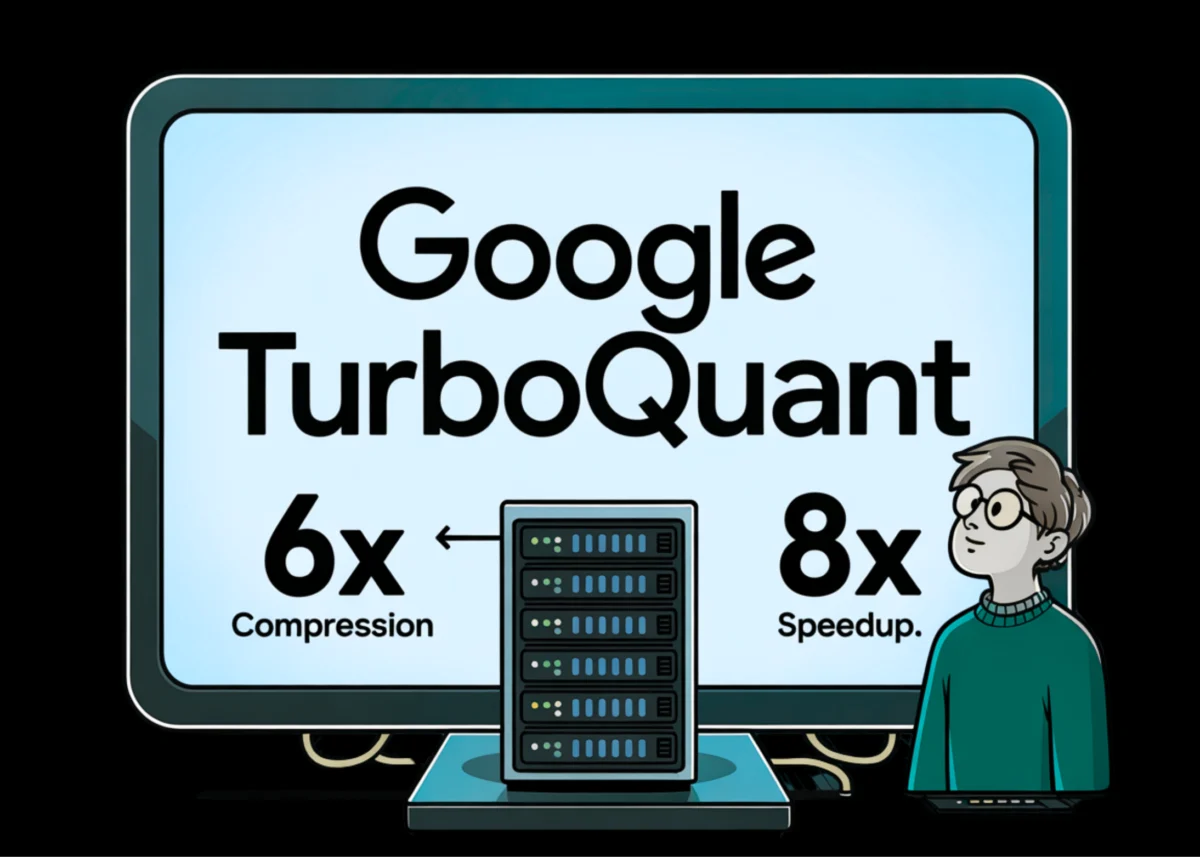
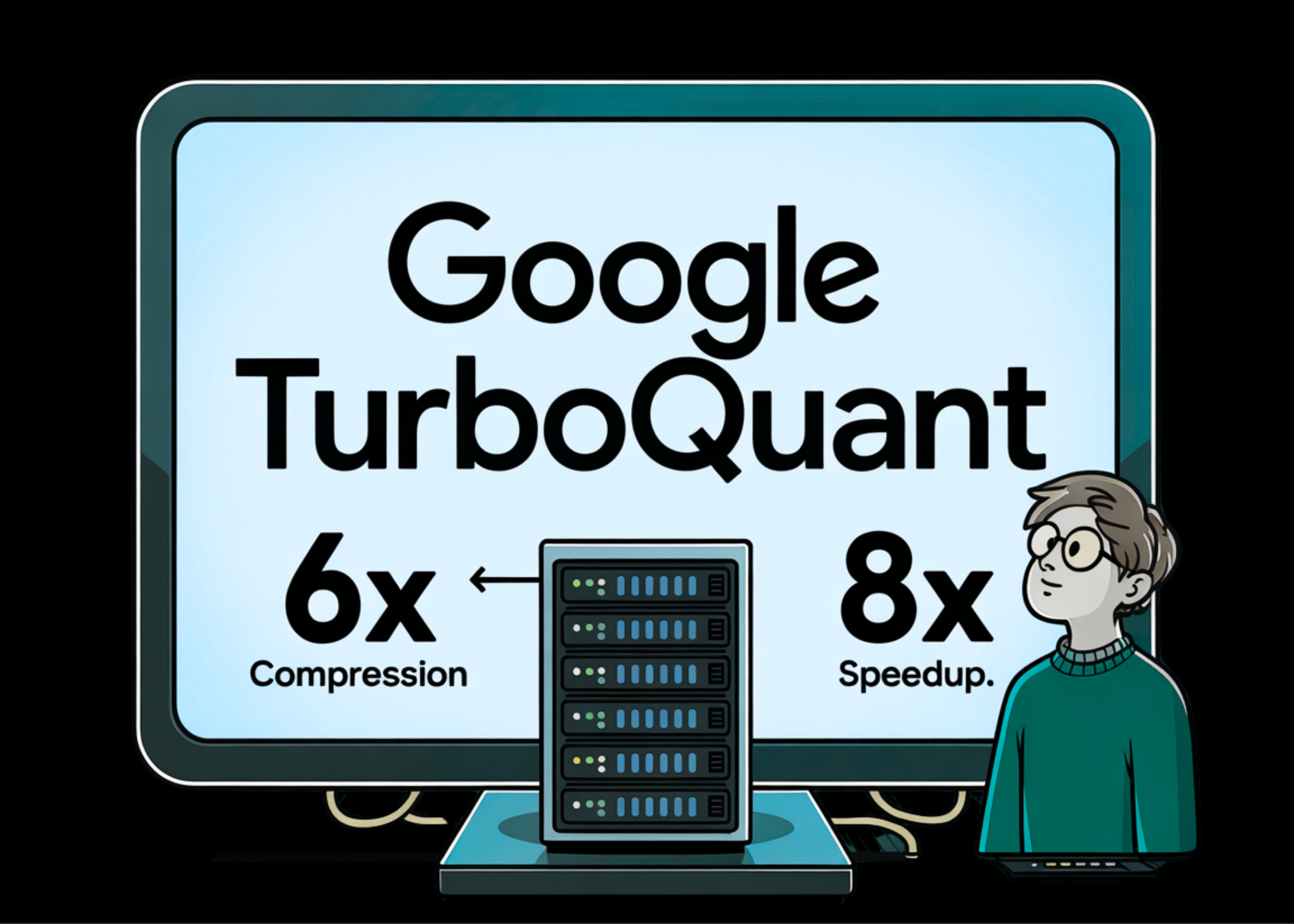
The rapid evolution of Large Language Models (LLMs) has brought the industry to a critical crossroads where computational power is no longer the primary bottleneck; instead, a phenomenon known as the "memory wall" has emerged as the most significant hurdle to further scaling. As models like Llama-3.1 and Ministral-7B-Instruct push the boundaries of context length and reasoning capabilities, the overhead associated with memory communication between High-Bandwidth Memory (HBM) and SRAM has become a prohibitive factor in real-time inference. In a breakthrough aimed at dismantling this barrier, a research team from Google has unveiled TurboQuant, a data-oblivious quantization framework designed to compress Key-Value (KV) caches by up to six times while delivering an eightfold speedup in processing, all while maintaining near-zero loss in model accuracy.
The Technical Context: Understanding the KV Cache Bottleneck
To appreciate the significance of TurboQuant, one must first understand the architecture of the modern Transformer. During the inference process of an LLM, the model generates text token by token. To avoid redundant computations, the "keys" and "values" of previously processed tokens are stored in a dedicated memory space known as the KV cache. As the context length increases—moving from standard 4,000-token windows to 128,000 or even a million tokens—the size of this cache grows linearly.
For state-of-the-art models, the KV cache can quickly exceed the capacity of even the most advanced GPUs, such as the NVIDIA H100. This forces systems to frequently move data between the fast SRAM and the larger but slower HBM. This constant data movement creates a communication overhead that dwarfs the actual time spent on mathematical calculations, leading to increased latency and higher operational costs for AI providers.
Traditional approaches to this problem have focused on simple scalar quantization, such as converting 16-bit floating-point numbers (FP16) to 8-bit or 4-bit integers. While effective for weights, these methods often struggle with the dynamic and high-dimensional nature of KV caches, frequently resulting in a "perceptual" degradation of the model’s ability to recall specific facts from long documents.
The Innovation of Data-Oblivious Quantization
TurboQuant represents a departure from traditional Vector Quantization (VQ) methods like Product Quantization (PQ). Standard VQ algorithms typically require extensive offline preprocessing and data-dependent codebook training. In these traditional scenarios, the system must "learn" the distribution of the data it is compressing to create an efficient map. However, LLM workloads are dynamic; the data distribution can change based on the prompt, the language, or the specific domain of the conversation.
The Google Research team addressed this by making TurboQuant "data-oblivious." Unlike its predecessors, TurboQuant does not require dataset-specific tuning or calibrations. This characteristic makes it highly compatible with modern hardware accelerators, as it relies on vectorized operations rather than the slow, non-parallelizable binary searches often required by trained codebooks.
By eliminating the training phase, TurboQuant reduces indexing time to virtually zero. In comparative tests for a vector dimension of 3072, Product Quantization required nearly 500 seconds for indexing, whereas TurboQuant achieved the same task in just 0.0021 seconds. This leap in efficiency allows for the real-time compression of KV caches during the generation process without introducing new latencies.
Geometric Mechanics and the Beta Distribution
The mathematical core of TurboQuant involves a sophisticated application of high-dimensional geometry. The algorithm applies a random rotation to the input vectors using an orthogonal matrix. This rotation serves a vital purpose: it induces a concentrated Beta distribution on each coordinate, regardless of the original data’s distribution.
In high-dimensional space, these coordinates become nearly independent and identically distributed (i.i.d.). This transformation simplifies a complex multi-dimensional problem into a series of continuous 1D k-means or Max-Lloyd scalar quantization problems per coordinate. By solving this optimization once for specific bit-widths and storing the resulting codebooks, TurboQuant can execute quantization with extreme speed during online inference.
The research team established that TurboQuant’s Mean Squared Error (MSE) distortion is provably within a small constant factor of approximately 2.7 of the absolute theoretical limit—defined by Shannon’s Lower Bound—across all bit-widths. At a 1-bit width, the performance is even more impressive, sitting only a factor of 1.45 away from the theoretical optimum.
Eliminating Inner Product Bias in Attention Mechanisms
One of the most persistent challenges in quantization is the preservation of the inner product. In the attention mechanism of a Transformer, the model calculates the relationship between tokens using inner products. If a quantization map is optimized strictly for MSE, it often introduces a multiplicative bias. For example, a 1-bit MSE-optimal quantizer in high dimensions can exhibit a bias of 2/π, which significantly distorts the attention scores and leads to "hallucinations" or loss of context.
To solve this, Google developed a two-stage approach titled TURBOQUANT_prod. This variant combines magnitude quantization with an unbiased vector quantization step. The result is a provably unbiased estimator for inner products. By ensuring that the expected value of the quantized inner product equals the original value, TurboQuant maintains the integrity of the attention mechanism even at extreme compression levels.
Empirical Validation: Llama-3.1 and the Needle-In-A-Haystack Test
The true test of any compression algorithm is its performance on industry-standard benchmarks. Google Research tested TurboQuant on the Llama-3.1-8B-Instruct and Ministral-7B-Instruct models, focusing on "Needle-In-A-Haystack" (NIAH) retrieval tasks. This test requires the model to find a specific piece of information buried within a massive context window.
Under a 4x compression ratio, TurboQuant demonstrated 100% retrieval accuracy. Even more strikingly, it matched full-precision (FP16) performance up to 104,000 tokens. This suggests that the memory savings do not come at the cost of the model’s "intelligence" or its ability to handle long-form documents.
To further refine performance, TurboQuant utilizes an outlier treatment strategy for non-integer bit-widths. By identifying specific "outlier" channels that carry more significant information and allocating them higher precision (e.g., 3 bits) while keeping non-outliers at a lower precision (e.g., 2 bits), the system can achieve effective bit-rates like 2.5 or 3.5 bits per channel. This granular control allows developers to balance the trade-off between memory footprint and model quality with high precision.
Chronology and Industry Implications
The development of TurboQuant follows a series of advancements in the field of model optimization. In 2022 and 2023, the focus was largely on Weight Quantization (GPTQ, AWQ), which allowed large models to run on consumer GPUs. However, as the industry shifted toward "Long Context" in 2024, the KV cache became the new bottleneck.
TurboQuant represents the next phase of this evolution. By providing a mathematically grounded, hardware-friendly method for VQ, Google has set a new standard for inference efficiency. The implications for the AI industry are manifold:
- Reduced Operational Costs: Cloud providers can host more concurrent users on a single GPU by reducing the memory footprint of each session’s KV cache.
- Extended Device Capability: Edge devices, such as smartphones and laptops with limited RAM, will be able to run more sophisticated models with longer context windows.
- Sustainability: By reducing the need for constant data movement between HBM and SRAM, TurboQuant lowers the energy consumption of AI inference, addressing growing concerns regarding the environmental impact of data centers.
Analysis of the "Data-Oblivious" Advantage
Industry analysts suggest that the "data-oblivious" nature of TurboQuant is its most disruptive feature. In a production environment, the time required to "train" a quantization codebook is often more expensive than the benefits the compression provides. By creating a system that works "out of the box" for any vector distribution, Google has removed a significant engineering hurdle.
Furthermore, the speedup of 8x is not merely a theoretical calculation but a reflection of how TurboQuant interacts with the GPU’s SIMD (Single Instruction, Multiple Data) architecture. Because the algorithm avoids complex branching and relies on rotations and scalar lookups, it can be fully fused into the attention kernel, minimizing the latency of the compression step itself.
Conclusion
TurboQuant is a significant milestone in the quest to make Large Language Models more efficient and accessible. By bridging the gap between Shannon’s information-theoretic limits and the practical constraints of modern GPU architecture, Google Research has provided a blueprint for the next generation of AI deployment. As models continue to grow in complexity, techniques like TurboQuant will be essential in ensuring that the "memory wall" does not become a ceiling for the potential of artificial intelligence. The framework’s ability to offer extreme compression with zero accuracy loss suggests that the future of LLM inference lies not just in bigger hardware, but in smarter, more mathematically elegant software solutions.