


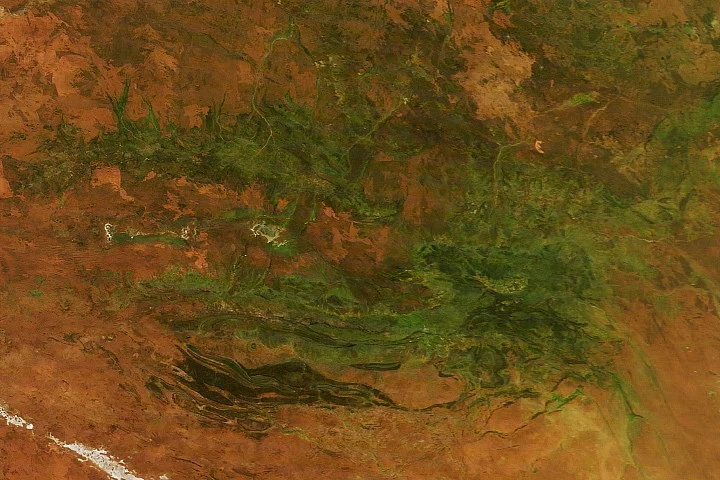
The usually parched and iconic "Red Centre" of Central Australia has undergone a dramatic and visually stunning transformation, painting its vast desert landscapes in vibrant hues of green following an extraordinary period of heavy rainfall in February and early March 2026. This ecological spectacle, captured vividly by NASA’s Earth-observing satellites, comes amidst significant disruptions on the ground and the looming threat of further extreme weather events across the continent.
A Verdant Transformation from Space
On March 10, 2026, the Moderate Resolution Imaging Spectroradiometer (MODIS) aboard NASA’s Terra satellite provided a stark visual testament to this profound change. Images of the southern Northern Territory, where the town of Alice Springs lies near Australia’s geographic heart, revealed expansive stretches of newly lush vegetation. This verdant panorama stood in sharp contrast to images taken just two months prior, in January 2026, which depicted the region in its characteristic rusty-red and ochre tones, a result of the extensive oxidation of iron-rich rocks that define its geological makeup. The ability of MODIS to monitor large-scale environmental changes with its broad swath and frequent revisits makes it an invaluable tool for tracking such rapid shifts in Earth’s ecosystems, particularly in remote and dynamic regions like the Australian outback.
The "Red Centre" moniker, deeply ingrained in the Australian consciousness and global imagery, reflects the region’s predominantly arid climate, where average annual rainfall for Alice Springs typically hovers around 280 millimeters (approximately 11 inches). Therefore, the rainfall figures recorded in early 2026 represent an exceptional departure from the norm, triggering an almost instantaneous ecological response from the dormant seed banks and resilient flora adapted to these episodic events. The visual evidence from space underscores the sheer scale of the transformation, stretching across hundreds of square kilometers and providing a clear delineation between the pre-rain desert and its rejuvenated state.
February 2026: A Month of Record-Breaking Deluge
The catalyst for this transformation was an unprecedented deluge throughout February 2026. The Northern Territory experienced an average of 239 millimeters (9 inches) of rain across its affected areas, a figure that alone nearly equals the typical annual precipitation for Alice Springs. This made February 2026 the third-wettest February on record for the territory, a dataset meticulously maintained by the Bureau of Meteorology (BoM) dating back to 1900. Such concentrated rainfall in an arid environment not only saturates the ground but also revitalizes ephemeral river systems that can remain dry for years, sometimes even decades. For context, the average February rainfall for Alice Springs is typically around 40-50 mm, making the 239 mm recorded across the territory an almost five-fold increase over the monthly average. This extreme deviation from the norm highlights the intensity and unusual nature of the weather system.
The initial phase of heavy rainfall in early February was attributed to a series of intense thunderstorms. These storm cells generated localized but powerful downpours, leading to a rapid and dramatic increase in water levels in typically dry riverbeds, including the Todd River, which flows through Alice Springs. The Todd River, renowned for its rarity of flow, became a torrent, a spectacle for some but a significant hazard for others. Flash flooding quickly ensued in Alice Springs and surrounding areas, resulting in uprooted trees, damaged infrastructure, and numerous instances of people becoming stranded by swiftly rising waters. Emergency services were stretched thin, responding to calls for assistance and issuing urgent warnings to residents about the dangers of floodwaters, particularly urging against driving through submerged roads. Local news reports at the time detailed the extensive damage to property and the considerable challenges faced by first responders.
The Stalling Tropical Low: Prolonged Impact and Natural Disaster Declaration
The situation intensified later in February when a tropical low-pressure system stalled over central Australia for nearly a week. This prolonged weather event delivered continuous heavy rainfall over an already saturated landscape. Unlike typical transient storms, the stationary nature of this low allowed for a sustained period of precipitation, exacerbating the flooding and extending its reach across vast inland catchments in the Northern Territory and into western Queensland. The phenomenon of a stalled tropical low is particularly dangerous in arid regions, as the ground’s capacity to absorb water is quickly overwhelmed, leading to extensive sheet flooding and prolonged inundation.
The cumulative impact of these successive rain events was severe enough for officials to declare a natural disaster. This declaration underscores the widespread damage and disruption caused, triggering government support and resources for recovery efforts. Roads, many of which are unsealed tracks vital for remote Indigenous communities and pastoral stations, became impassable for extended periods, isolating populations and disrupting crucial supply chains for food, fuel, and medical supplies. The declaration highlighted the profound socio-economic and logistical challenges posed by such extreme weather in sparsely populated, remote regions. Emergency relief efforts, coordinated by the Northern Territory Emergency Service (NTES) and local government bodies, focused on assessing damage, providing essential supplies to cut-off communities, and ensuring the safety and well-being of residents, often involving aerial reconnaissance and supply drops.
The Ecological Marvel: A Desert Reborn
Beyond the immediate challenges to human infrastructure and safety, the rainfall has brought about a temporary but spectacular ecological revival. The Australian desert, far from being barren, is home to a remarkable array of flora and fauna adapted to survive long periods of drought and capitalize on infrequent rainfall. The deep saturation of the soil has triggered the germination of millions of dormant seeds, leading to an explosion of native grasses, wildflowers, and shrubs. This phenomenon, often referred to as a "desert bloom," transforms the landscape from its characteristic red and brown to a vibrant tapestry of greens and purples, punctuated by bursts of yellow, pink, and white wildflowers. Species like the Sturt’s Desert Pea, the official floral emblem of the Northern Territory, are known to flourish spectacularly in such conditions.
This sudden abundance of vegetation creates a temporary but critical food source for local wildlife. Insect populations boom, attracting a diverse range of birds, including migratory species that travel thousands of kilometers to exploit these ephemeral resources. Lizards, marsupials like kangaroos and wallabies, and other desert creatures also benefit immensely from the increased food and water availability, often experiencing a surge in breeding activity during these rare periods of plenty. The replenished waterholes and temporary lakes, which can persist for weeks or months, become vital hubs for biodiversity, drawing in animals from vast surrounding areas. For environmental scientists and ecologists, these events offer invaluable opportunities to study the resilience and adaptive strategies of desert ecosystems in response to extreme climatic variability, providing insights into survival mechanisms in some of the planet’s harshest environments.
Anticipating Further Extremes: Tropical Cyclone Narelle
As Central Australia grapples with the aftermath of its record-breaking rains, the continent faces the prospect of further severe weather. As of late March 2026, the Bureau of Meteorology issued urgent warnings for the approach of Tropical Cyclone Narelle. Forecasts indicated that severe storm impacts were expected to reach northern Queensland by late on March 19 or March 20. This impending cyclone represented a significant threat, bringing the potential for destructive winds, further torrential rainfall, and dangerous storm surges along coastal areas, particularly affecting communities along the Queensland coast.
The concern extended significantly inland, with flooding watches and warnings issued for areas already saturated by the recent events, including Alice Springs and the broader Northern Territory interior. The cumulative effect of consecutive extreme weather systems means that river catchments in the interior are already full, and the ground remains saturated, significantly increasing the risk of renewed and severe flooding even from moderate additional rainfall associated with Narelle’s remnants. Emergency management agencies across Queensland and the Northern Territory were on high alert, urging residents in potentially affected areas to finalize their cyclone preparedness plans, secure properties, and be ready to evacuate if advised. The coordination between state and federal emergency services, along with local councils and the Australian Defence Force (ADF) for logistical support, becomes paramount in managing such widespread and complex threats across a vast geographic area.
Australia’s Climate Dynamics: A Land of Extremes
This sequence of events – from record-breaking desert rains to flash floods and the threat of a major tropical cyclone – serves as a potent reminder of Australia’s highly variable and often extreme climate. The continent is famously characterized by its "boom and bust" cycles, oscillating between prolonged droughts and intense flood events. These patterns are largely influenced by large-scale climate drivers such as the El Niño-Southern Oscillation (ENSO), which dictates much of Australia’s rainfall variability, leading to periods of drought during El Niño phases and increased rainfall during La Niña events. While the specific drivers of the early 2026 rainfall events are subject to ongoing climate analysis, they fit within the broader historical context of a continent shaped by climatic extremes. Historically, significant rainfall events in the Red Centre have often been linked to strong La Niña cycles or unusual monsoonal troughs extending further south than typical.
The scientific community continues to monitor these events closely, seeking to understand how global climate change might be influencing the frequency and intensity of such phenomena. While individual weather events cannot be directly attributed to climate change without extensive analysis, the broader trend towards more extreme weather – hotter heatwaves, more intense rainfall events, and prolonged droughts – is consistent with climate projections for many regions, including Australia. Understanding these dynamics is crucial for developing robust long-term strategies for water management, urban planning, infrastructure resilience, and disaster preparedness in a continent increasingly exposed to the vagaries of a changing global climate. This includes investing in early warning systems, resilient infrastructure, and community education programs.
Implications and Ongoing Response
The immediate implications of the Central Australian floods are multi-faceted. On the one hand, there is the ecological rejuvenation, a spectacle that draws attention to the remarkable adaptability of desert ecosystems and offers a temporary reprieve for wildlife. On the other, there are the significant and often costly challenges to human infrastructure and safety. Repairs to roads, bridges, culverts, and other critical infrastructure will be extensive and costly, particularly in remote areas where access is difficult even in normal conditions. The economic impact on local businesses, especially those reliant on tourism, transportation, and pastoral activities, will also be considerable in the short term, with disruptions to supply chains and reduced visitor numbers.
Local authorities and emergency services, including the Northern Territory Emergency Service (NTES) and potentially the Australian Defence Force (ADF) for broader logistical and recovery support, will continue to play a crucial role in the immediate aftermath and recovery phase. This involves ongoing assessments of damage, providing humanitarian aid to affected communities, and facilitating the rapid restoration of essential services like power and communications. The experience gained from managing these complex and widespread events contributes significantly to refining disaster preparedness and response protocols, ensuring that communities are better equipped to face future climatic challenges, which are projected to increase in frequency and intensity.
The greening of the Red Centre is a powerful visual paradox: a symbol of both destructive forces and life-giving bounty. It underscores the profound interconnectedness of Australia’s vast landscapes and the delicate balance between natural resilience and vulnerability in the face of an ever-changing climate. As the nation braces for Tropical Cyclone Narelle, the events of early 2026 serve as a poignant reminder of nature’s formidable power and the ongoing imperative for vigilance, adaptation, and sustained investment in climate resilience.
The images captured by NASA’s Earth Observatory, using MODIS data from NASA EOSDIS LANCE and GIBS/Worldview, provide not just a snapshot of a moment but a scientific record vital for understanding the complex dynamics of our planet. Story by Kathryn Hansen, with additional reporting and analysis drawing on data from the Bureau of Meteorology and various news outlets.