

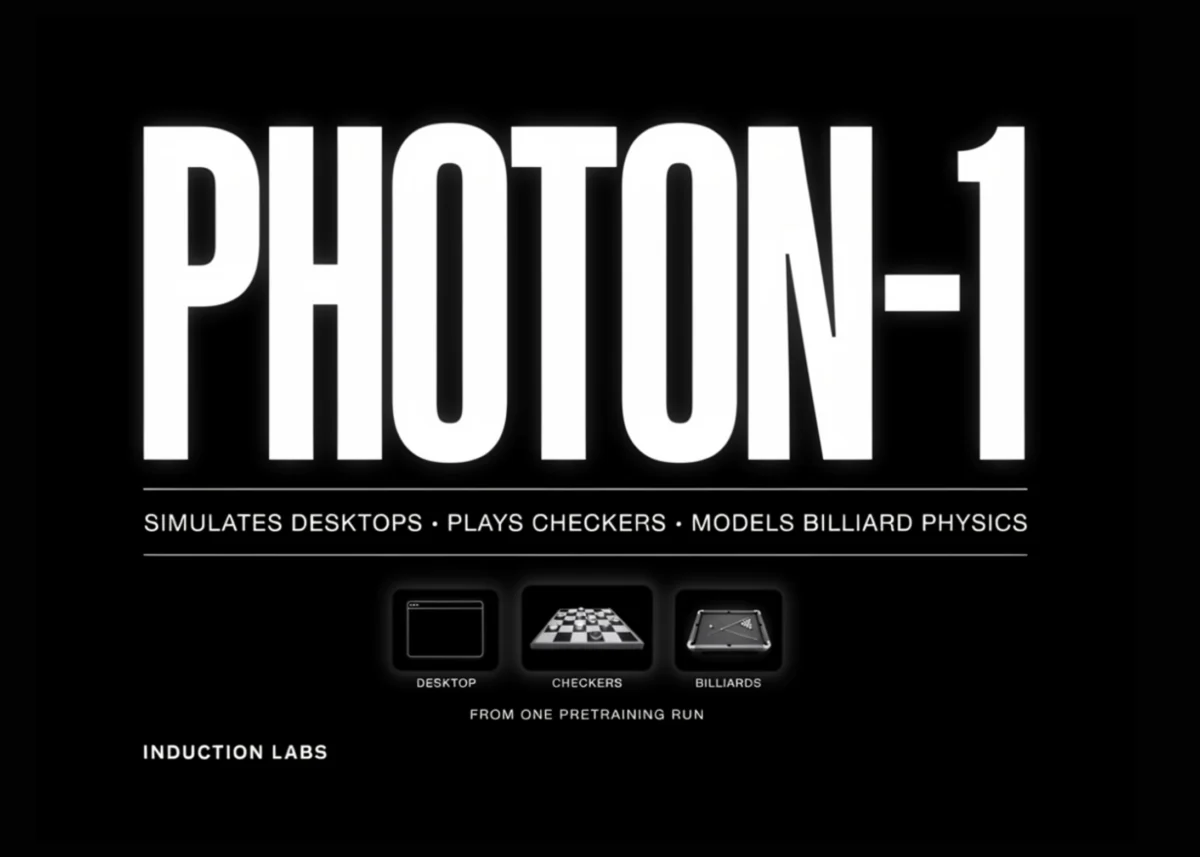
The landscape of artificial intelligence is currently undergoing a fundamental shift as researchers move from text-centric models toward agents capable of navigating complex digital and physical environments. In a significant technical release, Induction Labs has introduced Photon-1, a 106-billion parameter mixture-of-experts (MoE) transformer that utilizes a novel "imagination model" architecture. This development challenges the long-standing industry assumption that training AI agents on video requires explicit action labels—such as mouse clicks or keyboard strokes—to correlate with every frame. By focusing on raw video pretraining through next-latent-token prediction, Induction Labs claims to have bypassed a major data bottleneck, producing a model that outperforms established competitors like Gemini 3.1 Flash-Lite in specific computer-use benchmarks while requiring significantly less compute.
The Paradigm of Imagination Models
The core innovation of Photon-1 lies in its classification as an "imagination model." Historically, building agents that learn from video has been a labor-intensive process. Most systems require "action-labeled" data, where each frame of a video is paired with the specific command that generated it. Because this data is difficult to source and expensive to annotate, it has limited the scale of video-based agent training. Induction Labs argues that this requirement is no longer necessary.
An imagination model operates by predicting future frames autoregressively within a learned representation space. Unlike traditional generative models that might attempt to render every pixel of a future frame—a process that is computationally expensive and often results in "blurry" or inaccurate details—Photon-1 utilizes next-latent-token prediction. It does not generate pixels during its pretraining phase. Instead, it models the world in an abstract, discrete latent space. This approach allows the model to learn an "implicit policy." By observing 18 years of computer demonstration videos, the model develops an internal understanding of cause and effect, recognizing the underlying concepts of human tasks without ever seeing a label for a specific mouse movement.
Technical Architecture and the Compression Breakthrough
To make a 106B-parameter model viable for high-speed video processing, Induction Labs implemented a sophisticated compression strategy. The architecture relies on a vision encoder utilizing Finite Scalar Quantization (FSQ). In this system, each video frame is compressed into 960 discrete tokens. Each token is represented as an 8-dimensional vector, where each dimension can take one of five discrete values: −1, −1/2, 0, 1/2, or 1. This configuration creates a codebook of 5⁸ (390,625) possible codes.
The efficiency of this method is notable. The resulting encoding is approximately 2.2 KB per frame. According to technical data provided by Induction Labs, this represents a 100-fold improvement in compression compared to existing Optical Character Recognition (OCR) and multimodal model representations. Critically, this compression does not sacrifice the fidelity required for computer-use tasks; it preserves text legibility, UI layout, and minute state changes that are often lost in more aggressive lossy compression algorithms.
Furthermore, Photon-1 utilizes a differential latent encoder. Rather than encoding each frame as a standalone entity, the system encodes frames in pairs. This allows the latents to describe the differences between frames—the "delta"—rather than the static content. This focus on change is particularly effective for computer interfaces, where large portions of the screen remain static while small, crucial updates occur in specific windows or menus.
Pretraining at Scale: 18 Years of Video Data
The scale of the data used to train Photon-1 is vast, yet highly curated. The research team began with an internal index of approximately 2 billion publicly available videos. Through a rigorous filtering process designed to isolate high-quality instructional content, the corpus was narrowed down to 2 million computer screen recordings. To further optimize the dataset, an internal keyframe detection model was used to strip away redundant or static frames that offered no new information to the model.
The final dataset comprised 575 million frames, sampled at a rate of one frame per second. This equates to roughly 552 billion tokens, representing 18 years of continuous video footage. Photon-1 was pretrained from scratch for a single epoch.
The computational demands of this training were substantial but highly optimized. Training the 106B-A5B (106 billion total parameters, with 5 billion active per token) MoE architecture at a 32K context window required approximately 30,000 H200 GPU-hours. This translates to a total of 4.4×10²² training FLOPs. The research team achieved an impressive 40% end-to-end Model FLOPs Utilization (MFU) by implementing the training in PyTorch with custom fused kernels for both the vision encoder and the MoE layers. This high MFU suggests a highly efficient hardware-software integration, maximizing the output of the Nvidia H200 clusters.
Benchmark Performance and Cost Analysis
Induction Labs evaluated Photon-1 against Gemini 3.1 Flash-Lite, a model widely regarded for its efficiency in multimodal tasks. On an internal computer-use benchmark, Photon-1 not only matched but exceeded the performance of the Gemini model. What makes this result significant is the disparity in resources used. Photon-1 utilized significantly less pretraining compute than the estimated requirements for the Gemini 3.1 series.
The economic implications are equally striking. Induction Labs reports that Photon-1 is roughly three times less expensive to serve than Gemini 3.1 Flash-Lite. Specifically, the weighted inference cost for Photon-1 is cited at $0.11 per 1 million tokens, compared to $0.36 for Gemini. This calculation is based on a 10:1 input-to-output token ratio, which reflects the typical data flow in computer-use automation where the model processes many visual frames (input) to produce a single action command (output).

At a granular level, Photon-1’s breakeven cost on Induction Labs’ proprietary hardware is $0.06 per 1 million input tokens and $0.60 per 1 million output tokens. Notably, these figures are achieved without the use of speculative decoding, suggesting further room for optimization in future iterations.
Transitioning from Imagination to Actionable Agency
While the pretraining phase focuses on "imagination" (predicting the next state), the model must still be taught how to interact with an interface to be useful as an agent. To bridge this gap, Induction Labs finetuned Photon-1 on fewer than 35,000 computer-use trajectories. These trajectories provide the model with the specific action and instruction formats required to navigate modern operating systems.
Specialized "computer use tokens" were introduced, allowing the model to emit discrete actions like clicks, drags, and keystrokes. At the point of inference, the model follows a two-step cognitive process: it first predicts the state of the next frame (the intended outcome) and then outputs the specific action required to achieve that state.
To refine these capabilities, the model underwent online reinforcement learning (RL). This process involved running "rollouts" in real-time across a massive fleet of virtual machines (VMs). These Linux-based VMs hosted five different desktop environments—LXQt, Xfce, MATE, GNOME, and Plasma—to ensure the model could generalize across different UI styles. Each environment was equipped with Google accounts for web-based tasks and an internal, rate-limit-free ChatGPT clone, allowing the agent to practice using other AI tools to solve complex problems.
Cross-Domain Generalization and Physical Intuition
One of the most compelling findings from the Photon-1 research is the model’s ability to generalize beyond the desktop environments it was trained on. Since the model learned to predict state changes in a general latent space, it developed a form of "visual logic" that applies to other domains.
To test this, the research team finetuned Photon-1 on two domains entirely absent from its pretraining: tournament checkers and billiard simulations.
- Checkers: Using 20,000 games from the Open Checkers Archive 2.0, Photon-1 was compared against a vision encoder baseline (no imagination pretraining) and an LLM baseline (Ling-flash-2.0). Photon-1 outperformed both in world simulation accuracy and move quality.
- Billiards: Using 10,000 synthetically generated games, the model was tasked with predicting ball trajectories. Photon-1 achieved a mean absolute error (MAE) of 0.47 against the ground-truth physics engine. In contrast, the LLM baseline recorded an MAE of 1.15, and the vision encoder baseline recorded 1.44.
These results suggest that by "imagining" the next state of a computer screen, the model accidentally learned broader principles of physics, spatial reasoning, and strategic planning.
Industry Implications and Future Outlook
The release of Photon-1 by Induction Labs highlights a potential path forward for the development of lean, efficient, and highly capable AI agents. By proving that raw video is a viable—and perhaps superior—pretraining medium compared to action-labeled datasets, Induction Labs has opened the door for scaling agents using the vast amounts of video data available on the internet.
The efficiency of the MoE architecture, combined with the extreme compression of FSQ, addresses the "inference tax" that has hindered the widespread adoption of vision-based agents. As these models become cheaper to run, the possibility of "always-on" AI assistants that observe and assist with desktop tasks in real-time becomes more feasible.
However, some caveats remain. The benchmarks used to claim superiority over Gemini 3.1 Flash-Lite are internal and have not yet been independently verified by the broader research community. Additionally, the reliance on a single epoch of pretraining, while efficient, leaves questions about the model’s ultimate performance ceiling if trained for longer durations or on even larger datasets.
Regardless of these hurdles, the technical achievement of Photon-1 signals a move toward "world models" for the digital realm. By teaching a model to imagine the future before it acts, Induction Labs has provided a blueprint for the next generation of autonomous digital workers. The integration of human-like priors—such as the model’s learned ability to use a ChatGPT clone to answer knowledge questions—suggests that the gap between "seeing" and "doing" is closing rapidly.