
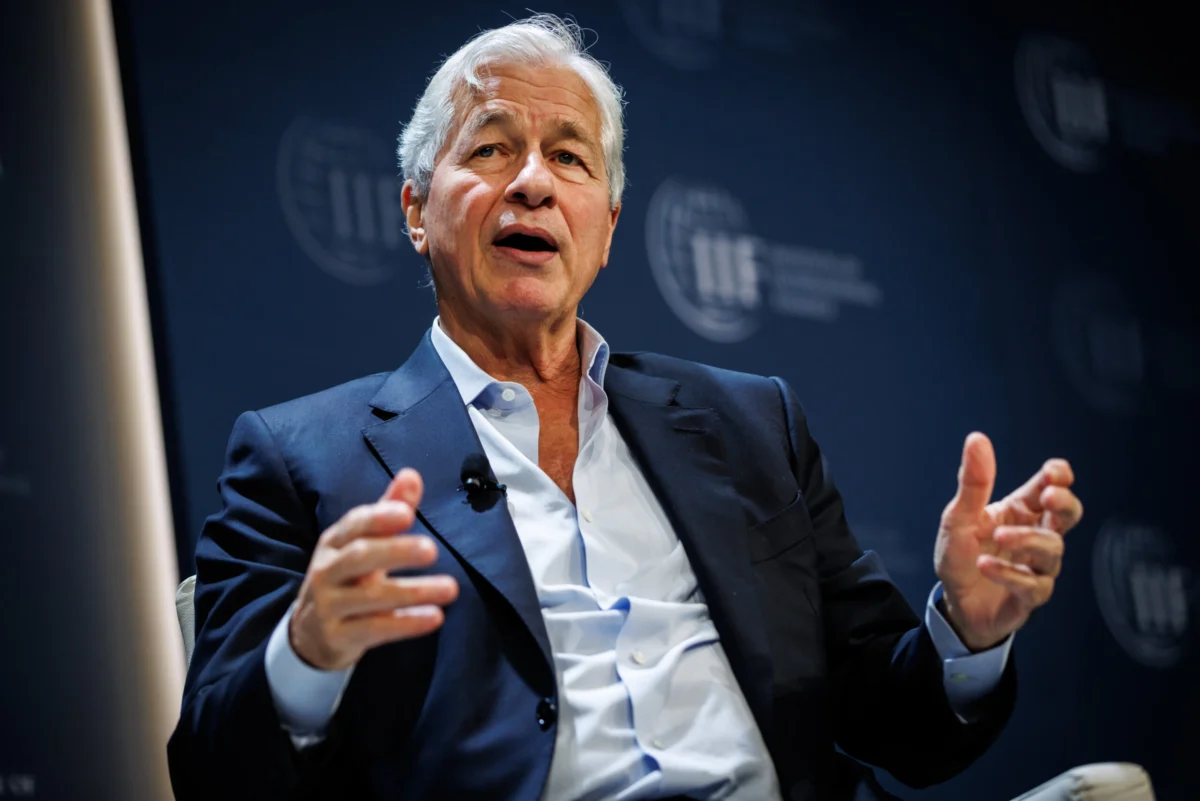
Jamie Dimon, the influential chief executive officer of JPMorgan Chase & Co., offered a nuanced and somewhat contrarian perspective on the escalating conflict in the Middle East, suggesting that while the Iran war poses significant near-term risks, it might paradoxically pave the way for long-term peace in the region. Speaking at a conference in Washington, D.C., on Tuesday, Dimon, who leads the world’s largest bank by market capitalization, articulated his view to Palantir executive and former Congressman Mike Gallagher, emphasizing the evolving attitudes among key regional players. His remarks, delivered amidst heightened global anxieties, underscored the intricate links between geopolitical stability, economic prosperity, and national security, drawing attention to broader challenges facing the United States in an increasingly complex world.
The veteran banker’s assessment is rooted in what he perceives as a fundamental shift in regional interests. According to Dimon, a convergence of strategic objectives is emerging among Saudi Arabia, the United Arab Emirates, Qatar, the United States, and Israel, all of whom, he believes, are now genuinely seeking a lasting peace. He specifically highlighted the Persian Gulf states’ demonstrable willingness to pursue this trajectory, noting a stark difference from two decades prior. "The attitude is not what the attitude was 20 years ago," Dimon stated, asserting that "They all want it." This evolving sentiment, he argued, could transform the current volatile environment into an unexpected pathway towards stability.
The Middle East Conflict: A Catalyst for Re-evaluation
The recent escalation in the Middle East, which commenced last month, has undeniably sent tremors through global markets and diplomatic circles. The conflict was ignited following a series of extensive strikes launched by the United States and Israel against Iran, including a particularly impactful one that resulted in the death of the country’s supreme leader. These actions, coming after years of simmering tensions, proxy conflicts, and a complex web of alliances and rivalries, marked a significant and dangerous turning point. The immediate economic fallout was evident, with global oil prices surging dramatically due to widespread concerns over potential supply disruptions from the critical energy-producing region. For context, analysts noted a 10-15% jump in crude benchmarks like Brent and WTI in the immediate aftermath, reflecting the market’s sensitivity to geopolitical instability in the Strait of Hormuz, a vital shipping lane for a significant portion of the world’s oil supply.
Despite the initial market volatility, there was a brief period of optimism when stocks experienced a rally on Monday after President Donald Trump, in a social media post, indicated that the involved parties had engaged in discussions about a "complete and total resolution" to the conflict. However, this glimmer of hope was quickly extinguished when Iran promptly denied that any such talks were underway, injecting further uncertainty into the diplomatic landscape and reminding observers of the deep-seated distrust that characterizes relations in the region.
Dimon’s seemingly contrarian stance on the war’s potential long-term benefits is deeply intertwined with economic realities. He argued compellingly that the region’s sustained need for foreign direct investment (FDI) serves as a powerful incentive for peace. Gulf nations, in particular, have been significant recipients of FDI over the past several years, channeling billions into ambitious diversification projects spanning technology, tourism, infrastructure, and renewable energy, exemplified by initiatives like Saudi Vision 2030 and the UAE’s economic development plans. This influx of capital is critical for their economic transformation and future growth, and Dimon posited that such investment flows would inevitably "dry up without stability." His stark illustration, "They can’t have neighbors lobbing ballistic missiles into their data centers," underscores the fundamental incompatibility of sustained conflict with the requirements of a modern, investment-driven economy. Prolonged instability not only deters new investors but also jeopardizes existing projects, damages critical infrastructure, and disrupts supply chains, leading to substantial economic losses and a brain drain of skilled professionals. The economic cost of conflict, therefore, becomes a powerful, albeit painful, catalyst for seeking resolution.
A Broader Critique of US National Security Policies
Beyond his specific analysis of the Middle East, Dimon utilized the platform to voice profound frustrations regarding the United States’ own national security policies and industrial capabilities. In a wide-ranging interview that also touched upon the transformative impact of artificial intelligence on the workforce, the future of stablecoins, and JPMorgan’s new global headquarters in New York, issues of national security and geopolitics clearly dominated his discourse.
Dimon called for the U.S. to "get our act together" concerning industries vital to national security, a sentiment that resonated with his motivation behind JPMorgan’s substantial $1.5 trillion initiative launched last year. This program, designed to invest in key sectors, aims to bolster American competitiveness and resilience. His critique was unsparing: "I am deeply frustrated… about our own policies in America, which set us back," he declared, citing the nation’s inability to manufacture sufficient munitions as a prime example of systemic shortcomings. This issue gained prominence during the ongoing conflict in Ukraine, where the U.S. and its allies faced challenges in ramping up production of artillery shells and other vital military supplies quickly enough to meet demand, exposing vulnerabilities in the Western defense industrial base.
Dimon drew a pointed comparison, lamenting, "We’ve become like Europe, we’re unable to move and change, change budgeting, change procurement." This comparison highlights what he perceives as bureaucratic inertia and a lack of agility in American governmental and industrial processes, mirroring long-standing criticisms leveled against European defense spending and procurement mechanisms. The implication is that the U.S., despite its economic and military might, is hampered by an outdated system that struggles to adapt to rapid geopolitical shifts and urgent demands, potentially compromising its ability to respond effectively to future crises. This inability to swiftly retool and scale production, whether for defense articles or critical civilian goods, represents a strategic vulnerability in an era defined by great power competition.

The China Challenge: Interdependence and Adversarial Preparedness
Turning his attention to the escalating strategic rivalry with China, Dimon asserted that the U.S. government and corporate sector "made a huge mistake" over the past few decades by allowing the nation to become overly dependent on critical components from China. This dependence spans a multitude of sectors, from rare earth minerals essential for advanced technologies and defense systems to active pharmaceutical ingredients and key components for electronics. The COVID-19 pandemic, in particular, brought these supply chain vulnerabilities into sharp relief, sparking widespread calls for reshoring and diversification of manufacturing bases.
Dimon’s analysis acknowledged China’s remarkable economic and industrial achievements. He noted, "We should acknowledge [China has] done some things magnificently well," specifically crediting China with excellence in manufacturing batteries, electric vehicles, drones, and ships. This recognition serves not as praise but as a stark warning, urging American leaders to confront their own shortcomings and to prepare for a future where China is not merely a trading partner but a formidable economic and potential military adversary.
The prospect of conflict over Taiwan loomed large in Dimon’s remarks. He advised Americans to "assume that conflict may one day arise" over China’s stated desire to unify with Taiwan, even if by force. This scenario, a perennial flashpoint in U.S.-China relations, carries immense geopolitical and economic implications, given Taiwan’s critical role in global semiconductor manufacturing. Dimon’s call for preparedness is therefore not just military but also economic and diplomatic. He advocated for a clear-eyed assessment of U.S. capabilities and vulnerabilities: "We should look at our own shortcomings, and then be prepared, if they ever become an adversary, to face off against them." This involves bolstering domestic industrial capacity, investing in cutting-edge research and development, and forging stronger alliances to counter potential aggression.
Furthermore, Dimon drew a direct connection between current global conflicts and the broader strategic posture against China. He posited that "Winning the wars in Ukraine and Iran would be very helpful" in dealing with China. This statement suggests that successful resolution of these ongoing conflicts, demonstrating American resolve and effectiveness, would not only free up resources but also project an image of strength and capability that could deter potential Chinese adventurism. It implies a strategic view where regional conflicts are not isolated events but interconnected theaters in a larger geopolitical competition.
Beyond Geopolitics: A Glimpse into JPMorgan’s Broader Vision
While geopolitics took center stage, Dimon’s interview briefly touched upon other areas reflecting the dynamic global landscape and the bank’s strategic priorities. His reference to the impact of artificial intelligence on the workforce underscores the banking sector’s ongoing adaptation to technological disruption. AI is poised to revolutionize operations, customer service, and data analysis, potentially displacing some jobs while creating new ones that require different skill sets. JPMorgan, like other financial institutions, is investing heavily in AI to enhance efficiency and develop new products.
Similarly, his mention of stablecoins points to the financial industry’s evolving engagement with digital assets. Stablecoins, cryptocurrencies designed to maintain a stable value relative to a fiat currency like the U.S. dollar, are increasingly viewed as a bridge between traditional finance and the nascent digital economy. While regulatory frameworks are still developing, major banks are exploring their potential for faster, cheaper cross-border payments and other financial services. JPMorgan itself has been a pioneer in this space with its JPM Coin, a blockchain-based digital coin for wholesale payments.
Finally, the reference to JPMorgan’s new global headquarters in New York, a towering symbol of its enduring presence in the financial capital, serves as a reminder of the bank’s physical and institutional footprint, even as its CEO navigates the complex currents of global politics and technology.
In conclusion, Jamie Dimon’s address offered a powerful and multifaceted perspective from the pinnacle of global finance. His insights into the Iran conflict, U.S. national security, and the China challenge reveal a profound understanding of the interconnectedness of geopolitical stability, economic health, and domestic policy. His call for strategic foresight, industrial self-correction, and a pragmatic approach to global competition serves as a significant commentary from a leader whose institution is intimately connected to the pulse of the world economy. His analysis, though at times provocative, underscores the urgent need for a cohesive and adaptable strategy from the United States to navigate an increasingly volatile and competitive international order.