


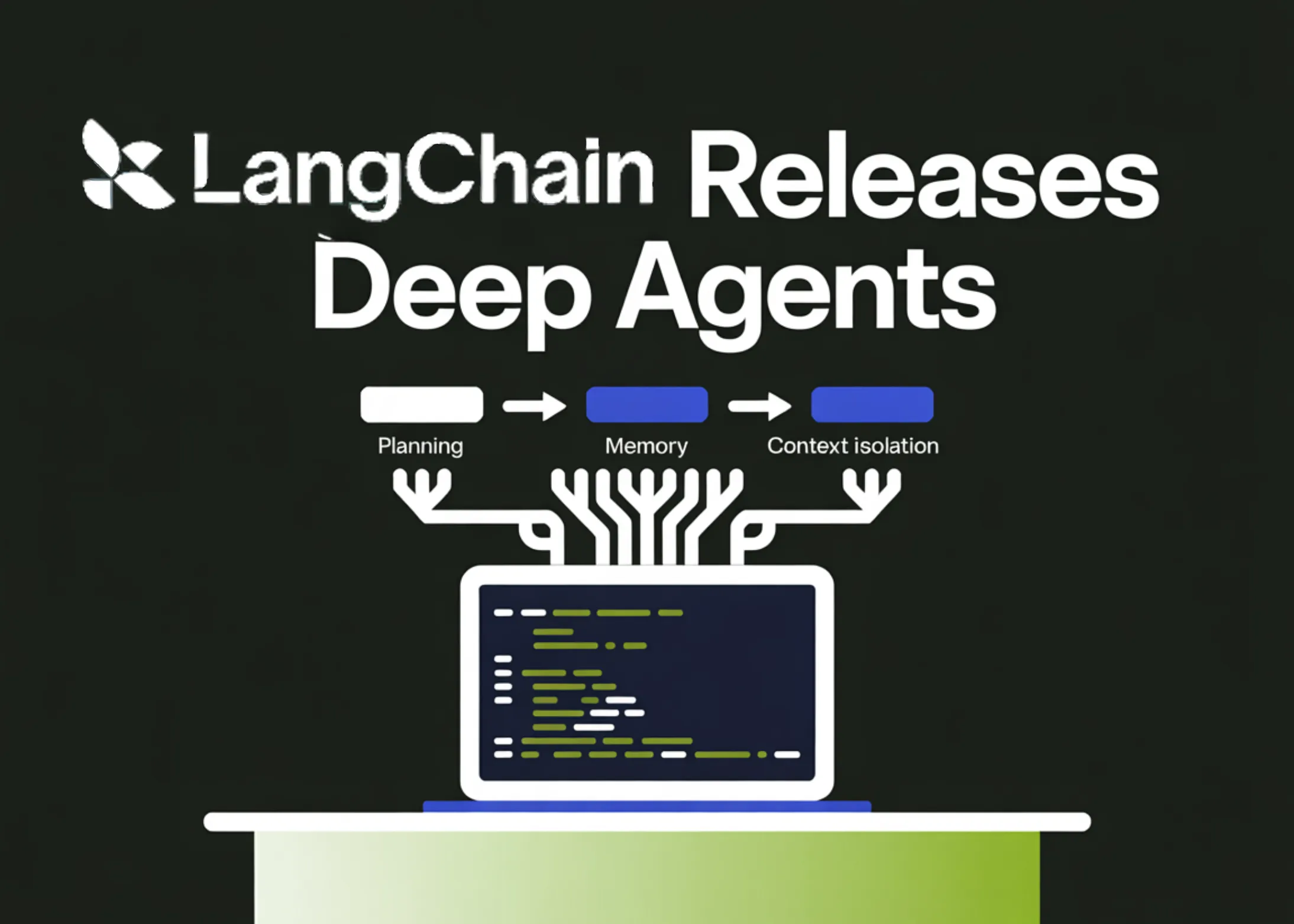
The landscape of artificial intelligence development is shifting from simple chat-based interactions toward sophisticated agentic workflows capable of executing complex, multi-stage tasks. While Large Language Model (LLM) agents have demonstrated proficiency in basic tool-calling loops—such as retrieving a single piece of data or answering a straightforward query—they frequently encounter significant performance degradation when faced with tasks that are stateful, artifact-heavy, or require numerous sequential steps. To bridge this functional gap, LangChain has introduced Deep Agents, a specialized "agent harness" designed to provide the necessary infrastructure for durable, long-running AI operations.
Deep Agents is not a new reasoning model or a separate runtime environment. Instead, it serves as a high-level library built atop LangChain’s existing agentic building blocks and powered by the LangGraph runtime. By packaging a set of standardized defaults and built-in tools around the traditional tool-calling loop, LangChain aims to simplify the development of agents that can plan, manage expansive contexts, delegate subtasks, and maintain information across extended conversations. This move signals a broader industry trend toward "agentic orchestration," where the focus shifts from the underlying model to the system architecture that governs the model’s behavior.
The Evolution of Agentic Frameworks and the Statefulness Problem
The development of Deep Agents follows a period of rapid experimentation within the AI community. Early agent frameworks often relied on the ReAct (Reason + Act) pattern, which functions well for short-duration tasks but struggles with "contextual drift" or "forgetting" during longer engagements. As an agent performs more steps, the prompt history grows, consuming tokens and increasing the likelihood that the model will lose track of the original objective or fail to utilize previously gathered information.
In early 2024, LangChain released LangGraph to provide developers with more granular control over these cycles, allowing for cyclic graphs and state management. However, many developers found that building a robust agent from scratch—including planning modules, file systems, and subagent delegation—remained a high-friction task. Deep Agents addresses this by offering a "pre-configured chassis" for these complex operations. It is designed for developers who require agents capable of sophisticated reasoning but who do not wish to manually architect the underlying state-handling logic for every new project.
Core Architecture and Default Toolsets
The primary value proposition of Deep Agents lies in its default configuration. Many existing agent systems leave the responsibility of planning and intermediate storage to the application developer. In contrast, Deep Agents integrates these features directly into its runtime. According to the project’s technical documentation, the library includes a suite of core components that transform a standard LLM into a more capable digital worker.
Central to this suite is the write_todos tool, which facilitates explicit planning and task decomposition. Rather than improvising every subsequent action based solely on the immediate prompt, the agent uses this tool to break a complex objective into discrete, trackable steps. This structured approach is particularly vital for research-intensive tasks, software engineering, or data analysis jobs where the path to a solution is not linear.
Furthermore, Deep Agents provides a robust set of filesystem tools, including read_file, write_file, edit_file, ls, glob, and grep. These tools are paired with sandboxed shell access through an execute function, allowing the agent to interact with a computational environment safely. By providing these capabilities out of the box, LangChain enables agents to act more like human developers who use a terminal and text editor to manage their workspace.
Filesystem-Based Context Management as a Solution to Token Limits
One of the most significant technical hurdles in agent development is the "context window" constraint. Even with models supporting millions of tokens, performance often degrades as the context fills up—a phenomenon frequently referred to as "lost in the middle." Deep Agents addresses this through a concrete design choice: filesystem-based context management.
Instead of attempting to keep every piece of generated code, research note, or intermediate report within the active prompt window, the agent is encouraged to offload large datasets into a virtual filesystem. The agent can write a report to a file, summarize its contents, and then retrieve specific sections only when needed. This method prevents context window overflow and allows the system to handle variable-length tool results that would otherwise crash a simpler agent loop.
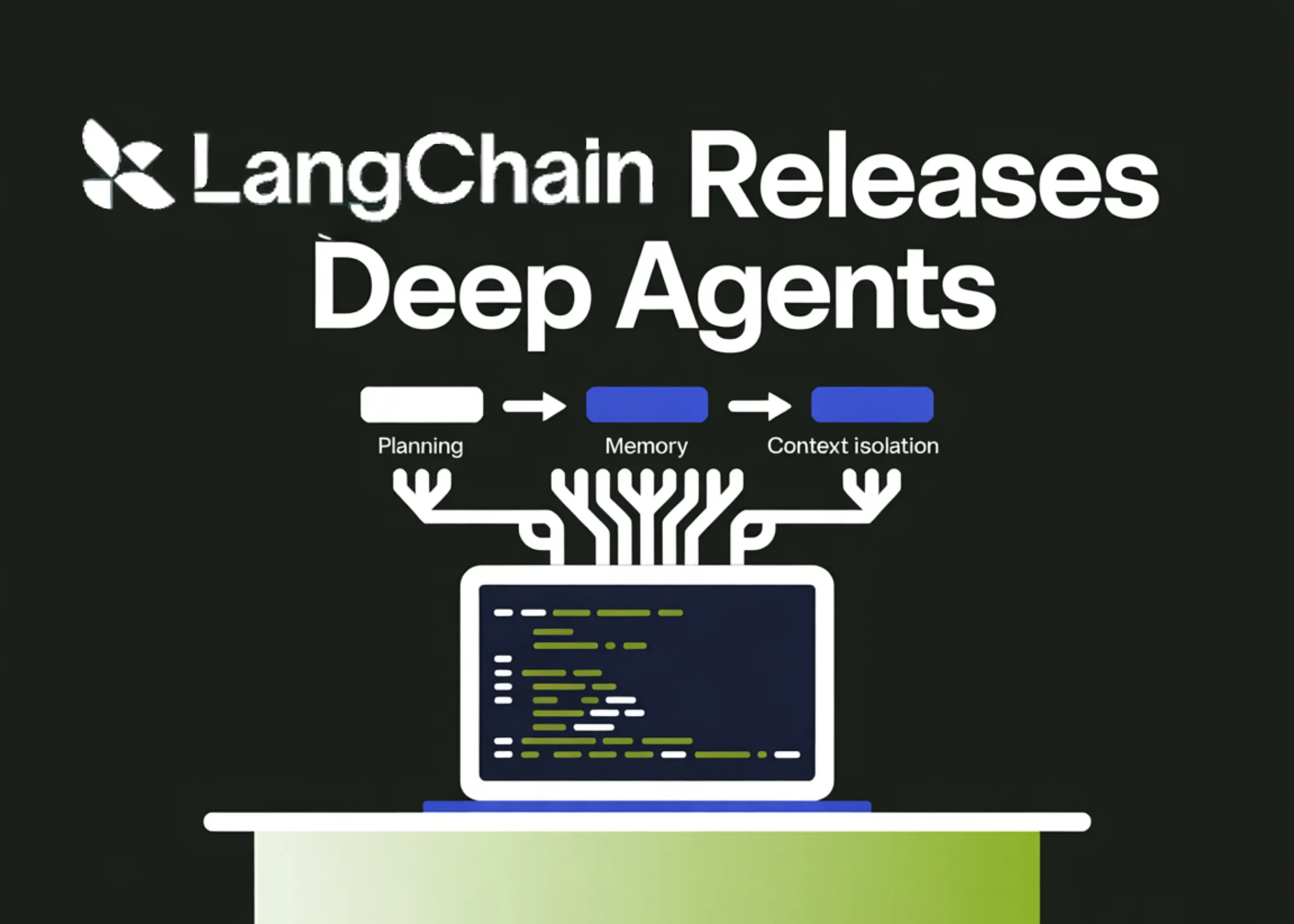
To support various deployment environments, Deep Agents offers multiple backend types for this virtual filesystem. The default is the StateBackend, which maintains an ephemeral filesystem within the LangGraph state for a specific thread. For more permanent or complex needs, developers can utilize the FilesystemBackend, LocalShellBackend, or a CompositeBackend, providing a high degree of flexibility in how the agent’s "working memory" is stored and accessed.
Subagents and the Strategy of Context Isolation
As tasks grow in complexity, a single agent thread can become overwhelmed by an accumulation of objectives and temporary data. To mitigate this, Deep Agents introduces the task tool, which allows the primary agent to spawn specialized subagents. This mechanism, known as context isolation, ensures that the main orchestration thread remains clean and focused on high-level goals, while subagents handle the "heavy lifting" of specific technical requirements.
Industry analysts note that this hierarchical approach is one of the most effective ways to maintain model quality. When a subagent is spawned, it operates within its own localized context, reducing the risk of "cross-contamination" where details from one subtask interfere with another. Once the subagent completes its objective, it returns the relevant results to the main agent, which then integrates the information into the broader project plan. This modularity not only improves performance but also makes the system significantly easier for human developers to debug and audit.
Integration with LangGraph and Long-Term Persistence
While Deep Agents provides a simplified starting point, it remains deeply integrated with the LangGraph ecosystem. When a developer uses the create_deep_agent(...) function, the system returns a CompiledStateGraph. This means that all the advanced features of LangGraph—such as real-time streaming, the LangGraph Studio visualization tool, and persistent checkpointers—are available by default.
This integration is crucial for "human-in-the-loop" workflows. Because the agent’s state is persisted through LangGraph’s Memory Store, a human user can pause the agent’s execution, review its "todo" list or filesystem, provide feedback, and then resume the process. This level of durability is essential for enterprise applications where autonomous agents must operate over hours or days rather than seconds. Furthermore, the use of the Memory Store allows the agent to maintain long-term memory across different conversation threads, enabling it to remember user preferences or past project details in subsequent sessions.
Deployment and Technical Requirements
For developers looking to implement Deep Agents, the technical requirements are centered on "tool-calling" capabilities. The system requires an LLM that is proficient at identifying when to call a specific tool and how to format the arguments correctly. Current industry leaders like OpenAI’s GPT-4o, Anthropic’s Claude 3.5 Sonnet, and certain fine-tuned open-source models are the primary targets for this library.
The deployment process is designed to be streamlined. A typical setup involves installing the deepagents package, configuring a search provider (such as Tavily), and initializing the agent with a system prompt and a set of custom tools. Because Deep Agents runs on the LangGraph runtime, it can be deployed using LangGraph Cloud or other standard Python-based infrastructure, ensuring that it can scale from a local prototype to a production-grade service.
Market Implications and the Future of Autonomous Agents
The release of Deep Agents comes at a time of intense competition in the AI infrastructure space. Companies like CrewAI, AutoGPT, and Microsoft (with its AutoGen framework) are all vying to become the standard for agentic orchestration. LangChain’s move to provide a "batteries-included" harness suggests a strategic pivot toward usability without sacrificing the depth that power users require.
By moving planning and memory management into the default runtime, LangChain is effectively lowering the barrier to entry for building "agentic" software. This has significant implications for industries such as software development, where agents can now be tasked with refactoring entire repositories, or legal and financial services, where agents can conduct multi-step audits and research projects that involve thousands of pages of documentation.
In conclusion, LangChain’s Deep Agents represents a maturation of the AI agent ecosystem. It acknowledges that the "intelligence" of the model is only one part of the equation; the "harness" that manages state, plans tasks, and handles data is equally critical. As organizations move beyond simple chatbots and toward autonomous digital assistants, the architectural patterns established by Deep Agents—specifically planning, filesystem-based memory, and subagent delegation—are likely to become the standard blueprints for the next generation of AI-driven productivity.