
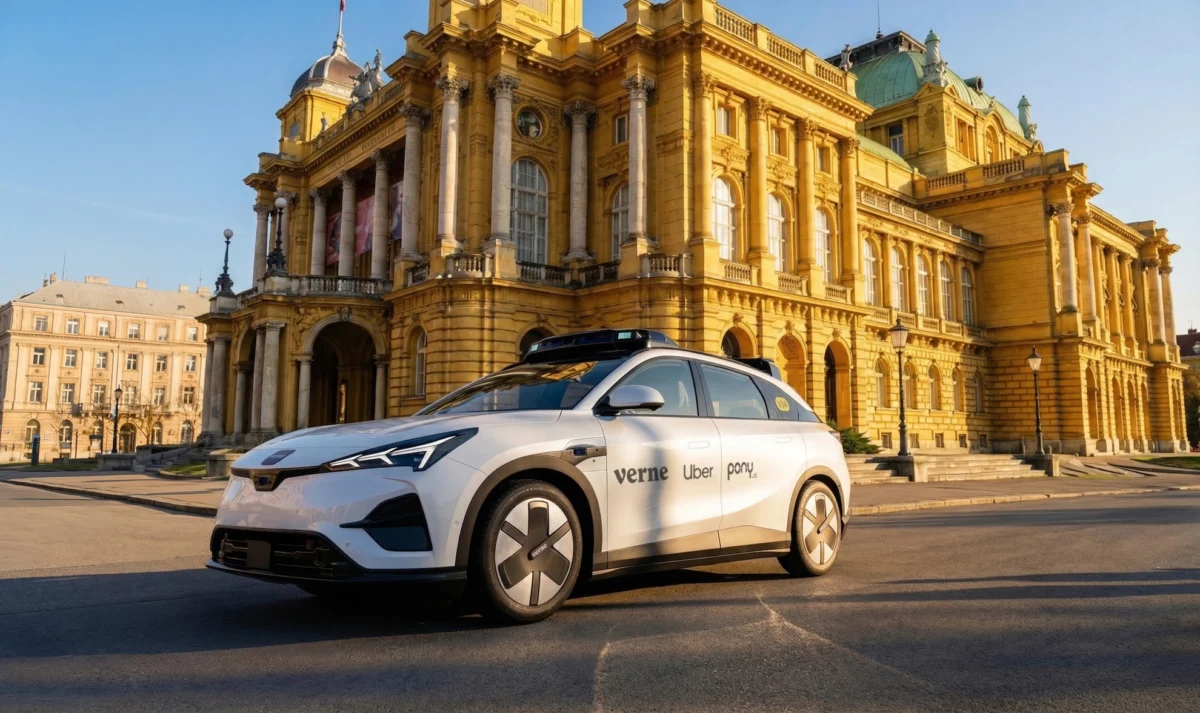
Mate Rimac, the visionary founder of Croatian electric vehicle powerhouse Rimac Group, is seeing a significant portion of his ambitious seven-year journey into electric robotaxis come to fruition through a landmark strategic partnership. This collaboration brings together global ride-hailing giant Uber, leading Chinese autonomous vehicle technology firm Pony.ai, and Rimac’s own dedicated robotaxi startup, Verne, to launch a commercial autonomous ride-hailing service in Europe. The pioneering service is slated to commence operations in Zagreb, Croatia, marking a pivotal moment for autonomous mobility on the continent.
The formal announcement, made on Thursday, outlined a clear division of roles within the nascent venture. Pony.ai will serve as the technological backbone, providing its advanced autonomous driving system and supplying the initial fleet of robotaxis, specifically the Arcfox Alpha T5 model, developed in conjunction with Chinese automotive manufacturer BAIC. Verne, Mate Rimac’s brainchild, will take on the crucial responsibilities of fleet ownership and day-to-day operations, ensuring the seamless functioning and maintenance of the autonomous vehicles. Uber, leveraging its extensive global ride-hailing network and millions of active users, will integrate the robotaxi service into its platform, making autonomous rides accessible to the public. Furthermore, Uber has signaled its intent to make an undisclosed strategic investment in Verne, underscoring its commitment to the partnership and supporting future expansion efforts across new markets.
While a specific launch date for the commercial service remains under wraps, on-road testing is already actively underway in Zagreb, the capital city of Croatia and the operational base for the Rimac Group. This initial deployment in Rimac’s home territory provides a strategic advantage, potentially allowing for a more streamlined regulatory process and a focused testing environment before broader expansion.
The Genesis of Verne: From Hypercars to Urban Mobility
Verne, though not yet possessing the global brand recognition of established autonomous driving players like Waymo or Cruise, harbors equally outsized ambitions. The company originated in 2019 under the internal moniker Project 3 Mobility (P3) within the burgeoning ecosystem of the Rimac Group. This group has rapidly evolved from its origins in electric hypercars, notably the record-breaking Nevera, to encompass a diversified portfolio including Rimac Bugatti, Rimac Energy, and Rimac Technology, a supplier of high-performance EV components to global automakers. Mate Rimac, who holds a 23% stake in the overarching group, has consistently steered his ventures towards pushing the boundaries of electric and autonomous technology.
Occasional updates about Project 3 Mobility hinted at its progress, but it wasn’t until July 2024 that Verne officially launched, publicly revealing a more detailed strategic roadmap and announcing a significant Series A investment round totaling €100 million. This substantial capital injection signaled serious intent and provided the necessary resources to accelerate development and operational planning. The shift from ultra-luxury, high-performance vehicles to mass-market urban mobility might seem counterintuitive to some, given Rimac’s association with the Nevera, an electric hypercar starting at approximately $2.2 million. However, Mate Rimac has long articulated a vision that transcends conventional automotive manufacturing. He has consistently expressed a belief that the advent of advanced autonomous vehicle technology will eventually render the business of high-volume, human-driven electric vehicles obsolete. "It will take a while, but it’s coming; I’m sure about that," Rimac had stated years prior, underscoring his unwavering conviction in the autonomous future.
A Strategic Partnership for European Expansion
The tripartite alliance represents a significant strategic move for all parties involved. For Uber, it solidifies its asset-light strategy in the autonomous vehicle space. After divesting its Advanced Technologies Group (ATG) to Aurora in 2020, Uber has shifted its focus from in-house AV development to strategic partnerships with leading technology providers. This approach allows Uber to integrate cutting-edge autonomous capabilities into its platform without bearing the immense financial and technical burdens of developing the technology itself. By partnering with Verne and Pony.ai, Uber gains a foothold in the emerging European robotaxi market, leveraging its existing user base and operational expertise to scale the service efficiently. The undisclosed investment in Verne further entrenches Uber’s commitment to the venture’s long-term success and expansion.
For Pony.ai, the partnership marks a crucial step in its global expansion strategy. A prominent player in China’s autonomous driving landscape, Pony.ai has been actively testing and operating robotaxi services in several Chinese cities, including Guangzhou, Beijing, and Shanghai, and has also conducted trials in the United States. Its robust Level 4 autonomous driving system, proven through millions of kilometers of real-world testing, provides the technical backbone for the European deployment. The collaboration with BAIC on the Arcfox Alpha T5 robotaxi demonstrates Pony.ai’s capability to integrate its technology into purpose-built vehicles, which are essential for commercial scalability. This venture provides Pony.ai with a valuable entry point into the complex European market, potentially paving the way for further collaborations and deployments across the continent.
Verne, under the leadership of CEO Marko Pejkovic, positions itself as the operational linchpin, bringing together the disparate elements of technology, platform, and local market understanding. Crucially, Verne is not developing its own self-driving system. Instead, its strategic focus is on the urban electric vehicle itself – designing and manufacturing purpose-built robotaxis – as well as developing the comprehensive ride-hailing application and the intricate back-end infrastructure required to manage a large-scale autonomous fleet. This includes sophisticated systems for vehicle cleaning, maintenance, charging, and dynamic deployment, all essential for a robust and reliable commercial service.
The Vehicle and Operational Strategy
Initially, the Verne robotaxi service will deploy the Arcfox Alpha T5 vehicles supplied by Pony.ai and BAIC. This pragmatic approach allows for a faster market entry while Verne continues to refine and prepare its own purpose-built two-seater electric vehicles. Mate Rimac’s original vision for Verne has always centered around these specialized two-seater electric vehicles, designed from the ground up for urban robotaxi operations. These vehicles prioritize efficiency, maneuverability in congested city environments, and a tailored passenger experience over the multi-passenger capacity of conventional ride-hailing vehicles.
Verne plans to establish a new factory in Lučko, Croatia, dedicated to the production of these robotaxi EVs, with operations anticipated to commence later this year. In November of the previous year, Verne had announced the successful production and testing of 60 verification prototypes of its bespoke vehicles, indicating significant progress in its hardware development. However, the current announcement with Uber and Pony.ai did not provide an updated timeline for the deployment of these custom-designed two-seaters, suggesting that the Arcfox Alpha T5 will serve as the primary operational vehicle for the initial phase of the commercial launch. Users will have the flexibility to hail these robotaxis either through Uber’s ubiquitous ride-hailing application or via Verne’s proprietary app.
Croatia as a Proving Ground and Gateway to Europe
The selection of Zagreb as the launch city is not merely coincidental but strategic. As the home base of the Rimac Group, Zagreb offers a familiar and supportive environment for the initial rollout. Croatia, as a European Union member state, provides a regulatory framework that, while still evolving for autonomous vehicles, may offer more flexibility for initial deployment compared to larger, more densely regulated markets in Western Europe. This "living lab" approach allows Verne to fine-tune its operations, gather critical real-world data, and demonstrate the viability of its service in a controlled yet authentic urban setting.
The broader European autonomous vehicle market presents a complex landscape. While significant progress has been made in North America and China, Europe has faced challenges due to diverse national regulations, varied urban infrastructures, and differing public perceptions. This partnership aims to overcome some of these hurdles by establishing a concrete operational footprint. Marko Pejkovic, CEO of Verne, articulated this ambition, stating, "Europe needs autonomous mobility that can move from testing to a real service. At Verne, we are bringing together the technology, platform, and operational capabilities required to make this a reality, starting in Zagreb before expanding to new markets." This statement underscores the strategic importance of this launch as a springboard for wider European expansion.
Broader Implications and Future Outlook
The long-term vision for Verne extends far beyond the borders of Zagreb. The company plans to scale its operations to a "fleet of thousands of robotaxis over the next few years," as detailed in Thursday’s announcement. This ambitious growth trajectory suggests a significant investment in infrastructure, vehicle production, and operational expansion. The success of this initial deployment in Zagreb will be critical in demonstrating the economic viability and operational efficiency required to attract further investment and secure regulatory approvals in other European cities.
The partnership holds profound implications for the future of urban mobility. Successful robotaxi services have the potential to significantly reduce traffic congestion, lower urban emissions by deploying all-electric fleets, and enhance accessibility for populations currently underserved by traditional transportation options. For the Croatian economy, the establishment of Verne’s factory in Lučko and the creation of a robust operational infrastructure promise job creation and a boost to the country’s burgeoning technology sector, further solidifying Croatia’s position as an innovation hub in Europe.
For Mate Rimac, this venture represents a pivotal moment in his entrepreneurial journey, showcasing his ability to diversify from the niche market of ultra-luxury hypercars to address the mass-market challenges of urban transportation. His unwavering belief in the transformative power of autonomous technology, cultivated over nearly a decade, is now taking tangible form, poised to redefine how people move within cities. The collaboration between a Croatian innovator, a Chinese technology leader, and an American ride-hailing giant exemplifies the increasingly globalized nature of the autonomous vehicle industry, signaling a future where seamless, self-driving urban transport becomes an everyday reality across continents. As on-road testing progresses in Zagreb, the world watches to see how this ambitious European robotaxi service will unfold, setting a precedent for the future of autonomous mobility.