

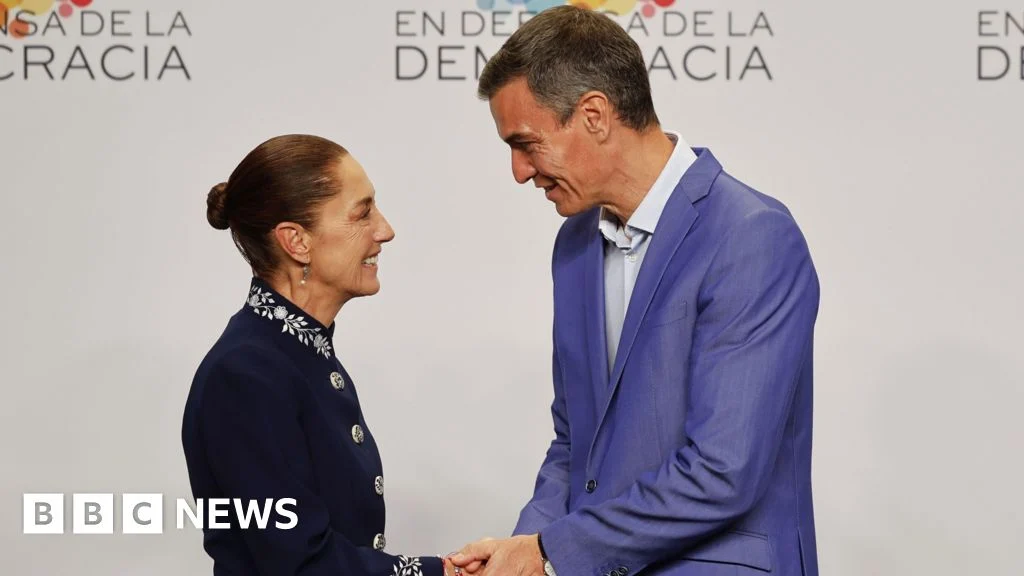
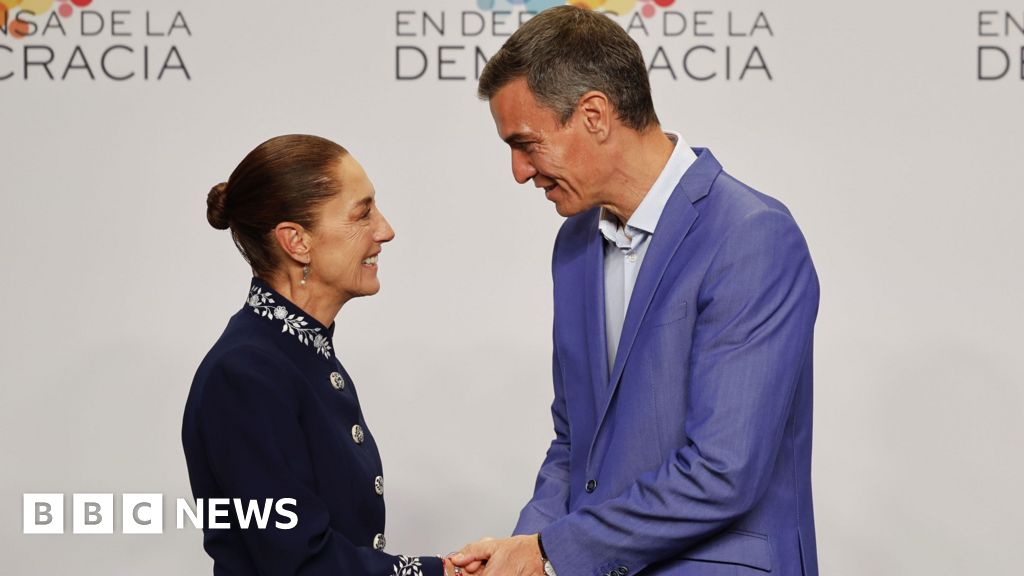
Barcelona, Spain – Mexican President Claudia Sheinbaum declared Saturday that there was "no diplomatic crisis" with Spain, signaling a significant warming of relations after years of tension rooted in the 16th-century Spanish conquest of Mexico. Her remarks came as she arrived at the "In Defence of Democracy" summit in Barcelona, a gathering of left-leaning leaders aimed at countering rising illiberalism globally. This diplomatic thaw was underscored by Sheinbaum’s subsequent meeting with Spanish Prime Minister Pedro Sánchez, co-chair of the summit, marking a pivotal moment in the complex historical relationship between the two nations.
A New Chapter in Spain-Mexico Relations
President Sheinbaum’s assertion that "There is no diplomatic crisis. There never has been," and her emphasis on recognizing "the strength of our country’s indigenous peoples," set a conciliatory tone for her first presidential visit to Spain. This visit, the first by a Mexican head of state in eight years, carries immense symbolic weight, signaling a deliberate effort by both governments to move past historical grievances that have strained diplomatic ties. The Spanish economy minister, in a statement to Reuters, echoed this sentiment, describing Sheinbaum’s presence as "a very important and positive sign of a rapprochement between the two countries."
For years, the legacy of Spain’s colonization of Mexico has been a contentious issue, periodically erupting into diplomatic friction. The historical narrative, marked by the violent dismantling of the Aztec empire, the decimation of indigenous populations through warfare and imported diseases, and the imposition of a new cultural and religious order, has cast a long shadow over bilateral relations. Mexico, a nation with a rich indigenous heritage, has increasingly sought to confront and reconcile with this past, demanding a more explicit acknowledgment from Spain regarding the atrocities committed during the conquest.
Historical Context: The Lingering Shadows of the Conquest
The Spanish conquest, initiated in 1519 by Hernán Cortés, led to the fall of Tenochtitlan, the Aztec capital, in 1521. This period was characterized by immense suffering for the indigenous peoples, whose sophisticated civilizations were systematically dismantled. Scholars estimate that millions perished due to warfare, forced labor, and epidemics such like smallpox, which ravaged communities with no natural immunity. The cultural and religious imposition by the Spanish Crown and the Catholic Church further suppressed indigenous identities and practices, leaving a profound and enduring impact on Mexico’s national psyche.
For many Mexicans, particularly indigenous communities, the conquest represents a profound historical injustice that has never been adequately addressed by Spain. Calls for an apology have gained traction in recent decades as part of a broader global movement demanding accountability for colonial-era abuses. These demands are not merely about assigning blame but about fostering reconciliation, acknowledging historical trauma, and validating the experiences and resilience of indigenous peoples.
Chronology of a Rift and Reconciliation
The diplomatic chill between Madrid and Mexico City intensified in 2019 under Sheinbaum’s predecessor, Andrés Manuel López Obrador. In March of that year, López Obrador sent letters to King Felipe VI of Spain and Pope Francis, formally requesting apologies for human rights violations committed during the conquest. He argued that Spain had a moral obligation to acknowledge the "pain and suffering" inflicted upon indigenous populations, emphasizing that true reconciliation could only begin with a sincere apology. The Spanish government, under then-Foreign Minister Josep Borrell, firmly rejected the demand, stating that Spain "has never apologized and will not apologize" for historical events, viewing such calls as anachronistic and divisive. This rejection initiated a period of pronounced diplomatic distance.
The strain became even more evident in 2024 when Sheinbaum, following López Obrador’s lead, took the unprecedented step of not inviting King Felipe VI to her presidential inauguration. In a reciprocal move, Spain opted not to send any high-level official representative, a significant diplomatic snub that underscored the depth of the disagreement. Traditionally, inaugurations of heads of state are attended by high-ranking foreign dignitaries, and the absence of a Spanish royal or ministerial presence highlighted the ongoing friction.
However, recent months have seen concerted efforts to bridge this divide. A pivotal moment occurred in March, when King Felipe VI, during a visit to an exhibition on indigenous Mexican women in Madrid, made an unprecedented public acknowledgment of "a lot of abuse" during the conquest of the territory that would become Mexico. He stated, "There are things that, when we study them, with our present-day criteria, our values, obviously cannot make us feel proud." This marked the first time a Spanish monarch had publicly recognized abuses during the country’s colonial era, a statement widely interpreted as a significant gesture towards reconciliation.
This gesture was reciprocated in February when President Sheinbaum extended an invitation to King Felipe VI to attend the upcoming FIFA World Cup, which Mexico will co-host with the United States and Canada. According to the Spanish royal palace, Sheinbaum expressed that the sporting event would provide "a timely opportunity to evoke the depth and unique character of the ties between Mexico and Spain." This exchange of invitations and acknowledgments signaled a mutual desire to de-escalate tensions and seek common ground. Further paving the way for improved relations, Spain’s Foreign Minister José Manuel Albares had earned commendation from Sheinbaum in October, when he acknowledged "pain and injustice" in the countries’ shared history, further cementing the diplomatic groundwork for the Barcelona meeting.
Economic and Cultural Ties: Beyond the Political Fray
Despite the political turbulence, the economic and cultural ties between Spain and Mexico have remained robust. Spain is one of the largest foreign investors in Mexico, with significant presence in sectors such as banking, energy, tourism, and telecommunications. Major Spanish corporations like BBVA, Santander, Repsol, and Iberdrola have substantial operations in Mexico, contributing to bilateral trade figures that consistently exceed several billion euros annually. In 2023, for instance, bilateral trade between the two nations was estimated to be over €8 billion, highlighting the deep commercial interdependence that exists irrespective of diplomatic spats.
Culturally, the two nations share a common language, deep-seated historical connections, and vibrant exchanges in arts, literature, and academia. Millions of Mexicans have Spanish ancestry, and a significant Mexican diaspora resides in Spain, just as many Spaniards have made Mexico their home. These human connections and economic interests have often provided a stabilizing force, preventing political disagreements from completely derailing the broader relationship. The recent diplomatic rapprochement is expected to further bolster these ties, potentially unlocking new avenues for cooperation and investment.
The "In Defence of Democracy" Summit: A United Front Against Illiberalism
President Sheinbaum’s visit to Barcelona was framed within the broader context of the "In Defence of Democracy" initiative, a summit dedicated to strengthening democratic principles against the global rise of illiberalism and authoritarianism. This was the fourth meeting of the initiative, bringing together leaders from various left-leaning governments, including Spanish Prime Minister Pedro Sánchez and Brazilian President Luiz Inácio Lula da Silva, who co-chaired the event.
In his opening remarks, Prime Minister Sánchez underscored the urgency of the summit’s mission, stating, "Democracy cannot be taken for granted." He warned of "attacks on the multilateral system, one attempt after another to challenge the rules of international law, and a dangerous normalisation of the use of force." These sentiments reflect a growing concern among democratic leaders about the erosion of international norms, the spread of disinformation, and the rise of nationalist and populist movements that often undermine democratic institutions.
Brazilian President Lula da Silva delivered a scathing critique of the United Nations Security Council, labeling its five permanent members (the US, China, Russia, France, and the UK) as "lords of war" due to their veto power. He argued that the current structure of the UN Security Council is dysfunctional and outdated, failing to effectively address contemporary global conflicts and challenges. "No president of any country in the world, however powerful, has the right to keep imposing rules on other countries," Lula asserted, advocating for a more equitable and representative global governance system. This critique resonates with many developing nations who feel marginalized by the current international power dynamics.
A tangible outcome of the summit was a joint statement by the leaders of Brazil, Mexico, and Spain, announcing their agreement to increase humanitarian aid deliveries to Cuba. They described Cuba as undergoing a "humanitarian crisis," implicitly acknowledging the severe economic challenges faced by the island nation, exacerbated by external sanctions and internal inefficiencies. This collective action highlights a shared progressive foreign policy stance among the participating nations.
Contrasting Ideologies: The Rise of the Far-Right in Europe
The Barcelona summit occurred against a backdrop of a parallel and ideologically opposed gathering in Milan, Italy, where thousands of supporters of the "Patriots for Europe" party rallied. This right-wing grouping within the European Parliament, comprising leaders from France’s far-right Rassemblement National (RN), Italy’s Lega party, and the Dutch PVV party, presented a stark contrast to the liberal democratic agenda being discussed in Spain.
Jordan Bardella, leader of France’s RN, and Matteo Salvini, Italy’s Deputy Prime Minister and head of Lega, were prominent figures at the Milan rally. Their agenda focused on issues such as strict immigration controls, national sovereignty, and resistance to what they perceive as excessive bureaucracy and regulation imposed by the European Commission and the European Union. Bardella specifically cited "immigration and the ever-increasing regulations imposed by the European Commission and the European Union on European industry and on the economies of the eurozone" as key discussion points.
Salvini, addressing the cheering crowd, declared, "In Europe, the Alliance of Patriots is the only true adversary for the Brussels bureaucrats who serve a few businessmen and warmongers." This rhetoric underscores a growing populist sentiment across Europe, which seeks to challenge the established political order and promote nationalist interests. The presence of Geert Wilders, leader of the Dutch far-right PVV party, further solidified the pan-European nature of this movement, which is expected to play a significant role in the upcoming European Parliament elections. The simultaneous occurrence of these two ideologically divergent summits vividly illustrates the profound ideological schism currently shaping global politics.
Implications and Future Outlook
President Sheinbaum’s declaration of "no diplomatic crisis" and her meeting with Prime Minister Sánchez mark a new chapter in Spain-Mexico relations. The symbolic gestures from both sides, culminating in this high-level engagement, suggest a mutual desire to prioritize cooperation and shared interests over historical disputes. The acknowledgement of past abuses by King Felipe VI is a critical step towards healing historical wounds and could serve as a precedent for other former colonial powers. This diplomatic shift is expected to foster increased bilateral trade, investment, and cultural exchange, benefiting both economies.
On a broader scale, the Barcelona summit and the Milan rally underscore the intensifying global ideological struggle. The "In Defence of Democracy" initiative represents a concerted effort by progressive leaders to bolster multilateralism, human rights, and democratic values in an increasingly fragmented world. Conversely, the rise of the far-right, as showcased in Milan, signifies a powerful counter-narrative emphasizing national sovereignty, anti-immigration policies, and a skepticism towards international institutions. The juxtaposition of these events highlights the critical juncture at which global politics finds itself, grappling with competing visions for the future of governance, international relations, and societal values. The trajectory of Spain-Mexico relations, moving from historical grievance to reconciliation, offers a glimmer of hope that even deeply rooted historical conflicts can be addressed through dialogue and mutual respect, potentially inspiring similar efforts in other regions.