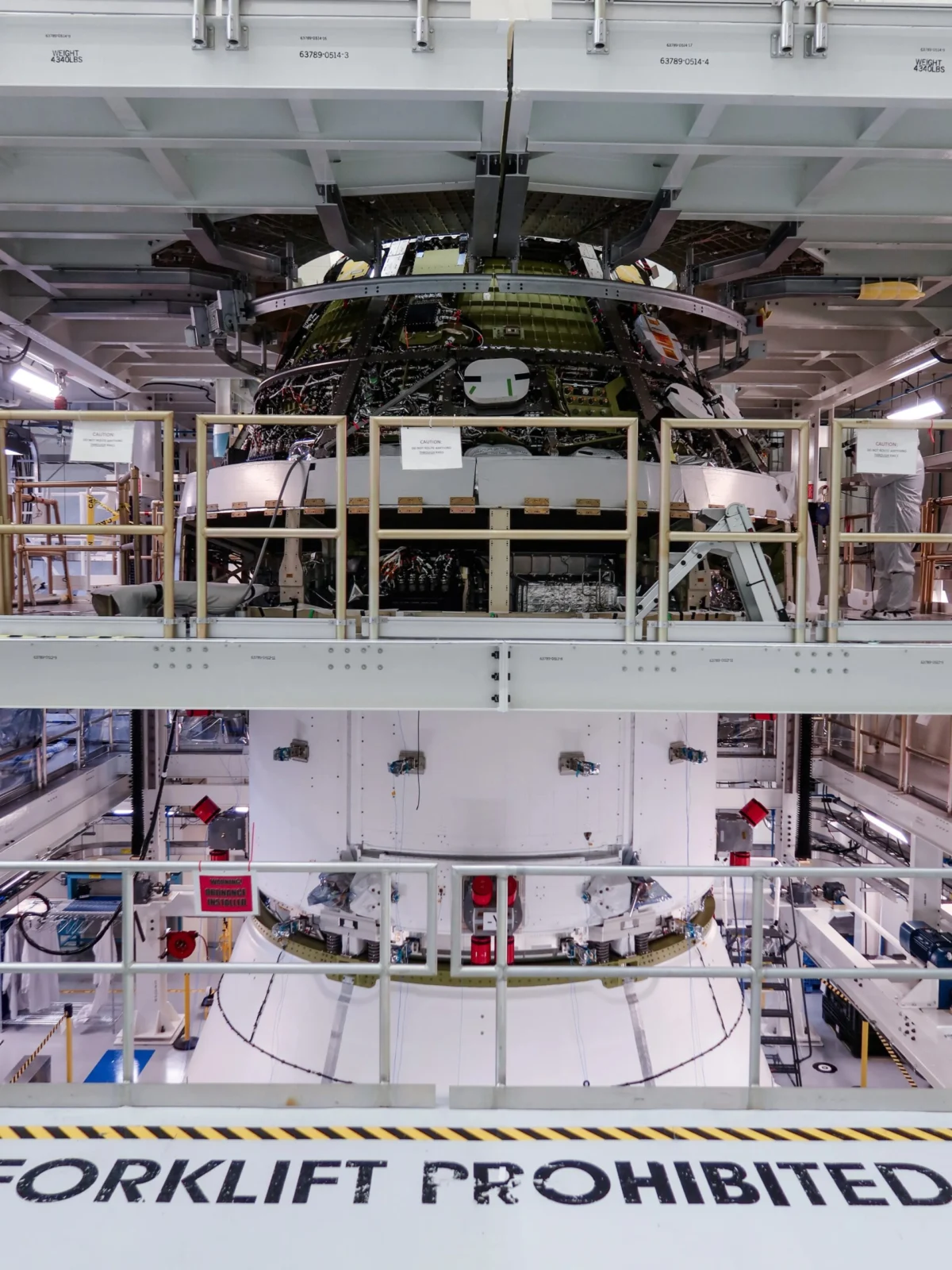
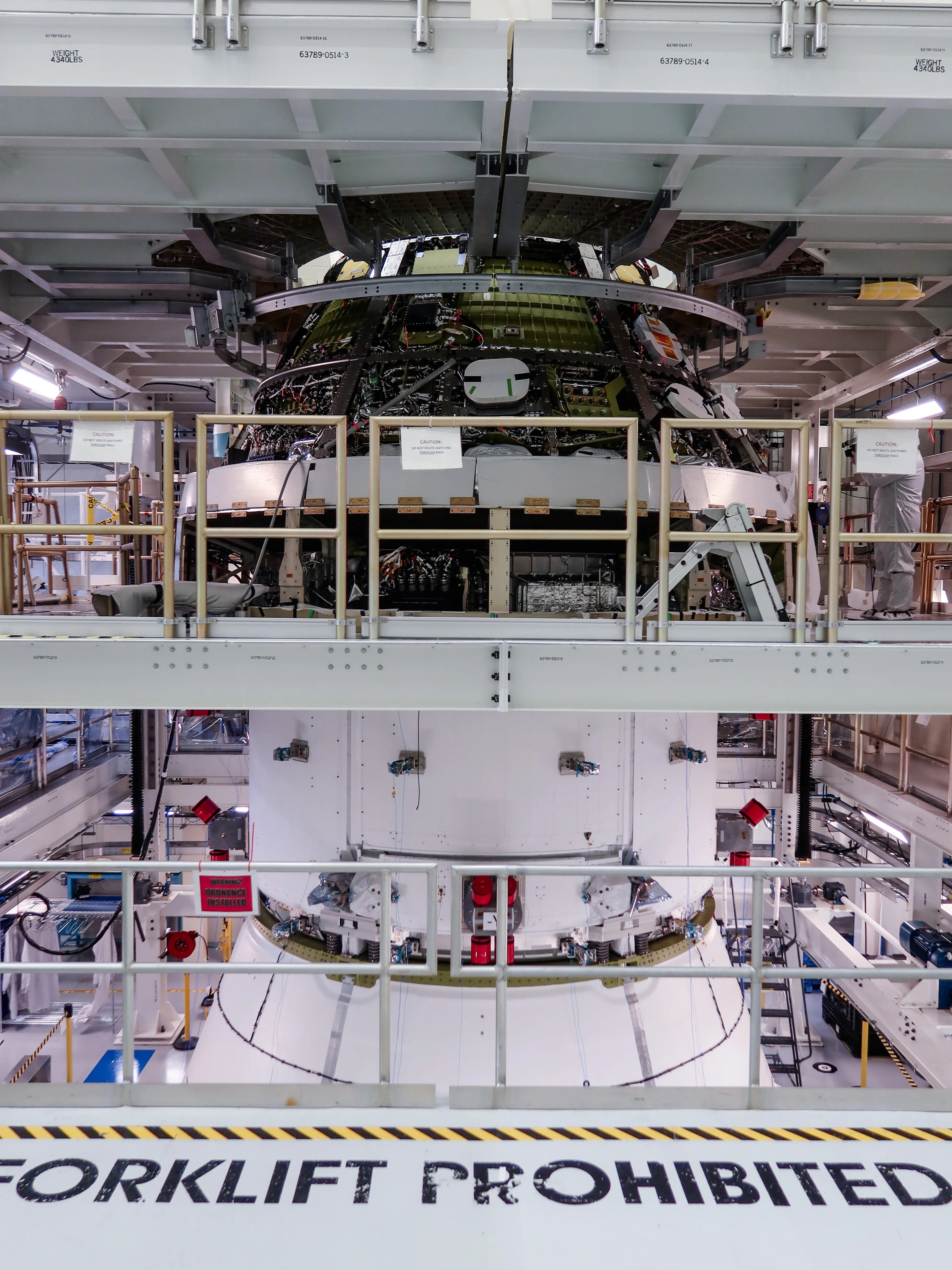
In a pivotal moment for humanity’s return to the Moon, technicians at NASA’s Kennedy Space Center in Florida successfully joined the Orion crew and service modules on July 30, 2026. This critical integration took place inside the Neil Armstrong Operations and Checkout Building, marking a significant step forward for the Artemis III mission, which aims to land astronauts on the lunar surface for the first time in over half a century. The completed Orion spacecraft, now poised for final preparations, represents the culmination of years of international collaboration and technological innovation, bringing the vision of sustainable lunar exploration closer to reality.
A Critical Integration for Lunar Return
The joining of the crew module (CM) and the European Service Module (ESM) is a complex and highly precise operation, essential for forming the complete Orion spacecraft that will transport astronauts to lunar orbit. This union is not merely a mechanical attachment but a meticulous process involving the intricate connection of electrical, data, and fluid lines that are vital for the spacecraft’s functionality. Engineers and technicians spent weeks preparing for this milestone, conducting exhaustive tests on each module individually before their final assembly. The successful integration signifies that the primary components designed to protect, sustain, and propel the human crew are now united, ready to undergo comprehensive integrated testing.
The Orion spacecraft is central to NASA’s Artemis program, designed to be the deepest-space human exploration vehicle ever built. Its robust design and capabilities are tailored to withstand the extreme conditions of space travel, from launch through trans-lunar injection, lunar orbit, and the challenging high-speed re-entry into Earth’s atmosphere. For Artemis III, Orion will serve as the crew’s home away from Earth, providing life support for the journey to and from lunar orbit, where it will rendezvous with a human landing system for the descent to the lunar surface.
The Orion Spacecraft: A Deep Dive into its Components
The Orion spacecraft is a marvel of modern engineering, comprising two main sections that work in concert to achieve its ambitious mission objectives.
The Crew Module (CM): The Heart of Human Exploration
The crew module is the pressurized habitat where astronauts will live and work during their mission. Built by Lockheed Martin, it is designed to carry up to four astronauts and provide a safe, habitable environment for missions lasting up to 21 days or longer with additional support. The CM is equipped with advanced life support systems, including environmental control and atmospheric revitalization, water management, and waste disposal systems, ensuring the crew’s health and comfort during transit. Its interior features state-of-the-art displays and controls, allowing astronauts to monitor and manage the spacecraft’s systems.
Perhaps its most critical function is its role in Earth re-entry. The CM is the only part of Orion designed to return through Earth’s atmosphere. It boasts a sophisticated heat shield, the largest of its kind ever built, capable of withstanding temperatures reaching nearly 5,000 degrees Fahrenheit during its fiery descent. After decelerating through the atmosphere, a parachute system deploys to slow the module for a splashdown in the Pacific Ocean, where recovery teams await. The CM’s structural integrity and thermal protection are paramount for crew safety, making its integration a moment of immense technical scrutiny.
The European Service Module (ESM): Powering and Propelling Orion
The European Service Module, a vital contribution from the European Space Agency (ESA) and its prime contractor Airbus Defence and Space, provides the primary propulsion, power, and life support consumables for Orion. This cylindrical module, situated directly beneath the crew module, is an international testament to collaborative space exploration.
The ESM houses Orion’s main engine, a repurposed Space Shuttle Orbital Maneuvering System (OMS) engine, which will execute major propulsive maneuvers, including trans-lunar injection, lunar orbit insertion, and the crucial burn to return to Earth. Complementing the main engine are 24 smaller reaction control system (RCS) thrusters, providing precise attitude control and maneuvering capabilities.
Beyond propulsion, the ESM generates electricity through four large, cross-shaped solar array wings, which can span over 19 feet (5.8 meters) each when deployed, providing sufficient power for all spacecraft systems. It also stores and delivers critical consumables such as water, oxygen, and nitrogen to the crew module, while also managing the spacecraft’s thermal control, radiating excess heat into space. The ESM’s intricate network of tanks, engines, and plumbing represents a highly complex system, without which Orion could not achieve its deep-space objectives. Its successful attachment to the crew module is therefore an indispensable step in preparing Orion for its ambitious journey.
Artemis III: Pioneering a New Era of Lunar Exploration
Artemis III is envisioned as the mission that will restore human footprints on the lunar surface, a monumental achievement not seen since Apollo 17 in 1972. However, Artemis III is not merely a revisit; it aims to establish a sustainable presence at the lunar South Pole, a region of immense scientific interest due to the potential presence of water ice in permanently shadowed craters.
Mission Objectives and the Lunar South Pole
The primary objectives of Artemis III include:
- Landing the first woman and the first person of color on the Moon, marking a new era of diverse human exploration.
- Conducting extensive scientific research at the lunar South Pole, studying lunar geology, volatile resources, and the history of the solar system.
- Testing technologies and procedures essential for long-duration lunar surface operations, laying the groundwork for future lunar bases and missions to Mars.
- Demonstrating rendezvous and docking capabilities with commercial human landing systems in lunar orbit, a critical test for the future architecture of lunar surface access.
The lunar South Pole is a scientifically rich target, offering unique opportunities to study ancient lunar material and potentially harvest resources. The presence of water ice could be transformative for future missions, providing propellant, breathable air, and potable water, thereby reducing the need to launch these heavy resources from Earth.
The Artemis III Crew: A Blend of Experience and New Horizons
The crew assigned to Artemis III reflects the international and diverse nature of the Artemis program. NASA astronauts Randy Bresnik, Andre Douglas, and Frank Rubio, alongside ESA (European Space Agency) astronaut Luca Parmitano, represent a formidable team. Randy Bresnik, a veteran of two space shuttle missions and an International Space Station (ISS) expedition, brings extensive orbital flight experience. Andre Douglas, selected in NASA’s 2020 astronaut class, represents a new generation of explorers, specializing in aerospace engineering and bringing fresh perspectives to deep space missions. Frank Rubio, also from the 2017 astronaut class, is an experienced flight surgeon and helicopter pilot, offering invaluable medical and operational expertise. Luca Parmitano, an Italian ESA astronaut, is a seasoned spacefarer with two long-duration missions aboard the ISS, including serving as commander, demonstrating strong leadership and operational skills. This international quartet will be at the forefront of this historic mission, embodying the collaborative spirit of human spaceflight.
Testing Next-Generation Human Landing Systems
A unique and critical aspect of the Artemis III mission is the in-space testing of commercial Human Landing Systems (HLS). Unlike the Apollo program, where NASA developed the lunar module in-house, Artemis leverages commercial partners to build the vehicles that will ferry astronauts from lunar orbit to the surface and back. This strategy aims to foster innovation, reduce costs, and accelerate development timelines.
The Artemis III mission specifically calls for Orion to test rendezvous and docking capabilities with test versions, or test articles, of commercial human landing systems from Blue Origin and SpaceX. This is a crucial validation step before these systems are used for crewed lunar landings.
Blue Origin’s Blue Moon Lander
Blue Origin, led by Jeff Bezos, is developing its Blue Moon lunar lander, designed to deliver payloads and eventually humans to the lunar surface. Their HLS concept for Artemis is a multi-stage vehicle capable of transporting astronauts and significant cargo. The test article for Artemis III will demonstrate its ability to navigate to lunar orbit, maintain station-keeping, and perform precise docking maneuvers with Orion, proving its readiness for future crewed operations. Blue Origin’s approach emphasizes reusability and robust payload capacity, aiming to support a sustained human presence on the Moon.
SpaceX’s Starship Human Landing System (HLS)
SpaceX, under the leadership of Elon Musk, is developing a specialized variant of its Starship vehicle for the Human Landing System. The Starship HLS is a fully reusable, super-heavy-lift launch and landing system designed to transport both crew and large amounts of cargo to the Moon and eventually Mars. Its sheer size and capacity represent a radical departure from traditional lunar lander designs. For Artemis III, a Starship HLS test article will perform a similar rendezvous and docking demonstration with Orion in lunar orbit. This test is vital for proving the operational compatibility between Orion and Starship, ensuring that astronauts can safely transfer between the two vehicles before descending to the lunar surface. The Starship HLS architecture involves multiple refueling operations in Earth orbit before proceeding to the Moon, a complex ballet of orbital mechanics that is also being meticulously developed and tested.
The dual-provider approach for HLS ensures redundancy and promotes competition, fostering innovation and providing NASA with multiple options for future lunar missions. The successful rendezvous and docking tests during Artemis III will be a significant validation of this commercial partnership model.
The Road to Artemis III: A Programmatic Timeline
The Artemis program is a phased approach to lunar exploration, building capabilities and demonstrating technologies with each successive mission.
Origins of Artemis: From Apollo’s Legacy to a Sustainable Lunar Presence
The Artemis program builds upon the legacy of the Apollo missions, but with a fundamentally different long-term vision. While Apollo was focused on demonstrating a one-time capability to land humans on the Moon, Artemis aims for sustainability – establishing a long-term human presence, utilizing lunar resources, and preparing for future missions to Mars. The program was officially named in 2017, drawing inspiration from Apollo’s twin sister in Greek mythology, symbolizing a new generation of lunar explorers, including the first woman on the Moon.
Artemis I: Uncrewed Success (2022)
The foundational mission, Artemis I, launched on November 16, 2022. This uncrewed test flight successfully sent an Orion spacecraft on a 25-day journey around the Moon and back, demonstrating the performance of the Space Launch System (SLS) rocket and validating Orion’s systems in a deep-space environment. The mission provided invaluable data on Orion’s heat shield performance, navigation, communications, and orbital maneuvering, paving the way for future crewed missions. Its success was a critical confidence builder for the entire program.
Artemis II: Crewed Lunar Flyby (Projected 2024/2025)
Artemis II is planned to be the first crewed mission of the Artemis program, carrying four astronauts on a lunar flyby. This mission will test Orion’s critical systems with humans aboard, including life support, communications, and navigation, as they journey around the Moon and return to Earth. It will be the furthest humans have traveled into space since Apollo 13. The lessons learned from Artemis II will directly inform the final preparations for Artemis III, ensuring that Orion and its crew are fully prepared for the challenges of lunar landing.
Looking Ahead: Artemis IV and Beyond
Beyond Artemis III, the program envisions a sustained human presence on and around the Moon. Artemis IV and subsequent missions will begin assembling the Gateway, a small space station in lunar orbit that will serve as a staging point for lunar surface missions and a science outpost. These missions will also focus on establishing a base camp at the lunar South Pole, conducting extensive scientific research, and developing technologies for in-situ resource utilization (ISRU) – the practice of living off the land by using lunar resources. The ultimate goal is to leverage the Moon as a proving ground for the even more ambitious objective of sending humans to Mars.
Kennedy Space Center: The Gateway to Deep Space
The Neil Armstrong Operations and Checkout Building at NASA’s Kennedy Space Center (KSC) in Florida holds significant historical and contemporary importance. Originally constructed for the Apollo program, it was the facility where Apollo command and service modules were assembled and tested. Today, it has been modernized and repurposed to support the Orion program, continuing its legacy as a vital hub for human spaceflight processing.
KSC itself is more than just a launch site; it is a multi-user spaceport and a nexus of space innovation. From its origins as a missile testing range, it evolved into the launch complex for Mercury, Gemini, and Apollo missions, and later the Space Shuttle program. Today, KSC supports not only NASA’s deep space missions but also a growing number of commercial launch providers, cementing its role as the nation’s premier spaceport. The intricate work of integrating Orion’s modules in this historic building underscores KSC’s enduring importance as the starting point for humanity’s most ambitious space endeavors.
Voices from the Frontier: Official Reactions and Perspectives
While specific statements were not provided in the original snippet, the significance of this milestone allows for logical inference of reactions from key stakeholders.
NASA Administrator Bill Nelson would likely commend the tireless efforts of the NASA and contractor teams, emphasizing the critical role of this integration in advancing Artemis III. "This milestone brings us another step closer to returning humans to the lunar surface, a monumental achievement that will inspire a new generation and push the boundaries of human exploration," Nelson might state, underscoring the agency’s commitment to the program’s success and the future of deep space exploration.
ESA Director General Josef Aschbacher would highlight the strength of international partnerships. "ESA’s contribution of the European Service Module is a testament to the power of global collaboration in space," Aschbacher could remark. "This integration symbolizes our shared vision for exploring the cosmos and our collective commitment to advancing scientific discovery and human presence beyond Earth."
The Artemis III astronauts, Randy Bresnik, Andre Douglas, Frank Rubio, and Luca Parmitano, would undoubtedly express their excitement and anticipation. Luca Parmitano might share, "Seeing Orion come together like this fuels our anticipation for the mission. Every piece of hardware integrated is a step closer to the Moon, and we are incredibly proud to be part of this historic journey."
Representatives from commercial partners like Blue Origin and SpaceX would likely acknowledge the progress. "We are committed to supporting NASA’s Artemis program and look forward to demonstrating our Human Landing System capabilities with Orion in lunar orbit," a Blue Origin spokesperson might affirm, while SpaceX could reiterate its dedication to rapidly developing and testing its Starship HLS to meet NASA’s lunar exploration goals.
Broader Implications for Space Exploration and Beyond
The integration of the Orion crew and service modules for Artemis III is more than just a technical achievement; it carries profound implications for the future of space exploration and humanity’s place in the cosmos.
Reshaping Lunar Exploration
Artemis III is not an endpoint but a catalyst for a new era of lunar exploration. By targeting the lunar South Pole, the mission will unlock scientific insights into the Moon’s history and potential resources, fundamentally reshaping our understanding of Earth’s closest celestial neighbor. The establishment of a sustainable presence on the Moon will transform it from a destination to a proving ground, a stepping stone for deeper space travel.
The Commercial Space Revolution
The reliance on commercial partners for critical elements like the Human Landing Systems signifies a paradigm shift in space exploration. This public-private partnership model fosters innovation, drives down costs, and accelerates technological development, proving that commercial entities can play an indispensable role in ambitious government-led initiatives. The success of Artemis III will further validate this model, potentially leading to even greater commercial involvement in future space endeavors.
International Collaboration as a Cornerstone
ESA’s significant contribution through the European Service Module underscores the growing importance of international collaboration in complex space missions. The challenges of deep space exploration are immense, and by pooling resources, expertise, and technological capabilities, nations can achieve feats that would be difficult, if not impossible, for any single entity alone. Artemis is a truly global endeavor, strengthening diplomatic ties and fostering a shared vision for humanity’s future in space.
Inspiring the Next Generation
The return of humans to the Moon, particularly with the inclusive goals of Artemis, holds immense power to inspire. Witnessing astronauts walk on the lunar surface, especially the first woman and person of color, will undoubtedly captivate audiences worldwide, encouraging young people to pursue careers in science, technology, engineering, and mathematics (STEM). This inspiration is crucial for nurturing the innovators and explorers of tomorrow.
Path to Mars
Ultimately, the Artemis program is laying the foundational capabilities for sending humans to Mars. The technologies developed, the operational experience gained, and the scientific knowledge acquired on the Moon are all critical steps toward the even more distant goal of interplanetary human travel. Orion, SLS, the HLS, and the Gateway are all components of an architecture designed not just for the Moon, but for the ultimate journey to the Red Planet.
The joining of the Orion modules for Artemis III is a tangible symbol of progress in this grand human endeavor. It represents years of dedication, ingenuity, and collaboration, bringing us closer to a future where humanity not only returns to the Moon but establishes a sustained presence, pushing the boundaries of what is possible in space exploration.