

A critical new methodology developed by the NASA Engineering and Safety Center (NESC) is set to revolutionize how human missions to Mars are designed, ensuring the safety and success of astronauts venturing into deep space. This comprehensive framework, detailed in the 2025 Technical Update, introduces a suite of advanced analytical models designed to provide evidence-based insights into crew workload, training requirements, and the essential expertise needed for unprecedented Martian endeavors. The initiative marks a significant pivot from Earth-dependent mission control to a paradigm emphasizing autonomous, resilient human performance in the face of extraordinary constraints.
The Unprecedented Challenge of Mars Exploration
Human spaceflight has historically relied heavily on a vast, integrated support system from Earth. Missions to Low Earth Orbit (LEO), such as those involving the International Space Station (ISS), benefit from real-time communication with extensive ground control teams, often referred to as an "extended crew." This collective intellect provides immediate guidance, manages complex objectives, and responds to anomalies with unparalleled speed and depth of knowledge. As depicted in historical mission data, the sheer volume of ISS ground personnel underscores this critical support structure, enabling astronauts to operate with a robust safety net.
However, the journey to Mars fundamentally breaks this real-time lifeline. The sheer astronomical distances involved introduce significant communication delays, which can stretch up to 22 minutes one-way. Furthermore, celestial mechanics, particularly during superior conjunctions when Mars passes behind the Sun from Earth’s perspective, can result in communication blackouts lasting up to three weeks. These profound limitations necessitate a radical rethinking of mission design, especially concerning the human elements of crew size, workload management, specialized expertise, and, most importantly, human resilience. Astronauts on Mars will face time-critical decisions and unforeseen failures with only their onboard knowledge, tools, and decision-support systems, often without pre-existing procedures or the luxury of immediate ground assistance. This shift demands that the onboard crew be self-sufficient to an unprecedented degree.
NASA’s Strategic Imperative: Enhancing Human Factors for Deep Space
Recognizing this critical gap, NASA’s Human Factors Technical Discipline Team (TDT) within the NESC has been actively developing strategies to leverage human strengths and protect both personnel and mission objectives. Comprising experts with deep knowledge of human performance across all aspects of NASA missions and drawing lessons from other safety-critical industries, the TDT’s overarching goal is to ensure that science-based human factors knowledge and lessons learned are applied rigorously throughout every stage of the mission lifecycle.
The TDT’s strategic approach is multifaceted, focusing on five key pillars:
- Discipline Tool Modification and Creation: Developing and adapting existing tools and creating new ones to meet NASA’s unique needs and constraints for deep-space missions.
- Success Enhancement Strategies: Building robust strategies to increase the discipline’s chances for success, integrating human factors early and effectively into design processes.
- Enhanced Simulation Techniques: Improving simulation methodologies to extract maximum information, particularly crucial when verification and validation opportunities are limited due to the unique nature of Mars missions.
- New Analysis Methods: Developing novel analytical methods specifically tailored for evaluating human performance within the complex and constrained contexts of NASA’s Mars missions.
- Reframing Human Performance: Shifting the understanding of human performance to emphasize the indispensable role of human resilience as a cornerstone of mission success. This reframe acknowledges that astronauts will not just execute procedures but must adapt, innovate, and recover from unforeseen challenges autonomously.
A Data-Driven Framework: The Mars Crew Size Decision Process
To address the void in detailed quantitative analysis for Mars crew size determinations, the NESC has developed a systematic and quantitative methodology. This approach, along with its associated suite of modeling tools, enables the creation of an evidence-based trade space that can guide crucial decisions regarding crew size for human Mars missions. This work provides actionable analysis to programs and projects in their early development phases, fostering the simultaneous consideration of mission architecture, operational concepts, and the precise roles humans will play throughout the mission. This analytical rigor supports the development of mission designs that preserve and enable human resilient performance, ultimately ensuring the safety and success of future Mars exploration.
Historically, Mars crew size decisions often lacked the granular quantitative analysis required to accurately assess crew tasking, workload, and expertise. By extending methodologies proven in the Department of Defense (DoD) for manpower determination, the NESC’s human factors trade space methodology offers a repeatable and data-driven means to evaluate whether a given crew complement possesses the capability to accomplish mission objectives and respond successfully to unforeseen failures with potential Loss of Crew or Loss of Mission (LOC/LOM) consequences.
The core process involves an iterative approach, conceptually represented by the Mars Crew Size Decision Process. This adaptability is vital as technologies evolve and mission assumptions are refined. The steps include:
- Gathering Mars Mission Concepts and Information: Collecting detailed data on proposed mission architectures, objectives, and technological capabilities.
- Determining Use Cases to Model: Identifying specific operational scenarios and critical tasks that require human intervention and performance.
- Creating a Trade Space Evaluation Framework: Establishing parameters and criteria for assessing different crew configurations and their associated risks and benefits.
- Conducting Human Performance Modeling: Applying the specialized models to simulate various scenarios and quantify human factors.
- Performing Trade Space Analyses: Evaluating the outputs from the models to make informed decisions about optimal crew size, skillsets, and training.
Key Insights from Four Human Performance Models
Central to this methodology are four distinct human performance models, each designed to reveal critical insights into the human factors influencing Mars mission design and execution.
1. IV Operations for Planetary Surface EVA Model:
This model delved into the mental workload experienced by intravehicular (IV) Mars crewmembers responsible for supporting a planetary surface extravehicular activity (EVA). The simulation mirrored activities currently performed by Mission Control Center personnel for ISS EVAs, but with the critical distinction of being executed entirely by an onboard crewmember. The findings were stark: the model predicted that during a Mars surface technical EVA conducted at a pace equivalent to an ISS EVA, the workload for an IV crewmember performing combined essential flight controller duties would be unacceptably high. This level of workload would severely impact task performance, increasing the likelihood of errors and compromising mission safety. The implication is clear: mission planners must reconsider EVA pacing, explore advanced automation for support tasks, or increase the IV support crew complement to ensure mission-critical EVAs can be safely and effectively conducted independently of Earth-based support.
2. Robotic Arm Assisted EVA Operator Model:
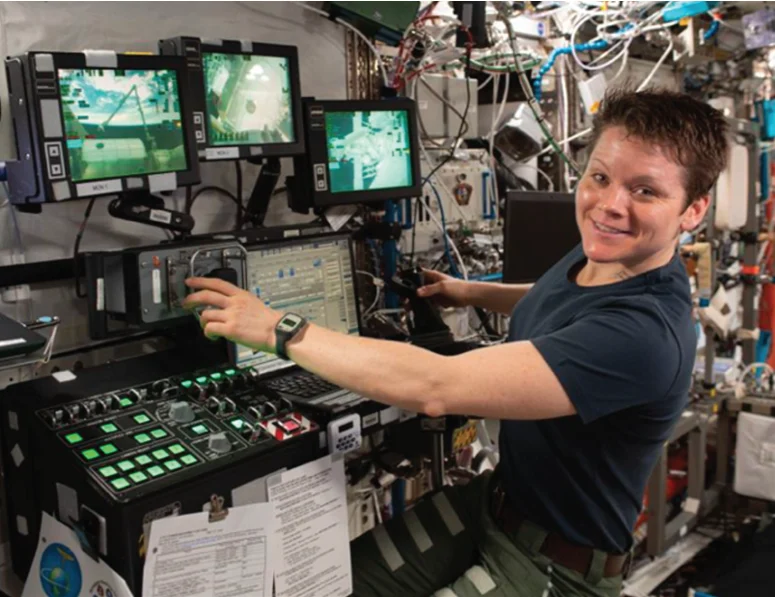
This model assessed the mental workload of a crewmember operating a robotic arm, a crucial tool for maintenance, assembly, and scientific tasks, particularly on a Mars transit vehicle. The simulation examined both manual and automated control modes. The results indicated that two crewmembers might be necessary to mitigate unacceptably high workload during manual robotic arm operations. This suggests that complex manual tasks, especially those requiring fine motor control and sustained attention, could overwhelm a single operator in the high-stress environment of deep space. Furthermore, consistent with existing scientific literature, the model predicted that stressors such as sleep debt significantly increase mental workload and degrade performance, leading to extended task completion times and increased risk. This highlights the critical importance of robust crew well-being protocols and accounting for fatigue in crew-size determinations and operational planning.
3. Mars Transit Crew Model:
Focusing on a nine-month Mars transit mission, this analysis aimed to determine crew utilization and staffing requirements by reallocating planned and unplanned tasks typically managed by ground control to the onboard crew. Using ISS-equivalent task assumptions as a baseline, the modeling predicted that more than six crewmembers would be needed to achieve the same number of work hours as a four-person ISS mission, assuming average rates for unplanned events. This substantial increase underscores the profound impact of Earth-independence on daily crew workload. Without the immediate and extensive support of ground control, the onboard crew must shoulder a significantly greater burden of ongoing responsibilities, maintenance, and anomaly response. This finding is critical for ensuring an adequate crew complement to manage the continuous demands of a prolonged deep-space journey without succumbing to overload or fatigue.
4. Personnel, Expertise, and Training Model:
Given the unavoidable communication delays and blackouts with Mars, coupled with the complete absence of rapid return-to-Earth options, NASA will rely almost entirely on the expertise and resilience of the onboard crew to respond to unforeseen failures. To quantify this critical need, a custom model was developed to assess the crew expertise required to meet mission objectives and respond effectively to unforeseen events with LOC/LOM potential and short time-to-effect.
Analysis of historical ISS data revealed a sobering fact: the probability of at least one occurrence of such a critical failure during a Mars transit mission is greater than 99%. This indicates that encountering a mission-threatening anomaly is not a possibility but a near certainty. A sensitivity analysis was conducted to examine the relationship between a successful crew response and the LOC/LOM outcome under various crew success rates (90%, 95%, 98%, and 99.985%). The estimated likelihood of a LOC/LOM consequence for all but the most conservative of these cases (i.e., less than 99.985% success) remained greater than 1%. According to the Human System Risk Board risk matrix, this falls squarely within the "very high" or "red" range, signifying unacceptable risk. The likelihood of LOC/LOM consequences only drops below 0.1% (the "yellow" or acceptable range) for an astonishingly high successful response rate of 99.985%. This model powerfully illustrates that when unforeseen failures occur on a mission to Mars, it will be absolutely critical that the crew possesses an exceptionally high level of expertise to accurately diagnose problems, develop solutions, and restore critical functionality. The Personnel, Expertise, and Training model is designed to provide the agency with the capability to consider this crucial trade space of expertise, training, and risk.
Broader Implications for Deep Space Exploration
The NESC’s pioneering work extends far beyond mere crew size calculations; it fundamentally reshapes the planning and execution of future deep-space missions. These models provide the foundational data to inform critical decisions across several domains:
- Mission Architecture and Operational Concepts: The findings will directly influence the design of habitats, propulsion systems, and exploration strategies. For instance, the need for increased IV support during EVAs might lead to larger habitats or more automated robotic systems. The high workload during transit suggests a need for highly robust, self-repairing systems and potentially increased crew quarters to mitigate stress.
- Technology Development: The emphasis on autonomous operations and high crew expertise will spur the development of advanced artificial intelligence (AI) and machine learning tools for onboard decision support, diagnostics, and predictive maintenance. Automation of routine and complex tasks will become paramount to reduce crew workload.
- Crew Selection and Training: Future Mars astronauts will require an even broader and deeper skillset than their LEO predecessors. They will need to be proficient not only in their primary scientific or engineering disciplines but also in medicine, advanced repairs, system diagnostics, and crisis management under extreme psychological pressure. Training programs will have to simulate communication delays and blackouts, forcing crews to develop unparalleled autonomy, adaptability, and resilience. Psychological preparedness for prolonged isolation and the immense responsibility of self-sufficiency will be paramount.
- Redefining Human Resilience: The NESC’s framework underscores that resilience is not merely a desirable trait but a non-negotiable design requirement for Mars missions. This means designing systems, procedures, and training that actively enable crews to cope with, adapt to, and recover from unexpected events, rather than just preventing them. It acknowledges that even with the best planning, the unknown will always be a factor in deep space.
This groundbreaking methodology from the NESC is a crucial step towards ensuring that humanity’s audacious leap to Mars is not only achievable but also conducted with the highest possible degree of safety and success. By providing an evidence-based approach to the complex human factors involved, NASA is paving the way for a new era of autonomous and resilient deep-space exploration.