


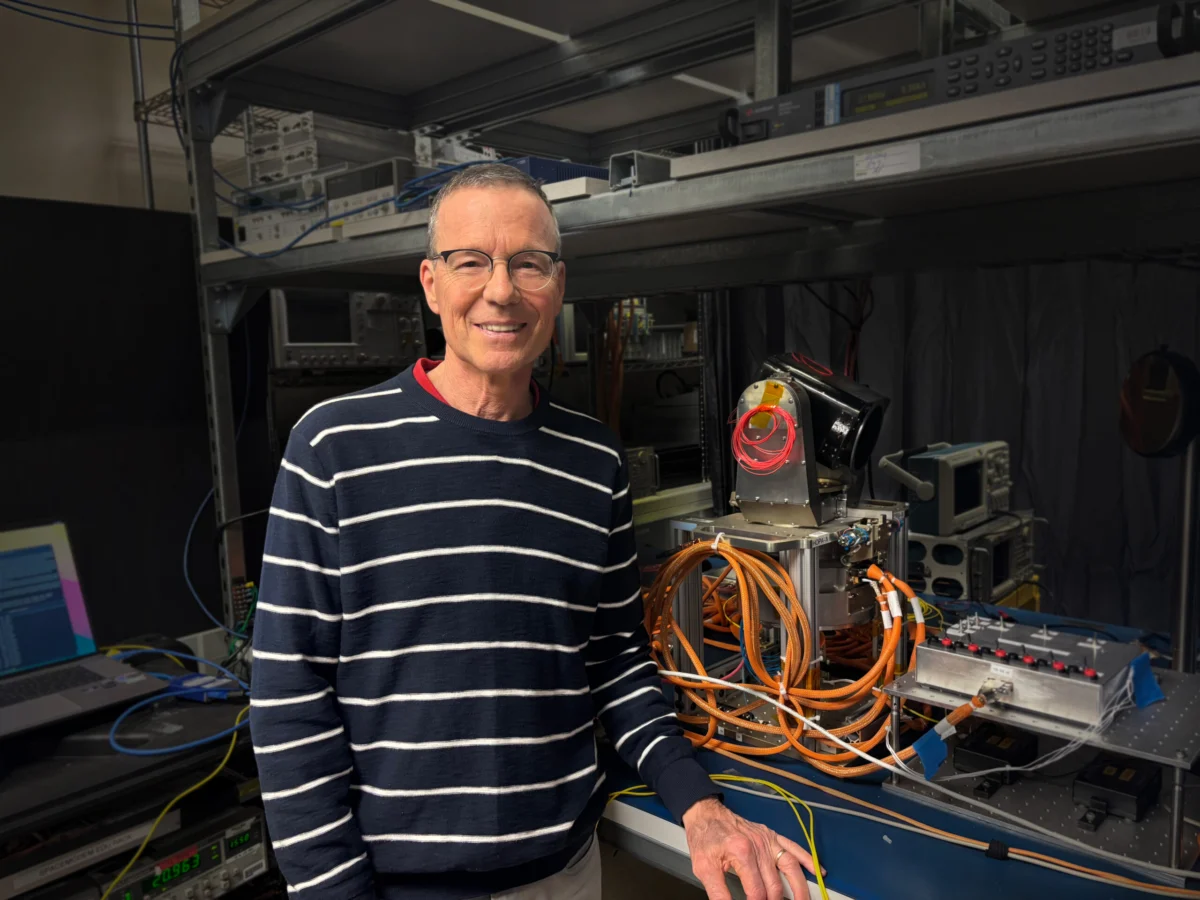
The successful deployment and operation of the Orion Artemis II Optical Communications System (O2OCOM) during NASA’s crewed Artemis II mission in April 2026 marked a pivotal advancement in deep space communication, heralding a new era for human exploration beyond Earth orbit. Overseen by Flight Manager Peter Rossoni at NASA’s Goddard Space Flight Center in Greenbelt, Maryland, this historic achievement enabled the first use of laser communications on a crewed deep space mission, demonstrating unparalleled data transfer rates and robust connectivity between astronauts journeying around the Moon and mission control on Earth.
The Visionary Behind the Breakthrough
For Peter Rossoni, the journey to this landmark achievement began decades ago, fueled by a childhood fascination with the Apollo missions. As a young boy, he watched in awe as astronauts ventured to the Moon, igniting a passion for space exploration that would ultimately define his career. Following in the scientific footsteps of his parents, Rossoni pursued a path that led him to the cutting edge of laser communications technology, eventually finding his calling within NASA. His appointment as Flight Manager for the O2OCOM system on Artemis II placed him at the helm of a project poised to bridge the vast distances of space with beams of light, a generational leap from the radio communications that defined the Apollo era. Rossoni’s leadership was instrumental in transforming a nascent technology into an operational cornerstone for humanity’s return to the Moon and beyond.
Artemis II: A Critical Testbed for Deep Space Exploration
The Artemis II mission itself represented a crucial step in NASA’s ambitious Artemis program, which aims to establish a sustainable human presence on the Moon and prepare for future crewed missions to Mars. Launching aboard the powerful Space Launch System (SLS) rocket, the Orion spacecraft carried a four-person international crew: NASA astronauts Reid Wiseman, Victor Glover, and Christina Koch, alongside CSA (Canadian Space Agency) astronaut Jeremy Hansen. Their approximately 10-day journey around the Moon served as a vital test flight for Orion’s life support systems, navigation, and, critically, its communication capabilities.
While Artemis I, an uncrewed test flight in late 2022, successfully demonstrated the Orion spacecraft’s performance, Artemis II introduced the complexity of human factors and the critical need for advanced, reliable communications. The mission’s primary objectives included validating all spacecraft systems with crew aboard, performing critical maneuvers in deep space, and proving the efficacy of new technologies like O2OCOM. The success of O2OCOM was not merely a technical demonstration but a fundamental enabler for the crew’s safety, scientific objectives, and the overall mission success, laying the groundwork for Artemis III, which plans to land humans on the lunar south pole.
Unveiling Optical Communications Technology
At the heart of this communication revolution is the Orion Artemis II Optical Communications System, a sophisticated terminal designed to transmit data using invisible infrared laser light. Unlike traditional radio frequency (RF) systems, which rely on broader radio waves, optical communications leverage the properties of light, allowing for significantly higher data rates due to the shorter wavelengths of photons. This enables the packing of vastly more information into each transmission. The O2OCOM system was capable of downlink speeds up to an astounding 260 megabits per second (Mbps), a rate that dwarfs conventional deep space radio systems. To put this into perspective, such a speed would allow for the transmission of a full-length 4K movie from the Moon to Earth in approximately one minute.
The development of optical communications has been a long-term strategic investment for NASA. Prior to O2OCOM, foundational experiments like the Laser Communications Relay Demonstration (LCRD), launched in 2021, and the Integrated LCRD Low Earth Orbit User Modem and Antenna Terminal (ILLUMA-T) on the International Space Station, successfully demonstrated the viability of laser links from Earth orbit. These precursor missions provided invaluable data and operational experience, moving optical communications from the realm of experimental proof-of-concept to a deployable, operational technology. The Artemis II mission represented the ultimate validation, proving its capability in the challenging, dynamic environment of deep space, far beyond Earth’s protective magnetic field and atmosphere.
Seamless Integration and Operational Excellence
Integrating a cutting-edge laser communications system into an existing spacecraft architecture and ground network was an immense engineering challenge. The O2OCOM system operated in parallel with Orion’s traditional radio communications, ensuring redundancy and mission safety. However, both systems had to seamlessly interface with the same networks at the Mission Control Center (MCC) at NASA’s Johnson Space Center in Houston and aboard the Orion spacecraft. The team, under Rossoni’s guidance, developed innovative solutions to allow these disparate technologies to work in concert, maximizing the benefits of laser communications while maintaining the reliability of established RF links.
Extensive testing and preparation were critical to the system’s success. Rossoni and the dedicated optical flight and ground teams supported rigorous pre-flight activities, including countless practice runs simulating team and facility operations, comprehensive operational readiness reviews to confirm the terminal and ground segment were flight-ready, and meticulous coordination to ensure smooth collaboration among all personnel. This thorough preparation culminated in a communications system that offered up to 100 times greater capacity than previous deep space communication methods. This enhanced capacity significantly improved the connection between the astronauts and their support teams, while simultaneously freeing up the conventional radio communications systems for sensitive, critical data streams and essential voice communications. The ground segment for O2OCOM relied on NASA’s Deep Space Network (DSN), which was upgraded with optical ground stations capable of receiving the laser signals from Orion. These ground stations, located strategically around the globe, ensured continuous coverage and robust data reception, acting as the Earth-based "eyes" to catch the precise laser beams transmitted across hundreds of thousands of miles.
Data Flow from Lunar Orbit: A Flood of Information
During the approximately 10-day mission, Peter Rossoni joined the mission control team in Houston, personally overseeing the intricate data flow from the O2OCOM terminal on Orion to the MCC. The system performed flawlessly, transmitting an unprecedented volume and variety of data from the lunar vicinity back to Earth. In total, the optical terminal transferred over 450 gigabytes of data. This staggering amount of information is roughly equivalent to streaming 100 high-definition movies, showcasing the immense bandwidth capabilities of laser communications.
The data transmitted included high-definition video of the crew and their activities, stunning photographs of the Moon and Earth from deep space, critical engineering telemetry detailing the spacecraft’s performance, invaluable scientific data gathered by onboard instruments, detailed flight procedures, and routine crew communications. This rich stream of information not only provided mission control with a more comprehensive real-time understanding of the mission’s progress but also allowed for quicker analysis of scientific findings and enhanced public engagement through high-fidelity imagery and video. The ability to transmit such a large volume of data at speed significantly advanced the potential for real-time decision-making, in-depth scientific analysis, and immediate responses to any unforeseen circumstances in the demanding environment of deep space.
Statements from the Frontline and Leadership
Peter Rossoni articulated the profound significance of this achievement: “Communications is an important pillar of exploration. We’re venturing into deep space for longer periods of time, and we need that vital link back to the home base. Laser communications were proven to work in previous experiments, so the demonstration phase is over. Artemis II showed us what it can do operationally.” He further emphasized, “Beyond supporting a crewed mission around the Moon, I’m excited to work with an amazing team of talented engineers and visionaries who understand that high-performance communications and networking is a key element of exploration infrastructure.” Rossoni concluded, echoing a sentiment from a respected Goddard scientist, “Communications is the secret sauce behind all NASA missions. For Artemis II in particular, with the astronauts’ mission and safety at stake, it was critical to have robust communications to both enhance successful exploration and address any eventualities in the demanding environment of deep space. I had a deep sense of fulfillment when the Orion Artemis II optical communications system started working, and it kept growing as the mission progressed, with more and more objectives achieved.”
Inferred reactions from NASA leadership underscored the strategic importance of this milestone. NASA Administrator Bill Nelson likely lauded the O2OCOM success as a testament to American ingenuity and international collaboration, stating, "Artemis II is not just about sending humans back to the Moon; it’s about pushing the boundaries of what’s possible. The operational success of optical communications is a game-changer, providing the data highways we’ll need for sustainable lunar exploration and ultimately, our journey to Mars." Astronauts Reid Wiseman, Victor Glover, Christina Koch, and Jeremy Hansen would have expressed their confidence and appreciation for the enhanced connectivity, perhaps commenting on the reassuring real-time video links and the ability to share their experiences with unprecedented clarity. "Knowing we have such a robust, high-bandwidth link to Earth provides an incredible sense of security and allows us to focus entirely on our mission objectives," an astronaut might have remarked. Lisa Campbell, President of the Canadian Space Agency, would have highlighted Canada’s vital role in the Artemis program and the collaborative spirit that made such technological advancements possible, emphasizing the importance of international partnerships in expanding humanity’s reach into space.
The Road Ahead: Implications for Deep Space Exploration
The operational success of O2OCOM on Artemis II has profound implications for the future of deep space exploration. It transitions optical communications from a promising technology to an essential component of NASA’s infrastructure, unlocking capabilities previously unimaginable. For upcoming Artemis missions, including Artemis III, which will land humans on the Moon, and subsequent missions aimed at establishing the Gateway lunar orbital outpost, high-bandwidth communication will be critical. It will enable real-time high-definition streaming from the lunar surface, supporting complex scientific experiments, remote medical consultations, and enhanced public engagement.
Looking further ahead, toward human missions to Mars, the need for robust, high-capacity communications becomes even more paramount. As missions extend in duration and distance, the ability to transmit massive amounts of data—including high-resolution imagery, complex scientific telemetry, real-time health monitoring of astronauts, and even remote control of robotic assets—is non-negotiable. Optical communications offer a pathway to making such distant missions safer, more productive, and more connected to Earth. This technological leap also fosters innovation in the commercial space sector, potentially leading to new applications for high-speed data transfer in satellite constellations, lunar industries, and even deep space tourism. The demonstration on Artemis II has firmly established laser communications as the future backbone of human deep space exploration, ensuring that as humanity ventures further into the cosmos, the vital link back home remains stronger and clearer than ever before.
Collaborative Innovation at its Finest
The success of the Orion Artemis II Optical Communications System is a testament to the power of collaborative innovation across numerous NASA centers and international partners. From the visionary engineers and scientists at Goddard Space Flight Center who designed and developed the system, to the mission control teams at Johnson Space Center who orchestrated its operations, and the critical support from the Deep Space Network, this achievement was a symphony of expertise. The partnership with the Canadian Space Agency, integral to the Artemis program, further underscores the global commitment to pushing the boundaries of human endeavor. This collective effort ensures that the future of space exploration will be characterized not only by ambitious journeys but also by an unprecedented ability to share the wonders and challenges of those journeys with all of humanity.