The advent of NASA’s SkyFall mission heralds a new era in Martian exploration, poised to deploy a fleet of three advanced rotorcraft to the Red Planet in late 2028. These sophisticated helicopters, designed to build upon the groundbreaking success of the Ingenuity Mars Helicopter, will undertake an unprecedented aerial survey, leveraging state-of-the-art instrumentation to probe the Martian surface and subsurface with unparalleled detail. The mission signifies a pivotal shift towards integrating aerial platforms as indispensable tools in planetary science, promising to unlock new insights into Mars’ geological history, potential for past or present life, and resources for future human endeavors.
Building on a Legacy: The Ingenuity Precedent
The foundation for SkyFall’s ambitious undertaking was meticulously laid by the Ingenuity Mars Helicopter, a diminutive yet revolutionary technology demonstrator that redefined the possibilities of extraterrestrial flight. Launched alongside the Perseverance rover in July 2020 and landing in February 2021, Ingenuity’s primary objective was simply to prove that powered, controlled flight was feasible within Mars’ incredibly thin atmosphere, which possesses only about 1% the density of Earth’s at sea level. Against all odds, Ingenuity not only achieved this but far surpassed expectations, completing an astonishing 72 flights over nearly three years.
Ingenuity’s maiden flight on April 19, 2021, lasted just 39 seconds, ascending to an altitude of 3 meters. This historic achievement validated decades of engineering and scientific endeavor, demonstrating the viability of rotorcraft in an alien environment. What followed was an extended mission that pushed the boundaries of its capabilities. Over its operational lifespan, Ingenuity covered a total distance of 17.7 kilometers, reaching altitudes of up to 24 meters and achieving speeds of up to 6.5 meters per second. It provided invaluable aerial reconnaissance for the Perseverance rover, helping to scout potential routes, identify scientifically interesting geological features, and even photograph areas inaccessible to the rover. Its flights dramatically enhanced the rover’s operational efficiency by enabling faster traverse planning and targeted scientific investigations. The data gathered on atmospheric dynamics, flight stability, and dust mitigation proved crucial for designing future Martian aerial vehicles. The mission officially concluded in January 2024 after sustaining damage to one of its rotor blades during its final flight, leaving behind an indelible legacy of innovation and perseverance. Ingenuity’s remarkable performance unequivocally demonstrated that aerial perspectives are not merely a novelty but a powerful asset for planetary exploration, capable of generating valuable scientific data and logistical support.
SkyFall’s Advanced Arsenal: Unveiling Martian Secrets
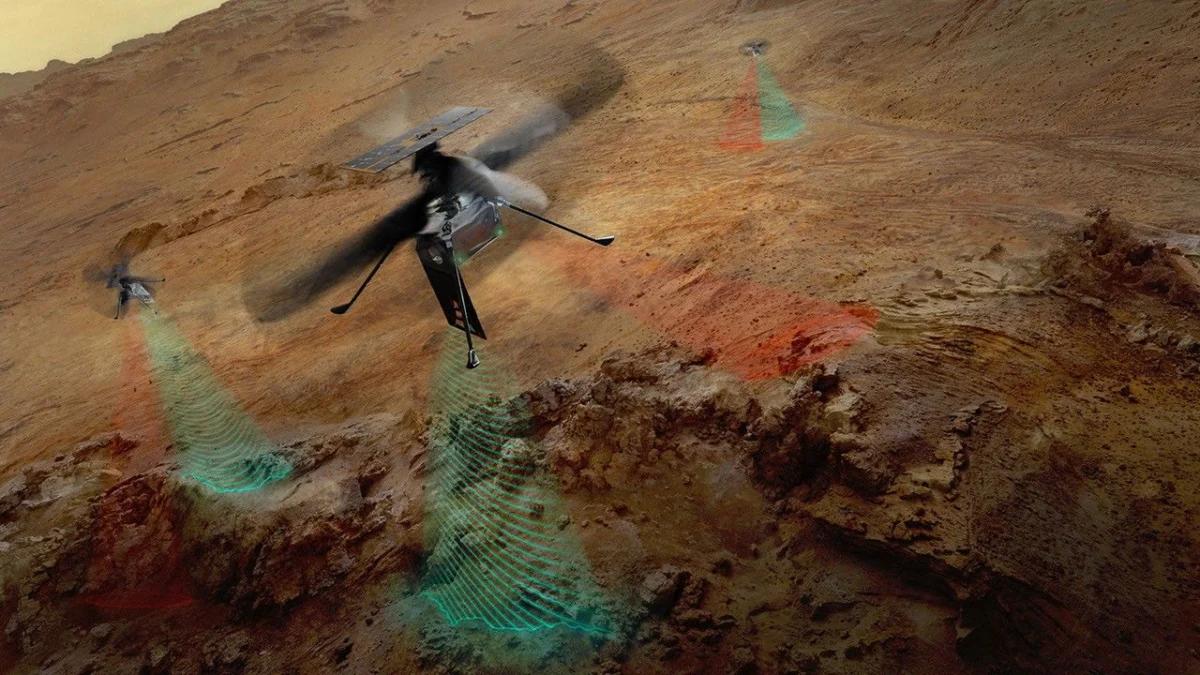
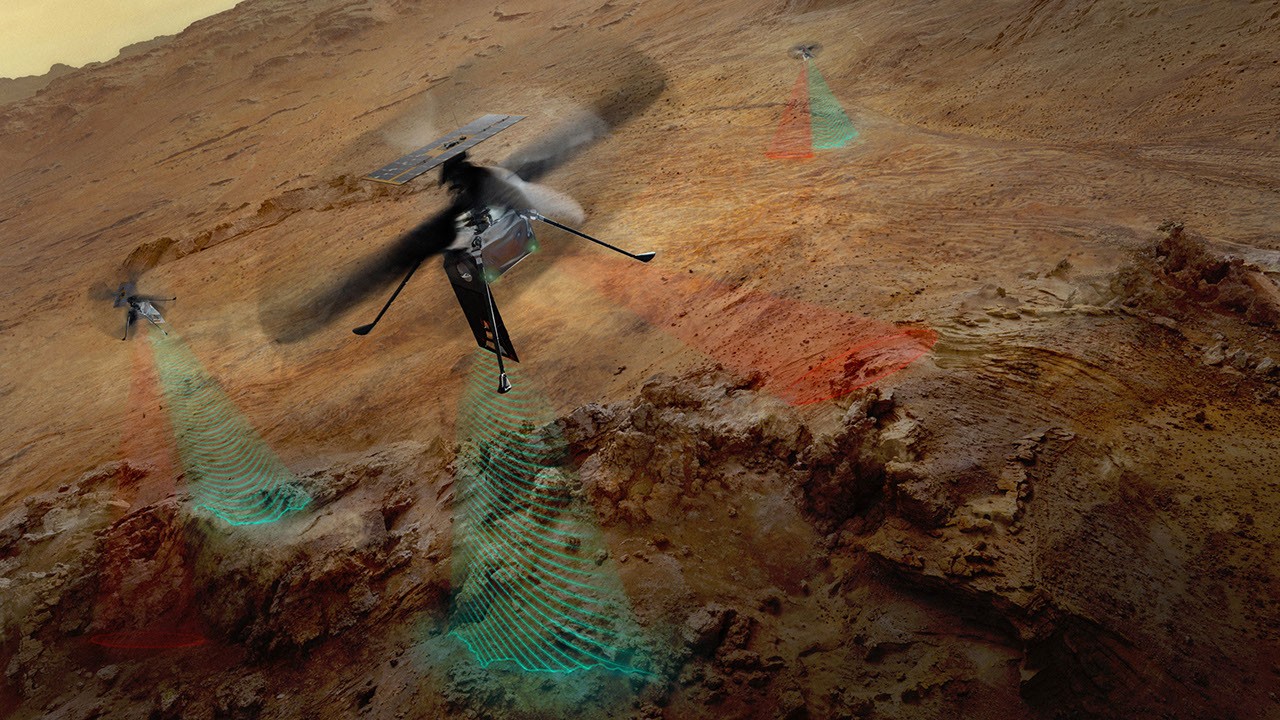
The SkyFall helicopters represent the next evolutionary leap in Martian aerial exploration, moving beyond a technology demonstration to a full-fledged scientific mission. Each of the three rotorcraft will be equipped with four distinct instruments, significantly expanding their scientific capabilities compared to Ingenuity’s primary imaging cameras. The artists’ concept vividly illustrates two key capabilities: the collection of subsurface radar data via green frequency waves and near-infrared imagery data from regolith and other surface features via red beams.
The subsurface radar system is a particularly exciting addition. By emitting radar waves that penetrate the Martian surface, these instruments can map geological structures, identify layers of rock and sediment, and, crucially, detect potential reservoirs of subsurface water ice. Water ice is a critical resource for future human missions, serving as a source for drinking water, breathable oxygen, and rocket fuel. Furthermore, the presence and distribution of subsurface water ice are paramount in the search for extant or extinct microbial life, as liquid water is a fundamental requirement for life as we know it. The ability to conduct such surveys from an aerial platform allows for rapid coverage of vast and diverse terrains, providing a three-dimensional understanding of the Martian geology that would be impossible with ground-based rovers alone.
Concurrently, the near-infrared imagery data collection will provide detailed spectroscopic information about the composition of the Martian surface. Near-infrared light interacts with different minerals in unique ways, allowing scientists to identify the presence of various hydrous minerals, carbonates, sulfates, and other compounds that tell the story of Mars’ aqueous past. By analyzing the spectral signatures of regolith (crushed rock and dust) and other surface features, SkyFall can map mineral distributions, identify regions of past hydrothermal activity, and potentially pinpoint areas where ancient habitable environments may have existed. This data will complement and extend the observations made by orbital spacecraft and ground-based rovers, offering high-resolution compositional maps of areas of interest.
While the primary concept highlights radar and near-infrared, the mention of "four instruments each" suggests additional capabilities. These could plausibly include advanced high-resolution visible-light cameras for detailed topographical mapping and visual geological analysis, as well as meteorological sensors to gather local atmospheric data (temperature, pressure, wind speed and direction) crucial for both flight operations and understanding Martian climate patterns. Together, these instruments will enable a comprehensive scientific investigation from an agile, aerial perspective, providing critical data points for understanding Mars’ evolution, habitability, and resource potential.
The Mission Profile: Launch and Operations
The SkyFall mission is slated for launch in late 2028, a date that places it at the forefront of the next wave of Mars exploration. The helicopters are expected to launch aboard NASA’s Space Reactor-1 Freedom, a mission name that hints at advanced propulsion or power generation capabilities, potentially leveraging a nuclear fission reactor. Such a system could provide significant power for long-duration deep-space travel or sustained operations on the Martian surface, underscoring a commitment to robust, long-term exploration initiatives. The specific architecture of Space Reactor-1 Freedom, whether it is a dedicated launch vehicle, a carrier spacecraft with its own reactor, or a broader mission including a surface power demonstration, signifies NASA’s strategic investment in next-generation space technologies.
Upon arrival at Mars, likely after a cruise phase of several months, the SkyFall helicopters will be deployed to their designated operational areas. Unlike Ingenuity, which was tethered to the Perseverance rover’s immediate vicinity, SkyFall’s fleet approach implies a more distributed and coordinated exploration strategy. Each helicopter could be assigned specific regions or scientific objectives, or they could work in tandem to cover larger areas more efficiently. The ability to deploy multiple aerial assets simultaneously offers redundancy and allows for a greater scientific return, enabling comparative studies across different Martian terrains.
The operational phase on Mars will involve a series of flights, data collection, and communication relays back to Earth. The helicopters will need to navigate autonomously or semi-autonomously, manage their power systems (likely solar-powered with battery storage for night operations), and contend with the challenging Martian environment, including dust storms and extreme temperature fluctuations. The data collected will be transmitted to Earth, likely through an orbiter acting as a relay, allowing scientists to process and analyze the wealth of information gathered from these pioneering aerial platforms.
Technological Prowess and Engineering Challenges
The development of the SkyFall helicopters entails overcoming significant engineering challenges, even with Ingenuity’s success as a blueprint. The increased payload of four instruments per helicopter demands more robust propulsion systems, larger rotors, and more efficient power management. The Martian atmosphere, with its extreme thinness and composition (primarily carbon dioxide), makes generating lift a formidable task. This necessitates large, lightweight rotor blades spinning at very high speeds – often over 2,400 revolutions per minute – to generate sufficient thrust.
Autonomy is another critical aspect. Given the communication delays between Earth and Mars (ranging from 3 to 22 minutes), real-time human control is impossible. The SkyFall helicopters must be capable of executing complex flight plans, performing hazard avoidance, and conducting scientific observations with minimal human intervention. This requires sophisticated onboard navigation systems, advanced sensors for terrain mapping, and powerful flight control software. Furthermore, the operational environment poses threats such as abrasive dust, which can degrade sensitive components and solar panels, and extreme temperature cycles that cause materials to expand and contract, leading to fatigue. Engineers will have implemented enhanced dust-mitigation strategies and robust thermal management systems to ensure the longevity and reliability of the SkyFall fleet. The experience gained from Ingenuity, including its resilience to dust accumulation and cold Martian nights, will be directly applied and improved upon in the SkyFall design.
Collaborative Endeavor: The Teams Behind SkyFall
The SkyFall project is a testament to the collaborative spirit and expertise within NASA and its partners. Managed by NASA’s Jet Propulsion Laboratory (JPL), a division of Caltech, the mission benefits from JPL’s unparalleled legacy in Mars exploration, including the design and operation of nearly all U.S. Mars landers and rovers. JPL’s deep expertise in robotics, autonomous systems, and deep-space communication is critical to the success of SkyFall.
AeroVironment of Arlington, Virginia, a key partner in the development of the history-making Ingenuity rotorcraft, will once again play a crucial role. They are co-designing and co-manufacturing the SkyFall helicopters, bringing their specialized knowledge in unmanned aerial systems and lightweight composite structures to the project. This continued partnership ensures continuity of expertise and leverages the invaluable lessons learned from Ingenuity’s development and operational phases. The synergy between JPL’s systems engineering prowess and AeroVironment’s specialized rotorcraft design capabilities is essential for pushing the boundaries of Martian aerial technology.
The overall Mars Exploration Program, under which SkyFall falls, is managed by JPL on behalf of NASA’s Science Mission Directorate in Washington. This hierarchical structure ensures that the mission’s scientific objectives align with NASA’s broader goals for understanding the Red Planet, from its geological evolution to its astrobiological potential.
Paving the Way for Future Exploration
The implications of the SkyFall mission extend far beyond its immediate scientific returns. It represents a critical step in developing the capabilities necessary for future, more ambitious planetary exploration.
- Enhanced Scientific Discovery: The ability to rapidly survey vast, rugged, and previously inaccessible terrains will dramatically accelerate the pace of scientific discovery on Mars. Aerial platforms can reach areas too steep or too hazardous for rovers, providing crucial context for ground-based observations and enabling more informed site selection for future missions, including potential sample return campaigns.
- Support for Human Missions: As NASA plans for human missions to Mars in the coming decades, aerial scouts like SkyFall could become indispensable. They could assist in reconnaissance for landing sites, mapping optimal routes for astronaut traverses, identifying potential hazards, and even locating resources like water ice for in-situ resource utilization (ISRU). Imagine astronauts deploying a small fleet of drones to survey their immediate surroundings or a distant geological feature before venturing out.
- Paradigm Shift in Planetary Exploration: SkyFall solidifies the concept of aerial mobility as a fundamental component of planetary science. This success could pave the way for similar rotorcraft missions to other celestial bodies with atmospheres, such as Titan, Venus, or even gas giant moons. The lessons learned will inform the design of future aerial vehicles for diverse extraterrestrial environments.
- Technological Advancement and Terrestrial Applications: The innovations in lightweight materials, autonomous navigation, power efficiency, and sensor integration developed for SkyFall will undoubtedly have spin-off applications on Earth. These could benefit drone technology for environmental monitoring, disaster response, infrastructure inspection, and even advanced aerial logistics.
Beyond SkyFall: The Future of Aerial Robotics on Mars
The SkyFall mission is not an endpoint but a significant milestone in a long-term vision for Mars exploration. Its success will likely lead to even more capable and specialized aerial platforms. Future Mars helicopters could carry heavier payloads, enabling more sophisticated scientific instruments, or even small robotic arms for sample collection. They could be designed for longer endurance, potentially operating for years, or for specific environments, such as polar regions to search for deeply buried ice. The concept of "swarms" of highly autonomous drones, coordinating their efforts to map entire regions or respond to dynamic events like dust devils, is no longer the stuff of science fiction but a tangible future within reach.
By leveraging the legacy of Ingenuity and pushing the boundaries of aerial technology, SkyFall is poised to revolutionize our understanding of the Red Planet. Its launch in 2028 will mark the beginning of an exciting new chapter, demonstrating that the sky is no longer the limit for exploring Mars, but rather a new frontier to be conquered. The data collected by these three intrepid helicopters will undoubtedly inspire future generations of scientists and engineers, furthering humanity’s quest to unravel the mysteries of our cosmic neighborhood.