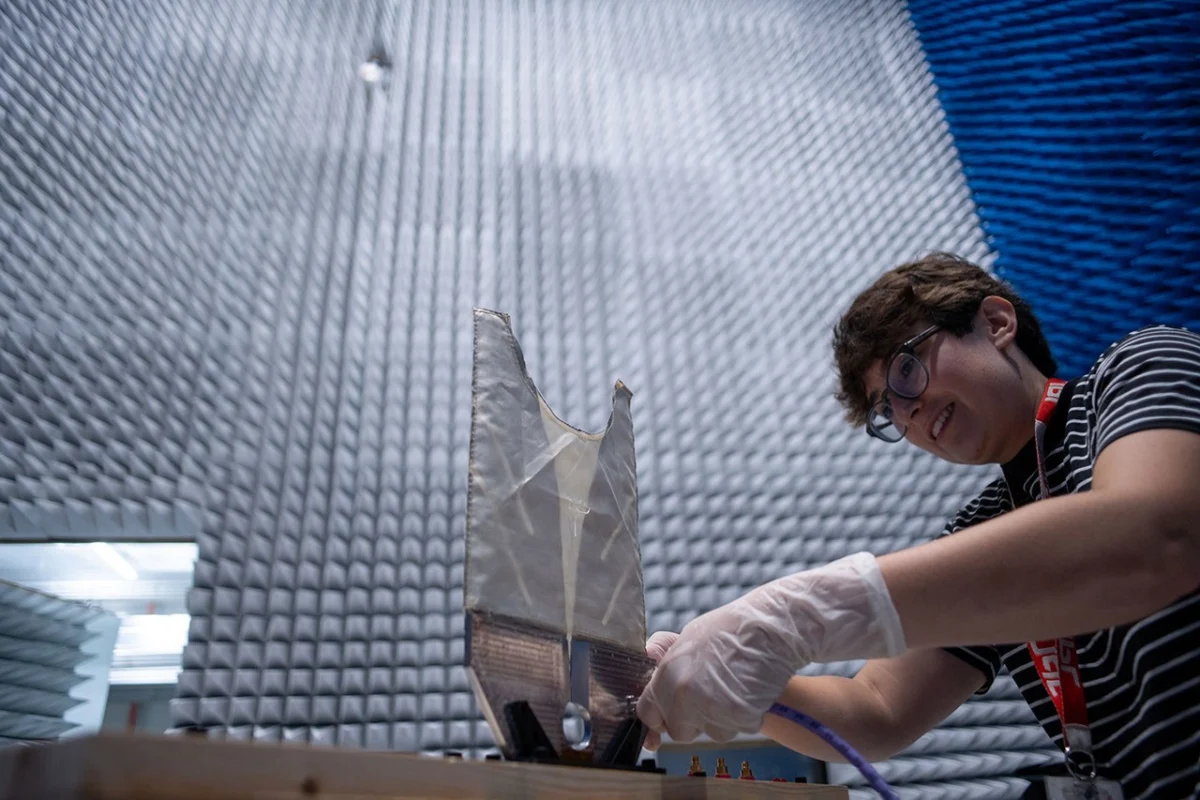
In a critical step toward pioneering subsurface exploration on Mars, engineer Maya Román from the SkyFall ground-penetrating radar (GPR) team at NASA’s Jet Propulsion Laboratory (JPL) in Southern California was recently observed connecting a coaxial cable to a test antenna within the Environmental Test Lab’s electromagnetic interference (EMI) testing chamber. This meticulous work underscores the rigorous preparation required for a mission poised to revolutionize our understanding of the Red Planet’s hidden depths. The antenna, strategically positioned facing upwards during the test, aimed to mitigate reflections and interference, ensuring the precise measurement of its radiation pattern in a controlled environment. This intricate testing is a fundamental component of developing the SkyFall mission, which is designed to expand the aerial exploration paradigm established by the groundbreaking Ingenuity Mars Helicopter.
The Legacy of Ingenuity: Paving the Way for Aerial Ambition
The SkyFall mission stands on the shoulders of an undisputed giant in space exploration: the Ingenuity Mars Helicopter. Launched alongside the Perseverance rover in July 2020, Ingenuity embarked on what was initially conceived as a mere technology demonstration of up to five test flights. Its primary objective was to prove that powered, controlled flight was feasible in Mars’ extremely thin atmosphere, which possesses only about 1% of Earth’s atmospheric density. Against all odds, Ingenuity far exceeded expectations, ultimately completing an astonishing 72 flights over a period of nearly three years before its mission concluded in January 2024 due to rotor blade damage.
Ingenuity’s unparalleled success transformed Martian exploration. It not only validated the concept of aerial mobility but also showcased the immense value an aerial perspective could provide to surface missions. By acting as an advance scout for the Perseverance rover, Ingenuity delivered crucial reconnaissance, helping the rover team identify efficient, time-saving routes across treacherous Martian terrain and pinpoint compelling locations for scientific investigation. Its high-resolution imagery and topographical data allowed scientists to gain unprecedented context for geological features and potential sampling sites, enhancing the overall scientific return of the Perseverance mission. The helicopter’s ability to traverse distances quickly and survey areas inaccessible to a rover proved that a new dimension of exploration was not only possible but indispensable for future endeavors. This remarkable legacy directly inspires SkyFall, which aims to leverage similar aerial platforms but with an even more ambitious scientific payload and objective.
SkyFall: Unveiling Mars’ Subsurface Secrets
Building upon Ingenuity’s trailblazing flights, the SkyFall mission represents a significant leap forward. It will deploy a fleet of three sophisticated aircraft, each equipped with four distinct instruments, with ground-penetrating radar being a central component. The core objective of SkyFall is to probe beneath the Martian surface, seeking to uncover secrets that have remained hidden from orbital and surface-based instruments.
Ground-penetrating radar operates by emitting radio waves into the ground and detecting the reflections that bounce back from subsurface structures and material interfaces. The time it takes for the waves to return, and the strength and characteristics of the reflected signals, allow scientists to create a detailed profile of what lies beneath. On Earth, GPR is widely used in archaeology, geology, civil engineering, and glaciology to detect buried artifacts, map geological layers, locate underground utilities, and measure ice thickness. For Mars, the applications are even more profound.
The Martian subsurface is of immense scientific interest for several critical reasons. Firstly, it offers a potentially more benign environment than the harsh surface, shielded from intense solar and cosmic radiation. This shielding makes the subsurface a prime candidate for preserving signs of past, or even present, microbial life. If life ever emerged on Mars, the subsurface might be its last refuge. Secondly, GPR is ideally suited to search for subsurface water ice or even pockets of liquid water, which could be stable at greater depths due to geothermal heat and increased pressure. Identifying these water resources is not only vital for astrobiology but also for future human missions, as water ice could be converted into drinking water, breathable oxygen, and rocket propellant. Thirdly, GPR can help map the planet’s geological layers, providing insights into Mars’ hydrological history, volcanic activity, and climate evolution over billions of years. By flying above the surface, SkyFall’s GPR will be able to survey vast swathes of terrain much more efficiently than a ground-based rover, generating unprecedented regional subsurface maps.
Rigorous Testing in the Environmental Test Lab: Ensuring Martian Readiness
The image of Maya Román meticulously connecting the coaxial cable in the EMI testing chamber at JPL highlights the rigorous engineering and testing protocols essential for any space mission. The Environmental Test Lab is a crucible where spacecraft components and entire systems are put through their paces to ensure they can withstand the extreme conditions of launch, space transit, and operation on another planet.
Electromagnetic interference (EMI) testing is a particularly critical aspect of this process. Spacecraft are densely packed with electronic components, each generating its own electromagnetic fields. Without proper shielding and design, these fields can interfere with one another, corrupting data, causing malfunctions, or even leading to mission failure. The EMI chamber, characterized by its distinctive grey and blue geometric foam acoustic panels, is an anechoic chamber designed to absorb electromagnetic waves and sound, creating a controlled environment free from external interference. This allows engineers to precisely measure the electromagnetic emissions of a device and assess its susceptibility to external electromagnetic fields, ensuring that the SkyFall instruments will operate harmoniously and reliably in the Martian environment.
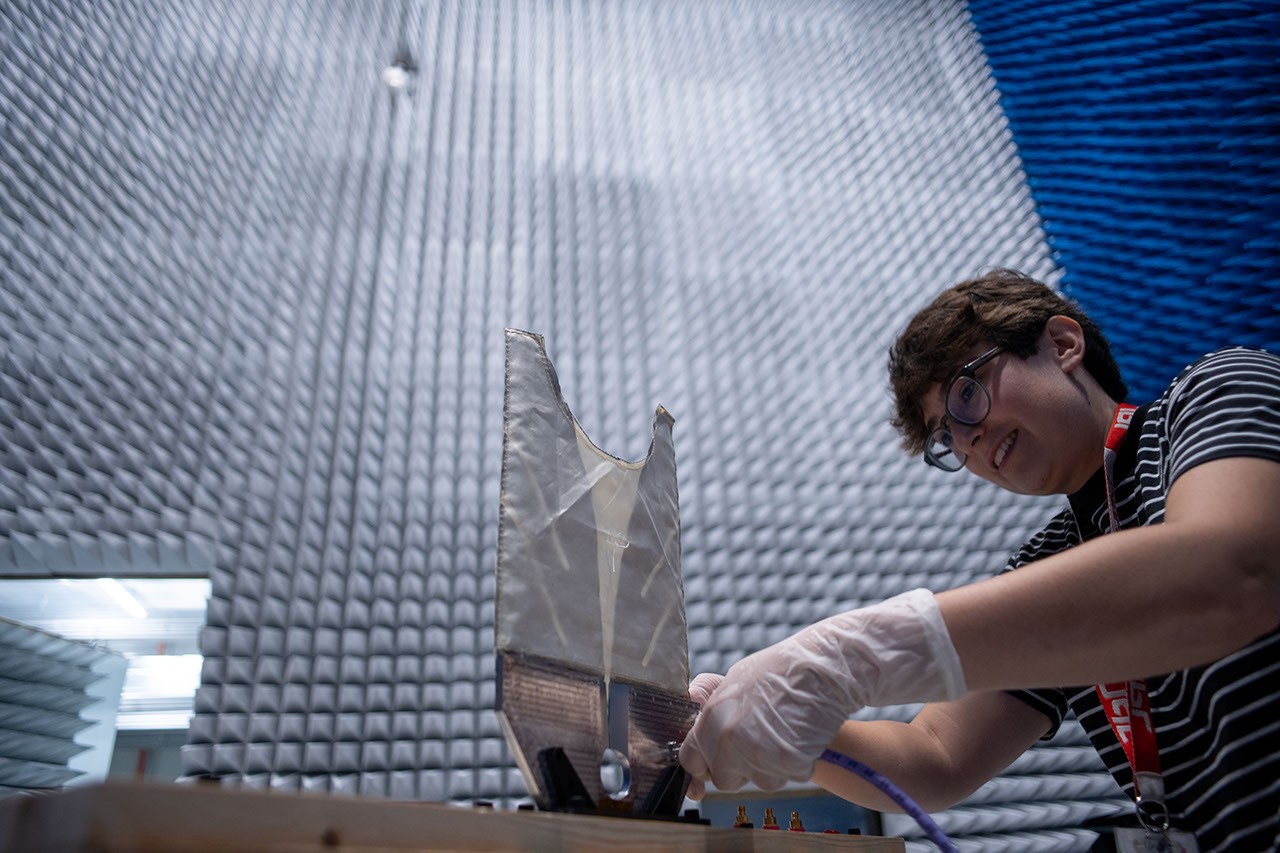
The specific test shown, involving the careful positioning of the antenna and connection of a coaxial cable, is part of a series of characterization measurements. These tests confirm that the GPR antenna’s performance, including its radiation pattern and efficiency, meets design specifications under simulated operational conditions. Such exhaustive testing is not limited to EMI; components also undergo vibration tests to simulate launch stresses, thermal vacuum tests to mimic the extreme temperature swings and vacuum of space, and radiation tests to assess resilience against cosmic rays and solar flares. This multi-faceted validation process is paramount to ensuring the mission’s success and safeguarding the immense investment of resources and human ingenuity.
Powering Deep Space Ambitions: The Role of Space Reactor-1 Freedom
The SkyFall mission is slated for launch aboard NASA’s Space Reactor-1 Freedom in late 2028. The choice of Space Reactor-1 Freedom as the launch platform and, implicitly, as a potential power source, underscores the ambitious and long-duration nature of the SkyFall mission. While solar arrays are commonly used for Martian surface missions like Perseverance, the deployment of a space reactor suggests requirements for sustained, high-power operations, potentially in environments or during periods when solar power is insufficient.
Nuclear fission power systems, such as the Kilopower Reactor Using Stirling Technology (KRUSTY) or similar concepts, offer significant advantages for deep space and planetary surface missions. They provide continuous power independent of sunlight, crucial for operations in shadowed regions, during dust storms, or for missions far from the Sun. This reliable, robust power source enables longer mission durations and the operation of power-intensive instruments like advanced radar systems and multiple aerial vehicles. The development and deployment of Space Reactor-1 Freedom signify NASA’s commitment to enabling increasingly complex and power-hungry missions, pushing the boundaries of what is possible in planetary exploration. Its integration with SkyFall highlights a strategic move towards self-sufficient, long-term robotic presence beyond Earth.
Broader Implications for Martian Science and Future Human Exploration
The SkyFall mission represents a pivotal moment in Mars exploration, promising to unlock new dimensions of scientific discovery and lay crucial groundwork for future human endeavors. By systematically exploring the Martian subsurface, SkyFall directly contributes to the overarching goal of understanding Mars’ potential for past or present life. The detection of subsurface water ice, in particular, would be a game-changer, not only for astrobiology but also for resource utilization by future human colonists. In-situ resource utilization (ISRU) – the practice of living off the land – is essential for making human missions to Mars sustainable and affordable. Identifying accessible water ice deposits would provide a critical resource for drinking water, oxygen production, and rocket fuel manufacturing.
Furthermore, SkyFall’s aerial capabilities, combined with its GPR payload, will significantly enhance our understanding of Martian geology and climate history. By mapping subsurface stratigraphy, scientists can reconstruct the planet’s past environmental conditions, including periods when liquid water may have been abundant on the surface. This data will refine our climate models and provide insights into the processes that led Mars to its current arid state.
The success of SkyFall will also further solidify the paradigm shift in planetary exploration initiated by Ingenuity. It will demonstrate the versatility and power of aerial platforms, proving that they are not merely technology demonstrators but indispensable scientific tools capable of independent and complex missions. This could pave the way for an entire new class of planetary explorers, including fixed-wing aircraft, balloons, and more advanced rotorcraft, designed for a variety of scientific objectives on Mars and other celestial bodies with atmospheres, such as Titan.
Expert Perspectives and the Road Ahead
NASA and JPL scientists and engineers consistently emphasize the collaborative spirit and relentless innovation driving missions like SkyFall. As a JPL project scientist, one might infer sentiments such as, "Ingenuity showed us the sky’s the limit on Mars. SkyFall will show us what lies beneath. This mission isn’t just about flying; it’s about seeing Mars in a way we never have before, peering into its hidden past and potential for life." An engineer closely involved in the project might add, "Every cable connection, every test in the EMI chamber, is about ensuring that when SkyFall reaches Mars, it performs flawlessly. The Martian environment is unforgiving, so our preparation must be meticulous. We are building the eyes and ears that will reveal Mars’ deepest secrets."
The anticipated launch in late 2028 marks a significant milestone on the horizon. Following its arrival at Mars, the SkyFall aircraft will commence their unprecedented mission, mapping the subsurface with high precision. The data collected will undoubtedly redefine our understanding of the Red Planet, offering tantalizing clues about its geological evolution, its hydrological history, and, most compellingly, its potential to harbor life. SkyFall is not just a mission; it’s a testament to humanity’s enduring quest to explore, understand, and ultimately, reach for the stars.