


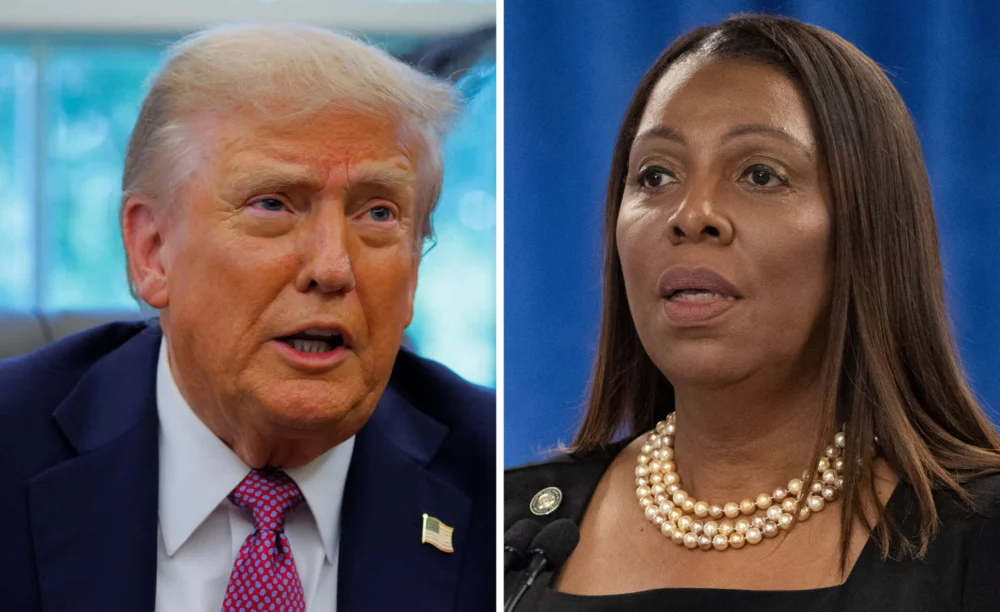
New York Attorney General Letitia James, alongside the chief legal officers of 23 other states, has launched a fresh legal challenge against former President Donald Trump’s recently reimposed global tariff regime, just days after a landmark Supreme Court decision invalidated his previous attempt. The lawsuit, filed Thursday in the U.S. Court of International Trade, aims to declare Trump’s latest tariffs illegal and compel the federal government to issue refunds to affected states and businesses. This action marks a significant escalation in the ongoing legal and economic skirmishes surrounding the former president’s trade policies, underscoring the persistent tension between executive trade authority and constitutional checks and balances.
The Genesis of the Dispute: Trump’s "Liberation Day" Tariffs and SCOTUS Rejection
The current legal confrontation is rooted in Trump’s ambitious "Liberation Day" tariffs, first implemented last year, which sought to impose broad duties on a wide array of imported goods. The administration at the time justified these tariffs as necessary to rebalance global trade, protect domestic industries, and enhance national security, framing them as a pivotal component of its "America First" economic agenda. To enact these sweeping duties, the Trump administration relied on the International Emergency Economic Powers Act (IEEPA) of 1977, a statute typically reserved for addressing national security threats or foreign policy crises through economic sanctions.
This initial application of IEEPA quickly drew legal fire. Attorney General James, leading a coalition of 11 states, filed a lawsuit challenging the legality of these tariffs, arguing that the president had overstepped his authority by using an emergency powers act for what they contended was a conventional trade policy objective. This state-led effort was eventually consolidated with numerous other lawsuits filed by businesses and trade groups, culminating in a significant case heard by the Supreme Court.
In a resounding decision delivered last month, the Supreme Court largely sided with the challengers, ruling that Trump’s use of IEEPA to impose the "Liberation Day" tariffs was improper. The Court’s opinion emphasized that IEEPA was not designed to serve as a general vehicle for broad tariff imposition but rather for specific, narrowly defined emergency situations. This ruling was widely seen as one of the most substantial legal setbacks for Trump’s economic policies during his second term, forcing the administration to rescind most of the contested duties. Furthermore, a federal court subsequently ruled that companies which had paid these now-invalidated tariffs were due billions of dollars in refunds, adding a significant financial dimension to the legal outcome.
A Swift Pivot: New Tariffs Under the Trade Act of 1974
Undeterred by the Supreme Court’s definitive rejection, President Trump moved with remarkable speed to salvage his signature trade policy. Immediately following the high court’s ruling, his administration announced a new wave of global tariffs, demonstrating a clear intent to maintain the pressure on international trade partners and continue his protectionist agenda. This time, however, the administration shifted its legal rationale, invoking Section 122 of the Trade Act of 1974 as the basis for the renewed duties.
The new global tariff rate was initially set at 10% on a broad range of imports. However, the Trump administration has already signaled its intention to escalate this, with plans to raise the rate to 15% in the near future. This swift recalibration underscores the administration’s commitment to its tariff strategy, even in the face of significant legal obstacles and widespread economic uncertainty.
The Core of the New Legal Challenge: Misuse of Section 122 and Constitutional Concerns
The coalition of state attorneys general, many of whom were instrumental in the successful challenge against the IEEPA-based tariffs, argues that the Trump administration is once again misusing federal law. Their new lawsuit contends that Section 122 of the Trade Act of 1974 is being improperly applied to justify the latest global tariffs.
According to James and her counterparts, Section 122 was specifically designed to address monetary imbalances and exchange rate issues, particularly those relevant during a period when the U.S. dollar was pegged to gold. Its historical context and legislative intent, they argue, do not support its use as a broad instrument for imposing across-the-board tariffs to combat general trade imbalances or to achieve protectionist goals. They assert that the administration is distorting the original purpose of the statute to circumvent the Supreme Court’s recent decision.
Beyond the specific interpretation of Section 122, the attorneys general also raise fundamental constitutional objections. They contend that the president’s unilateral imposition of these tariffs violates the Constitution’s separation-of-powers principle. This bedrock principle vests Congress with the exclusive authority to "lay and collect Taxes, Duties, Imposts and Excises," as stipulated in Article I, Section 8. The lawsuit posits that by implementing these widespread tariffs without specific congressional authorization, the administration is encroaching upon legislative prerogative, effectively levying taxes on American consumers and businesses without their elected representatives’ consent.
Furthermore, the lawsuit alleges that the new tariffs violate other requirements of the 1974 Trade Act, specifically those mandating that duties be applied consistently across countries. The plaintiffs argue that the administration’s approach lacks the necessary uniformity and targeted application envisioned by the statute, leading to arbitrary and potentially discriminatory trade practices. Attorney General James articulated this perspective, stating, "This effort is a clear attempt to escape the Supreme Court’s ruling in the case against the tariffs imposed under IEEPA."

Economic Repercussions and Stakeholder Reactions
The ongoing tariff saga has created significant economic turbulence and uncertainty, drawing strong reactions from various stakeholders. Attorney General James vociferously criticized the administration’s actions, stating, "After the Supreme Court rejected his first attempt to impose sweeping tariffs, the president is causing more economic chaos and expecting Americans to foot the bill. President Trump is ignoring the law and the Constitution to effectively raise taxes on consumers and small businesses."
The economic impact of the previous "Liberation Day" tariffs was substantial. Businesses across various sectors reported increased costs, supply chain disruptions, and reduced profitability. Importers faced higher expenses, which were often passed on to consumers in the form of elevated prices for a wide range of goods, from electronics to apparel. Manufacturers reliant on imported components also saw their production costs rise, sometimes leading to difficult decisions regarding pricing, investment, and employment. Economic analyses by organizations such as the U.S. Chamber of Commerce and the National Retail Federation consistently highlighted the negative effects on American competitiveness and household budgets.
The prospect of new tariffs, starting at 10% and potentially rising to 15%, reignites these concerns. Industry leaders have expressed frustration over the persistent policy instability. The National Retail Federation, for instance, previously warned that tariffs act as a tax on American consumers and businesses, hindering economic growth. Similarly, agricultural groups have voiced apprehension about retaliatory tariffs from other countries, which could harm U.S. exports.
While the White House spokesman did not immediately respond to requests for comment on the new lawsuit, the administration has consistently defended its tariff policies as crucial for achieving fairer trade deals and protecting American jobs. Officials often argue that tariffs are a necessary tool to pressure other nations into renegotiating trade agreements and to counter unfair trade practices, such as intellectual property theft or currency manipulation. They emphasize the long-term benefits of fostering domestic production and reducing reliance on foreign supply chains.
The recent ruling ordering billions of dollars in refunds for companies that paid the invalidated IEEPA tariffs further underscores the financial stakes involved. This payout represents a direct cost to the federal treasury and highlights the tangible economic consequences of legally contested trade policies. For businesses, while the refunds are welcome, the prolonged uncertainty and the administrative burden of navigating shifting tariff regimes remain significant challenges.
A History of Legal Entanglements: Trump and James
The legal battle over tariffs is but one chapter in a lengthy and often contentious history between former President Trump and Attorney General James. James has been a prominent figure in numerous legal challenges against Trump’s policies and business practices, frequently drawing the ire of the former president.
In a notable turn of events, Trump’s administration’s Justice Department had indicted James in October on two counts: bank fraud and making false statements to a financial institution. These charges, filed during a period of intense political polarization, were highly controversial. However, a judge subsequently threw out her indictment, and two separate grand juries declined to revive the efforts, effectively clearing James of the charges. This history adds a layer of personal and political animosity to the current tariff litigation, with both figures having a well-documented record of adversarial engagements in the legal arena.
Broader Implications: Executive Power, Trade Policy, and the Role of States
This latest lawsuit carries profound implications extending beyond the immediate tariff dispute. It represents another critical test of the boundaries of presidential power in matters of international trade. The Supreme Court’s earlier ruling on IEEPA sent a clear signal that there are limits to executive authority in trade policy, particularly when statutory mandates are overstretched. The current challenge under Section 122 will further refine these boundaries, potentially clarifying the scope of presidential discretion under various trade laws.
The persistent legal challenges also contribute to an environment of sustained policy uncertainty, which can deter foreign investment, disrupt global supply chains, and complicate long-term business planning. For international trade partners, the fluctuating U.S. tariff landscape makes stable commercial relations difficult to maintain, potentially leading to retaliatory measures and a fragmentation of global trade.
Furthermore, the proactive role of state attorneys general in challenging federal policy is a significant aspect of this saga. It highlights the states’ growing willingness to act as a check on federal executive power, especially when they perceive federal actions to infringe upon their residents’ economic interests or constitutional rights. This trend underscores the dynamic nature of federalism and the increasing assertiveness of states in national policy debates, particularly when the federal government is led by an opposing political party.
As the Court of International Trade prepares to hear arguments, the outcome will not only determine the fate of Trump’s latest tariffs and the potential for further refunds but will also shape the legal landscape for future presidential administrations seeking to wield trade policy as a tool for economic or geopolitical objectives. The ongoing saga serves as a compelling reminder of the intricate interplay between executive authority, congressional intent, judicial review, and the economic well-being of the nation.