


The evolution of artificial intelligence has transitioned from simple text generation to the development of sophisticated autonomous agents capable of executing complex, multi-step tasks such as software engineering, web navigation, and tool manipulation. However, a significant bottleneck has persisted in the post-training phase of these Large Language Models (LLMs): the stark trade-off between computational efficiency and the ability of the model to generalize to new, unseen scenarios. While Supervised Fine-Tuning (SFT) offers a low-cost entry point for training, it often results in models that struggle with out-of-domain (OOD) tasks, effectively "memorizing" training data rather than learning underlying logic. Conversely, end-to-end reinforcement learning (E2E RL) provides robust generalization but requires astronomical computational resources due to the need for repeated, high-turn on-policy rollouts. In response to this challenge, a research team from NVIDIA has introduced PivotRL, a novel framework designed to deliver the high-performance benefits of reinforcement learning with the data efficiency typically reserved for supervised methods.
The Landscape of Agentic Post-Training
To understand the significance of PivotRL, one must first examine the limitations of current post-training methodologies. In the agentic AI sector—where models interact with environments like terminal consoles or web browsers—training typically follows one of two paths. Supervised Fine-Tuning involves training a model on human-curated or AI-generated trajectories of successful task completions. This method is efficient because the "correct" answers are provided upfront, requiring only a few passes over the data. However, SFT lacks a mechanism for exploration; when the model encounters a state slightly different from its training data, its performance often collapses, a phenomenon known as OOD degradation.
On the other side of the spectrum lies Reinforcement Learning (RL), specifically algorithms like Proximal Policy Optimization (PPO) or Group Relative Policy Optimization (GRPO). These methods allow a model to explore various actions and receive rewards based on outcomes. While this fosters deep reasoning and adaptability, it is notoriously "compute-heavy." For every small update to the model’s parameters, the system must generate thousands of new sequences (rollouts) to see what works and what does not. For long-horizon tasks involving dozens of turns, the cost of these rollouts becomes prohibitive for all but the largest tech organizations.
The Architecture of the PivotRL Framework
PivotRL bridges this gap by moving away from full-trajectory rollouts and focusing instead on targeted, turn-level updates. Rather than re-evaluating an entire 50-step software engineering task, the framework identifies specific "pivotal" moments where the model’s decision-making is most critical. This surgical approach is powered by two core innovations: Pivot Filtering and Functional Rewards.
Pivot Filtering: Identifying Teachable Moments
In a standard agentic interaction, many steps are trivial or redundant. For example, in a web-browsing task, clicking "accept cookies" is rarely the point where a model learns complex reasoning. PivotRL utilizes a "Pivot Filtering" mechanism to ignore these uninformative turns.
The process begins by extracting all "assistant turns" from an existing SFT dataset into a candidate pool. These candidates are then profiled using a frozen reference policy. The system specifically looks for "pivots"—states where local, on-policy rollouts show a high variance in outcomes. If a model always succeeds at a turn, there is nothing left to learn. If it always fails, the gradient signal is too weak to provide direction. PivotRL targets the "middle ground" where the model is inconsistent. By focusing compute only on these high-variance states, the framework ensures that every gradient update provides maximum information, effectively eliminating the "uninformative-turn bottleneck" that plagues traditional RL.
Functional Rewards: Beyond Exact String Matching
A persistent issue in training agents is the "brittleness" of rewards. Traditional SFT-to-RL pipelines often rely on exact string matching. If a training demonstration shows an agent typing ls to list files, but the model under training types ls -a, a strict matching system would mark the model’s action as a failure, even though the latter is functionally valid.
PivotRL replaces this rigid system with Functional Rewards. This mechanism uses domain-specific verifiers—ranging from schema checks to "LLM-as-a-judge" scoring—to determine if an action is logically acceptable within the context of the state. By rewarding functional success rather than syntactic mimicry, PivotRL allows the model to explore a wider "basin of attraction" of correct behaviors, which is a key driver in its superior out-of-domain performance.
Empirical Analysis and Performance Metrics
The NVIDIA research team conducted extensive testing of PivotRL using the Qwen3-30B-A3B-Thinking-2507 model as a baseline. The framework was evaluated across four demanding agentic domains: conversational tool use (via Tau-Bench), software engineering (via SWE-Bench Verified), terminal control (Terminal-Bench), and web browsing (BrowseComp).
In-Domain Superiority
In direct comparison with models trained solely through SFT on the same datasets, PivotRL showed marked improvements in accuracy. On Tau-Bench, which tests a model’s ability to use tools in a conversation, PivotRL achieved a 53.6% success rate, representing a +5.7% increase over the SFT baseline. In the highly complex SWE-Bench Verified environment—where agents must resolve real-world GitHub issues—PivotRL reached a 44.2% success rate, a +4.0% improvement over SFT. These gains suggest that even with the same data, the RL-based "pivot" approach extracts more intelligence and reliability from the model.
The OOD Stability Breakthrough
Perhaps the most striking result of the NVIDIA study was the model’s stability across non-agentic tasks. A common side effect of fine-tuning a model for a specific task (like coding) is "catastrophic forgetting," where the model loses its ability to perform general tasks like math or logic puzzles.
NVIDIA’s data showed that while standard SFT caused an average performance regression of -9.83% across eight OOD benchmarks (including math and science QA), PivotRL maintained a near-zero average change of +0.21%. In fact, PivotRL demonstrated a +10.04% higher OOD accuracy in general knowledge tasks compared to the SFT-trained version. This suggests that PivotRL’s selective update mechanism preserves the "foundational" knowledge of the base model while still allowing it to specialize in agentic behavior.
Efficiency Gains and Computational Savings
One of the primary goals of PivotRL was to reduce the massive overhead of reinforcement learning. The research team quantified these savings specifically on the SWE-Bench Verified benchmark, which is considered one of the most compute-intensive evaluations for AI agents.
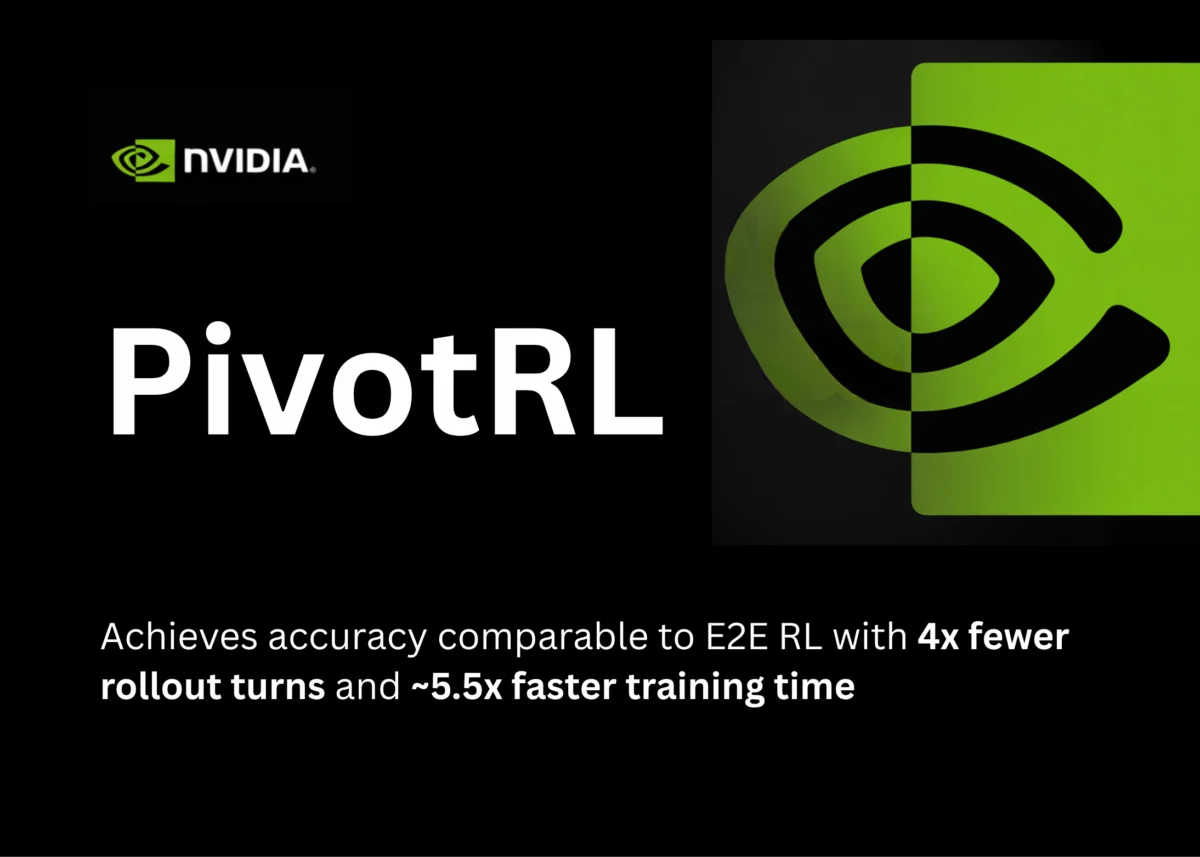
The results indicated that PivotRL is approximately 10 times more efficient than traditional end-to-end RL. Because the framework does not require the generation of entire trajectories for every update—instead focusing on isolated turns—it drastically reduces the "sampling" cost. On SWE-Bench, PivotRL achieved its peak performance with significantly fewer model calls, making it a viable strategy for organizations that do not have the massive GPU clusters required for full-scale E2E RL.
Broader Implications for the AI Industry
The introduction of PivotRL arrives at a critical juncture in AI development. As the industry moves from "chatbots" to "action-bots," the ability to train models that are both efficient and reliable is paramount. The framework’s success suggests several shifts in how AI will be developed in the coming years.
First, the reliance on massive, human-labeled datasets may decrease. Because PivotRL can take existing, imperfect SFT trajectories and "refine" them through targeted RL, the quality of the initial data becomes less of a hard ceiling on the model’s eventual performance. Second, the framework provides a blueprint for "generalist agents." By solving the problem of OOD degradation, NVIDIA has shown that it is possible to create a model that is an expert at browsing the web or writing code without losing its ability to help a user with their homework or explain a scientific concept.
Furthermore, the "Functional Reward" system addresses a major philosophical hurdle in AI safety and alignment. By rewarding the outcome of an action rather than the form of the action, researchers can create agents that are more flexible and less prone to "reward hacking" or getting stuck on minor syntactic errors.
Conclusion and Future Outlook
PivotRL represents a significant step forward in the quest to create autonomous agents that are both smart and scalable. By identifying the "pivotal" moments in a task and applying a surgical application of reinforcement learning, NVIDIA researchers have demonstrated that the trade-off between efficiency and generalization is not an unbreakable law of AI.
As this technology is integrated into broader training pipelines, the industry can expect to see a new generation of LLM-based agents that are more robust in the face of uncertainty and more capable of handling the messy, unpredictable environments of the real world. The findings published by the NVIDIA team offer a compelling case for "turn-level" training as the future standard for agentic post-training, potentially lowering the barrier to entry for high-performance AI development and accelerating the deployment of autonomous systems across the global economy.