

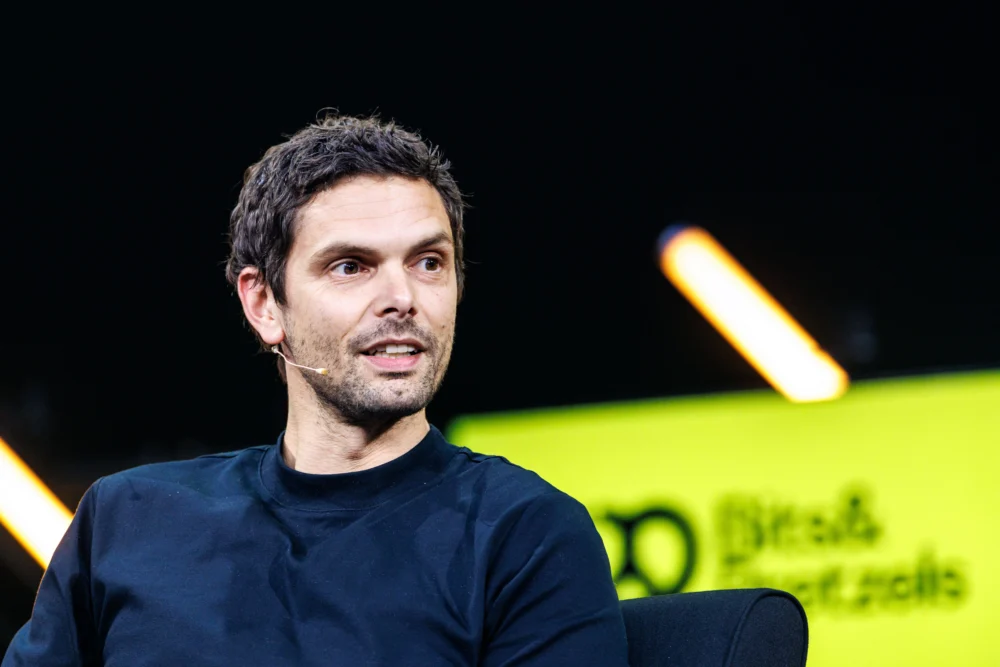
Finnish entrepreneur Peter Sarlin, a prominent figure in the artificial intelligence landscape, has officially departed from his role as CEO of AMD Silo AI, a unit formed eighteen months after the acquisition of his startup, Silo AI, by chipmaker AMD for a reported $665 million. Sarlin’s exit marks a significant transition, as he now assumes the chairmanship of two ambitious new ventures: NestAI, a physical AI laboratory, and QuTwo, an AI startup strategically positioned to prepare companies for the impending era of quantum computing. This strategic pivot underscores a burgeoning belief among technologists in the transformative potential of hybrid computing, particularly at the intersection of AI and quantum mechanics, addressing the escalating computational demands and energy footprint of contemporary AI systems.
The Evolution of an AI Visionary: From Silo AI to a Quantum Leap
Peter Sarlin’s journey with Silo AI culminated in one of Europe’s most notable AI acquisitions. Founded with a vision to deliver pragmatic, enterprise-grade AI solutions, Silo AI rapidly established itself as a leader in applied AI, attracting a diverse client base across various industries. The $665 million acquisition by AMD, a global semiconductor giant, was a testament to Silo AI’s technological prowess and its team’s expertise. For AMD, the acquisition was a strategic move to bolster its AI software capabilities, complementing its robust hardware offerings and intensifying its competition with rivals in the burgeoning AI market. Sarlin’s integration into AMD Silo AI as CEO was seen as a crucial step to ensure continuity and leverage his leadership in scaling the unit’s innovations within AMD’s broader ecosystem.
However, after an eighteen-month tenure, Sarlin has chosen a new path, signaling a deep conviction in the next wave of computational innovation. His departure, announced with a "heavy heart" via a personal LinkedIn post, marks not an end but a significant new beginning, shifting his focus from the established enterprise AI domain to the cutting edge of future computing paradigms. This move reflects a broader trend among leading technologists who are increasingly looking beyond incremental improvements in classical computing to unlock the next generation of AI capabilities.
QuTwo: Orchestrating the Quantum-AI Convergence
At the forefront of Sarlin’s new endeavors is QuTwo, a venture fully funded by his family office, PostScriptum. Describing itself as "an AI lab for the quantum era," QuTwo is not merely anticipating the maturation of quantum computing but actively building bridges to it. The core premise of QuTwo stems from the observation that current AI models, despite their remarkable advancements, are encountering an "efficiency wall." The exponential growth in parameters and computational requirements of large language models and complex neural networks is leading to unprecedented energy consumption and computational bottlenecks, challenging scalability and sustainability. Industry reports frequently highlight the escalating carbon footprint of AI, with some estimates suggesting that AI training could soon consume a significant percentage of global electricity if current trends continue unchecked.
QuTwo posits that quantum computing, with its potential for exponential speedups in certain computational tasks, could eventually offer a solution to this efficiency dilemma. However, rather than waiting for fault-tolerant quantum computers to become ubiquitous – a development that many experts believe is still years, if not decades, away – QuTwo is adopting a pragmatic, near-term strategy. The startup is developing QuTwo OS, an innovative orchestration layer designed to facilitate a seamless transition between classical and quantum computing environments, enabling hybrid computing approaches today. This allows enterprises to begin integrating quantum-inspired algorithms and, eventually, true quantum processing into their workflows, making use of the best available hardware for specific computational tasks.
The immediate application of QuTwo’s vision is already taking shape through significant enterprise collaborations. Notably, QuTwo is partnering with European fashion retail giant Zalando to develop "lifestyle agents." These AI tools aim to transcend traditional product search by proactively suggesting products and experiences tailored to individual customer preferences, moving beyond simple transactional interactions to foster deeper, more personalized engagements. This initiative underscores a strategic shift in retail towards predictive analytics and hyper-personalization, areas where quantum-enhanced AI could provide a distinct competitive advantage by processing vast datasets with unparalleled efficiency.
Furthermore, QuTwo has launched a joint quantum AI research initiative with OP Pohjola, a major Finnish financial services provider. The financial sector, with its intensive need for complex modeling, risk assessment, and fraud detection, stands to gain immensely from the speed and accuracy that quantum algorithms could offer. These design partnerships, which Sarlin indicates are already generating "tens of millions" in revenue, are crucial for QuTwo. They serve as co-development opportunities, allowing the startup to refine its product based on real-world enterprise needs while providing early adopters a critical advantage in exploring future computing paradigms.
NestAI: Exploring the Physical Frontier of AI
Alongside QuTwo, Sarlin’s new portfolio includes NestAI, a physical AI lab. While details about NestAI are less extensive, its establishment signals Sarlin’s continued interest in the tangible applications of AI beyond purely digital realms. Physical AI typically involves the integration of artificial intelligence with robotics, sensors, and real-world environments, aiming to create intelligent systems that can perceive, reason, and act in the physical world. This domain encompasses areas like autonomous robotics, smart infrastructure, advanced manufacturing, and human-robot interaction. NestAI’s focus suggests a complementary vision to QuTwo, potentially exploring how quantum-enhanced AI could drive the next generation of intelligent physical systems, leading to more efficient, adaptable, and robust autonomous technologies. The convergence of physical AI with advanced computational backends like hybrid quantum-classical systems could unlock unprecedented capabilities in fields ranging from industrial automation to environmental monitoring.
The Quantum Computing Ecosystem: A Landscape of Promise and Challenge
Sarlin’s deep dive into quantum computing is not an isolated endeavor. Through PostScriptum, he has already invested in Finnish quantum companies like IQM and QMill, signaling a long-term commitment to the sector. IQM, for instance, is a prominent player in the European quantum computing landscape, focusing on superconducting quantum processors. These investments reflect a growing consensus among forward-thinking investors and technologists that quantum computing will eventually outperform classical computers in a wide array of industry applications, from drug discovery and material science to financial modeling and complex optimization problems. Critically, many also believe it will significantly ease AI’s escalating energy demands, offering a path towards more sustainable advanced computing.
The quantum computing industry, while still in its nascent stages, is experiencing rapid growth. Global investment in quantum technologies has surged in recent years, driven by both government initiatives and private capital. Reports from consultancies like McKinsey and Boston Consulting Group project the quantum computing market to reach billions of dollars within the next decade, albeit with a wide range of uncertainty depending on technological breakthroughs. The current generation of quantum devices, often referred to as Noisy Intermediate-Scale Quantum (NISQ) computers, can perform computations that are difficult for classical machines but are prone to errors. The ultimate goal is fault-tolerant quantum computing, which requires sophisticated error correction mechanisms that are still under intense research and development.
This gap between current capabilities and future potential is precisely where QuTwo’s hybrid computing strategy becomes critical. Sarlin emphasizes that initial use cases for quantum will undoubtedly require mixed hardware environments. Enterprises, he argues, are primarily concerned with solving their business problems, not managing complex computational infrastructures. QuTwo OS aims to abstract away this complexity, acting as the intelligent routing layer that directs workloads to the most appropriate computing resource – be it classical CPU/GPU arrays, quantum-inspired hardware, or future quantum processors.
Quantum-Inspired Computing: A Bridge to the Future
A key element of QuTwo’s immediate strategy is leveraging "quantum-inspired" computing. This approach utilizes classical hardware but simulates quantum behavior or employs algorithms derived from quantum principles. It offers a tangible advantage today because it works around the significant hurdles that still hinder the widespread adoption of quantum hardware, such as decoherence, limited qubit counts, and error rates. Quantum-inspired algorithms can already provide speedups or more efficient solutions for certain optimization problems on classical supercomputers, serving as a practical stepping stone. QuTwo OS is designed with this flexibility in mind, capable of supporting quantum or non-quantum algorithms and chips alike, ensuring adaptability as the technological landscape evolves.
A Convergence of Expertise: The QuTwo Leadership Team
The ambition of QuTwo is matched by the caliber of its leadership team, which brings a formidable blend of experience from both sides of the quantum-AI divide. On the quantum front, the team includes Kuan Yen Tan, a co-founder of IQM, whose deep expertise in superconducting quantum processors is invaluable. Antti Vasara, another board member, also chairs SemiQon, a Finnish semiconductor startup focused on quantum chips, providing critical insights into quantum hardware development.
The enterprise and AI side is equally robust. Peter Sarlin himself brings his extensive experience in building and scaling AI companies. He is joined by Kaj-Mikael Björk, one of his former co-founders at Silo AI, ensuring continuity in their shared vision for applying advanced AI to real-world problems. Further strengthening the board is Pekka Lundmark, the former CEO of Finnish telecom giant Nokia, whose vast experience in leading large, technology-driven enterprises provides strategic guidance on global market penetration and organizational scaling.
Collectively, the QuTwo team comprises over 30 quantum and AI scientists, a testament to the interdisciplinary nature of their mission. Sarlin is unequivocal about the company’s identity: "We’re building for the quantum world, but QuTwo is an AI company," he states. This declaration clarifies QuTwo’s primary objective: to "push AI workloads from classical to quantum," fundamentally reimagining how AI is computed and deployed.
Broader Implications and Future Outlook
Peter Sarlin’s bold move carries significant implications for the technology landscape, particularly within the Finnish and broader European innovation ecosystems. It highlights Finland’s growing prominence as a hub for both AI and quantum computing research and development, building on a strong foundation of scientific talent and governmental support for deep tech.
Globally, QuTwo’s strategy could serve as a blueprint for how enterprises can navigate the complex transition to quantum computing. By focusing on an orchestration layer and hybrid models, QuTwo de-risks early adoption for companies, making the quantum era less abstract and more actionable. This approach could accelerate the practical application of quantum technologies, potentially shortening the timeline for achieving "quantum advantage" in commercially relevant scenarios.
The race for quantum supremacy is not just a scientific endeavor but an economic one, with nations and corporations vying for leadership in a technology that promises to reshape industries. Companies like QuTwo, by focusing on the interface between existing AI demands and future quantum capabilities, are positioning themselves as critical enablers in this global competition. Their success could dictate how quickly and effectively industries can harness the unprecedented power of quantum computing to solve some of the world’s most complex challenges, from climate modeling and drug discovery to personalized medicine and secure communications.
As AI continues its rapid advancement, its computational and energy demands will only intensify. The vision championed by Peter Sarlin and QuTwo – a future where AI workloads seamlessly transition between classical and quantum processors – represents a pragmatic yet ambitious response to these challenges. It signifies a pivotal moment in the evolution of computing, where the fusion of artificial intelligence and quantum mechanics promises not just incremental improvements, but a truly transformative leap forward.