


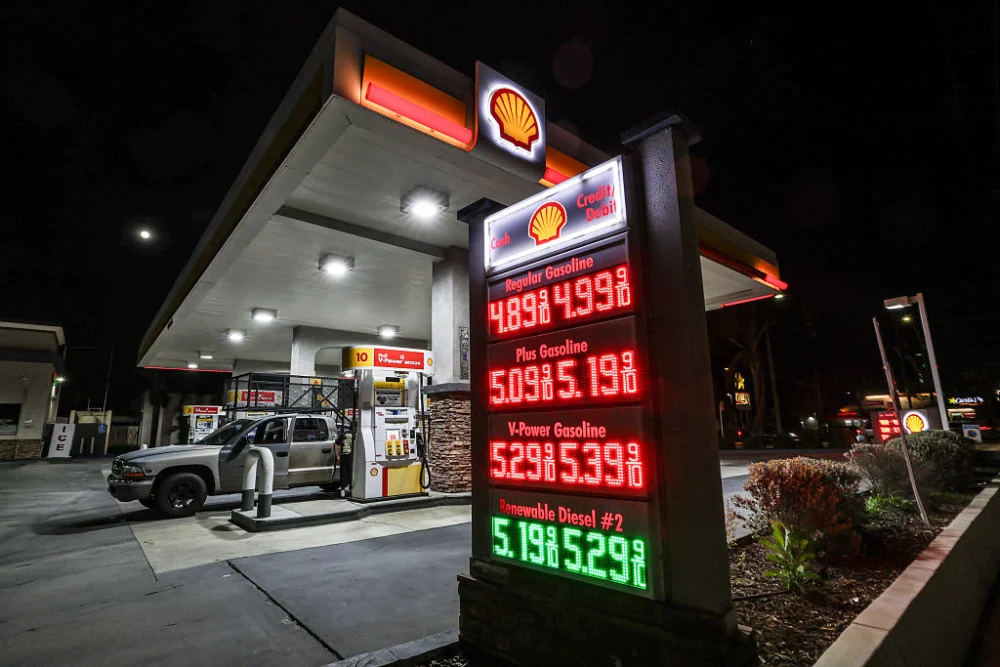
The escalating cost of crude oil, exacerbated by the ongoing U.S.-Iran war, poses a significant and immediate challenge to President Donald Trump’s economic agenda, potentially undermining the consumer-side benefits of his signature legislative achievement, the "big beautiful bill" (OBBA). Economic analysts are increasingly concerned that the surge in gasoline prices at the pump could effectively negate the financial stimulus intended by the individual tax cuts, diverting household savings and refunds directly into energy expenditures rather than broader economic activity.
The Economic Erosion of Tax Relief
At the heart of this economic dilemma is a stark comparison between the anticipated fiscal benefits of the tax cuts and the burgeoning costs associated with higher oil prices. According to detailed analysis from Raymond James, nearly all the economic impact derived from the individual tax cuts within the "big beautiful bill"—encompassing both smaller payroll withholdings and sweetened tax refunds—could be entirely erased if crude oil prices sustain an elevation of more than $20 per barrel compared to pre-U.S.-Iran war levels.
Tavis McCourt, a strategist at Raymond James, articulated this precarious balance in a recent client note. "With the $25 move last week, if the oil price stays here, it essentially offsets the fiscal benefit from the OBBA," McCourt wrote, highlighting the swift and substantial impact of the recent price hikes. His methodology involves applying any increase in oil market prices to the vast sum of over $420 billion that American consumers collectively spent on gasoline during the fourth quarter of 2025. In an interview with CNBC, McCourt further clarified that his calculations meticulously account for both potential reduced demand stemming from higher prices and the inherent need for companies to bolster their profit margins in a volatile market.
This comprehensive approach led McCourt to a sobering conclusion: a sustained $20 increase in oil prices could translate into an additional $150 billion in consumer spending at the fuel pump. This figure stands in stark contrast to the estimated total of $129 billion in individual tax cuts for 2025, as projected by the Tax Foundation. The overwhelming majority of these tax cuts were slated to materialize through tax refunds during the current filing season, designed to put more disposable income directly into the hands of American households. The current market reality, with U.S. oil trading at $88.20 a barrel on Tuesday morning—a significant leap from its pre-war closing price of $67.02 on February 27—suggests that this offsetting scenario is already in play.
The Geopolitical Catalyst: U.S.-Iran War and Oil Market Volatility
The dramatic shift in oil prices is directly attributable to the U.S.-Iran war, which erupted prior to late February 2026. While the original article provides limited details on the conflict, its impact on global energy markets has been immediate and profound. Geopolitical tensions in the Middle East inherently inject a risk premium into oil prices, as traders and refiners factor in potential supply disruptions, damaged infrastructure, or blockades of crucial shipping lanes like the Strait of Hormuz. The outbreak of hostilities between the United States and Iran, a major oil-producing nation and guardian of a critical maritime chokepoint, triggered a rapid and aggressive repricing of crude futures.
The initial shock saw prices surge by $25 a barrel in a single week, indicating the market’s severe apprehension regarding global oil supply stability. Although oil prices experienced a "whiplash" of volatility on Monday, reflecting perhaps a mix of profit-taking, speculative trading, and evolving perceptions of the conflict’s trajectory, the underlying trend remains upward. The sustained elevation above $88 per barrel underscores that the market continues to price in significant geopolitical risk and potential supply constraints. President Trump stated in a Monday interview with a CBS News reporter that the war is "very complete," yet he offered no timeline for its conclusion during a subsequent press conference, leaving investors and consumers in a state of uncertainty regarding how long these elevated prices might persist.
The "Big Beautiful Bill": Intended Stimulus and Reality Check
The "big beautiful bill" was touted by the Trump administration as a cornerstone of its economic policy, aimed at stimulating growth through broad-based tax relief. The individual tax cuts, particularly those impacting middle-income households, were designed to boost consumer spending, investment, and ultimately, accelerate U.S. economic growth throughout 2026. Economists had widely anticipated that the fiscal stimulus generated by this legislation would contribute to a reacceleration of the U.S. economy, building on existing momentum.
The timing of the oil price shock could not be more critical. It coincides precisely with the period when American consumers are set to receive the bulk of their anticipated tax refunds. Citadel Securities estimated just last week that only 30% of these refunds had been distributed by March 1, with projections indicating a rise to approximately 75% by May 1. This means that as consumers begin to receive their expected financial windfall, they are simultaneously confronted with significantly higher costs for essential goods and services, primarily gasoline.
Gabriel Shahin, CEO of Falcon Wealth Planning, encapsulated this concern in an email to CNBC: "The bottom line is that if we were expecting those tax refunds to lift consumer spending, these higher oil prices are just redirecting all that cash toward energy costs. It’s essentially voiding out the economic boost we were set to see." This redirecting effect means that the intended stimulus, rather than fostering new discretionary spending or savings, is instead acting as a buffer, preventing a sharper decline in consumer purchasing power but failing to generate the net economic expansion originally envisioned.
Expert Perspectives: Diverging Views on Resilience and Comparison
While the immediate impact of higher oil prices on consumer budgets is evident, economists and market strategists hold nuanced views on the broader implications for the U.S. economy.
Stephanie Roth, chief economist at Wolfe Research, noted in a Monday interview that her own estimations for the financial hit consumers could face from elevated oil prices are strikingly similar to the elevated spending she had projected from the tax law. However, Wolfe Research subsequently tempered this view in a Tuesday note, suggesting that oil prices would need to remain consistently above $100 per barrel for an extended period for the full offsetting effect to materialize. "In all these scenarios, it has to last longer than it is now," Roth cautioned. "The impact on gas prices so far has been short-lived, and modest compared to how it may ultimately play out."
The duration of this elevated price environment is a critical factor. McCourt’s analysis of historical oil shocks provides a cautionary tale. Following the Gulf War in 1990 and the Russian invasion of Ukraine in 2022, it took approximately six months for oil prices to return to pre-surge levels. This historical precedent suggests that even if a resolution to the U.S.-Iran conflict were imminent, a significant lag in price normalization could still exert downward pressure on consumer spending for several months, effectively dampening the anticipated stimulus through the better part of 2026.
Conversely, some market participants remain more sanguine about the economy’s ability to absorb the shock. Dan Niles, portfolio manager at Niles Investment Management, argued that the tax refunds themselves might serve as a crucial mechanism for the economy to weather higher oil prices. He drew parallels to earlier periods of elevated oil prices in 2022 and 2023, when Wall Street widely predicted an impending recession due to rising interest rates and high energy costs, yet the economy largely averted a significant downturn. "You already had that stress tested a bit," Niles observed. "So if that’s the case back then, and coming off of inflation surging in 2021, and you still didn’t get a recession, why would you think inflation down at 3% and oil at $100 would cause a recession now?"
However, Roth cautioned against drawing overly direct comparisons to previous periods of energy price surges. She emphasized the distinct macroeconomic backdrop. "The economic backdrop is not a mirror image of where we are today," she stated. "Core inflation was running at 5.5% compared to 3% today. Job growth was running at around 500,000, now we’re at 37,000 over the past couple of months. So it’s just an entirely different backdrop." This nuanced perspective suggests that while the economy demonstrated resilience in the past, its current lower inflation and significantly slower job growth could make it more vulnerable to an oil price shock.
Broader Economic Implications and Outlook
The potential weakening of the stimulus from the "big beautiful bill" carries broader implications for the U.S. economic outlook. If consumer spending, a vital engine of growth, is merely treading water due to diverted funds, the anticipated reacceleration of GDP growth could be curtailed. This scenario would also complicate the Federal Reserve’s ongoing efforts to manage inflation, as higher energy costs filter through the supply chain and potentially sustain price pressures.
For the stock market, McCourt believes that while the consumer spending impact might be significant, it may not drastically alter overall market outlooks. He suggests that equity markets, particularly the S&P 500, may not have fully priced in a substantial surge in consumer spending from the tax cuts to begin with. He pointed to the underperformance of consumer discretionary stocks relative to the S&P 500 in 2026 as evidence that investors were already cautious about this sector.
Ultimately, the stability of the labor market emerges as a crucial determinant of the economy’s resilience. "We just have never had a sustained pullback in consumer spending without substantial job losses," McCourt affirmed. While there will likely be "some shifts in spending" as consumers adjust their budgets to accommodate higher energy costs, McCourt remains confident that "it’s probably not going to impact the overall consumer spending levels" as long as the job market remains robust and unemployment rates stay low. A strong labor market provides the fundamental income streams necessary for households to absorb price shocks, even if it means sacrificing discretionary purchases.
The current situation presents a delicate balance for policymakers and economic observers. The "big beautiful bill" aimed to provide a clear fiscal tailwind, but the unexpected geopolitical turbulence has introduced a powerful headwind. The true test of the U.S. economy’s strength in 2026 will lie in its ability to navigate these crosscurrents, with the duration of the U.S.-Iran conflict and the sustained trajectory of oil prices remaining critical variables that could determine whether the promised tax relief delivers its full economic potential or is largely absorbed at the gas pump.