


The Tokyo-based artificial intelligence laboratory Sakana AI has announced the release of Fugu-Cyber, a specialized model designated as fugu-cyber-v1.0, representing the latest evolution in its Fugu orchestration ecosystem. This release marks a significant transition for the company, moving from general-purpose orchestration toward a domain-specific architecture tailored for the high-stakes environment of cybersecurity. Fugu-Cyber is positioned not as a standalone large language model (LLM) in the traditional sense, but as a third dedicated endpoint within the Fugu orchestrator, a system designed to route complex tasks across a swappable pool of frontier models to optimize for reasoning accuracy and cost-efficiency.
The launch of Fugu-Cyber follows the May 2026 introduction of the base Fugu orchestrator, which sought to redefine how enterprises interact with multiple LLMs. By integrating a security-tuned endpoint, Sakana AI is directly challenging established industry leaders like OpenAI and Anthropic, who have recently deployed their own cyber-specific iterations of frontier models. Fugu-Cyber arrives at a time when the cybersecurity industry is increasingly turning toward agentic AI to manage the overwhelming volume of threat telemetry and the shortening window between vulnerability discovery and exploitation.
The Evolution of the Fugu Orchestration Family
To understand the significance of Fugu-Cyber, one must look at the trajectory of Sakana AI since its inception. Founded by former Google researchers and authors of the seminal "Attention Is All You Need" paper, the company has consistently focused on nature-inspired AI development. The Fugu family represents their attempt to solve the "jack of all trades, master of none" problem inherent in monolithic LLMs. Instead of training a single massive model to handle everything from creative writing to exploit code analysis, Sakana’s Fugu orchestrator acts as a high-level manager.
The chronology of this development is rapid. In early 2026, Sakana AI released the Fugu technical report, detailing a system that could dynamically build "agentic scaffolds." By June 2026, the company realized that general-purpose reasoning was insufficient for the nuances of security operations, leading to the development of the fugu-cyber-v1.0 endpoint. This model is specifically fine-tuned on datasets involving vulnerability research, threat intelligence reports, and incident response playbooks, allowing it to "think" like a security analyst when delegating sub-tasks.
Performance Benchmarking and Comparative Analysis
Sakana AI has released performance data for Fugu-Cyber across two primary benchmarks: CyberGym and CTI-REALM. These evaluations are critical because they measure different phases of the cybersecurity lifecycle, from offensive capability to defensive intelligence processing.
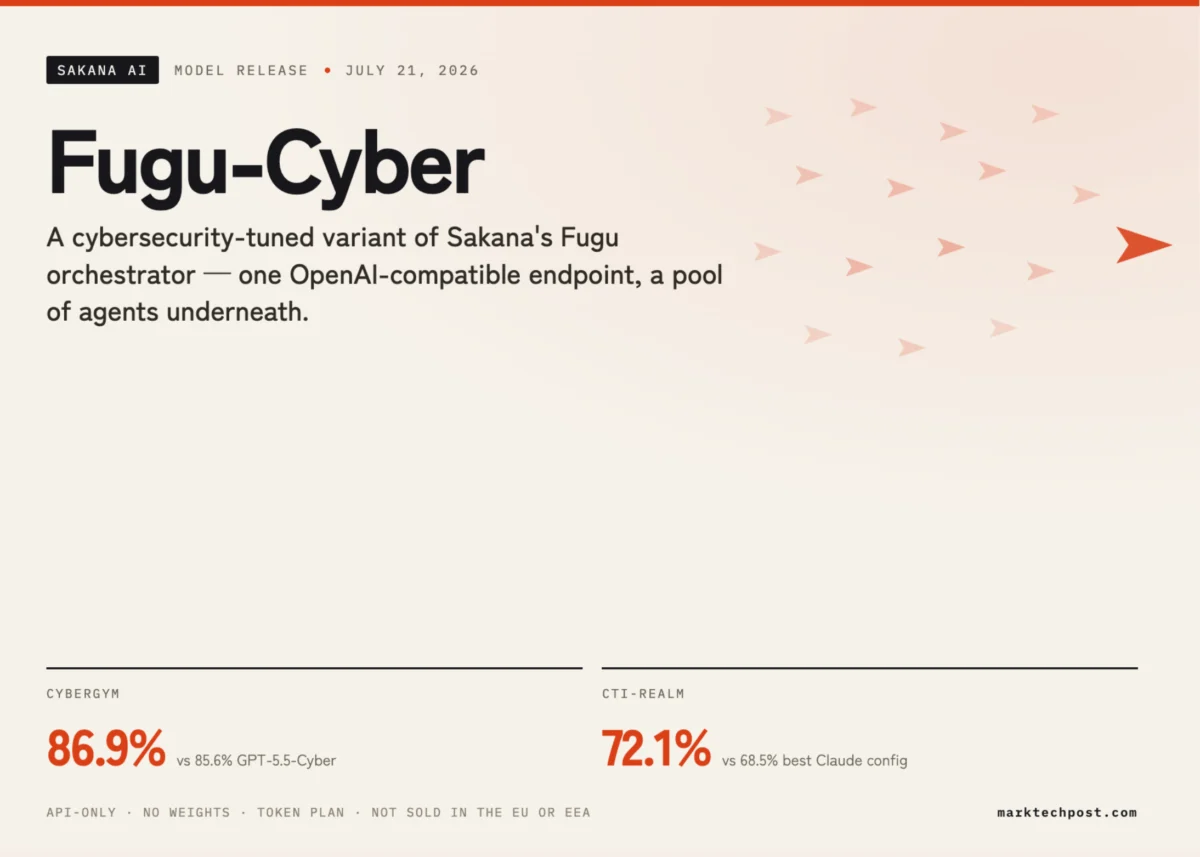
On the CyberGym benchmark, Fugu-Cyber achieved a success rate of 86.9%. CyberGym is designed to evaluate an agent’s ability to find and prove the existence of software bugs, often requiring the model to navigate complex codebases and demonstrate a "proof of concept" exploit. For context, when CyberGym was first introduced in mid-2025, the highest-performing agent-model pairings struggled to exceed a 20% success rate. By April 2026, Anthropic’s Claude Mythos Preview—developed under the internal "Project Glasswing"—reached 83.1%. OpenAI’s GPT-5.5-Cyber subsequently pushed the frontier to 85.6%. Sakana’s 86.9% suggests a marginal but notable lead over these established players, indicating that its orchestration-based approach may be more effective at "chain-of-thought" reasoning required for exploit discovery than monolithic models.
The second benchmark, CTI-REALM (Cyber Threat Intelligence – Reasoning, Extraction, and Linkage Model), focuses on the defensive side of the spectrum. It measures how effectively an AI can transform raw threat intelligence into actionable detections. Unlike CyberGym’s pass/fail metric, CTI-REALM uses a trajectory reward system, scoring performance on a scale of 0 to 1. Fugu-Cyber recorded a score of 0.721 (which Sakana interprets as a 72.1% success rate). This performance is particularly striking when compared to Microsoft’s internal evaluations of Claude models, which typically clustered between 0.624 and 0.685. The ability to bridge the gap between "finding a bug" and "creating a detection" is what Sakana describes as the most defensible and valuable aspect of the Fugu-Cyber announcement.
Technical Architecture: TRINITY and the Conductor
The underlying mechanism of Fugu-Cyber relies on two research pillars presented at ICLR 2026: TRINITY and the Conductor. These frameworks allow the Fugu orchestrator to move beyond simple prompt-response interactions.
The TRINITY framework assigns three distinct roles across the pool of available LLMs: the Thinker, the Worker, and the Verifier. In a cybersecurity context, when a user asks Fugu-Cyber to analyze a suspicious binary, the "Thinker" role develops a multi-step plan for disassembly and analysis. The "Worker" roles execute these steps, perhaps using different models optimized for Python scripting or assembly language interpretation. Crucially, the "Verifier" role acts as a safety and accuracy check. Sakana’s research team argues that in security work, the Verifier is the most vital component; it ensures that a candidate vulnerability surfaced by a Worker is actually valid before any remediation or patch is proposed to the human user.

Complementing TRINITY is "The Conductor," a system that uses reinforcement learning to master natural-language coordination strategies. Instead of using hard-coded logic to route tasks, The Conductor learns which models are best at specific sub-tasks based on past performance. For Fugu-Cyber, this means the system has learned to route memory corruption queries differently than it routes phishing email analysis. However, Sakana maintains a proprietary hold on the exact routing logic, meaning users cannot see which specific underlying models are being utilized for each step of a multi-stage security operation.
Access Control and Ethical Guardrails
Given the dual-use nature of a model that excels at finding software vulnerabilities, Sakana AI has implemented a stringent access policy for Fugu-Cyber. The model is not available for general public use through a simple sign-up process. Instead, it is gated behind four specific dimensions of control.
First, prospective users must submit a formal application detailing their intended use case. These applications are reviewed manually by the Sakana team to vet the legitimacy of the requester. Verified contact details and corporate/institutional affiliation are mandatory. Second, the model is governed by an updated Acceptable Usage Policy (AUP) that explicitly prohibits offensive misuse, such as the creation of malware or the execution of unauthorized penetration tests against third-party infrastructure.
Third, the geographical availability of the Fugu API is restricted. Currently, it is not offered in the European Union (EU) or the European Economic Area (EEA). Sakana AI has stated that this is a temporary measure while the company works toward full compliance with the General Data Protection Regulation (GDPR) and the emerging EU AI Act, which places high-risk requirements on models with "systemic risk" capabilities like those found in cybersecurity.
Economic Positioning and Subscription Tiers
The pricing structure for Fugu-Cyber reflects its position as a premium tool. Unlike the general Fugu and Fugu-Ultra models, which are included in Sakana’s $20, $100, and $200 monthly subscription tiers, Fugu-Cyber is restricted to a "Token Plan" billing model.
The rates are set at $6 per million input tokens, $36 per million output tokens, and $0.60 per million cached input tokens. This represents a flat 20% premium over the Fugu-Ultra rates. Furthermore, Sakana has introduced a tiered pricing structure based on context length. If a run exceeds 272,000 tokens—a common occurrence when analyzing large codebases or long-running incident logs—the rates double. This pricing strategy signals that Sakana views Fugu-Cyber as an enterprise-grade tool for high-value tasks rather than a high-volume utility for minor queries.
Industry Implications and Future Outlook
The release of Fugu-Cyber highlights a growing trend in the AI industry: the shift from "all-purpose" models to "expert" swarms. By proving that an orchestrated group of models can outperform a single frontier model on specialized benchmarks like CyberGym, Sakana AI is providing a blueprint for the next phase of AI development.
For the cybersecurity industry, the implications are twofold. On the defensive side, the high score on CTI-REALM suggests that AI can significantly reduce the "mean time to detect" (MTTD) by automating the synthesis of threat intelligence. On the offensive side, the 86.9% success rate in bug finding underscores the urgent need for AI-driven defense (the "Blue Team") to keep pace with AI-driven vulnerability research (the "Red Team").
As Sakana AI moves toward GDPR compliance and broader international availability, the competition between Fugu-Cyber, OpenAI’s GPT-5.5-Cyber, and Anthropic’s Claude Mythos is expected to intensify. The success of these models will likely be measured not just by their benchmark scores, but by their ability to operate within the ethical and legal frameworks of a world increasingly wary of the power of autonomous digital agents. For now, Fugu-Cyber stands as a testament to the power of specialized orchestration, offering a glimpse into a future where AI is not just a tool for answering questions, but a sophisticated engine for solving some of the most complex technical challenges in the digital age.